Vendor Lock in Supply Chain Management
Vendor lock refers to a situation where a customer becomes dependent on a single supplier, limiting their flexibility and options in procurement.
Updated
Overview
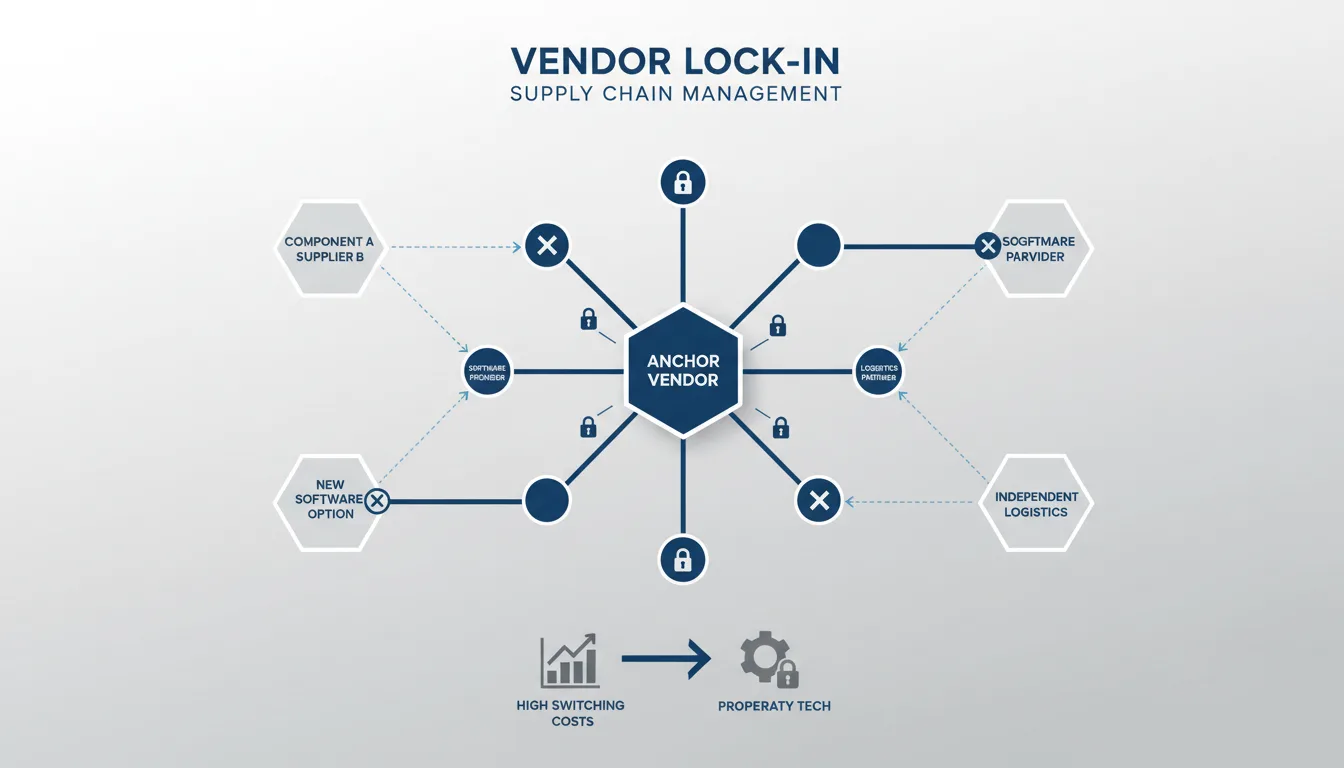
Vendor lock, also known as vendor lock-in, describes a situation where a customer is dependent on a particular vendor for products and services, effectively limiting their ability to switch to another provider without incurring significant costs or inconvenience. This scenario is particularly prevalent in supply chain management and information technology sectors, where companies may invest heavily in a vendor’s ecosystem, leading to dependent relationships, often referred to as "sticky customers" or customer captivity.
Etymology and Origins
The concept of "vendor lock-in" emerged as a significant concern with the proliferation of proprietary technologies in the mid to late 20th century. While the exact first documented usage is debated, the term gained prominence in the software industry during the 1980s and 1990s when companies began to heavily invest in specific hardware and software ecosystems. Early discussions often centered around proprietary operating systems and database technologies.
The linguistic roots reflect the economic theory of "switching costs", a concept formalized in economics to explain barriers to changing suppliers or products. The term "lock-in" itself conveys the idea of being trapped or constrained, similar to how a physical lock restricts movement. This metaphor accurately described the predicament businesses faced when tied to a single vendor’s architecture, making migration to alternatives prohibitively expensive or complex. The evolution of the term parallels the increasing reliance on integrated software solutions, where the interconnectedness of systems amplified the difficulty and cost of switching vendors.
Historical Development
Vendor lock-in has evolved alongside technological advancements and market dynamics, transforming from a hardware-centric issue to a complex challenge in modern digital ecosystems:
- Pre-1970s: Hardware Lock-in: Early computing was dominated by mainframe manufacturers like IBM. Customers invested heavily in proprietary hardware and operating systems, leading to high "exit barriers" if they wished to switch to another vendor. The high cost of equipment and specialized expertise created a natural lock-in.
- 1970s-1980s: Emergence of Proprietary Software: With the rise of enterprise resource planning (ERP) systems and specialized databases, companies like SAP and Oracle began to offer comprehensive, integrated solutions. These systems, while powerful, often came with proprietary data formats and programming languages, making data migration and interface development costly. This era saw businesses become heavily dependent on specific vendors for critical business processes, from material requirements planning (MRP) to financial management.
- 1990s: Internet Boom and Supply Chain Integration: The rapid expansion of the internet and globalized supply chains emphasized the need for interconnected systems. Companies invested in supply chain management (SCM) software that integrated with their ERP systems. The dot-com boom witnessed many startups making long-term commitments to singular technology stacks, often finding themselves at the mercy of their vendors when market conditions shifted or technology evolved rapidly. Academic works, such as Information Rules by Carl Shapiro and Hal Varian (1999), extensively discussed the economic implications of lock-in and switching costs in the information age.
- 2000s: Open Source and SaaS Alternatives: As a response to vendor lock-in, the open-source movement gained traction, promoting flexibility and interoperability through standardized interfaces and publicly available code. Concurrently, the rise of Software-as-a-Service (SaaS) models promised lower upfront costs and greater flexibility, but also introduced new forms of lock-in through data residency, integration complexities, and dependence on a vendor's infrastructure.
- 2010s-Present: Cloud Computing and Microservices: The expansion of cloud services (e.g., AWS, Azure, Google Cloud) further complicated vendor relationships. While multi-cloud strategies aim to mitigate risk, managing disparate cloud environments can introduce operational overhead, creating a form of "cloud lock-in." The shift towards microservices architecture and containerization seeks to abstract applications from underlying infrastructure, theoretically reducing lock-in by enabling greater portability. Modern logistics solutions, including mobile warehouse management systems, increasingly offer API-driven integrations to minimize this risk. The discussions on vendor lock-in have been documented in various publications, including "Software Ecosystems" which focused on the interdependencies created by software vendors.
Core Concepts
At the heart of vendor lock are several core concepts:
- Switching Costs: These refer to the costs, both financial and operational, that a customer incurs when changing vendors. High switching costs can deter companies from leaving a vendor, regardless of whether better options exist. These costs can include:
- Financial: License termination fees, new software procurement, infrastructure replacement, and data migration expenses.
- Operational: Reworking business processes, employee training on new systems, downtime during transition, and potential loss of historical data integrity.
- Strategic: Loss of existing integrations, disruption to ongoing projects, and potential competitive disadvantage during the transition period.
- Proprietary Technology: Vendors that utilize proprietary technology can create lock-in situations for customers by making it difficult to switch to competitors due to compatibility issues with existing infrastructures. This includes unique data formats, proprietary APIs (Application Programming Interfaces), custom hardware, or specialized software modules that are not easily transferable or interoperable with other systems. For example, a system might use a unique unit of measure configuration that requires significant remapping to another system.
- Long-Term Contracts: Extended agreements can secure vendor relationships but often complicate exit strategies for customers, leading to vendor lock-in. These contracts may include steep penalties for early termination, automatic renewals, or escalating pricing models that make moving away prohibitively expensive. They can also limit a customer's ability to negotiate better terms or adopt innovative solutions from competitors.
- Data Silos and Integration Complexity: When data is deeply embedded within a vendor's system with limited export options or proprietary integration methods, it becomes difficult to extract and use with alternative solutions. The complexity of integrating various systems, such as order management systems with WMS, can also create dependencies on specific vendors providing comprehensive solutions.
Industry Applications
Vendor lock is observed across various industries:
- Supply Chain Management (SCM): Businesses often establish long-term relationships with specific suppliers, as seen in purchase order management and vendor portals. This can make them highly dependent on their pricing, delivery schedules, quality standards, and even proprietary inventory tracking systems. For instance, a manufacturer relying on a single source for a specialized component might face significant disruption if that supplier encounters issues or raises prices. Similarly, a company deeply integrated with a 3PL's (Third-Party Logistics) proprietary warehouse management system may find data migration and process re-engineering challenging when switching providers.
- Technology: Companies using platforms like SAP or Oracle can find it challenging to migrate to alternative solutions due to embedded systems designed for specific business processes, extensive customization, and the sheer volume of historical data. The shift to cloud computing has introduced new layers of lock-in, where businesses become dependent on specific cloud providers for their infrastructure, databases, and managed services, making multi-cloud strategies a complex but necessary consideration.
- Manufacturing: Manufacturers often rely on specific equipment vendors (e.g., robotics, specialized machinery) that use proprietary software, spare parts, and maintenance services. Switching can require entirely new capital investments, retraining of staff, and re-validation of production processes.
- Healthcare: Healthcare providers face lock-in with Electronic Health Record (EHR) systems. These systems are highly specialized, deeply integrated into clinical workflows, and contain sensitive patient data, making migration extremely complex and costly due to regulatory compliance and data integrity requirements.
Benefits and Advantages
While vendor lock is often viewed negatively, there are some advantages, especially when managed strategically:
- Stability and Predictability: Long-term vendor agreements may lead to stable pricing, predictable service levels, and reliable support, allowing companies to plan their operations without disruption. This can be crucial for mission-critical systems and processes.
- Deep Integration and Optimization: Deep vendor relationships often lead to better integration of systems and processes, tailored solutions, and specialized knowledge transfer. This can improve efficiency, reduce operational friction, and unlock advanced features or optimizations that might not be available with generic solutions. Companies like SkuSavvy offer integrated systems that provide superior stock management, which, when strategically adopted, can lead to significant operational benefits while requiring careful management of potential dependencies.
- Reduced Complexity: Consolidating services with fewer vendors can simplify vendor management, reduce administrative overhead, and streamline support processes. A single point of contact for multiple services can improve troubleshooting and accountability.
- Strategic Partnerships: In some cases, a close relationship can evolve into a strategic partnership, where the vendor becomes an extension of the business, jointly innovating and co-developing solutions that provide a competitive edge.
Challenges and Limitations
Vendor lock-in presents significant challenges, which often outweigh the perceived benefits if not carefully managed:
- Lack of Flexibility and Agility: Companies may find it hard to adapt to changing market conditions, new business models, or technological advancements due to their dependency on one vendor. This can stifle innovation and hinder responsiveness to competitive pressures.
- Increased Costs and Budget Constraints: If a vendor raises prices, alters service terms unfavorably, or forces expensive upgrades, customers may feel trapped due to prior investments and contractual obligations. This can lead to inflated operational expenditures and unexpected budget overruns.
- Reduced Bargaining Power: A locked-in customer has significantly less leverage in negotiations with their vendor, leading to less favorable terms, slower response times, and limited influence over product roadmaps.
- Stifled Innovation: Dependence on a single vendor can limit access to alternative, potentially more innovative solutions or technologies available in the broader market. The vendor's product roadmap may not align with the customer's evolving strategic needs.
- Single Point of Failure and Security Risks: Over-reliance on one vendor introduces a single point of failure. If the vendor experiences outages, security breaches, or goes out of business, the customer's operations can be severely impacted. Furthermore, specific data residency and security practices of a single vendor might not meet all compliance requirements across different regions.
Best Practices
To avoid or mitigate the pitfalls of vendor lock-in, businesses should consider a proactive and strategic approach:
- Diversification and Multi-Vendor Strategy: Engaging multiple vendors for different services or components can reduce dependency on one source and improve bargaining power. This could involve using different cloud providers, multiple logistics partners, or sourcing raw materials from various suppliers. However, this strategy must be balanced against the increased complexity of managing multiple relationships and integrations.
- Negotiating Favorable Contractual Terms: Prioritize shorter contracts with manageable exit clauses, clear service level agreements (SLAs), and explicit terms regarding data ownership, portability, and termination. Companies should negotiate for the right to audit, transparent pricing models, and defined migration support. Utilizing a vendor portal can streamline communication and agreement management.
- Adoption of Open Standards and APIs: Prioritize solutions that adhere to open standards and offer robust, well-documented APIs (Application Programming Interfaces). This enables easier integration with other systems and facilitates data exchange, making it less painful to switch components or integrate best-of-breed solutions. SkuSavvy's developer API is an example of providing such flexibility.
- Data Portability and Ownership: Ensure contractual agreements explicitly grant customers full ownership of their data and mandate easy, standardized data export formats. Regular data backups and testing of export/import processes are crucial to validate data portability strategies.
- Regular Assessment and Vendor Relationship Management: Companies should regularly review their vendor relationships and assess whether they continue to meet their strategic goals effectively, offer competitive pricing, and innovate. This includes periodic market analysis to identify alternative solutions and assess the cost of switching. Proactive relationship management can also foster better collaboration and influence the vendor's product roadmap.
- Proof of Concept (PoC) and Pilot Programs: Before committing to a long-term contract, conduct thorough proof-of-concept projects or pilot programs with new vendors. This allows evaluation of system compatibility, integration effort, and operational fit without significant upfront investment or full-scale commitment.
- Composability and Modular Architectures: Design IT architecture with a focus on composability, using modular components that can be swapped out or upgraded independently. This reduces the interdependence between system parts and makes it easier to replace a single vendor's solution without overhauling the entire system. Modern integrations hubs support this approach.
Future Trends
The move towards cloud-based solutions and microservices architecture is expected to change the landscape of vendor lock-in. Businesses increasingly favor modular systems that allow for better integration and adaptable infrastructure. This shift, combined with the growing importance of open APIs and data sovereignty, can potentially reduce vendor lock-in risks as companies leverage competitive offerings from various service providers. However, new forms of lock-in may emerge around complex integration ecosystems or specialized platform services. The rise of blockchain technology may also offer novel solutions for supply chain transparency and vendor independence through decentralized record-keeping and smart contracts.
Related Concepts
Vendor lock-in is related to concepts such as supply chain flexibility, which emphasizes the ability of companies to adapt to changes quickly, and strategic sourcing that involves optimizing vendor relationships to minimize dependency while maximizing value. It also ties into concepts like dependency management, interoperability, and exit strategies in complex technological and operational environments.
Sources
- SkuSavvy Warehouse Stock Replenishment Guide
- SkuSavvy Purchase Order Management
- ResearchGate Software Ecosystems
- Forbes Supply Chain Flexibility
- McKinsey Strategic Sourcing
- Vendor Lock-in: Lessons from the Database World
- Switching Costs: What They Are and How to Calculate Them
- Barriers to Entry and Exit
- What Is Application Modernization?
- Supply Chain Management (SCM): How It Works, Purpose, and Example
- What Is Multi-Cloud Strategy? Benefits & Use Cases
- Mobile Warehouse Management System
- Unit of Measure Guide
- Order Management System
- Vendor Portal
- Visual Inventory Management System
- Developers / API
- Integrations Hub
- Data sovereignty beyond privacy: The need for responsible data governance
- Blockchain in supply chain: Impact and challenges
- Make Your Customers Sticky, Not Stuck