Vendor Dependence in Supply Chain Management
An exploration of vendor dependence, its implications on supply chains, management strategies, and impacts on organizations.
Updated
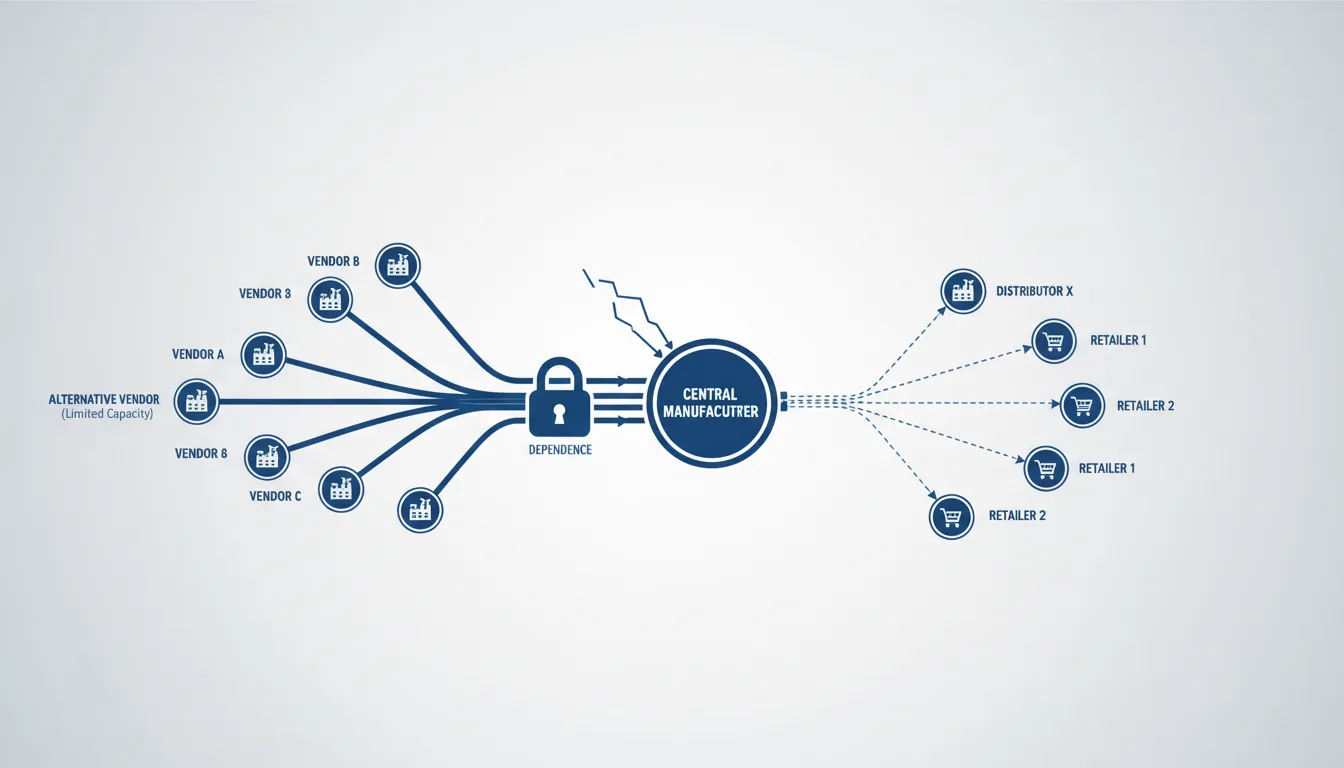
Vendor Dependence in Supply Chain Management
Overview
Vendor dependence refers to the reliance an organization has on its suppliers for critical inputs, materials, or services necessary for its operations and value chain. This dependence can significantly impact a company's supply chain performance, flexibility, resilience, and ultimately, its competitive advantage. Understanding vendor dependence is essential for supply chain managers and logistics professionals to effectively mitigate risks, optimize procurement strategies, and foster sustainable relationships.
Etymology and Origins
The term "vendor dependence" integrates two fundamental concepts: "vendor" and "dependence." The word "vendor" derives from the Latin venditor, meaning 'seller,' tracing its roots through Old French. Its usage in commerce has been present for centuries, referring broadly to anyone offering goods for sale. "Dependence" originates from the Latin dependere, meaning 'to hang from' or 'to rely on,' highlighting a state of being influenced or determined by another.
The concept of dependence in a business context, particularly concerning external providers, became more prominent with the rise of industrialization and specialized production in the 18th and 19th centuries. As companies began to outsource specific components or processes rather than performing everything in-house (vertical integration), the reliance on external suppliers became an economic factor. Early discussions in economics and business management often focused on the economic leverage or bargaining power between buyers and sellers. The explicit phrase "vendor dependence" likely solidified as supply chain management emerged as a distinct discipline in the mid-to-late 20th century, necessitated by increasingly complex and globalized networks that amplified the strategic implications of supplier relationships.
Historical Development
Vendor dependence has evolved significantly alongside the development of supply chain management as a discipline, mirroring shifts in industrial organization, technology, and global trade.
-
Pre-Industrial and Early Industrial Era (Pre-1900s): Prior to mass production, supply chains were often localized and relatively simple. Companies sourced materials directly, often from local artisans or commodity traders. While reliance existed, it was often on proximity and personal relationships. Vertical integration, where companies owned most of their production means, was common to minimize external dependencies. For instance, early textile mills often integrated spinning and weaving to control the entire process.
-
Early 20th Century (1900s-1950s): The advent of mass production, pioneered by figures like Henry Ford, brought increased specialization and the need for standardized parts from a network of suppliers. While Ford famously pursued vertical integration (e.g., owning rubber plantations and steel mills), he also relied on external suppliers for specialized components, beginning to formalize supplier relationships. The focus during this period was primarily on cost reduction and ensuring high-volume, consistent supply.
-
Mid-20th Century (1950s-1980s): Post-World War II, Japanese manufacturing philosophies, particularly the Toyota Production System (TPS) with its Just-In-Time (JIT) methodology, revolutionized supply chain thinking. TPS emphasized close, long-term, and collaborative relationships with a smaller number of trusted suppliers (known as Keiretsu). This intensified vendor dependence but also fostered mutual innovation and quality improvement. Simultaneously, the development of Material Requirements Planning (MRP) systems, significantly influenced by experts like Joseph Orlicky and Oliver Wight and enabled by early computing power from companies like IBM, allowed manufacturers to better plan and manage their dependent demand, automating aspects of procurement and scheduling with suppliers.
-
Late 20th Century (1980s-2000s): Globalization accelerated rapidly, leading to widespread outsourcing and off-shoring of manufacturing and services. This strategic shift was often driven by cost efficiencies, access to specialized labor, and new markets, but it inherently increased vendor dependence across vast geographical distances. The proliferation of Enterprise Resource Planning (ERP) systems became crucial for integrating procurement, production, inventory, and sales processes, providing a holistic view of the supply chain but also highlighting critical vendor linkages. Supply chain management emerged as a strategic imperative, moving beyond simple purchasing to encompass global networks and risk management.
-
21st Century (2000s-Present): The early 2000s saw a focus on lean and agile supply chains, but global disruptions (e.g., SARS, 9/11, Fukushima earthquake, financial crises, COVID-19 pandemic) exposed the vulnerabilities of highly dependent, globally stretched supply chains. This era has shifted emphasis towards supply chain resilience, visibility, and risk mitigation. Technological integration, including advanced analytics, AI, and IoT, is now critical for managing complex vendor ecosystems, enabling real-time monitoring and predictive capabilities to address potential disruptions proactively.
Core Concepts
Vendor dependence can be understood through several critical factors, requiring a nuanced approach to management:
- Single vs. Multiple Vendors: Companies may choose to depend on a single vendor for critical inputs, often driven by volume discounts, unique capabilities, or simplified logistics. However, this creates significant risk of disruption if that vendor fails, experiences quality issues, or encounters external shocks. Conversely, using multiple vendors (dual sourcing or multi-sourcing) can spread risk and enhance bargaining power but may increase complexity in management and potentially sacrifice volume discounts.
- Supplier Relationships: The nature of the relationship — from transactional to strategic partnership — heavily influences the implications of dependence. Strong, collaborative relationships built on trust and shared objectives can lead to better service levels, mutual innovation, and proactive problem-solving. Weak or adversarial relationships, conversely, can result in reliance on poor-performing suppliers, lack of transparency, and difficulty in managing disruptions.
- Risk Management: Effective vendor dependence strategies incorporate robust risk assessment processes, including evaluating financial stability, operational capacity, geopolitical stability, and disaster recovery capabilities of suppliers. The goal is to ensure businesses can quickly adapt to changes in supplier conditions or market dynamics.
- Total Cost of Ownership (TCO): Beyond the initial purchase price, TCO considers all direct and indirect costs associated with a vendor relationship over its lifecycle, including ordering, inspection, quality issues, inventory holding, and potential disruption costs. A lower unit price from a single vendor might lead to a higher TCO if not managed effectively.
- Supplier Segmentation: This involves categorizing suppliers based on their strategic importance, the criticality of the items they provide, and the risk they pose. This allows for differentiated management strategies, e.g., developing deep partnerships with strategic suppliers versus maintaining a competitive bidding approach for commodity suppliers.
- Dependency vs. Criticality: It's crucial to distinguish between being dependent on a vendor and that vendor being critical to operations. An organization might be dependent on many vendors for non-critical items, which poses less risk. However, dependency on a critical vendor (e.g., for a patented component or specialized service) warrants intense scrutiny and sophisticated mitigation strategies.
Industry Applications
Vendor dependence manifests differently across industries, often shaped by their unique operating environments and product characteristics:
- In manufacturing, companies like automotive original equipment manufacturers (OEMs) may depend on specific tier-1 material suppliers (e.g., for microchips, specialized alloys, or battery components). A disruption from a single supplier, as seen in the global semiconductor shortage, can halt entire production lines. Managing this requires sophisticated inventory planning and a resilient Mobile WMS system to track incoming supplier deliveries.
- The retail sector relies heavily on vendors for stock replenishment, particularly for fast-moving consumer goods. Effective management of this dependence requires precise demand forecasting and automated systems like the Stock Replenishment Guide to maintain optimal inventory levels and avoid stockouts or overstocking, which directly impact sales and customer satisfaction.
- Automotive manufacturers commonly engage in deep partnerships with suppliers, sometimes involving co-development of parts. This high degree of integration and shared intellectual property ensures quality and timely delivery but also creates significant mutual dependence. For example, a single specialized component supplier often provides parts for multiple car models across different OEMs.
- In the high-tech/electronics industry, companies often depend on a limited number of suppliers for highly specialized components (e.g., processors, specific display technologies) or rare earth minerals. Geopolitical factors or natural disasters in specific regions can severely impact the global supply of these critical inputs, necessitating complex geopolitical risk assessments and diversification strategies.
Benefits and Advantages
The strategic management of vendor dependence, particularly through fostering strong supplier relationships, offers several benefits:
- Cost Efficiency: Consolidating purchases with fewer, strategic vendors can lead to significant volume discounts, favorable payment terms, and reduced administrative overhead. Purchase Order Management systems facilitate this consolidation and negotiation.
- Quality Control: Focusing on a select group of trusted suppliers allows for more stringent quality monitoring, joint quality improvement programs, and greater assurance of consistent product and service standards. This can lead to reduced defects, lower warranty costs, and enhanced brand reputation.
- Collaboration and Innovation Opportunities: Strong vendor relationships can foster innovation through shared goals, joint research and development, and early supplier involvement in product design. This co-creation can lead to competitive advantages, faster time-to-market, and access to specialized expertise, as seen in the collaborative processes supported by an efficient Order Fulfillment Guide which often relies on supplier-provided packing specifications.
- Operational Efficiency: Streamlined communication, integrated processes, and shared information with key vendors can lead to improved forecasting accuracy, reduced lead times, and more efficient logistics, directly impacting operational productivity.
Challenges and Limitations
Despite its advantages, vendor dependence comes with significant challenges that, if not managed, can lead to severe consequences:
- Risk of Disruption: A high reliance on a limited number of suppliers, especially for critical components, increases vulnerability to supply chain disruptions caused by natural disasters, geopolitical events, economic instability, or supplier bankruptcy. The cascading effects of such disruptions can halt production, delay deliveries, and damage customer trust.
- Negotiation Leverage: High dependence on a single or few vendors can significantly reduce a company's bargaining power. This may result in unfavorable pricing, less flexible terms, or a lack of responsiveness from the supplier, harming potential cost savings and operational agility.
- Supply Chain Transparency: Increased dependence on external vendors necessitates ongoing assessment and visibility into supplier operations, including their sub-suppliers, to ensure compliance with quality, ethical, and environmental standards. Achieving this deep level of supply chain transparency can be challenging, especially in complex global networks.
- Loss of Intellectual Property (IP) or Competitive Edge: Over-reliance or deep integration with a single vendor, particularly in co-development scenarios, can pose risks to proprietary information, design specifications, or unique manufacturing processes. This can potentially erode a company's competitive advantage or lead to IP theft.
- Innovation Stagnation: If a highly dependent relationship exists with a vendor that lacks innovation or falls behind technologically, the relying company's products or services may suffer from a lack of cutting-edge features or outdated processes.
Best Practices
To manage vendor dependence effectively and transform potential risks into strategic advantages, organizations should consider the following best practices:
- Diversification and Dual Sourcing: For critical components or services, engage multiple qualified vendors to reduce single-point-of-failure risk. This includes identifying alternative suppliers, even if they are not actively used, to enable quick pivots during disruptions. Implementing a robust Automated Purchase Quantity system can help optimize order placement across diversified suppliers.
- Comprehensive Supplier Evaluation and Monitoring: Regularly assess and monitor vendors based on a holistic set of criteria, including financial stability, quality performance, delivery reliability, ethical practices, and innovation capabilities. Utilize tools like a Vendor Portal to centralize communication and performance data.
- Robust Contract Management: Utilize effective Purchase Order Management practices and comprehensive contracts that clearly define terms, service level agreements (SLAs), intellectual property rights, and contingency plans for disruptions. Implement a PO Approval Workflow to ensure all contracts meet internal policies.
- Supplier Development Programs: Invest in strategic suppliers to improve their capabilities, quality, and responsiveness. This can involve sharing best practices, offering training, or providing financial support, transforming a dependent relationship into a true partnership.
- Enhance Supply Chain Visibility with Technology: Implement advanced technologies such as visual inventory management systems, IoT sensors, and blockchain to gain real-time insights into supplier operations, inventory levels, and shipment statuses, enabling proactive issue resolution.
- Contingency Planning and Scenario Analysis: Develop detailed contingency plans for potential supplier failures or disruptions. Conduct regular scenario analyses to understand the impact of various risks and prepare mitigation strategies, including emergency sourcing or buffer inventory.
Future Trends
Looking forward, several transformative trends will continue to impact and reshape how organizations manage vendor dependence:
- Technological Integration and AI: The advent of AI, machine learning, and predictive analytics is expected to significantly enhance vendor management systems. These technologies will enable real-time performance monitoring, automated risk assessments, predictive disruption alerts, and optimized sourcing decisions, making supply chains more intelligent and resilient.
- Sustainability and Ethical Sourcing: As companies and consumers increasingly focus on environmental, social, and governance (ESG) factors, vendor selection criteria will evolve to prioritize environmentally responsible, ethical, and socially compliant partners. This will require greater transparency and auditing throughout the extended supply chain, utilizing tools like blockchain for traceability.
- Digital Twins and Supply Chain Control Towers: The development of digital twins and supply chain control towers will provide end-to-end, real-time visibility and simulate potential disruptions, allowing organizations to test different mitigation strategies virtually before they occur. This enhanced foresight will be crucial for managing complex dependencies.
- Geopolitical Reshaping and Nearshoring/Reshoring: Factors like geopolitical tensions, trade wars, and national security concerns will continue to reshape global supply chains. Organizations may opt for nearshoring or reshoring to reduce reliance on distant, potentially unstable regions, balancing cost efficiency with supply chain security and resilience.
- Cybersecurity Risk Management: As supply chains become more digitized and interconnected, the risk of cybersecurity breaches at any vendor point becomes a critical concern. Future vendor dependence management will heavily involve assessing and mitigating cybersecurity risks across the entire network.
Conclusion
Vendor dependence is a complex but critical aspect of supply chain management that requires careful consideration and strategic planning. While it offers benefits such as cost efficiency and collaborative innovation, it also presents significant challenges, including disruption risks and reduced leverage. By understanding its implications, implementing best practices like diversification and robust supplier monitoring, and embracing future technological advancements, organizations can transform vendor dependence from a vulnerability into a source of competitive advantage, fostering resilient, transparent, and sustainable supply chains. Effective management allows businesses to navigate the intricate web of supplier relationships, ensuring continuity, driving innovation, and protecting their long-term success.
Sources
- Stock Replenishment Guide
- Order Fulfillment Guide
- Purchase Order Management
- Supply Chain Performance
- Etymology of 'Vendor'
- Etymology of 'Depend'
- Industrial Revolution
- History of Textile Industry
- Henry Ford Biography
- APICS Dictionary - MRP
- History of IBM
- Gartner Glossary - ERP
- Building Supply Chain Resilience: Lessons from COVID-19
- Digital Supply Networks
- Investopedia - Volume Discount
- Automotive Semiconductor Shortage
- Mobile WMS Overview
- The Growing Need for Supply Chain Transparency
- Automated Purchase Quantity
- Vendor Portal
- PO Approval Workflow
- Visual Inventory Management System
- How AI is Transforming Supply Chain Management
- Gartner Glossary - Digital Twin
- What is Reshoring and Nearshoring?
- Cyber Supply Chain Risk Management