Total Quality Management
Total Quality Management (TQM) is a comprehensive management approach focused on continuous improvement, customer satisfaction, and employee involvement within organizations.
Updated
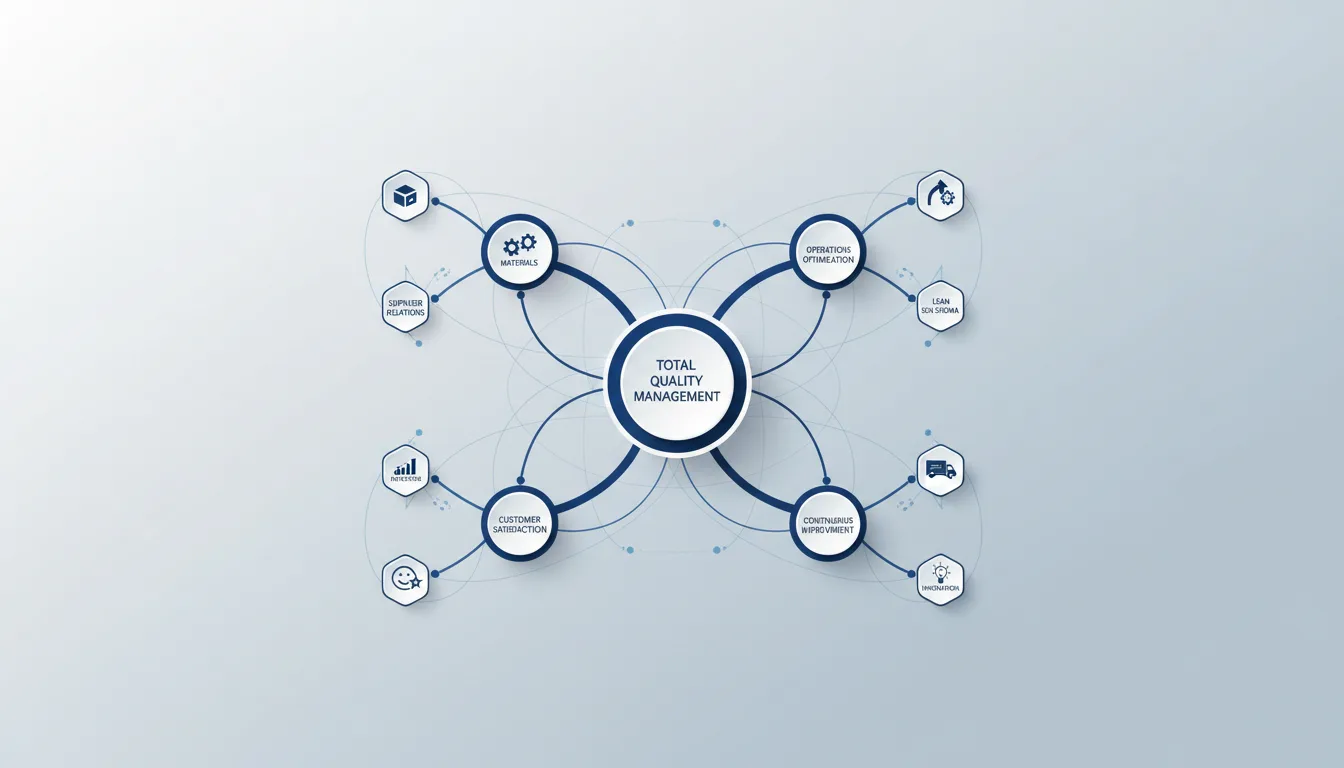
Overview
Total Quality Management (TQM) is an integrated management philosophy that emphasizes the importance of continuous improvement, employee involvement, and customer satisfaction to achieve an organization’s goals. TQM heralds a company-wide organizational culture that promotes the idea that all employees contribute to better processes, products, and services, ultimately leading to higher customer satisfaction and longevity in competitive markets. The key components of TQM include quality planning, quality control, quality improvement, and quality assurance, all driven by a strategic, data-centric approach.
Etymology and Origins
The term "Total Quality Management" gained prominence and was popularized in the 1980s, particularly as Western companies sought to understand and emulate the success of Japanese manufacturing. However, its intellectual and practical roots extend much deeper. The concept evolved from earlier forms of quality control, primarily Statistical Quality Control (SQC) and Total Quality Control (TQC).
Linguistic Roots and Evolution
- Total: Signifies that quality is not just the responsibility of a single department but rather a concern for all functions and levels within an organization, from top management to frontline employees. It implies a holistic, company-wide approach.
- Quality: Refers to meeting or exceeding customer requirements and expectations, encompassing both product/service attributes and process effectiveness. Historically, this evolved from merely identifying defects to preventing them.
- Management: Implies a systematic, structured approach to achieving organizational objectives, involving planning, organizing, leading, and controlling resources and processes to consistently deliver quality.
The term itself is often attributed to the Naval Air Systems Command in the United States in the mid-1980s, which adopted it to describe its Japanese-inspired quality improvement efforts. This built upon the earlier concept of Total Quality Control (TQC), a term coined by Armand V. Feigenbaum in his influential 1961 book of the same name. Feigenbaum's TQC emphasized that quality responsibility extends beyond the factory floor, involving design, engineering, procurement, sales, and service. TQM expanded upon this, further emphasizing customer focus, continuous improvement, and the strategic role of top management.
Historical Development
Foundations: Pre-World War II Era
The earliest scientific approaches to quality management emerged in the United States in the 1920s at Bell Telephone Laboratories. Here, Walter A. Shewhart developed statistical control charts in 1924, laying the groundwork for Statistical Process Control (SPC). His work, outlined in his 1931 book Economic Control of Quality of Manufactured Product, provided the statistical tools necessary to monitor and control processes, distinguishing between common and special causes of variation. This marked a crucial shift from mere inspection to process control and prevention.
Post-World War II Era and Japan's Quality Revolution
The modern foundations of TQM were profoundly shaped by the work of American statisticians and management consultants who introduced quality management techniques to post-war Japan. These pioneers included:
- W. Edwards Deming: Invited to Japan in 1950, Deming lectured on statistical quality control and management principles, including his 14 Points for Management. His emphasis on understanding variation, process improvement, and leadership commitment was instrumental in transforming Japanese industry. The annual Deming Prize for quality excellence was established in his honor in 1951.
- Joseph M. Juran: Juran first visited Japan in 1954, introducing the concept of managing for quality and the importance of top management involvement. His "Quality Control Handbook" (1951) provided a comprehensive guide to quality management, emphasizing planning, control, and improvement, encapsulated in his "Juran Trilogy."
Japan's adoption of these principles, championed by figures like Kaoru Ishikawa who developed the fishbone diagram and promoted quality circles, led to significant advancements in manufacturing quality. Japanese companies, initially known for inferior goods, rapidly became synonymous with high-quality, reliable products by the 1960s and 1970s, largely due to widespread implementation of quality circles and statistical process control (SPC).
The Emergence of TQM in the U.S. and Global Adoption
In the 1980s, as Japanese products dominated global markets, particularly in automotive and electronics, Western industries faced immense pressure to improve their quality standards. This led to a resurgence of interest in quality management in the United States and Europe.
- US Adoption: Organizations like Ford and Motorola implemented comprehensive quality initiatives, recognizing that TQM was key to competitiveness. Ford's "Quality is Job 1" campaign and Motorola's pioneering of the Six Sigma methodology were direct outcomes of this shift.
- Malcolm Baldrige National Quality Award: Established in 1987 in the U.S., this award recognized organizations for their achievements in quality and performance excellence, further promoting awareness and adoption of TQM practices across various sectors.
- Global Spread: By the 1990s, TQM principles expanded beyond manufacturing into service industries, including healthcare, education, government, and finance, as organizations worldwide recognized the universal applicability of customer focus and continuous improvement.
Key Milestones
- 1920s-1930s: Walter Shewhart develops statistical control charts at Bell Labs, foundational for SPC.
- 1950s: Deming and Juran introduce modern quality concepts to Japanese manufacturers, leading to rapid industrial improvement.
- 1961: Armand Feigenbaum publishes Total Quality Control, defining TQC as a company-wide philosophy.
- 1970s: Japanese companies achieve global leadership in quality, heavily leveraging TQC, quality circles, and methodologies like the Toyota Production System.
- 1980s: The rise of TQM practices in the United States and Europe, particularly in automotive and electronics, spurred by the need to compete with Japan.
- 1987: Establishment of the Malcolm Baldrige National Quality Award in the U.S.
- 1990s: Expansion of TQM principles into diverse service industries and increasing integration with other methodologies like Lean and Six Sigma.
- 2000s-Present: Continued evolution with the integration of digital technologies, big data, and AI for predictive quality and real-time process monitoring.
Core Concepts
At its core, TQM revolves around several fundamental principles that guide an organization toward excellence:
- Customer Focus: Understanding and meeting customer expectations is paramount. This includes both external customers (who buy products/services) and internal customers (employees who receive work from another department). Achieving customer satisfaction drives loyalty and business success.
- Total Employee Involvement: Engagement of all employees, from top management to the front line, in contributing to quality initiatives. This fosters a sense of ownership and leverages collective intelligence for innovation and problem-solving, often supported by clear role definitions and productivity tracking.
- Process-Centric: TQM advocates for viewing the organization's activities as a series of interconnected processes. The focus is on optimizing these processes, identifying bottlenecks, and eliminating waste to improve both efficiency and effectiveness. Visualizing and managing these processes is key, often utilizing tools like a visual inventory system.
- Integrated Systems: TQM aligns various parts of the organization—departments, processes, and people—to work towards a unified vision and common quality goals. This requires seamless communication and collaboration across functions.
- Continuous Improvement (Kaizen): A relentless commitment to ongoing improvement in all areas of the organization, embracing the philosophy of Kaizen. This involves regularly reviewing processes, identifying areas for enhancement, and implementing incremental changes to drive sustained excellence. In logistics, this could involve optimizing warehouse workflows or stock replenishment strategies.
- Fact-Based Decision Making: Decisions should be based on robust data analysis and factual evidence, rather than intuition or assumptions. This requires collecting, analyzing, and interpreting relevant data to understand process performance, identify root causes of problems, and measure the impact of improvements. Modern mobile WMS systems provide real-time data for such decisions.
- Strategic and Systematic Approach: TQM is not a short-term program but a long-term strategy integrated into the organization's overall business plan. It requires methodical planning, deployment, and evaluation of quality initiatives.
Industry Applications
TQM practices have been successfully applied across a diverse range of sectors, demonstrating its versatility and effectiveness:
- Manufacturing: Companies such as Toyota are prime examples, utilizing TQM principles extensively within their Toyota Production System (TPS). This approach focuses on eliminating waste (Muda), continuous improvement (Kaizen), and respect for people, leading to exceptionally high efficiency, superior product quality, and lower waste. Other manufacturers apply TQM to optimize assembly lines, supply chain management, and product design.
- Healthcare: Hospitals and healthcare systems adopt TQM approaches to increase patient satisfaction, enhance care quality, and improve operational efficiencies. This involves streamlining processes for patient admission and discharge, reducing medical errors, improving patient safety, and ensuring compliance with regulatory standards. Continuous monitoring of patient outcomes and process workflows are critical.
- Education: Educational institutions implement TQM principles to improve student learning outcomes, enhance faculty performance, and increase operational efficiencies. This can include continuous improvement of curriculum development, assessment methods, administrative processes, and stakeholder engagement (students, parents, community).
- Service Industries: Banks, hotels, and retail chains use TQM to improve service delivery, enhance customer experience, and ensure consistency. This might involve standardizing customer interaction processes, training staff for excellence, and using customer feedback to drive service improvements, often supported by efficient order fulfillment software.
Benefits and Advantages
Implementing TQM leads to several significant organizational benefits:
- Enhanced Customer Loyalty and Satisfaction: By consistently meeting and exceeding customer expectations, TQM fosters strong customer relationships, leading to repeat business and positive word-of-mouth. This is supported by efficient and accurate order management and fulfillment processes.
- Increase in Operational Efficiency and Reduction in Waste: A process-centric approach identifies and eliminates inefficiencies, reduces defects, and minimizes waste (e.g., rework, excess inventory). This translates into lower operational costs and improved resource utilization, aided by optimized warehouse layouts and batch picking strategies.
- Improved Employee Morale and Engagement: Involving employees in decision-making and problem-solving empowers them, leading to higher job satisfaction, increased motivation, and a stronger commitment to quality outcomes. Productivity tracking and clear employee roles also contribute.
- Strong Competitive Advantage: Organizations known for high quality and reliability can differentiate themselves in the market, attract new customers, and retain existing ones, gaining a significant edge over competitors.
- Better Adaptability and Innovation: A culture of continuous improvement encourages adaptability to changing market conditions and fosters an environment where innovation is valued and pursued.
Challenges and Limitations
While TQM provides numerous benefits, organizations may face several challenges during its implementation:
- Resistance to Change: Employees accustomed to traditional methods may resist new TQM practices, requiring substantial effort in change management, communication, and clear demonstration of benefits.
- Significant Investment: Effective TQM implementation requires considerable investment in training, process re-engineering, and technological infrastructure, which can be a barrier for some organizations.
- Necessity for Full Buy-in: TQM demands unwavering commitment and full buy-in from all organizational levels, especially top leadership. Without this, initiatives often fail to gain traction or become isolated departmental efforts.
- Complexity in Measurement: Measuring quality consistently across diverse processes and departments, particularly in service-oriented businesses, can be complex and require sophisticated data collection and analysis tools.
- Long-Term Commitment Required: TQM is not a quick fix; it is a long-term journey of cultural transformation, and organizations must be prepared for sustained effort over many years to realize its full benefits.
Best Practices
To successfully implement and sustain TQM, organizations should consider the following best practices:
- Leadership Commitment: Strong and visible leadership must champion TQM initiatives, articulate the vision for quality, and foster a culture that prioritizes quality as a strategic imperative. Leaders must lead by example.
- Employee Engagement and Empowerment: Actively involve employees at all levels in TQM practices, providing them with the necessary training, tools, and authority to identify problems, propose solutions, and implement improvements. Encourage the formation of quality circles and cross-functional teams.
- Continuous Training and Development: Provide ongoing training and development opportunities that emphasize quality practices, problem-solving methodologies (e.g., SPC, root cause analysis), and the use of quality tools. This ensures a skilled workforce capable of driving quality improvements.
- Data-Driven Decision Making: Implement robust systems for collecting, analyzing, and acting upon data related to processes, product performance, and customer feedback. Utilize visual inventory management systems and workflows for automation to gain actionable insights.
- Strategic Planning and Deployment: Integrate quality objectives into the overall strategic planning process. Deploy TQM initiatives systematically across the organization, ensuring alignment with business goals and clear metrics for success.
- Supplier Relationship Management: Extend TQM principles to suppliers, fostering collaborative relationships to ensure the quality of incoming materials and components, which is critical for overall product quality.
Future Trends
With the advent of new technologies, TQM continues to evolve, becoming more dynamic and predictive. The integration of advanced automation and data analytics significantly enhances the ability of organizations to monitor quality in real-time, driving quicker decision-making and responsiveness. Key trends include:
- Predictive Quality and AI/ML: Leveraging Artificial Intelligence and Machine Learning to analyze vast datasets for predictive maintenance, defect prevention, and process optimization. AI algorithms can identify subtle patterns that precede quality issues, allowing for proactive intervention.
- Internet of Things (IoT) for Real-time Monitoring: IoT sensors embedded in production lines, equipment, and even products enable continuous data collection, providing real-time insights into performance and potential quality deviations. This facilitates immediate corrective actions.
- Digital Twin Technology: Creating virtual replicas of physical systems allows for simulation and testing of process changes or product modifications in a risk-free environment, optimizing quality outcomes before physical implementation.
- Enhanced Customer Engagement: Digital transformation initiatives provide improved channels for customer engagement and feedback mechanisms (e.g., social media monitoring, AI-powered chatbots for support), allowing for faster response to customer needs and more precise quality improvements.
- Blockchain for Supply Chain Transparency: Using blockchain technology to create immutable records of product origins, manufacturing steps, and quality checks enhances transparency and traceability across complex supply chains, ensuring quality integrity.
- Integration with broader Supply Chain Visibility: TQM principles are increasingly integrated with end-to-end supply chain visibility solutions, enabling organizations to manage quality from raw material sourcing to final delivery, ensuring robust quality control at every touchpoint. Modern shipping and fulfillment software plays a crucial role here.
Related Concepts
Total Quality Management intersects with several other quality-related concepts and methodologies, often complementing them to achieve operational excellence:
- Lean Manufacturing: Focuses on eliminating waste (Muda) and maximizing value for the customer. While TQM is broader in scope, Lean provides specific tools and philosophies for process efficiency that directly support TQM's continuous improvement principle. The Toyota Production System is a prime example embodying both.
- Six Sigma: A data-driven methodology for eliminating defects and reducing variation in processes to near perfection (3.4 defects per million opportunities). Six Sigma provides powerful statistical tools that can be integrated into TQM's fact-based decision-making and continuous improvement efforts.
- Business Process Reengineering (BPR): Involves fundamental rethinking and radical redesign of business processes to achieve dramatic improvements in critical contemporary measures of performance such as cost, quality, service, and speed. While TQM focuses on continuous, incremental improvement, BPR may involve more transformative changes when processes are fundamentally broken.
- ISO 9000: A set of international standards for quality management systems. ISO 9000 provides a framework for organizations to ensure they meet customer and other stakeholder needs within statutory and regulatory requirements related to a product or service. TQM is a philosophy that often guides the implementation of an ISO 9000-compliant system. These methodologies emphasize similar principles of quality, efficiency, and customer satisfaction but may focus on different aspects or scales of improvement and operational excellence, often used in combination for comprehensive quality management.
Sources
- Visual Inventory System
- Mobile WMS Overview
- Order Management System
- Total Quality Management (TQM) - ASQ
- Total Quality Management: Past, Present and Future
- Total quality management: a review
- The Origin of Total Quality Management
- Total Quality Control
- Total Quality Control
- Bell Labs
- Walter A. Shewhart - Wikipedia
- W. Edwards Deming - Wikipedia
- The Deming Management Method
- Deming Prize List
- Joseph M. Juran - Wikipedia
- Juran's Quality Control Handbook
- Kaoru Ishikawa - Wikipedia
- BusinessWeek: Ford's 100th Anniversary
- Motorola - Wikipedia
- Six Sigma at Motorola
- Toyota Production System
- Order Management System - SkuSavvy
- Productivity Tracking - SkuSavvy Docs
- Visual Inventory Management System - SkuSavvy
- Workflows Overview - SkuSavvy Docs
- Stock Replenishment Guide - SkuSavvy Docs
- Mobile WMS Overview - SkuSavvy
- Total Quality Management (TQM) - ScienceDirect
- Shipping & Fulfillment Software - SkuSavvy
- Warehouse Layout Preview - SkuSavvy
- Batch Picking Guide - SkuSavvy Docs
- Employee Management - SkuSavvy Docs
- Quality Circles - ASQ