Time Inventory Management
Time Inventory Management is a strategy that optimizes inventory levels based on time-sensitive factors, enhancing operational efficiency and reducing carrying costs.
Updated
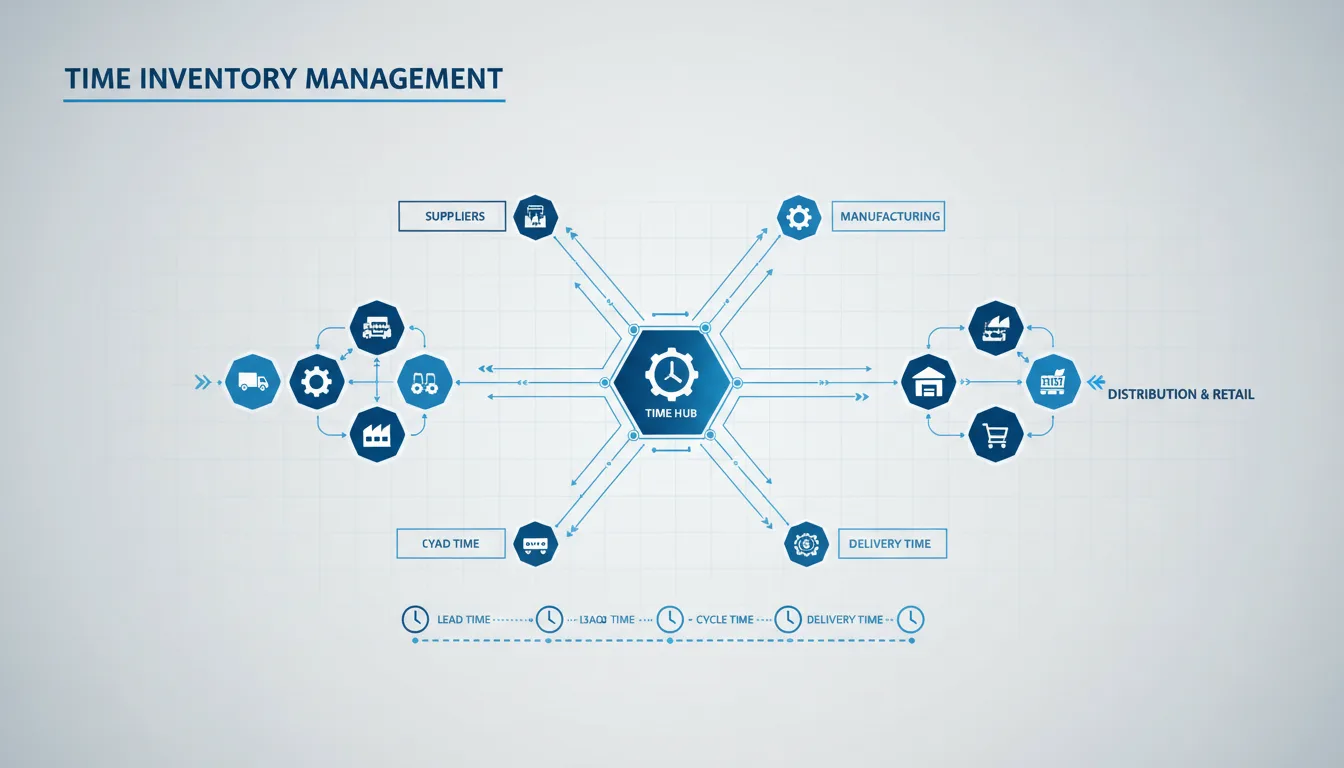
Time Inventory Management
Overview
Time Inventory Management refers to a strategic approach in logistics and supply chain management that emphasizes optimizing inventory levels according to various time-sensitive factors. Its primary goal is to balance the efficiency of stock availability against the costs associated with holding inventory. By minimizing excess stock and ensuring that items are available exactly when needed, companies can enhance their operational efficiency, reduce waste, and improve responsiveness to market demands. This approach is crucial for industries where the timing of inventory turnover, product shelf life, or rapid market changes can significantly impact profitability and customer satisfaction.
Key Principles:
Time Inventory Management relies on several core principles to achieve its objectives:
- Lead Time Reduction: Minimizing the time between placing an order and receiving it, or between starting production and having a finished product. This directly impacts the amount of safety stock required and is a cornerstone of supply chain management.
- Demand Forecasting Accuracy: Precise prediction of future customer demand allows for better planning of inventory inflows and outflows over time. Advanced algorithms and historical data analysis are key to this demand forecasting in supply chain management.
- Inventory Velocity & Turnover Optimization: Maximizing the rate at which inventory moves through the supply chain helps reduce holding costs and free up capital. A high inventory turnover ratio indicates efficient time inventory management.
- Cycle Time Optimization: Streamlining internal processes, from order placement to fulfillment, to reduce the total time inventory spends in various stages within the warehouse. Warehouse cycle time is a critical metric.
- Right-sizing Inventory: Determining the optimal levels of inventory, including safety stock and reorder points, to meet demand without incurring excessive carrying costs or risking stockouts. This is often achieved through inventory optimization software and techniques.
- Supply Chain Visibility: Real-time data on inventory levels, movement, and demand across the entire supply chain enables proactive decision-making. The power of real-time inventory visibility cannot be overstated for time-sensitive operations.
Etymology and Origins
While the specific term "Time Inventory Management" may not have a single, definitive origin date, the underlying concepts have evolved significantly alongside modern industrial and logistics practices. The emphasis on the time dimension in inventory control emerged from a need to move beyond simple quantity-based reordering.
The word "inventory" itself derives from the Latin "inventorium," meaning a list of things found, which implies a static count of goods at a particular moment. Early inventory practices, dating back to ancient civilizations, primarily involved physical counts and record-keeping for taxation, trade, or military supplies, focusing on the what and how much rather than the when or how long. The concept of managing goods over time gained traction with the advent of industrial production and complex supply chains.
Early Foundational Concepts (Early 20th Century)
Modern inventory management began to incorporate the time dimension with the rise of scientific management. The concept of Economic Order Quantity (EOQ), introduced in 1913 by Ford W. Harris, was one of the first mathematical models to explicitly consider the trade-off between ordering costs (which occur at a point in time) and holding costs (which accumulate over time). This laid foundational groundwork for optimizing inventory flow and implicitly linked inventory levels to their duration in storage.
The "Time" Dimension Emerges (Mid-20th Century Onward)
However, the true linguistic and conceptual shift towards time-sensitive inventory gained significant traction with the development of Just-in-Time (JIT) manufacturing in Japan, pioneered by the Toyota Production System (TPS) in the post-World War II era. Taiichi Ohno, a key architect of TPS, emphasized reducing waste (muda), including the waste of waiting and excess inventory, by producing and delivering goods just when they are needed. This philosophy inherently linked inventory levels to production and delivery timelines, making time a critical factor in manufacturing and logistics.
Subsequently, Material Requirements Planning (MRP) systems, developed in the 1960s and 1970s, introduced time-phased planning, where inventory needs were calculated backward from scheduled production dates, explicitly managing supply and demand across specific time buckets. This evolution solidified the idea that inventory is not merely a static stock but a dynamic resource that must be managed with respect to its timing within the operational flow.
Historical Development
The historical journey of inventory management, with an increasing focus on the 'time' dimension, can be traced through several pivotal eras:
Early 20th Century: Foundations of Quantitative Inventory
- 1913 - Economic Order Quantity (EOQ): As mentioned, Ford W. Harris developed the EOQ model, which provided a quantitative basis for determining the optimal order quantity to minimize total inventory costs, including carrying and ordering costs. This was an early attempt to optimize inventory over a period of time. While foundational, it relied on static assumptions and didn't fully address dynamic demand or supply chain complexities.
- 1930s-1950s - Statistical Inventory Control: During World War II and the post-war boom, statistical methods were applied to inventory control to manage fluctuating demand and supply more effectively. Concepts like safety stock and reorder points became more formalized, recognizing that uncertainty required buffering over time, yet also emphasizing the need to minimize idle time for capital.
Mid-20th Century: The Rise of Planning Systems
- 1950s-1960s - Reorder Point Systems & Manual Control: Many companies still relied on simple reorder point systems or manual card-based inventory control. These systems often resulted in large safety stocks to guard against uncertainties, leading to higher holding costs and obsolescence.
- 1960s-1970s - Material Requirements Planning (MRP): Pioneered by Joseph Orlicky at IBM, MRP systems revolutionized inventory by moving from independent demand forecasting to dependent demand, enabling time-phased planning of components based on a master production schedule. MRP was a significant leap in synchronizing inventory with production timelines, calculating when materials were needed to meet production schedules. The development of MRP systems during this period marked a critical shift from reactive to proactive, time-based inventory planning.
Late 20th Century: Lean and Integrated Systems
- 1970s-1980s - Just-in-Time (JIT) & Toyota Production System: Pioneered by Toyota in Japan, JIT emphasized producing and delivering goods just as they are needed, drastically reducing lead times and inventory holding costs. This philosophy, rooted in eliminating waste, fundamentally redefined the role of time in inventory management, pushing for minimal stock and rapid turnover. The widespread adoption of JIT principles, especially in the automotive industry, showcased its significant benefits.
- 1980s - Manufacturing Resource Planning (MRP II): Evolving from MRP, MRP II integrated additional business functions like finance, marketing, and human resources with manufacturing planning. Key figures like Oliver Wight played a significant role in popularizing MRP II, which offered a more comprehensive approach to managing all resources—including time—required for manufacturing, moving beyond just materials. This provided further refinement in synchronizing production with demand and financial planning.
- 1990s - Enterprise Resource Planning (ERP): ERP systems evolved from MRP II by integrating various business functions—including manufacturing, inventory, finance, and human resources—into a single, unified database. This integration provided greater visibility and control over inventory movements and financial implications across the entire enterprise, allowing for more precise time-based planning and coordination of supply chain activities.
- 1990s - Warehouse Management Systems (WMS): As supply chains grew in complexity, specialized warehouse management systems emerged to optimize internal warehouse operations. These systems enabled real-time tracking of inventory, optimized storage, picking paths, and shipping, directly impacting the speed and accuracy of inventory flow, thereby enhancing time-based management and reducing the time goods spend stagnant in the warehouse.
21st Century: Real-time, Predictive, and Agile Management
- 2000s - Advanced Planning Systems (APS) & Supply Chain Management (SCM): The focus shifted to integrating information across the entire supply chain, from suppliers to customers. APS offered sophisticated forecasting, demand planning, and inventory optimization capabilities, allowing for more dynamic adjustments to inventory levels based on real-time data and predictive analytics. This era saw the rise of global supply chain responsiveness as a key competitive advantage.
- 2010s-Present - Digitalization, IoT, and AI: The advent of technologies like the Internet of Things (IoT), RFID, and artificial intelligence (AI) has brought unprecedented levels of real-time inventory visibility and predictive power. AI and machine learning algorithms can analyze vast datasets to improve demand forecasting, identify potential supply chain disruptions, and recommend optimal inventory adjustments with greater speed and accuracy. This enables truly dynamic and agile time inventory management, crucial for complex omnichannel fulfillment strategies and navigating increasing supply chain volatility.
Benefits of Effective Time Inventory Management
Implementing robust time inventory management practices yields significant advantages across various aspects of business operations:
- Reduced Carrying Costs: By minimizing the amount of time inventory sits in storage, businesses drastically cut down on expenses related to warehousing, insurance, security, and capital tied up in stock. This directly impacts the bottom line, contributing to better inventory management.
- Improved Cash Flow: Less capital is tied up in slow-moving or excess inventory, freeing up funds for other critical investments or operational needs. Faster inventory turnover translates to quicker conversion of inventory into sales revenue.
- Enhanced Responsiveness & Customer Satisfaction: By ensuring products are available just when needed, companies can fulfill orders more quickly and reliably, leading to higher customer satisfaction and loyalty. This is particularly vital in industries with high demand variability or short product lifecycles.
- Minimized Obsolescence and Spoilage: For products with expiration dates, fashion items, or rapidly evolving technology, timely inventory movement prevents losses from spoilage, damage, or becoming outdated. Managing inventory by lots and expiration dates is a critical component.
- Optimized Space Utilization: Reduced inventory levels mean less warehouse space is required, or existing space can be utilized more efficiently for higher-value activities or a wider range of products. Visual tools like warehouse layout previews can help optimize this space.
- Better Supplier Relationships: Clear and timely communication with suppliers regarding demand forecasts and delivery schedules can foster stronger partnerships, potentially leading to better pricing and more reliable supply. This is often facilitated through robust purchase order management systems.
Challenges in Time Inventory Management
Despite its benefits, implementing and maintaining effective time inventory management can present several challenges:
- Demand Volatility and Uncertainty: Unpredictable spikes or drops in customer demand make accurate forecasting difficult, leading to either stockouts or excess inventory. Global events, economic shifts, and seasonal trends can exacerbate this.
- Supply Chain Disruptions: Unexpected events such as natural disasters, geopolitical issues, labor shortages, or supplier failures can severely impact lead times and the timely arrival of goods, undermining even the best-laid plans. Building supply chain resilience is crucial.
- Data Accuracy and Visibility: Poor data quality, lack of real-time inventory updates, or fragmented systems can hinder effective decision-making. Inaccurate inventory counts or slow information flow can lead to inefficiencies.
- Complexity of Global Supply Chains: Managing inventory across multiple locations, suppliers, and distribution channels adds layers of complexity, including varying lead times, customs regulations, and transportation challenges. This requires sophisticated global supply chain management strategies.
- Balancing Costs: Striking the right balance between the cost of holding inventory (storage, capital) and the cost of not having inventory (lost sales, expedited shipping) is a continuous challenge. Overly aggressive time-based strategies can lead to frequent stockouts if not carefully managed.
- Legacy Systems and Integration Issues: Many companies operate with older, disparate systems that do not communicate effectively, making it difficult to achieve the holistic visibility and automation required for optimal time inventory management. The importance of supply chain integration becomes paramount.
Key Strategies and Technologies
Effective time inventory management leverages a combination of strategic approaches and advanced technologies:
Strategic Approaches:
- Just-in-Time (JIT) / Lean Principles: Focus on eliminating waste by producing or procuring goods only when they are needed, reducing inventory holding times and costs. This requires strong supplier relationships and efficient production processes.
- Vendor-Managed Inventory (VMI): Vendor-Managed Inventory (VMI) involves suppliers taking responsibility for managing inventory levels at their customers' locations, optimizing replenishment schedules based on real-time consumption data. This reduces the customer's burden of forecasting and ordering.
- Cross-Docking: Minimizing storage time by directly transferring goods from inbound trucks to outbound trucks, without placing them into storage. This greatly accelerates inventory flow and reduces handling. SkuSavvy provides a Cross-Docking Guide.
- Optimized Stock Replenishment: Implementing strategies like continuous review (reorder point) or periodic review systems, coupled with demand forecasting, to ensure timely stock replenishment and prevent stockouts without excessive buffering.
- Cycle Counting: Regularly counting small, defined sections of inventory to maintain accurate stock records without requiring a full physical inventory shutdown. This ensures data accuracy, which is vital for time-based decisions. SkuSavvy offers a Cycle Counting Guide.
Enabling Technologies:
- Warehouse Management Systems (WMS): Modern WMS platforms are central to time inventory management. They provide real-time visibility into inventory levels, optimize storage locations (e.g., using bin put-away criteria), direct picking operations (like batch picking, pick-to-tote, or even efficient bin-to-bin inventory transfer), and manage shipping, all designed to expedite inventory flow within the warehouse.
- Enterprise Resource Planning (ERP) Systems: Provide a holistic view of business operations, integrating inventory data with sales, procurement, and financial information. This enables comprehensive planning and coordination across the entire supply chain.
- Demand Forecasting and Planning Software: Utilizes historical sales data, seasonal trends, promotional activities, and external factors (e.g., weather, economic indicators) to generate accurate demand forecasts, crucial for time-sensitive purchasing and production planning.
- Inventory Optimization Software: Employs mathematical models and algorithms to determine optimal inventory levels, safety stock, and reorder points across multiple locations and product lines, balancing service levels with holding costs.
- IoT, RFID, and Barcode Systems: These technologies provide automated, real-time tracking of inventory movement throughout the supply chain, from inbound receipts (e.g., PO Check-In) to outbound shipments. This enhanced visibility is foundational for timely decision-making.
- Automation and Robotics: Automated Storage and Retrieval Systems (AS/RS), robotic picking, and conveyor systems significantly reduce the time and labor involved in moving and managing inventory within a warehouse, contributing to faster cycle times and reduced lead times. Solutions like SkuSavvy's bin packing visualizer can also optimize space and speed.
Best Practices
To effectively implement and sustain time inventory management, organizations should adhere to these best practices:
- Invest in Robust Data Management: Ensure inventory data is accurate, up-to-date, and accessible in real-time. This includes precise unit of measure tracking and regular cycle counting. Inaccurate data is the enemy of time-sensitive decisions.
- Integrate Systems: Connect your WMS, ERP, Order Management System (OMS), and procurement systems to create a unified view of your inventory and supply chain. This seamless data flow is essential for timely actions and supply chain integration.
- Collaborate with Suppliers: Establish strong, collaborative relationships with suppliers to improve communication, reduce lead times, and enhance supply chain resilience. Share demand forecasts to enable suppliers to plan production accordingly.
- Optimize Warehouse Layout and Processes: Design your warehouse for efficient movement of goods. Implement lean principles in your internal logistics to minimize non-value-added time, such as excessive travel or waiting. SkuSavvy's workflows can help streamline operations and reduce unnecessary time consumption.
- Implement Advanced Forecasting: Utilize AI-driven or statistical forecasting tools to predict demand with greater accuracy, especially for products with volatile demand patterns. Continuously review and adjust forecasts based on new data.
- Segment Inventory: Categorize inventory based on its characteristics (e.g., ABC analysis, product lifecycle, demand volatility) to apply appropriate management strategies. High-value, fast-moving items may require stricter time-based controls.
- Monitor Key Performance Indicators (KPIs): Regularly track metrics such as inventory turnover rate, days of supply, lead times, order fulfillment cycle time, and carrying costs. Use these key inventory management KPIs to identify areas for improvement and measure the success of your time inventory management initiatives.
- Embrace Automation: Leverage automation in data capture (e.g., RFID, barcode scanning), warehouse operations (e.g., AS/RS), and even automated purchase order quantity calculations to reduce manual errors and increase speed.
Case Study: Apparel Retailer Optimizes Seasonal Inventory
A mid-sized apparel retailer faced significant challenges with seasonal inventory. They consistently held excess stock of out-of-season clothing, leading to markdowns and storage costs, while frequently experiencing stockouts for popular in-season items. Their traditional inventory system relied on annual forecasts and manual reordering, resulting in poor time-based management.
Solution Implemented:
- Demand Forecasting Upgrade: The retailer invested in a new demand planning software integrated with their ERP, leveraging historical sales data, social media trends, and economic indicators to generate weekly forecasts for seasonal items. This allowed for more agile responses to rapidly changing fashion trends.
- WMS Implementation: A mobile-enabled WMS was implemented to provide real-time visibility into inventory levels across their distribution centers and retail stores. This allowed for quick identification of slow-moving items and fast-selling products, enabling faster redistribution or markdown decisions.
- Optimized Replenishment: They adopted an automated stock replenishment system with dynamic reorder points based on current demand forecasts and actual sales, significantly reducing lead times for ordering new stock and preventing unnecessary buffer stock. This was critical for meeting seasonal peaks.
- Supplier Collaboration: The retailer shared their advanced demand forecasts with key apparel manufacturers, enabling them to align production schedules more closely with anticipated demand and reduce delivery lead times. This fostered a more responsive supply chain for seasonal goods. This strategy mirrors best practices in inventory optimization for fashion retail.
Results:
- Reduced Markdown Losses: A 25% reduction in markdown losses due to significantly less out-of-season excess inventory, directly linking to better timing of inventory outflow.
- Improved In-Stock Rates: A 15% improvement in the availability of popular seasonal items, leading to higher customer satisfaction and fewer lost sales, by ensuring inventory arrived just in time for peak demand.
- Lower Carrying Costs: A 10% decrease in overall inventory carrying costs due to optimized stock levels and faster turnover, freeing up capital previously tied up for extended periods.
- Faster Inventory Turnover: Average inventory turnover increased by 20%, reflecting more efficient use of capital and reduced time spent in storage.
This case study illustrates how focusing on the time dimension in inventory management—from forecasting to fulfillment—can yield substantial operational and financial benefits, proving the value of dynamic and time-sensitive approaches over static inventory models.
Sources
- Inventory Management: Balancing Cost and Service
- The Importance of Supply Chain Responsiveness
- Supply Chain Management - Lead Time
- Demand Forecasting in Supply Chain Management
- Inventory Turnover Ratio: What It Is and How to Calculate It
- Warehouse Cycle Time Explained
- Inventory Optimization: Balancing Service and Cost
- The Power of Real-Time Inventory Visibility
- A History of Inventory Management
- How Many Parts to Make at Once
- The Toyota Production System: Leaner, Faster, Better
- What is Just-in-Time (JIT) Manufacturing?
- Material Requirements Planning (MRP)
- Joseph Orlicky: The Inventor of MRP
- What is ERP? Enterprise Resource Planning Explained
- Mobile WMS Overview
- Vendor-Managed Inventory (VMI) Explained
- Supply Chain Resilience: What It Is and Why It Matters
- Managing Global Supply Chains: Challenges and Solutions
- The Importance of Supply Chain Integration
- Cross-Docking Guide
- Cycle Counting Guide
- Key Inventory Management KPIs
- Inventory Optimization in Fashion Retail: A Case Study
- Supply Chain Resilience: What It Is and Why It Matters
- Managing Global Supply Chains: Challenges and Solutions
- The Importance of Supply Chain Integration
- Inventory Optimization in Fashion Retail: A Case Study
- Bin-to-Bin Inventory Transfer
- Bin Packing Visualizer