Supply Management
Supply management entails the strategic approach to sourcing and acquiring goods and services needed by an organization.
Updated
Overview
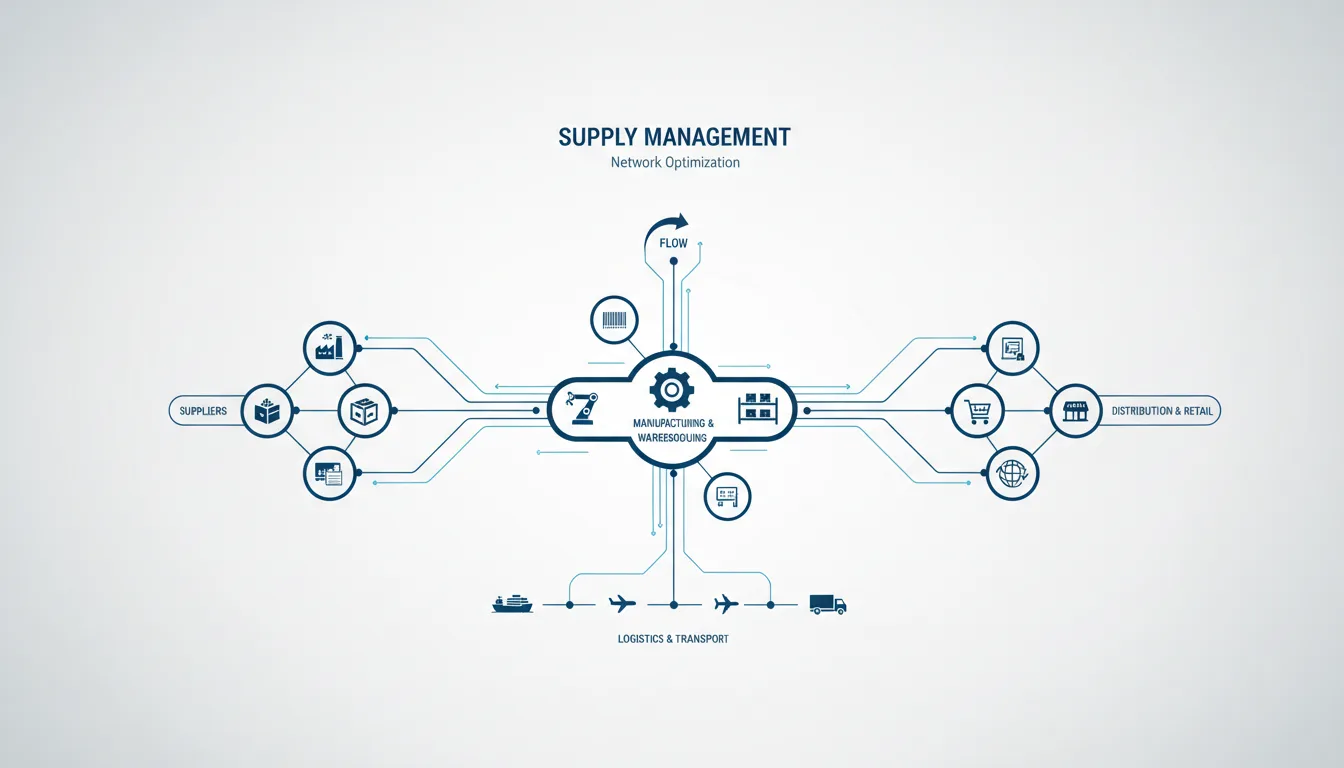
Supply management is the strategic approach to managing a company's supply base to ensure the efficient and effective acquisition of goods, services, and information needed for production, operation, or resale. Its primary objective is to optimize upstream supply chain operations, reduce total cost of ownership, mitigate risks, and foster strategic relationships with vendors and partners. Effective supply management is vital for maintaining product quality, enhancing operational efficiency, ensuring supply continuity, boosting customer satisfaction, and ultimately driving profitability and competitive advantage [6].
Etymology and Origins
The term "supply management" emerged as a more strategic and encompassing concept than its predecessors, "purchasing" and "procurement." While the act of buying and selling is ancient, the systematic management of an organization's supply base began to solidify in the mid-20th century. The National Association of Purchasing Agents (NAPA) established in 1915 and later renamed the Institute for Supply Management (ISM), played a pivotal role in professionalizing the function. Their journal, The Journal of Purchasing, evolving into The Journal of Purchasing and Materials Management, and eventually The Journal of Supply Chain Management, reflects this conceptual shift [7].
The move from "purchasing" to "supply management" reflected a growing understanding that the function was not merely transactional but strategic. It encompassed not just the act of buying but also planning, sourcing, negotiation, contract management, and supplier relationship management, recognizing the vital role suppliers play in an organization's success. This evolution was driven by changes in economic conditions, increased global competition, and the recognition that managing the incoming flow of resources was critical for competitive positioning and financial performance.
Historical Development
Early 20th Century: Efficiency and Standardization
Supply management as a discipline began gaining importance in the early 1900s, heavily influenced by the principles of scientific management pioneered by Frederick Winslow Taylor. The focus was on efficiency, cost reduction, and standardization of raw material acquisition. The advent of mass production by companies like Ford Motor Company not only transformed manufacturing processes but also necessitated structured approaches to sourcing large volumes of materials, often through vertical integration and long-term contracts. Early purchasing departments were primarily clerical, focused on securing materials at the lowest possible price.
1950s–1960s: Post-War Growth and Materials Management
The post-World War II economic boom catalyzed significant changes. Companies began to adopt a more integrated approach, recognizing the interplay between purchasing, inventory control, and logistics. This era saw the rise of "materials management" as a concept, integrating these functions under a single department to optimize material flow. Pioneering companies, particularly in Japan, such as Toyota, began developing innovative production systems that later formed the basis of lean manufacturing and Just-in-Time (JIT) practices, profoundly influencing how companies viewed their suppliers and inventory. Early technologies like barcodes, initially developed in the 1950s and commercialized in the 1970s, started to offer better tracking capabilities, laying groundwork for future inventory accuracy. The emergence of Materials Requirements Planning (MRP) systems in the 1960s marked a significant step towards computerized planning of production materials [8].
1980s: Strategic Sourcing and Global Competition
The concept matured significantly in the 1980s as global competition intensified and firms began to recognize the strategic value of their supplier base. The widespread adoption of Just-in-Time (JIT) inventory systems from Japanese manufacturers highlighted the importance of close supplier relationships, quality, and efficient logistics to minimize waste and enhance operational efficiency. This led to a shift from purely transactional purchasing to more strategic sourcing, where supplier selection and management became a competitive differentiator. Manufacturing Resource Planning (MRP II) systems evolved from MRP, integrating production planning, master scheduling, and even financial planning, providing a more comprehensive view of resource management [9].
1990s–2000s: Supply Chain Management and Digital Integration
The rise of global sourcing, complex supply networks, and the internet necessitated greater collaboration among supply chain partners. The term "Supply Chain Management" (SCM) was coined by consultant Keith Oliver of Booz Allen Hamilton in 1982 [10], formalizing the holistic view of managing the entire flow from raw materials to end consumer. The introduction of enterprise resource planning (ERP) systems further revolutionized supply management by integrating various operational processes—including purchasing, inventory, and production—into a unified framework. E-procurement platforms and web-based supplier portals began to streamline communication and transaction processes. This era emphasized information sharing and visibility across the supply chain.
2010s to Present: Digital Transformation, Resilience, and Sustainability
Today, advancements in technology, data analytics, artificial intelligence, and the Internet of Things (IoT) are fundamentally reshaping supply management. Organizations leverage cloud-based systems for real-time data access, advanced analytics, and predictive capabilities, allowing for enhanced supplier relationship management, risk assessment, and demand forecasting. The COVID-19 pandemic and other geopolitical events highlighted the critical importance of supply chain resilience and agility. Modern supply management also places a strong emphasis on sustainability, ethical sourcing, and circular economy principles, driving companies to scrutinize their supply bases for environmental and social impact [11].
Core Concepts
Supply management encompasses several core concepts, each critical for optimizing the acquisition process:
- Sourcing: This involves identifying, evaluating, selecting, and engaging potential suppliers. Companies employ sophisticated strategies such as strategic sourcing, which moves beyond price to consider total cost of ownership, quality, delivery, innovation, and risk. Vendor portals and advanced analytics help streamline supplier evaluation and selection.
- Procurement: The transactional process of acquiring goods and services, including issuing purchase orders, managing vendor contracts, expediting deliveries, and processing payments. Modern systems automate many of these steps, from automated purchase quantity calculations to PO approval workflows.
- Supplier Relationship Management (SRM): Building and maintaining effective, long-term relationships with key suppliers to foster collaboration, innovation, and mutual growth. SRM involves performance monitoring, joint problem-solving, and shared objectives, moving beyond adversarial negotiations to partnership models.
- Inventory Management: Ensuring that the right quantity of goods is available at the right time and place, while minimizing excess stock and associated carrying costs. Effective inventory strategies, supported by tools like a visual inventory management system, often incorporate techniques such as cycle counting, stock replenishment, and demand forecasting to optimize inventory levels and prevent stockouts or overstocking.
- Contract Management: Overseeing the creation, execution, and analysis of contracts to maximize operational and financial performance and to minimize risk. This includes ensuring compliance with terms and conditions and managing contract renewals.
Types and Classifications
Various types of supply management strategies exist, often tailored to organizational structure and strategic objectives:
- Centralized vs. Decentralized Supply Management:
- Centralized management consolidates purchasing decisions and supplier relationships under one corporate function, allowing for greater uniformity, leverage for volume discounts, standardized processes, and enhanced control. This is often beneficial for large organizations with multiple operating units.
- Decentralized management empowers individual business units or departments to make their own purchasing decisions, leading to more tailored approaches, faster response times to local needs, and greater autonomy. However, it can lead to fragmented efforts and missed economies of scale. Many organizations adopt a hybrid approach.
- Lean Supply Management: Focused on minimizing waste (e.g., excess inventory, waiting times, overproduction, defects) while maximizing value throughout the supply chain. Companies that adopt lean principles often achieve significant gains in efficiency, cost reduction, and quality by relentlessly eliminating non-value-added activities and fostering continuous improvement [12].
- Sustainable Supply Management: Emphasizes ethical sourcing practices, environmental responsibility, and social equity throughout the supply base. This includes favoring environmentally friendly suppliers, reducing carbon footprints, ensuring fair labor practices, and adopting circular economy principles to enhance brand image, meet regulatory requirements, and reduce long-term risks.
- Agile Supply Management: Designed for environments characterized by high volatility, uncertainty, complexity, and ambiguity (VUCA). Agile supply management focuses on flexibility, responsiveness, and quick adaptation to changing market conditions, customer demands, and disruptions. It often involves building robust supplier networks and fostering rapid decision-making processes.
Industry Applications
Supply management is critical across diverse sectors, each with unique requirements:
- Manufacturing: Involves precise coordination with suppliers for raw materials, components, and sub-assemblies; managing production schedules and work-in-progress inventory. The goal is to ensure a continuous flow of materials to support production without excess stockpiles.
- Retail: Focuses on efficient restocking strategies to meet fluctuating customer demand across multiple channels (in-store, online) without overstocking. Systems like the Inventory Management System are crucial for real-time visibility and optimized product availability, enabling strategies like omni-channel fulfillment and dropshipping.
- Healthcare: Requires extremely strict procurement processes to ensure that critical supplies, pharmaceuticals, medical devices, and personal protective equipment (PPE) are available when needed. The emphasis is on reliability, quality assurance, regulatory compliance, and resilience, which gained heightened visibility during the COVID-19 pandemic and subsequent supply shortages.
- Automotive: Known for its complex global supply chains, requiring precise coordination of thousands of components, often utilizing just-in-sequence (JIS) and just-in-time (JIT) deliveries to minimize inventory and maximize production efficiency. Supplier quality and reliability are paramount.
Benefits and Advantages
Utilizing effective supply management strategies can lead to significant competitive advantages:
- Lower Operational Costs: Achieved through improved procurement practices, strategic vendor negotiations, volume discounts, optimized inventory levels, and reduced waste.
- Enhanced Quality Control: Through rigorous supplier performance evaluation, robust quality agreements, and collaborative quality improvement initiatives, leading to higher product quality and fewer defects.
- Increased Agility and Responsiveness: To market changes, customer needs, and unforeseen disruptions, enabling faster product launches and more resilient operations.
- Improved Supplier Relationships: Fostering collaboration, innovation, and shared value creation with key suppliers, turning them into strategic partners rather than mere vendors.
- Reduced Risk: By diversifying the supplier base, implementing robust risk assessment frameworks, and enhancing visibility into the supply chain, organizations can better mitigate disruptions, quality issues, and geopolitical uncertainties.
Challenges and Limitations
Despite its importance, supply management faces several ongoing challenges:
- Supplier Risk Management: Over-reliance on single suppliers, geopolitical instability, natural disasters, and financial instability of suppliers can create significant vulnerabilities in supply continuity and quality. Effective risk mitigation requires continuous monitoring and contingency planning.
- Market Volatility and Demand Uncertainty: Fluctuating demand, rapid technological changes, and economic downturns can complicate forecasting, inventory management, and supplier capacity planning.
- Technological Integration and Data Silos: The need for seamless systems integration (e.g., ERP, WMS, SRM) and accurate, real-time data across a complex supply network poses ongoing challenges. Many organizations struggle with disparate systems and a lack of data visibility, hindering informed decision-making. Tools like a Mobile Warehouse Management System aim to bridge these gaps by providing real-time data from the warehouse floor.
- Globalization and Complexity: Managing extended global supply chains introduces challenges related to lead times, cultural differences, regulatory compliance, transportation costs, and ethical sourcing.
- Talent Gap: A shortage of skilled professionals in strategic sourcing, supply chain analytics, and supplier relationship management continues to be a hurdle for many organizations [13].
Best Practices
Implementing effective supply management involves several key best practices:
- Develop a Holistic Strategy: Align supply management objectives with overall business strategy, ensuring a clear understanding of how procurement and supplier relationships contribute to competitive advantage.
- Implement Robust Supplier Performance Management: Regularly review supplier performance metrics (e.g., quality, delivery, cost, innovation, responsiveness) and provide feedback for ongoing improvements. Utilize structured scorecards and frequent business reviews.
- Leverage Integrated Technology Solutions: Adopt modern, integrated technology platforms (e.g., ERP, WMS, SRM, e-procurement) for better data visibility, automation of routine tasks, predictive analytics, and process management. Solutions like SkuSavvy's workflows can streamline complex processes.
- Emphasize Collaboration and Trust: Build strong, collaborative relationships with strategic suppliers. Foster open communication, share long-term goals, and engage suppliers in product development and problem-solving to enhance innovation and resilience.
- Proactive Risk Management: Identify potential supply chain risks (e.g., single-source dependencies, geopolitical risks, natural disasters) and develop mitigation strategies, including supplier diversification, buffer inventory, and alternative sourcing plans.
- Focus on Total Cost of Ownership (TCO): Move beyond unit price to consider all costs associated with acquiring, using, and disposing of a product or service, including quality costs, delivery, inventory carrying costs, and risk.
- Invest in Talent Development: Continuously train and upskill supply management professionals in areas like negotiation, analytics, technology, and strategic thinking.
Future Trends
The future of supply management is likely to be shaped by several transformative trends:
- Advanced Analytics and AI/ML: Increased reliance on big data analytics, machine learning, and artificial intelligence for predictive supply chain management, demand forecasting, supplier risk assessment, and automated decision-making. This includes the use of digital twins for simulating supply chain scenarios.
- Blockchain Technology: Adoption of blockchain for enhanced traceability, transparency, and security in supply chains, particularly for proving ethical sourcing and combating counterfeiting [14].
- Increased Automation and Robotics: Further automation of warehouse operations, last-mile delivery, and administrative procurement tasks using robotics process automation (RPA).
- Sustainability and Circular Economy: Growing importance of sustainable and ethical sourcing practices, waste reduction, and the design of circular supply chains that minimize environmental impact and maximize resource utilization.
- Hyper-personalization and Micro-fulfillment: Supply chains will become even more agile and localized to cater to individualized customer demands and faster delivery expectations, leading to the rise of micro-fulfillment centers and advanced last-mile logistics.
- Resilience and Agility: Building highly resilient and agile supply networks capable of quickly adapting to disruptions, market shifts, and evolving customer needs will remain a top priority.
Related Concepts
Supply management is closely related to other concepts in logistics and supply chain management including:
- Demand planning: Forecasting future customer demand to inform procurement and production decisions.
- Logistics management: Planning, implementing, and controlling the efficient, effective forward and reverse flow and storage of goods, services, and related information between the point of origin and the point of consumption.
- Procurement strategies: Specific plans and tactics for acquiring goods and services.
- Supply Chain Management (SCM): The broader concept encompassing all aspects from raw material acquisition to end-customer delivery.
In summary, supply management is a dynamic and integral component of successful organizational practice that bridges procurement, operations, and strategy. Understanding its principles and applying best practices can lead to improved efficiency, significant cost savings, enhanced resilience, and a decisive competitive advantage in today's complex and interconnected business environment.
Sources
- Purchase Order Management
- Visual Inventory System
- Mobile Warehouse Management System
- Cycle Counting Guide
- WMS vs ERP Analysis
- A Review of Supply Management Research: Past, Present, and Future
- A Brief History of ISM
- The Evolution of Materials Requirements Planning (MRP)
- The Evolution of MRP to ERP
- The History of Supply Chain Management
- Sustainable Supply Chain Management: An Overview and Future Research Directions
- The Lean Supply Chain: A Vision for the Future
- The Supply Chain Talent Gap: Challenges and Opportunities
- Blockchain in Supply Chain Management: A Review and Future Research Agenda
- Vendor Portal
- Purchase Orders Guide
- Automated Purchase Quantity
- PO Approval Workflow
- Stock Replenishment Guide