Strategic Integration in Logistics and Supply Chain Management
An exploration of strategic integration within logistics, highlighting its importance, history, core concepts, applications, benefits, and industry trends.
Updated
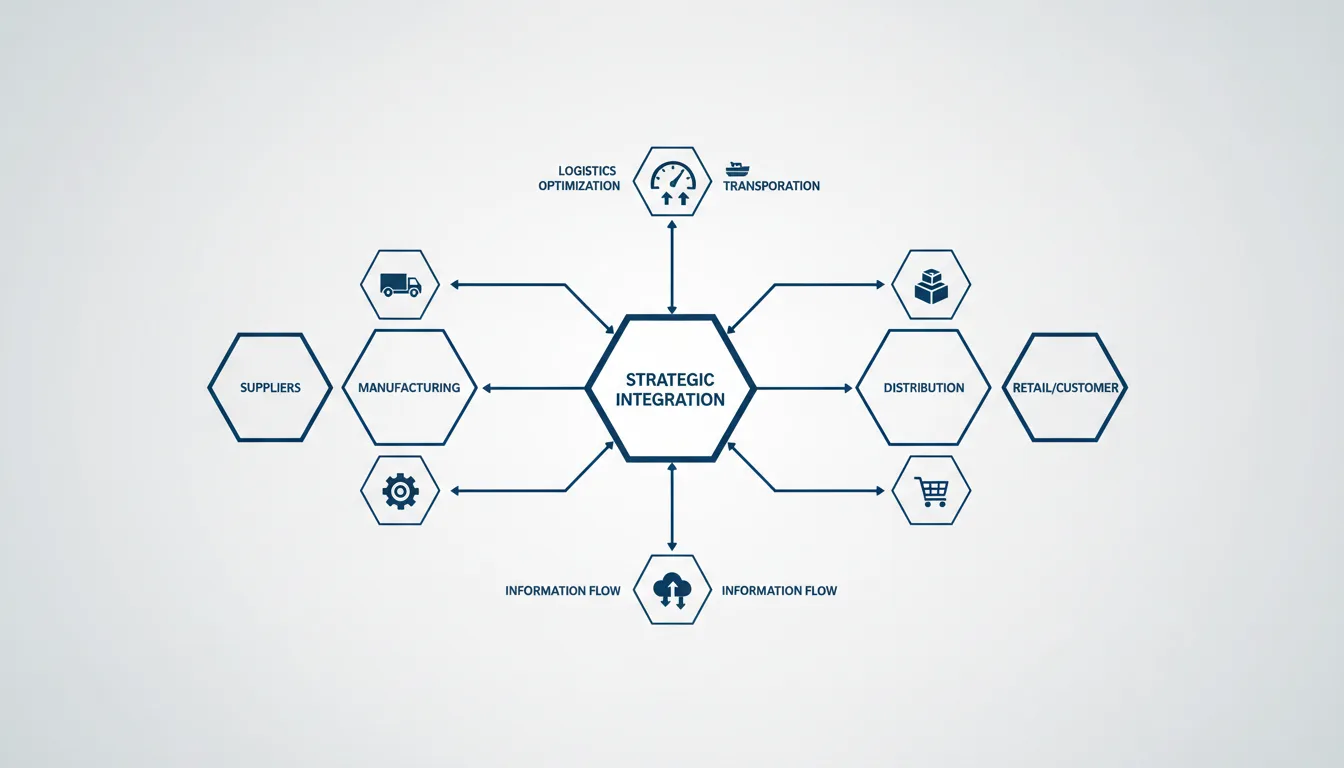
Strategic Integration in Logistics and Supply Chain Management
Overview
Strategic integration refers to the deliberate alignment and synchronization of logistics and supply chain processes with broader organizational goals and overarching business strategies [6]. This holistic approach fosters seamless collaboration across internal departments—such as procurement, production, sales, and distribution—and extends to external partners, including suppliers, distributors, and customers. The primary objective is to enhance overall efficiency, effectiveness, and responsiveness throughout the entire supply chain [7]. By synchronizing logistics functions with a company's strategic vision, organizations can proactively adapt to market fluctuations, optimize resource allocation, reduce operational costs, improve service delivery, and ultimately elevate overall customer satisfaction and competitive advantage.
Etymology and Origins
The concept of "strategic integration" began to gain traction within business management literature in the late 20th century, particularly as firms grappled with increasing market complexity and global competition. While the precise first documented usage within a logistics context is challenging to pinpoint, its linguistic roots stem from two core academic fields:
- Strategy: Emerging from military science and later applied to business in the mid-20th century, strategy (from Ancient Greek strategos, "generalship") refers to the art of planning and directing overall operations and movements in a war or campaign. In business, it signifies the comprehensive long-term plan designed to achieve specific goals under conditions of uncertainty [9].
- Integration: Derived from the Latin integratio, meaning "renewal" or "restoration," integration implies the act of combining separate parts into a unified whole. In a business context, it refers to the coordinated functioning of different organizational units or processes.
Initially, the term was broadly utilized in strategic management theories to describe the alignment of organizational resources, capabilities, and functional strategies (e.g., marketing strategy, production strategy) with corporate-level strategic objectives [10]. As global trade expanded and supply chains became more intricate in the 1970s and 1980s, the operational aspects of logistics and procurement gained significant strategic importance. Business scholars and practitioners recognized the necessity of integrating previously siloed functions—such as procurement, manufacturing, inventory management, and distribution—to achieve competitive advantage and operational excellence. This shift elevated logistics from a purely tactical function to a strategic imperative, leading to the explicit adoption and evolution of "strategic integration" within logistics and supply chain discourse.
Historical Development
Strategic integration’s evolution in logistics is intrinsically linked to the maturation of supply chain management as a discipline and advancements in information technology. Its prominence grew significantly from the latter half of the 20th century:
- 1950s-1970s: Functional Silos & Early Coordination: Logistics was primarily seen as a cost center focused on transportation and warehousing. However, early concepts like Material Requirements Planning (MRP), introduced in the 1960s, represented a nascent form of integration by coordinating material purchasing and production schedules [11].
- 1980s: Recognition of Logistics as a Strategic Function: The decade marked a pivotal shift, driven by increased global competition and the recognition that logistics could be a source of competitive advantage, not just an expense. Management guru Peter Drucker famously emphasized that "logistics is one of the last frontiers for cost reduction and service improvement" [12]. This period also saw the rise of Just-in-Time (JIT) manufacturing, pioneered by companies like Toyota, which demanded unprecedented levels of integration and collaboration with suppliers to minimize inventory and waste [13].
- 1990s: Emergence of Supply Chain Management (SCM): The term "Supply Chain Management" itself gained widespread adoption, notably through articles by consultants like Oliver and Webber [14]. This era formally articulated the need for end-to-end process integration, transcending individual corporate boundaries to include suppliers and customers. Seminal publications, such as The New Supply Chain Agenda by Reuben Slone et al. [4], provided frameworks and best practices for achieving this broad integration. The development of Enterprise Resource Planning (ERP) systems by companies like SAP and Oracle began to offer software platforms capable of integrating internal business functions like finance, HR, manufacturing, and logistics [15].
- 2000s: Technology-Driven Integration & Globalization: The proliferation of the internet and advancements in ERP systems, alongside specialized solutions like Warehouse Management Systems (WMS), significantly facilitated greater integration. These technologies enabled real-time data sharing and enhanced visibility across global supply chains. The drive for efficient global logistics, prompted by increased outsourcing and international trade, made strategic integration a fundamental requirement for operational resilience and growth.
- 2010s-Present: Digitalization, Automation & Advanced Analytics: The current era is characterized by an acceleration of digital transformation. Technologies such as cloud computing, big data analytics, artificial intelligence (AI), and machine learning have further enhanced the depth and breadth of strategic integration. These tools provide unprecedented insights, automate decision-making, and enable predictive capabilities, moving integration beyond mere data sharing to intelligent, autonomous coordination across complex networks [17]. Modern WMS solutions, like a Mobile Warehouse Management System [18], play a crucial role in digitizing and optimizing warehouse operations, which are central to overall supply chain integration.
This continuous evolution underscores that strategic integration is not a static state but an ongoing process vital for thriving in dynamic global markets.
Core Concepts
Strategic integration is built upon several interconnected core concepts that facilitate its successful implementation and yield significant operational advantages:
- Cross-Functional Collaboration: This involves breaking down organizational silos and encouraging seamless communication, shared objectives, and joint problem-solving among diverse departments. Beyond traditional functions like purchasing, production, and distribution, it extends to sales, marketing, finance, and even product development. For instance, close collaboration between sales and logistics ensures that demand forecasts are accurate, leading to optimized inventory levels and efficient delivery schedules. This ensures that each function understands and contributes to the overarching supply chain goals.
- Information Sharing and Transparency: Leveraging technology to foster real-time data exchange is paramount. This includes sharing critical information like demand forecasts, inventory levels, production schedules, and shipping statuses across all relevant stakeholders, both internal and external. Enhanced visibility across the supply chain—from raw material sourcing to final customer delivery—improves responsiveness, accuracy, and decision-making. Technologies such as Enterprise Resource Planning (ERP) systems, advanced Warehouse Management Systems (WMS), and Order Management Systems (OMS) are crucial for creating a single source of truth and enabling this transparency [20]. For example, a Visual Inventory Management System provides real-time insights into stock levels, enabling better planning and integration with sales and procurement.
- Process Synchronization and Harmonization: This concept focuses on designing and aligning processes across the supply chain to work together cohesively. It involves standardizing workflows, eliminating redundant steps, and ensuring that handoffs between different stages (e.g., from order placement to fulfillment to delivery) are smooth and efficient. This reduces lead times, minimizes errors, and optimizes resource utilization. For example, integrating Purchase Order Management with inventory receiving processes ensures that incoming goods are accurately recorded and immediately available for fulfilling customer orders.
- Continuous Improvement and Adaptability: Employing methodologies like Lean, Six Sigma, and Agile principles helps to identify inefficiencies, eliminate waste, and refine processes constantly. Strategic integration fosters a culture of ongoing enhancement, where performance metrics are regularly reviewed, feedback loops are established, and processes are adapted to changing market conditions or technological advancements. This proactive approach ensures the supply chain remains resilient and competitive.
These components work together to create a cohesive, agile, and adaptable supply chain capable of meeting dynamic market demands and contributing directly to strategic business objectives.
Industry Applications
Strategic integration is a universal principle with wide-ranging and critical applications across various sectors, enabling businesses to optimize their unique supply chain challenges:
- E-commerce: Industry leaders like Amazon epitomize strategic integration. They leverage highly integrated systems for order management, automated warehousing, and last-mile delivery to streamline order fulfillment, manage vast product ranges, and meet stringent customer delivery expectations efficiently. Their use of advanced analytics and robotics within warehouse operations and order fulfillment software allows for rapid processing and delivery across a global network.
- Automotive: Major manufacturers such as Toyota pioneered lean manufacturing and Just-in-Time (JIT) principles, which are fundamentally about strategic integration. They integrate deeply with their extensive supplier networks to ensure parts arrive precisely when needed for production, minimizing inventory holding costs and maximizing manufacturing efficiency. This involves shared production schedules, real-time demand signals, and highly synchronized logistics [14].
- Pharmaceuticals: This sector faces unique challenges related to regulatory compliance, cold chain logistics, and product traceability. Strategic integration is essential for managing complex global supply chains, ensuring product integrity, maintaining strict temperature controls, and complying with diverse national and international regulations. Integration across R&D, manufacturing, distribution, and regulatory affairs guarantees timely and safe delivery of life-saving medicines. For example, managing inventory with lots and expiration dates is critical for pharmaceutical integration.
- Retail (Omnichannel): With the rise of omnichannel retailing, strategic integration is crucial for providing a consistent customer experience across online, in-store, and mobile channels. Retailers must integrate inventory across all locations, manage returns seamlessly, and offer flexible fulfillment options like click-and-collect or ship-from-store. This requires robust order management systems that unify demand and inventory data across the enterprise.
Benefits and Advantages
The systematic implementation of strategic integration in logistics and supply chain management yields numerous tangible benefits, significantly contributing to an organization's bottom line and market position:
- Improved Operational Efficiency: By streamlining processes, eliminating redundant activities, and automating workflows, companies can drastically reduce operational bottlenecks and waste. This leads to faster throughput, optimized resource utilization (labor, equipment, space), and a more productive workforce. For instance, integrating a Mobile Warehouse Management System with an Order Management System can reduce order processing times and improve picking accuracy.
- Significant Cost Reduction: Strategic integration allows for better inventory optimization, reducing holding costs, obsolescence, and expedited shipping fees. By enhancing demand forecasting accuracy and coordinating procurement, companies can leverage bulk purchasing discounts and optimize transportation routes, thereby lowering logistics expenditures and overall operational costs. This includes optimizing inventory turns and reducing safety stock through better visibility [30].
- Enhanced Customer Satisfaction and Loyalty: Faster response times, more reliable delivery, increased order accuracy, and greater flexibility in fulfillment options directly translate to a superior customer experience. Integrated supply chains can quickly adapt to changing customer demands, provide real-time order tracking, and offer personalized services, fostering stronger customer relationships and loyalty.
- Increased Agility and Resilience: A strategically integrated supply chain is inherently more agile and resilient. The ability to share information rapidly and coordinate responses across the network enables quicker adaptation to disruptions (e.g., natural disasters, geopolitical events, sudden demand shifts) and market changes. This proactive adaptability minimizes risks and ensures business continuity [26].
- Better Decision-Making: With integrated data and enhanced visibility, decision-makers have access to comprehensive, real-time insights across the entire supply chain. This empowers them to make more informed, data-driven decisions regarding inventory levels, production schedules, sourcing strategies, and distribution networks, leading to more optimal outcomes.
Challenges and Limitations
Despite its compelling advantages, implementing strategic integration is a complex endeavor fraught with several significant challenges:
- Cultural Resistance: Perhaps the most formidable challenge is overcoming ingrained cultural inertia. Employees and departments often resist change, fearing loss of control, job displacement, or a shift in established routines. Fostering a collaborative mindset and breaking down departmental silos requires strong leadership, effective change management strategies, and clear communication about the benefits of integration.
- Data Management and Quality: True integration hinges on accurate, consistent, and timely data across disparate systems and organizations. Managing large volumes of data from various sources, ensuring data cleanliness, and establishing robust governance frameworks are critical. Poor data quality or incompatible data formats can severely hinder integration efforts, leading to erroneous insights and flawed decision-making.
- Complexity of Operations and Systems: Modern global supply chains involve numerous partners, diverse technologies, and varying geographical locations, each with its own processes and regulations. Achieving true integration amidst this inherent complexity requires sophisticated IT infrastructure, interoperable systems, and standardized protocols. Integrating legacy systems with newer technologies, often referred to as a 'Frankenstein' IT landscape, presents significant technical hurdles [31]. For example, aligning bin put-away criteria across different warehouses using different WMS can be challenging.
- Lack of Trust Among Partners: Effective strategic integration, especially with external partners like suppliers and 3PLs, requires a high degree of trust and transparency. Concerns about proprietary information sharing, intellectual property, and competitive dynamics can hinder the full realization of collaborative benefits. Building long-term, mutually beneficial relationships based on shared goals is crucial.
- High Upfront Investment: Implementing strategic integration often requires substantial investment in new technologies (e.g., ERP, WMS, advanced analytics), infrastructure upgrades, and training programs. Justifying this investment with a clear return on investment (ROI) can be challenging, particularly for smaller organizations. However, the long-term benefits often outweigh these initial costs.
Technology and Tools
Modern logistics heavily relies on advanced technology and sophisticated tools to enable and support strategic integration, transforming fragmented operations into a cohesive ecosystem. These tools provide the backbone for information sharing, process synchronization, and automation:
- Enterprise Resource Planning (ERP) Systems: ERPs are comprehensive software suites that integrate various business functions—finance, human resources, manufacturing, procurement, sales, and logistics—into a single, unified platform. By centralizing data and processes, ERPs facilitate enterprise-wide strategic integration, providing a holistic view of operations and enabling seamless information flow across departments. Leading ERP vendors include SAP, Oracle, and Microsoft Dynamics.
- Warehouse Management Systems (WMS): WMS solutions are critical for optimizing warehouse operations, from receiving and putaway to picking, packing, and shipping. A Mobile Warehouse Management System provides real-time visibility into inventory, streamlines workflows, and improves accuracy. Integrating WMS with ERPs and Order Management Systems (OMS) ensures that inventory data is consistent across the supply chain, directly impacting order fulfillment speed and accuracy.
- Order Management Systems (OMS): An OMS centralizes and manages customer orders from various channels (e-commerce, retail, phone) throughout their lifecycle. It routes orders to the optimal fulfillment location, tracks their status, and manages returns. Integrating an Order Management System with WMS and shipping carriers is vital for providing customers with accurate order status updates and efficient delivery.
- Transportation Management Systems (TMS): TMS optimizes the physical movement of goods, including planning, execution, and optimization of inbound and outbound freight. It helps in route optimization, carrier selection, freight auditing, and compliance, ensuring that transportation aligns with overall supply chain objectives and contributes to cost savings and improved service.
- Automated Order Fulfillment Software: Solutions like Pick, Pack, Ship Software streamline the entire order processing workflow, from automated picking instructions (e.g., batch picking, pick-to-tote) to packaging and shipping. These tools reduce human error, enhance speed, and improve throughput, directly impacting customer satisfaction. SkuSavvy's shipping and fulfillment software also supports advanced features like automated rate selection.
- Supply Chain Planning (SCP) Software: SCP tools use advanced algorithms and data analytics to optimize demand forecasting, production planning, inventory optimization, and sales & operations planning (S&OP). By integrating data from across the supply chain, SCP software helps businesses make proactive, strategic decisions to balance supply and demand efficiently.
- EDI (Electronic Data Interchange) and APIs (Application Programming Interfaces): These technologies are foundational for enabling seamless, automated communication and data exchange between different systems and trading partners, regardless of their internal software platforms. EDI has been a long-standing standard for B2B transactions, while APIs offer more flexible and real-time integration capabilities for modern cloud-based systems.
Future Trends
Looking ahead, the future of strategic integration in logistics and supply chain management will be shaped by rapidly evolving technologies and a growing emphasis on sustainability and resilience:
- Increased Automation and Artificial Intelligence (AI): Continued advancements in robotics, autonomous vehicles, and AI/Machine Learning will drive higher levels of automation across warehousing, transportation, and planning. AI-powered analytics will enable predictive capabilities for demand forecasting, risk management, and dynamic routing, facilitating more intelligent and adaptive integration.
- Sustainability and Circular Economy: Growing awareness of environmental impacts and stricter regulations are prompting companies to integrate sustainability into their logistics strategies. This involves optimizing routes to reduce emissions, adopting greener packaging, and designing supply chains for circularity (e.g., reverse logistics for recycling and reuse), requiring deeper integration with suppliers and customers on environmental goals.
- Blockchain Technology: Blockchain holds immense promise for enhancing transparency, traceability, and security across complex supply chains. By creating immutable records of transactions and movements, blockchain can improve trust among partners, simplify regulatory compliance, and enable more robust and verifiable data sharing, playing a critical role in future integration initiatives.
- Digital Twins and Control Towers: The concept of a "digital twin"—a virtual replica of a physical supply chain or its components—will allow for real-time simulation, monitoring, and optimization. Coupled with AI-powered "control towers" that provide end-to-end visibility and predictive analytics, these technologies will enable proactive management and highly integrated decision-making across the entire network.
- Hyper-Personalization and Customer-Centric Integration: As customer expectations for speed, flexibility, and personalization grow, strategic integration will extend further into the customer experience. This means integrating customer data and feedback loops more deeply into planning and fulfillment processes, enabling highly customized product offerings and delivery options, and even integrating with smart home devices for automated replenishment.
Strategic integration remains a vital area of focus for logistics professionals, supply chain managers, and organizations looking to leverage the full potential of their operations. By continuing to evolve and adapt to these trends, companies can ensure they thrive in an increasingly competitive, complex, and interconnected global environment.
Sources
- Mobile Warehouse Management System
- Pick, Pack, Ship Software
- WMS vs ERP Analysis
- The New Supply Chain Agenda
- Global Supply Chain
- Logistics and Supply Chain Management: An Introduction to Global Supply Chain Management
- Supply Chain Management Review
- Strategy: A History
- Strategic Management: Concepts and Cases
- The Evolution of Supply Chain Management
- Material Requirements Planning (MRP) Systems
- Management: Tasks, Responsibilities, Practices
- Just-in-Time (JIT) Manufacturing
- The Logistics of Supply Chain Management: Developing a Systems Perspective for the 21st Century
- What is ERP? An Introduction to Enterprise Resource Planning
- Artificial Intelligence in Supply Chain: A Comprehensive Review
- Mobile WMS Overview
- The importance of cross-functional integration in supply chain management
- What is an Order Management System (OMS)?
- Visual Inventory Management System
- Purchase Order Management
- The Role of Continuous Improvement in Supply Chain Performance
- Pharmaceutical Supply Chain Management
- Lots & Expiration Dates
- Omnichannel Retail: What It Is and Why It Matters
- The Impact of Supply Chain Integration on Firm Performance
- The Customer-Centric Supply Chain
- Building Resilient Supply Chains
- Managing Change in Supply Chain Transformation
- Data Management in Supply Chain
- Integrating Legacy Systems into Modern Supply Chains
- Bin Put-Away Criteria
- Transportation Management System (TMS)
- Bin-to-Bin Inventory Transfer
- Cycle Counting Guide
- Shipping and Fulfillment Software
- Automated Rate Selection
- Batch Picking Guide
- Pick-to-Tote Guide
- Supply Chain Planning Software: A Comprehensive Guide
- EDI vs API: Differences, Similarities, and Use Cases
- Sustainable Supply Chains: A Research Review
- Blockchain in Supply Chain Management
- Digital Twins in Supply Chain: A Vision of the Future
- The Rise of Hyper-Personalization in the Supply Chain
- Artificial Intelligence in Supply Chain: A Comprehensive Review