The Role of Simulation in Logistics and Supply Chain Management
Exploring the significance, historical development, and application of simulation in logistics.
Updated
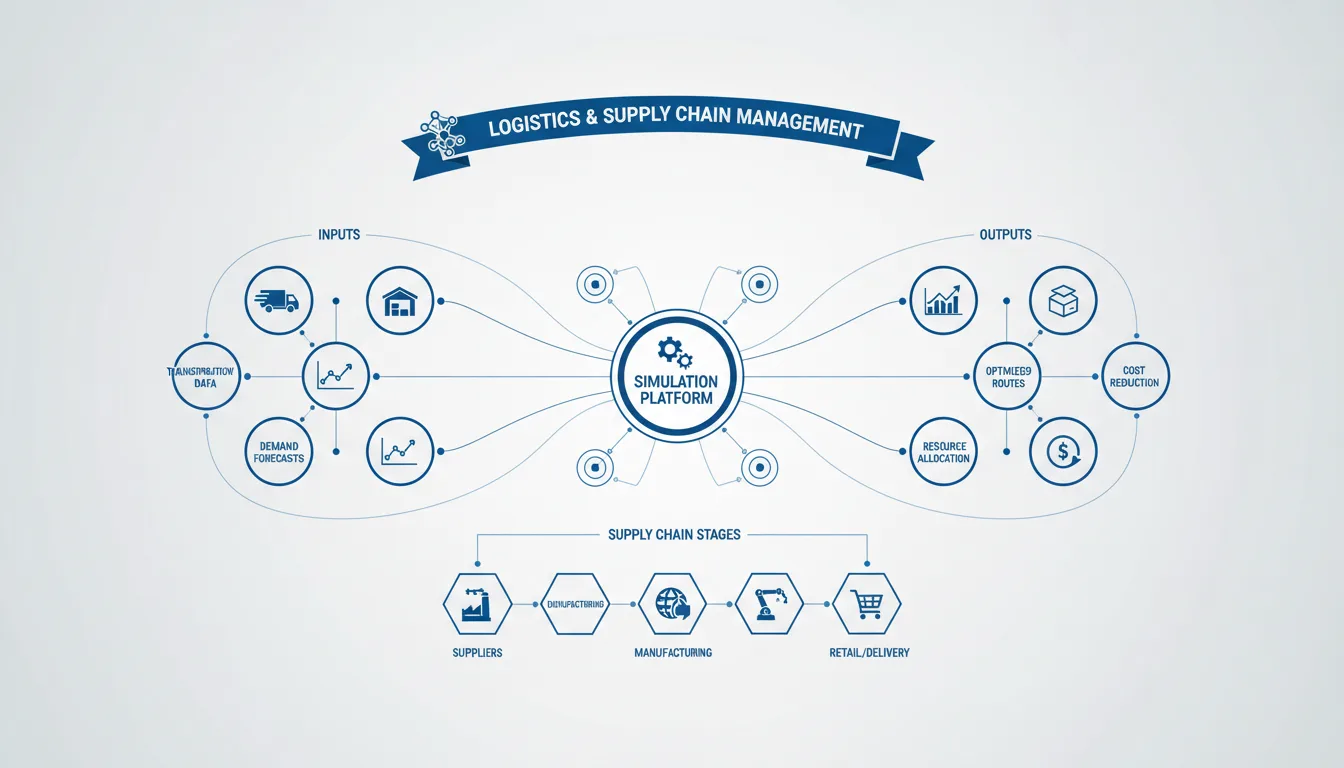
Overview
Simulation refers to the imitation of a real-world process or system over time. In logistics and supply chain management, simulation is crucial for optimizing operations, resource allocation, and decision-making. It enables businesses to visualize processes, predict outcomes, and analyze performance without the risks associated with physical trials.
Etymology and Origins
The term "simulation" derives from the Latin word "simulatio," meaning "to make similar" or "imitation" [4]. Its roots can be traced to the classical Latin similis (like, resembling) and simulare (to imitate, feign). While the concept of imitation for understanding dates back to ancient times, the formal use of "simulation" in a scientific or analytical context became more prevalent in the late 19th and early 20th centuries. Early instances involved physical models (e.g., wind tunnels, hydraulic analogies) to simulate complex systems [5]. The computational sense emerged with the advent of electronic computers.
Historical Development
Simulation has experienced significant transformations since its inception:
- Pre-1950s: Early forms of simulation existed in various fields long before computers. For example, sand tables were used for military strategy and physical models were built to study complex systems. The Monte Carlo method, developed during World War II by scientists like Stanisław Ulam and John von Neumann, was a crucial precursor, allowing for numerical simulation of complex problems using random sampling [6].
- 1950s-1960s: The rise of electronic computer technology allowed for the development of early simulation models. Pioneering works like Jay Forrester's System Dynamics at MIT, particularly his work on industrial dynamics, laid the groundwork for simulation in management and economics [7]. Early programming languages like SIMSCRIPT (1962) and GPSS (General Purpose Simulation System, 1961) were developed specifically for simulating discrete events [8]. These early efforts were computationally intensive and primarily accessible to academics and large corporations with mainframe computers.
- 1970s: The introduction of discrete-event simulation (DES) allowed for more precise modeling of logistics operations by focusing on events that change system states at discrete points in time. Key developments included improved algorithms and more accessible simulation languages.
- 1980s-1990s: The proliferation of personal computers and graphical user interfaces democratized simulation. Commercial simulation software packages like Arena (Systems Modeling, now Rockwell Automation) and Simul8 emerged, enabling more complex logistical modeling and scenario analysis. This era also saw the integration of simulation with operations research techniques, enabling more sophisticated supply chain design and optimization.
- 2000s-present: Advanced techniques, such as agent-based modeling (ABM) and integration with Artificial Intelligence (AI) and Machine Learning (ML), have propelled simulation into critical roles in predictive analytics and real-time decision-making by leveraging vast datasets [9]. The concept of digital twins, a virtual replica of a physical system, has gained prominence, utilizing simulation to monitor, predict, and optimize real-world assets and processes [10].
Core Concepts
Simulation functions through the creation of models that replicate the behavior of logistics systems under various conditions. Critical components include:
- Modeling: Constructing a representation of the logistics system. This involves defining entities (e.g., trucks, products, workers), attributes (e.g., capacity, speed), activities (e.g., loading, transport, picking), and their interactions. Models can be discrete-event, continuous, or agent-based, depending on the system's nature and the problem's scope [11].
- Data Collection & Input: Gathering historical and real-time data on demand, lead times, processing times, resource availability, and costs. The accuracy of the simulation heavily relies on the quality and completeness of this data.
- Execution: Running the simulation model over a specified period to observe its behavior and collect performance metrics under various predefined scenarios. This often involves Monte Carlo simulation for incorporating uncertainty and variability.
- Analysis & Optimization: Evaluating the simulation results to identify bottlenecks, test hypotheses, compare different operational strategies, and inform decisions for improving system efficiency, resilience, and cost-effectiveness. Statistical analysis is crucial here to draw meaningful conclusions.
Industry Applications
Simulation is vital across multiple sectors, including:
- Manufacturing: Optimizing production lines, scheduling, and inventory management to reduce work-in-process, improve throughput, and manage capacity. Simulation helps in designing lean manufacturing systems.
- Transportation & Distribution: Analyzing routes, fleet sizing, scheduling, warehouse layout, and network design to enhance delivery efficiency, minimize costs, and reduce carbon footprint. This includes simulating port operations, airport logistics, and last-mile delivery networks [12].
- Healthcare: Streamlining supply chains for medical supplies, managing hospital resource allocation (e.g., beds, operating rooms), and planning emergency response logistics to ensure resource availability and improve patient care flow.
- Retail & E-commerce: Using simulation to forecast demand, manage stock levels across multiple locations (Shopify Global Inventory), optimize store layouts, and streamline order fulfillment processes from warehouse to customer, ensuring timely delivery and customer satisfaction.
- Defense & Emergency Services: Planning complex logistical operations for troop deployment, disaster relief, and supply distribution in challenging environments, assessing resource needs and response times.
Benefits and Advantages
The primary advantages of using simulation in logistics include:
- Risk Reduction: Testing scenarios, such as new warehouse layouts or routing strategies, without real-world consequences, minimizing financial and operational risks.
- Cost Efficiency: Identifying optimal strategies to reduce waste, operational costs, and capital expenditures by optimizing resource utilization and process flows.
- Flexibility & Agility: Quickly adapting models to reflect changes in market conditions, demand fluctuations, or new operational designs, enabling proactive rather than reactive decision-making.
- Enhanced Decision-Making: Improves strategic, tactical, and operational planning through data-driven insights, predictive analysis, and robust "what-if" scenario testing.
- Improved Visibility & Understanding: Providing a deeper understanding of complex system interactions, helping stakeholders visualize bottlenecks and process dependencies that might not be apparent in real-world operations.
Challenges and Limitations
Despite its benefits, simulation in logistics faces several challenges:
- Data Requirements: Accurate and validated simulation models require vast amounts of high-quality, relevant data, which can be challenging and time-consuming to collect and clean.
- Complexity & Resources: Creating detailed, accurate models for large-scale, dynamic logistics systems can be highly resource-intensive, requiring significant time, computational power, and specialized software.
- User Expertise: Effective simulation analysis demands skilled personnel proficient in both logistics domain knowledge and the technical aspects of simulation modeling, software operation, and statistical analysis.
- Model Simplification & Validity: All models are simplifications of reality. Ensuring that the model's assumptions are valid and that it accurately reflects the real-world system's behavior (model validation) is critical but often difficult [13].
- Initial Investment: The upfront cost for specialized software, hardware, and training can be substantial.
Best Practices
To maximize the benefits of simulation in logistics, consider the following best practices:
- Define Clear Objectives: Clearly articulate the problem, specific issues, or scenarios the simulation aims to analyze and resolve. This guides model scope and data collection.
- Collaborative Development: Involve all relevant stakeholders—from warehouse managers to IT specialists—in the model development process to ensure relevance, accuracy, and buy-in.
- Data Management & Preparation: Invest in robust data management practices to ensure the accuracy, consistency, and availability of data required for model input and validation.
- Validate and Verify Models: Rigorously verify that the model works as intended (verification) and validate that it accurately represents the real-world system under study (validation) before relying on its outputs [14].
- Scenario Planning & Experimentation: Design a comprehensive set of scenarios to test different operational strategies, demand fluctuations, and resource availability, exploring the solution space thoroughly.
- Continuous Improvement: Simulation is not a one-time activity. Regularly update models and data inputs to adapt to changing business conditions, technology advancements, and new challenges, ensuring the model remains a valuable decision support tool.
Technology and Tools
Several modern tools facilitate simulation in logistics, allowing for real-time data integration and advanced analysis. Examples include:
- Discrete Event Simulation Software: Commercial platforms like Arena, Simul8, AnyLogic, and FlexSim are widely used in logistics. These tools provide graphical interfaces, pre-built libraries of logistics components, and powerful animation capabilities to visualize system behavior.
- Integration with Warehouse Management Systems (WMS): Modern simulation tools can integrate with WMS platforms like SkuSavvy's Mobile WMS to leverage real-time operational data for more accurate models and to feed simulation-derived optimal strategies back into daily operations. This integration can enhance capabilities like stock replenishment and bin putaway criteria.
- AI and Machine Learning: These technologies enhance predictive capabilities within simulation models, allowing for more refined simulations based on evolving data patterns (e.g., demand forecasting). They also facilitate automatic scenario generation and optimization, particularly in complex systems where traditional optimization methods might struggle [9].
- Digital Twins: These virtual replicas of physical assets, processes, or systems continuously update with real-time data. Simulation is a core component of digital twins, enabling predictive maintenance, performance optimization, and "what-if" analysis in a dynamic environment [10].
Future Trends
The future of simulation in logistics may see:
- Increased Automation and Self-Optimizing Systems: The integration of AI with simulation will lead to increasingly autonomous logistical systems that can dynamically adjust operations, predict disruptions, and self-optimize based on real-time data and simulation-derived insights.
- Greater Incorporation of Big Data Analytics: The exponential growth of data from IoT devices, WMS, and other sources will provide richer inputs for simulation models, enabling higher fidelity and more accurate predictions. Big data analytics will be crucial for extracting meaningful patterns to inform model parameters.
- Enhanced Visualization and Immersive Environments: Advanced visualization techniques, including 3D animation, virtual reality (VR), and augmented reality (AR), will facilitate real-time monitoring, intuitive scenario analysis, and collaborative decision-making, allowing stakeholders to "experience" the simulated environment.
- Cloud-Based Simulation and Accessibility: Cloud computing will make powerful simulation capabilities more accessible to small and medium-sized enterprises (SMEs) by reducing the need for expensive on-premise hardware and software, fostering wider adoption.
- Supply Chain Resilience and Sustainability: Simulation will play an even more critical role in designing resilient supply chains that can withstand disruptions (e.g., pandemics, geopolitical events) and in optimizing for sustainability goals, such as reducing carbon emissions and waste.
Related Concepts
Simulation is closely related to concepts such as:
- Optimization: Utilizing simulation data to enhance operational performance by feeding insights into optimization algorithms for routing, resource allocation, or inventory levels.
- Supply Chain Management: Simulation is an indispensable tool for end-to-end supply chain analysis, from strategic network design to tactical operations planning and daily scheduling.
- Risk Management: Simulations are crucial for assessing vulnerabilities, understanding the impact of disruptions (e.g., supplier failure, natural disasters), and developing mitigation strategies within complex supply chains.
- Operations Research: Simulation is a key methodology within the broader field of operations research, which applies advanced analytical methods to improve decision-making.
Sources
- Order Fulfillment Guide
- Visual Inventory System
- Mobile Warehouse Management System
- Simulation
- Sand table
- Monte Carlo method
- SIMSCRIPT
- General Purpose Simulation System
- Artificial intelligence in supply chain
- What is a Digital Twin?
- Discrete Event Simulation
- Using Simulation for Logistics and Supply Chain Optimization
- Simulation Model Verification & Validation
- Simulation Model Verification and Validation
- Visual Warehouse Layout
- Shopify Global Inventory
- Pick, Pack, Ship Software
- Quick Start Guide
- Stock Replenishment Guide
- Bin Put-Away Criteria
- Mobile Order Fulfillment Software