Scientific Management
An exploration of scientific management, its origins, historical development, core concepts, and its impact on modern logistics and supply chain management.
Updated
Scientific Management
Overview
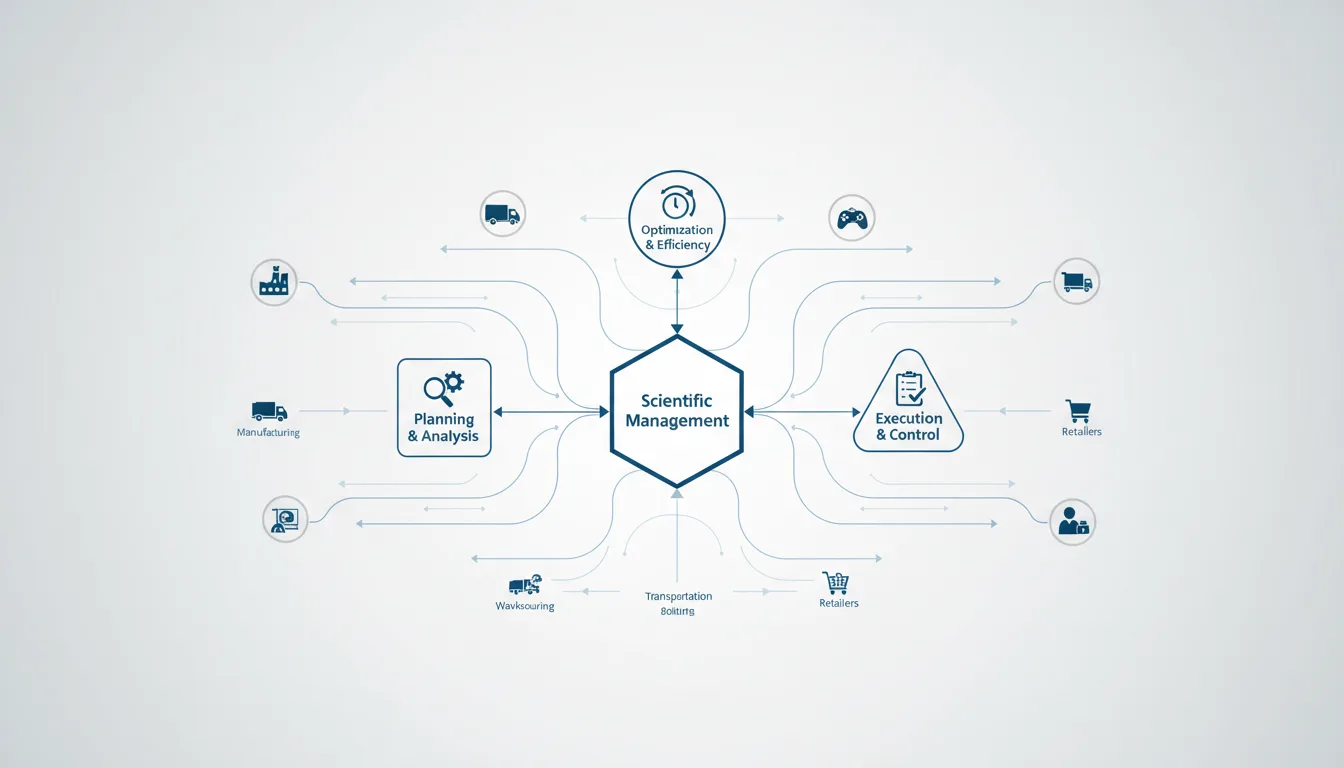
Scientific management, also referred to as Taylorism, is a management theory that analyzes and synthesizes workflows to improve economic efficiency and productivity. It is essential in logistics and supply chain management as it emphasizes standardized best practices, optimizing processes, and improving worker efficiency. The principles of scientific management have been widely adopted across various industries, resulting in more streamlined operations and enhanced productivity.
Etymology and Origins
The term 'scientific management' was first popularized by Frederick Winslow Taylor in the early 20th century. Taylor's seminal work, The Principles of Scientific Management, published in 1911, laid the groundwork for this approach. The concept combines scientific approaches to task management with labor efficiency theories and reflects industrial advancements developed during the Industrial Revolution. The term itself combines the words 'scientific,' denoting the systematic and evidence-based approach, and 'management,' referring to the organized coordination of activities to achieve specified objectives. Over time, the term evolved as it encompassed various productivity-enhancing methodologies inspired by Taylor and his contemporaries, transitioning from purely mechanical approaches to incorporating human and technological elements in the workplace.
Historical Development
The emergence of scientific management can be traced to the late 19th century as industries faced challenges related to productivity and labor efficiency. Key milestones in its development include:
- Late 1800s: Early advocates like Henry Gantt, known for the Gantt chart, worked alongside Taylor to develop new management techniques aimed at improving manufacturing processes. The establishment of time and motion studies during this period facilitated a significant understanding of operational efficiencies.
- 1910s: Taylor codified his ideas in The Principles of Scientific Management. The book became a classic in management literature, influencing countless industries by introducing time studies and standardized work methods. Frank Gilbreth further advanced these ideas through his work on motion study, which analyzed the individual's motions in the workplace for efficiency improvement.
- 1930s: The introduction of the human relations movement, which highlighted the importance of employee morale and social needs, began to balance the mechanical focus of scientific management. This was evident in the Hawthorne studies, which showed that worker productivity improved when they felt valued by their employers.
- 1970s-Present: The principles evolved with computerized management systems and modern inventory management systems that incorporate methodologies rooted in Taylorism to enhance inventory workflows and logistics efficiency. The integration of technologies such as ERP systems and data analytics tools has further propelled these traditional principles into contemporary applications, allowing organizations to harness real-time data for informed decision-making.
Core Concepts
Scientific management is anchored on several core concepts aimed at optimizing organizational efficiency:
- Time Studies: Conducting meticulous timing of tasks to establish efficient work processes and eliminate unnecessary motions. These studies aim to break down tasks to their most basic elements, allowing for the identification of time-saving opportunities.
- Standardization: Establishing uniform procedures for tasks to ensure consistency and streamline operations across the workforce. This standardization is crucial in logistics, where predictable outcomes reduce waste and enhance service delivery.
- Work Specialization: Dividing tasks into specialized roles allows workers to focus on specific duties that optimize their output and skill. This specialization leads to increased speed and quality in task completion.
- Incentives and Accountability: Implementing performance-based compensation to incentivize productivity and accountability among workers fosters a culture of high performance. Successful implementation has often required aligning organizational objectives with employee recognition systems to maintain motivation.
Industry Applications
Scientific management principles have been instantiated in multiple sectors:
- Manufacturing: Use of optimized assembly line processes that can lead to massive production efficiencies, such as those pioneered by Ford Motor Company in the 1920s. The assembly line significantly reduced the time and cost of producing vehicles.
- Logistics: Efficient warehouse management practices arise from Taylorist principles, which emphasize metrics in operations like cycle counting and order fulfillment. Amazon has exemplified this through state-of-the-art warehouses that utilize scientific principles in conjunction with advanced technologies to streamline processes further.
- Retail: The application of data-driven methodologies to enhance inventory turnover rates, accomplished through systems such as the visual inventory management system. Retailers utilize customer data to optimize stock levels and reduce waste, aligning with principles of scientific management.
Benefits and Advantages
Scientific management offers numerous advantages for organizations:
- Enhanced Productivity: Streamlining workflows through time-efficient processes helps increase total output. Companies such as Toyota illustrate this advantage through methods like Just-In-Time (JIT) production, which minimizes waste while maximizing efficiency [6].
- Cost Reduction: Reduced costs through optimized resource allocation and management help lower operational expenditures.
- Improved Worker Morale: Establishing clear expectations via standardization can boost worker satisfaction and engagement, especially when combined with performance incentives that empower employees.
Challenges and Limitations
While beneficial, implementing scientific management can present challenges:
- Resistance to Change: Employees may resist replacing established methods with new processes, fearing job loss or increased scrutiny. Addressing this resistance through transparency and education is crucial for successful change management.
- Overemphasis on Efficiency: A singular focus on efficiency can sometimes disregard the human element of work, leading to burnout or dissatisfaction. Organizations must balance efficiency with employee engagement strategies, ensuring that the workplace remains humane.
- Dynamic Market Considerations: In volatile environments, strict adherence to Taylorism can hinder flexibility and adaptive management practices. Agility in responding to changing market conditions is essential for long-term sustainability.
Best Practices
Organizations seeking to apply scientific management principles can adopt best practices such as:
- Engage employees in redesigning work processes to cultivate a sense of ownership and buy-in. This participative approach can mitigate resistance to change and enhance morale.
- Leverage technology, such as mobile warehouse management systems, to facilitate real-time productivity tracking while ensuring that the workforce remains adaptable to changes.
- Continuously evaluate processes and adapt best practices to meet evolving business needs and market dynamics. Utilizing feedback loops can help fine-tune processes for optimal performance.
Future Trends
Looking ahead, the principles of scientific management are likely to evolve alongside advances in technology:
- Automation: Increasing reliance on automated systems for inventory management will enhance the principles of efficiency that Taylor sought to establish. Robotics and AI applications will play significant roles in this evolution.
- Data Analytics: Real-time analytics tools will support ongoing improvements in operational efficiencies, assisting managers in making data-driven decisions based on productivity metrics. Cloud-based systems will streamline integrations of these analytical tools into everyday practices.
Scientific management remains a foundational theory in logistics that continues to inform modern practices in efficiency and productivity optimization.
Sources
[1] Visual Inventory System - https://www.skusavvy.com/visual-inventory-management-system [2] Order Fulfillment Guide - https://www.skusavvy.com/docs/guides/warehouse/order-fulfillment [3] Mobile Warehouse Management System - https://www.skusavvy.com/mobile-warehouse-management-system [4] Cycle Counting Guide - https://www.skusavvy.com/docs/guides/warehouse/cycle-counting [5] The Human Side of Scientific Management - https://www.jstor.org/stable/25705447 [6] Just in Time: The Management Revolution - https://www.sciencedirect.com/science/article/abs/pii/S0024630706000788