Scenario Planning in Logistics and Supply Chain Management
Scenario planning is a strategic tool that enables logistics and supply chain professionals to anticipate future challenges and opportunities through structured analyses.
Updated
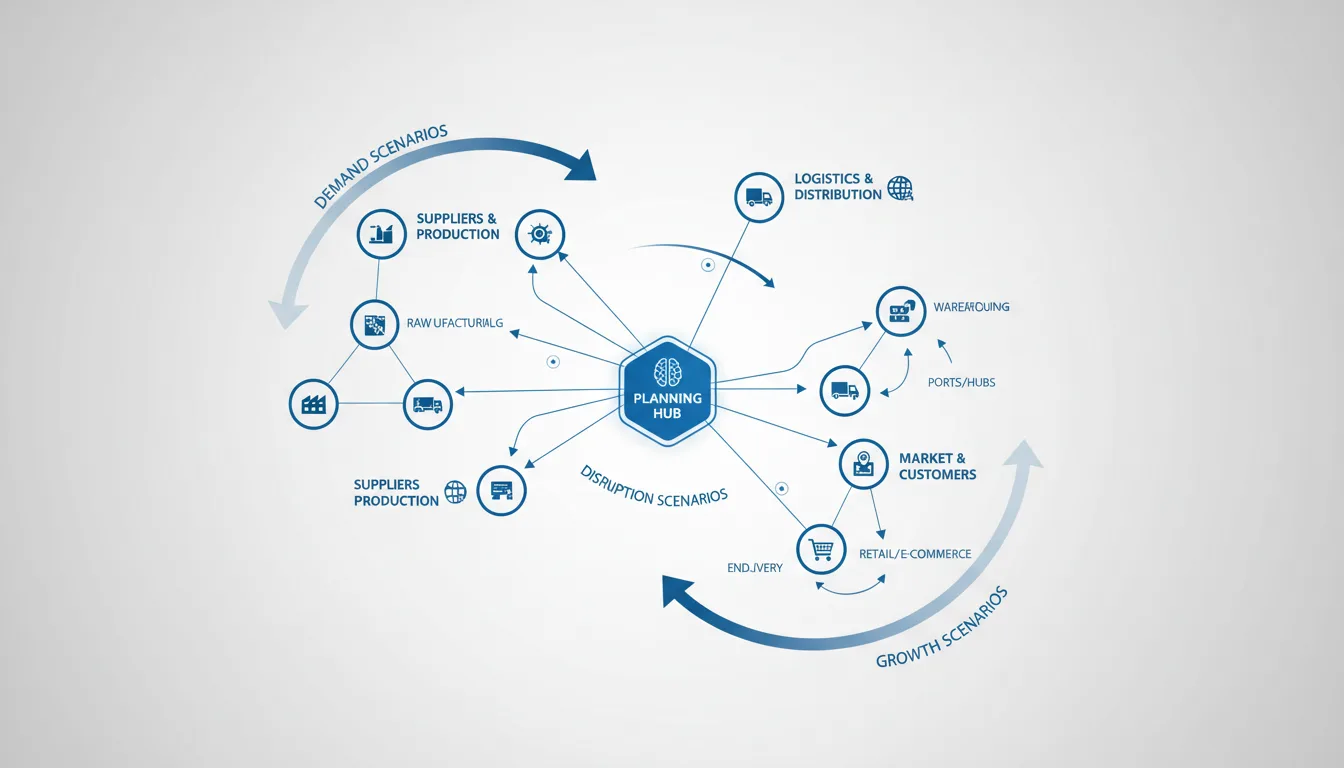
Scenario Planning in Logistics and Supply Chain Management
Overview
Scenario planning is a strategic technique used to envision and prepare for different future contexts in logistics and supply chain management. It helps organizations identify potential risks and opportunities by creating a range of plausible scenarios, enabling better decision-making and strategic planning. The ability to anticipate various market conditions and disruptions makes scenario planning crucial for maintaining resilience in logistics operations.
Etymology and Origins
The term "scenario" originates from the Italian word "scenaria," relating to a script or a sketch. The concept first gained traction in the 1960s within the context of military strategy, specifically in the U.S. Army during the Cold War, as noted by the earliest documented usage. However, it was subsequently adopted by businesses, especially in the 1980s, to navigate uncertain environments. The seminal work by Pierre Wack at Royal Dutch Shell in the early 1970s introduced structured scenario planning to corporate strategy, allowing firms to explore potential future developments systematically. The evolution of the term reflects its adaptation from military use to a broader application in various sectors, emphasizing the need for strategic foresight in management.
Historical Development
Scenario planning has evolved significantly since its inception. In the 1970s, Shell's use of scenario analysis to navigate the oil crisis marked a turning point in corporate strategy. This methodology gained prominence as companies sought to avoid risks analogous to those faced during the crisis. In the 1980s, organizations such as General Motors and Goodyear adopted similar approaches, further institutionalizing the practice across industries.
By the late 1980s, public sector entities began looking towards scenarios to inform policy-making, influenced by methodologies from the business world. The 1990s saw a shift toward incorporating advanced modeling techniques, allowing firms to conduct more sophisticated analyses. Technological advancements played a critical role in this progression, transitioning from manual planning to computerized tools, and eventually to automated systems and predictive analytics dominated by AI. Important international standards, such as various ISO Standards, and Just-In-Time (JIT) manufacturing developed by Toyota, fundamentally shaped scenario planning's adoption in logistics.
Core Concepts
The core of scenario planning lies in the development of various scenarios that reflect different possible futures based on unpredictable variables or trends, such as economic shifts, regulatory changes, or technological advancements. Key components include:
- External Forces: Identifying critical drivers of change in the industry, such as globalization, is vital for shaping scenarios.
- Scenario Development: Crafting narratives that describe plausible future environments and their implications for logistics processes often leverages advanced analytics software.
- Implications Analysis: Evaluating how each scenario impacts the supply chain helps organizations prioritize investments and strategies to mitigate risks or seize opportunities.
Benefits and Advantages
Implementing scenario planning in logistics offers several benefits:
- Enhances strategic foresight, enabling proactive rather than reactive management.
- Decreases risks associated with supply chain disruptions by fostering flexibility and adaptability.
- Encourages collaborative decision-making across departments and stakeholders, leading to more comprehensive strategic outcomes.
Challenges and Limitations
While beneficial, scenario planning also faces challenges:
- Difficulty in predicting all relevant factors accurately, as uncertainty surrounds many market conditions.
- Resistance to change within organizations, especially in ingrained corporate cultures.
- Potentially high resource investment in time and analysis, which may be perceived as cost-ineffective by management.
Best Practices
To successfully implement scenario planning in logistics, consider the following best practices:
- Involve a diverse group of stakeholders to ensure comprehensive perspectives during scenario development.
- Regularly review and update scenarios to reflect changing market conditions and emerging trends.
- Use both qualitative and quantitative data to support scenario analyses for robust insights. Engaging with visual data frameworks enhances understanding and communication of complex scenarios.
Technology and Tools
Modern scenario planning heavily leverages technology for enhanced predictive capabilities. Tools such as advanced analytics software and visual data frameworks assist in developing and analyzing scenarios. Integrating scenario planning with inventory management and fulfillment systems can further enhance responsiveness to changing scenarios and facilitate timely decision-making. Firms utilizing mobile warehouse management systems are better equipped to respond to scenario-driven changes.
Future Trends
Looking forward, scenario planning in logistics is likely to evolve by integrating artificial intelligence and machine learning, providing deeper insights through predictive analytics. The growing importance of sustainability will also necessitate scenario planning that factors in environmental impacts and regulatory shifts. For instance, organizations are beginning to incorporate ecological scenarios in their planning to address shifting consumer preferences towards sustainable practices.
Related Concepts
Scenario planning overlaps with other strategic frameworks such as risk management, supply chain resilience, and agile methodologies. Understanding these connections can enhance a logistics professional's ability to navigate complex and dynamic environments effectively.
Sources
- Shell Scenarios: A Case Study
- How Big Data Revolutionizes Strategic Planning
- 5 Ways Artificial Intelligence is Transforming Scenario Planning
- General Motors' Scenario Planning Strategy
- Advanced Order Management Systems
- Visual Inventory Management System
- Shell Scenarios: A Case Study
- How Big Data Revolutionizes Strategic Planning
- 5 Ways Artificial Intelligence is Transforming Scenario Planning
- ISO Standards and Their Impact on Logistics
- Shell Scenarios: A Case Study
- How Big Data Revolutionizes Strategic Planning
- 5 Ways Artificial Intelligence is Transforming Scenario Planning
- General Motors' Scenario Planning Strategy
- ISO Standards and Their Impact on Logistics
- Just-In-Time Manufacturing by Toyota
- Globalization