Sales and Operations Planning (S&OP)
Cross-functional planning process that aligns supply with demand for optimal business performance.
Updated
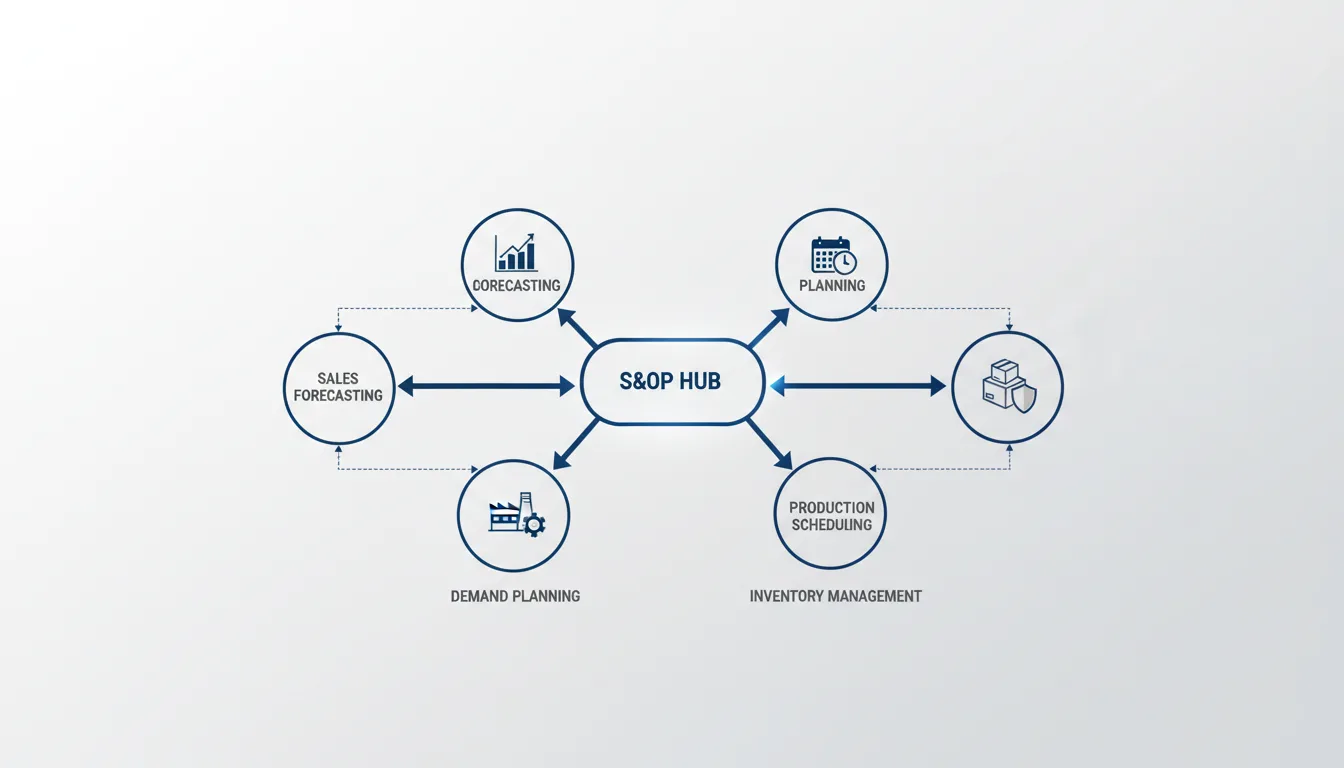
Sales and Operations Planning (S&OP)
Definition
S&OP is an integrated business management process that aligns demand, supply, and financial planning across an organization. It provides a structured forum for cross-functional decision-making, aiming to balance supply with demand to achieve strategic business objectives and ensure the company operates with one unified plan. This holistic approach typically spans an 18-36 month rolling horizon, reviewed monthly, to anticipate future challenges and opportunities.
Etymology and Origins
The term Sales and Operations Planning (S&OP) emerged and was formally adopted in the early 1980s, primarily to describe a new, more integrated approach to managing the interface between sales (demand) and operations (supply) within manufacturing organizations. While elements of production planning and demand management existed earlier, S&OP brought a structured, executive-level review to reconcile these functions.
The linguistic roots reflect its purpose: 'Sales' represents the demand side, driven by market needs and customer orders, while 'Operations' encompasses the supply side, including manufacturing, procurement, and logistics. The 'Planning' aspect highlights the forward-looking, proactive nature of the process, moving beyond reactive management. Pioneers like Oliver Wight are widely credited with formalizing the S&OP process and popularizing the term. Consultants such as Thomas Wallace and Bob Stahl were instrumental in developing and disseminating the methodology, advocating for its adoption as a critical component of Manufacturing Resource Planning (MRP II) before it evolved into a standalone, broader business process.
Historical Development
The journey to modern S&OP began with earlier manufacturing planning methodologies:
- Early Inventory Control (1950s-1960s): Initial efforts focused on managing inventory levels using basic statistical methods. However, these often lacked integration with production schedules or sales forecasts, leading to inefficiencies.
- Material Requirements Planning (MRP) (1960s-1970s): Developed by firms like IBM, MRP revolutionized production planning by calculating material needs based on a master production schedule. It significantly improved production efficiency but was still primarily an operational tool, not fully integrated with financial or sales plans.
- Just-In-Time (JIT) Manufacturing (1970s): Pioneered by Toyota, JIT emphasized minimizing inventory and improving flow, further highlighting the need for precise demand signals and coordinated supply. While not directly S&OP, JIT underscored the value of tightly linked functions.
- Manufacturing Resource Planning (MRP II) and the Birth of S&OP (1980s): Oliver Wight's Class A MRP II framework expanded MRP to include other business functions like finance, marketing, and human resources. Within this framework, S&OP was introduced as the executive-level process to align the aggregated sales plan with the aggregate production plan, tying operational decisions to financial outcomes. The objective was to create a single operating plan for the business that everyone understood and committed to.
- Expansion and Software Integration (1990s-2000s): As businesses grew in complexity and global reach, S&OP evolved. The rise of Enterprise Resource Planning (ERP) systems provided a platform for better data integration. Dedicated Advanced Planning and Scheduling (APS) software began to support more sophisticated forecasting and optimization. The APICS (now ASCM) organization played a key role in standardizing S&OP best practices and certification.
- Integrated Business Planning (IBP) and Digital Transformation (2010s-Present): S&OP has matured into Integrated Business Planning (IBP), a more comprehensive process that extends planning beyond sales and operations to encompass product innovation, strategic initiatives, and detailed financial integration, often spanning a longer horizon. Modern S&OP/IBP leverages big data, advanced analytics, machine learning, and cloud-based platforms for real-time visibility, predictive forecasting, and enhanced scenario planning, crucial for navigating volatile markets.
The S&OP Process
The S&OP process typically follows a monthly cycle, ensuring continuous alignment and adaptation to market changes. This iterative approach helps maintain a dynamic balance between demand and supply.
Step 1: Data Gathering
This foundational step involves compiling relevant historical and current data from various internal and external sources. Accuracy in this phase is paramount, as it feeds the entire planning cycle.
- Collect historical sales and demand data, often from ERP systems or point-of-sale data.
- Review supply constraints, including production capacity, raw material availability, labor resources, and logistics limitations.
- Gather financial actuals, such as revenue, costs, and profit margins, to understand past performance.
- Analyze market intelligence, including economic forecasts, competitor activities, promotional plans, and new product introductions.
Step 2: Demand Planning
This step focuses on creating an unbiased, unconstrained view of future demand, often leveraging a blend of statistical methods and market insights.
- Create a consensus demand forecast by combining statistical models with input from sales, marketing, and product development teams. This should reflect customer demand, not what operations can supply.
- Review new products and promotions, integrating their expected impact into the forecast.
- Identify demand risks and opportunities, such as potential market shifts or unexpected customer interest.
- Document assumptions clearly, explaining the rationale behind the forecast numbers to foster transparency and accountability.
Step 3: Supply Planning
With the unconstrained demand forecast in hand, the supply team develops plans to meet this demand, identifying any gaps or constraints.
- Develop production plans, detailing quantities, timing, and resource requirements.
- Assess capacity and constraints across manufacturing, warehousing, and transportation. This includes evaluating available mobile warehouse management systems for operational efficiency.
- Plan inventory levels, including strategic buffer stocks (safety stock) and optimal stock replenishment strategies to balance service levels with holding costs. Leveraging tools like a visual inventory management system can provide real-time insights.
- Identify supply risks, such as potential material shortages, geopolitical events, or logistics disruptions.
- Evaluate procurement strategies, often supported by purchase order management systems, to secure necessary raw materials and components.
Step 4: Pre-S&OP Meeting
This cross-functional meeting, often involving mid-level management, reviews the demand and supply plans to identify imbalances and propose solutions.
- Review demand/supply imbalances, analyzing the gaps between what sales expects and what operations can realistically deliver.
- Develop scenarios and options to close these gaps, such as increasing production, adjusting promotions, or exploring alternative sourcing.
- Quantify financial impacts of different scenarios, providing data for executive decision-making.
- Prepare recommendations for the Executive S&OP Meeting, outlining the preferred course of action with supporting analysis.
Step 5: Executive S&OP Meeting
This is the culminating step where senior leadership makes strategic decisions and commits resources based on the recommendations.
- Present the integrated plan to leadership, highlighting key assumptions, risks, and proposed solutions.
- Make decisions on identified gaps and imbalances, often involving trade-offs between service levels, inventory, and cost.
- Approve resource allocation, committing budgets, personnel, and assets to execute the chosen plan.
- Set strategic direction for the upcoming planning horizon, ensuring the operational plan aligns with overall business goals. The output of this meeting becomes the input for detailed execution plans, including the Order Management System for fulfillment.
Key Benefits
Implementing a robust S&OP process yields significant advantages across the organization:
- Improved Forecast Accuracy: Collaborative input from sales, marketing, and operations, combined with historical data analysis, significantly improves the reliability of demand forecasts. This is crucial for operations, especially during holiday seasons or other peak times, helping avoid both stockouts and excess inventory.
- Better Inventory Management: S&OP helps balance availability and cost, preventing costly overstock situations while ensuring customer demand is met. This is illustrated through strategic stock replenishment and optimized safety stock levels, which are critical components of an effective visual inventory management system.
- Enhanced Customer Service: By aligning supply capabilities with demand, companies can meet delivery promises more consistently, leading to higher customer satisfaction. This is essential in competitive markets like e-commerce, especially during flash sales or new product launches, where efficient pick, pack, and ship software is vital.
- Reduced Costs: Optimization of resources, avoidance of expediting fees, and minimized waste throughout the supply chain contribute to significant cost savings. Effective S&OP also streamlines processes, leading to more efficient order fulfillment and lower operational expenses. This can include optimizing inbound logistics through better purchase order management.
- Strategic Alignment: S&OP bridges the gap between executive strategy and day-to-day operations. It connects tactical decisions to overall business strategy, aligning the company’s vision with its operational capabilities and financial targets.
- Improved Cash Flow: By optimizing inventory and reducing waste, S&OP directly impacts working capital. Better inventory turns and reduced obsolescence free up cash, improving the company's financial health.
- Increased Collaboration and Communication: The cross-functional nature of S&OP fosters better communication and understanding between departments, breaking down silos and promoting a unified business approach.
Success Factors
Achieving the full benefits of S&OP requires a concerted effort and adherence to best practices:
Process Discipline
- Regular Monthly Cadence: Adhering to a regular monthly S&OP cycle ensures ongoing operations and adaptability to changing market conditions. Skipping meetings or steps undermines the process's integrity.
- Prepared Participants: All participants must come to meetings prepared with relevant data, insights, and recommendations to encourage informed discussions and effective outcomes.
- Clear Agendas and Outputs: Well-defined agendas keep meetings focused, and clear documentation of decisions, action items, and financial impacts ensures transparency and follow-through.
- Action Tracking: Robust mechanisms for tracking actions and commitments from each S&OP cycle ensure accountability and drive continuous improvement.
Data Quality
- Accurate Demand Signals: High-quality, clean historical data and reliable market intelligence are critical for predicting sales accurately and generating a realistic demand forecast.
- Current Capacity Data: Up-to-date and accurate capacity data must reflect real-time operational abilities, including equipment availability, labor constraints, and material supply. The use of barcodes and cycle counting can significantly enhance data accuracy.
- Clean Master Data: Consistent and accurate master data for products (including unit of measure), customers, and vendors avoids confusion, reduces errors, and maintains a smooth workflow across all systems.
- Reliable Financial Data: Integrated and reliable financial data supports confident decision-making by clearly quantifying the cost and revenue implications of various planning scenarios.
Executive Engagement
- Active Sponsorship from Leadership: Visible and active commitment from senior executives is crucial to ensure S&OP is prioritized, resources are allocated, and decisions are respected throughout the organization.
- Decision-Making Authority: The Executive S&OP meeting must have the authority to make critical trade-off decisions, empowering teams to act promptly on approved plans rather than merely reviewing them.
- Cross-functional Attendance: Mandatory attendance from key leaders across sales, marketing, operations, finance, and product development fosters collaboration and ensures a holistic view.
- Strategic Context: Leaders must provide the strategic context for planning, helping teams understand the overarching business direction and purpose, and how S&OP contributes to achieving long-term goals.
Common Pitfalls
Despite its benefits, S&OP implementation can stumble if common pitfalls are not avoided:
- Skipping Steps or Meetings: Bypassing any part of the monthly S&OP cycle, especially the pre-S&OP or executive review, can lead to coordination failures, unaddressed imbalances, and a loss of process integrity.
- Lack of Cross-functional Participation: Without active engagement from all key departments, the process risks generating siloed thinking, partial plans, and a lack of organizational buy-in. This leads to plans that are not truly integrated.
- No Financial Integration: Failing to link operational plans with financial forecasts (revenue, costs, profitability) can result in discrepancies during approvals and a lack of clear financial accountability for the S&OP plan.
- Gaming the Forecast: If departments manipulate forecasts to protect their own interests (e.g., sales overstating demand to ensure supply, operations understating capacity to ensure easy targets), it undermines trust, accuracy, and true collaboration.
- Not Making Decisions: If the Executive S&OP meeting merely reviews data without making clear, actionable decisions, the entire process becomes an academic exercise, stalling progress and preventing the organization from capitalizing on opportunities or mitigating risks.
- Focusing on Short-Term Fixes: S&OP is designed for a medium-to-long-term horizon. If meetings consistently devolve into solving immediate operational issues rather than strategic balancing, the process loses its value.
- Lack of Performance Measurement: Without clear KPIs (Key Performance Indicators) to track S&OP effectiveness (e.g., forecast accuracy, inventory turns, customer service levels), it's difficult to assess progress or identify areas for improvement.
Sources
- Oliver Wight S&OP Guide
- APICS S&OP Framework
- The Evolution of Sales and Operations Planning
- Toyota's History: Just-In-Time
- IBM's History: MRP
- Oliver Wight S&OP Guide
- APICS S&OP Framework
- GS1 Barcodes
- Toyota's History
- IBM's History of MRP
- Sales and Operations Planning by H. Thomas Hohman
- The History of S&OP Part 1
- Closed-Loop MRP II: The Beginning of Business Excellence
- What is Material Requirements Planning (MRP)?
- What is Manufacturing Resource Planning (MRPII)?
- What is ERP?
- What is Sales and Operations Planning (S&OP)?
- What is Integrated Business Planning (IBP)?
- How to Manage Supply Constraints
- What is an Advanced Planning and Scheduling (APS) System?
- Mobile WMS Overview
- Visual Inventory Management System
- Purchase Order Management
- Order Management System
- What is On-Time Delivery (OTD)?
- How to Calculate ROI on a Shopify Inventory Management App
- What is a KPI (Key Performance Indicator)?
- Capacity Planning and Demand Management
- What is Consensus Forecasting?
- About Oliver Wight
- The Evolution of S&OP to IBP
- Benefits of S&OP in Modern Supply Chains
- Technology's Impact on S&OP
- Oliver Wight S&OP Guide
- APICS S&OP Framework
- What Is Sales & Operations Planning (S&OP)?
- APICS Dictionary: Manufacturing Resource Planning (MRP II)
- The Evolution of Supply Chain Management: From MRP to IBP
- Sales and Operations Planning: An Executive's Guide
- Visual Inventory Management System
- Purchase Order Management
- Integrations Hub
- Integrated Business Planning: The Future of S&OP
- Integrated Business Planning (IBP)
- Mobile WMS Overview | SkuSavvy
- Visual Inventory Management System | SkuSavvy
- Purchase Order Management | SkuSavvy
- Order Management System | SkuSavvy
- Pick, Pack, Ship Software | SkuSavvy
- Barcodes Guide | SkuSavvy
- Cycle Counting Guide | SkuSavvy
- Unit of Measure Guide | SkuSavvy
- Sales and Operations Planning by H. Thomas Hohman
- GS1 Barcodes
- Toyota's History