Route Optimization in Logistics
An in-depth exploration of route optimization, its importance, historical development, and the technologies driving its evolution in logistics.
Updated
Overview
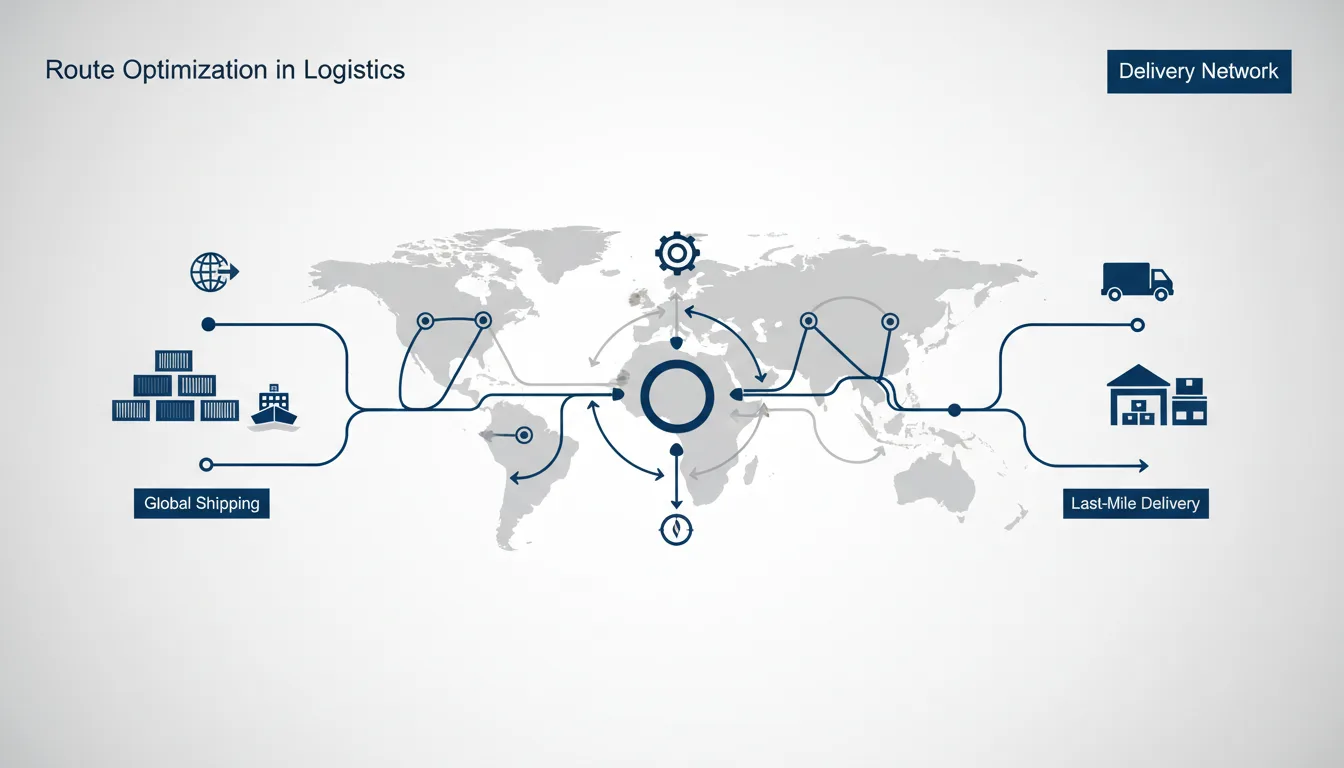
Route optimization refers to the process of determining the most cost-effective and time-efficient routes for transporting goods in logistics and supply chain management. It is crucial for minimizing transportation costs, improving delivery times, and increasing customer satisfaction. As logistics becomes increasingly complex, driven by factors like e-commerce growth and rising customer expectations for rapid delivery, the need for efficient routing becomes paramount for companies wanting to maintain a competitive edge and reduce their carbon footprint. Implementing advanced route optimization strategies can lead to significant operational savings and improved service levels.
Etymology and Origins
The term "route optimization" stems from the combination of "route," which originates from the Latin word "rupta," meaning a way or path, and "optimization," from the Latin "optimus," meaning the best. While the linguistic roots are ancient, the application of "optimization" in a scientific, mathematical sense, particularly for logistics and operational efficiency, gained prominence during and after World War II. This era saw the rise of operations research, a discipline focused on applying advanced analytical methods to improve decision-making.
The phrase "route optimization" itself began to gain traction in the logistics industry in the late 20th century as computational power increased, allowing for more sophisticated analysis and algorithmic approaches to transportation planning. Before this, routing was largely a manual process, relying on dispatcher experience and paper maps.
Historical Development
Route optimization has evolved significantly over the decades, driven by advancements in mathematics, computing power, and real-world logistical challenges:
-
Pre-1950s: Manual Methods & Early Concepts
Before the advent of computers, route planning was primarily a manual, experiential process. Dispatchers would use paper maps and their knowledge of local roads and traffic patterns to assign routes. The foundational mathematical problem, the Traveling Salesman Problem (TSP), which seeks the shortest possible route that visits a set of cities and returns to the origin city, was formally defined in the 1930s and became a significant focus in operations research post-WWII. -
1950s-1960s: Operations Research & Algorithmic Foundations
This period marked the birth of modern route optimization. Groundbreaking work by George Dantzig and John Ramser in 1959 led to the formulation of the Vehicle Routing Problem (VRP), an extension of the TSP that considers multiple vehicles, capacities, and time windows. Early efforts focused on developing basic algorithms, often solved manually or with early mainframe computers, for route planning in areas like school bus routing and milk delivery. These mathematical models laid the groundwork for all subsequent developments. -
1970s-1980s: Heuristics, Personal Computing, and GIS
As the VRP proved to be NP-hard (computationally very difficult to solve exactly for large instances), researchers developed heuristic and metaheuristic algorithms that could find good, though not necessarily optimal, solutions in a reasonable amount of time. The advent of personal computing in the 1980s made these algorithms more accessible. Concurrently, early Geographic Information Systems (GIS) began to emerge, offering digital mapping capabilities that would later integrate with routing software. GPS technology also started its journey towards commercial viability, initially developed for military applications. -
1990s: Commercial Software & Internet Mapping
The widespread adoption of the internet and more powerful desktop computers propelled route optimization into commercial applications. Companies like MapQuest popularized online route mapping services for consumers, demonstrating the potential for broader use. Early dedicated routing software began to incorporate GIS data and more sophisticated algorithms, allowing businesses to plan and manage their fleets more effectively. The focus shifted from academic problem-solving to practical, deployable solutions for industries like package delivery and field service. -
2000s: Real-time Data & Telematics Integration
The turn of the millennium saw GPS technology become ubiquitous, particularly in commercial vehicle fleets. This led to the integration of telematics systems, allowing for real-time tracking of vehicles and drivers. This capability was a game-changer, enabling dynamic routing where routes could be adjusted in real-time based on live data such as traffic conditions, delivery delays, or new order requests. This marked a significant leap from static, pre-planned routes. -
2010s-Present: Big Data, AI/ML, and Last-Mile Focus
The last decade has been characterized by the explosion of big data, advanced analytics, and machine learning. Route optimization systems now leverage vast amounts of historical and real-time data – including weather, traffic patterns, historical delivery times, and driver performance – to predict optimal routes with high accuracy. The rise of e-commerce has placed immense pressure on last-mile delivery, making sophisticated route optimization critical for meeting customer expectations for speed and cost-effectiveness. This era also sees a growing emphasis on sustainability, with optimization models incorporating factors like fuel efficiency and electric vehicle charging points.
Core Concepts
At its core, route optimization employs advanced algorithms to analyze multiple factors that affect transportation efficiency, aiming to balance cost, time, and service quality. Key concepts include:
- Graph Theory: A fundamental mathematical concept that underlies many optimization algorithms. Routes are modeled as graphs, where nodes (vertices) represent locations (e.g., depots, delivery points) and edges (arcs) represent the paths between them, often weighted by distance, time, or cost. Algorithms like Dijkstra's or A* are used to find shortest paths within these graphs.
- Traveling Salesman Problem (TSP) & Vehicle Routing Problem (VRP): As mentioned, TSP is the classic problem of finding the shortest route visiting every city exactly once and returning to the origin. VRP extends TSP by considering multiple vehicles, vehicle capacities, time windows for deliveries/pickups, and various constraints. These problems form the mathematical backbone of route optimization.
- Cost Functions: These are mathematical expressions that evaluate the efficiency and feasibility of a given route. They typically calculate necessary variables such as fuel costs, driver wages, vehicle maintenance, time costs (e.g., idle time, overtime), and potential penalties for late deliveries or missed service windows. The goal of optimization is to minimize this total cost function.
- Constraints: Realistic route optimization must consider numerous real-world limitations. These include vehicle capacity (weight and volume), driver hours of service regulations, time windows for deliveries, road restrictions (e.g., weight limits, height restrictions), customer-specific requirements, and availability of resources.
- Dynamic Routing: A more sophisticated method that adjusts routes in real-time based on live data inputs such as traffic jams, road closures, new orders, or unexpected delays. This requires continuous data feeds and rapid re-optimization capabilities, often utilizing machine learning to predict evolving conditions.
Technology and Tools
Modern route optimization relies on sophisticated tools and technologies that integrate various data sources and analytical capabilities. These include:
- Routing Software & Planning Systems: These are the primary applications that use complex algorithms to calculate optimal routes based on user inputs and real-time data. They range from standalone desktop applications to cloud-based enterprise solutions. Advanced examples include dedicated software that integrates with broader logistics platforms, like a mobile warehouse management system or a comprehensive order management system, to facilitate better decision-making from order intake to final delivery.
- Geographic Information Systems (GIS): GIS platforms provide the spatial data (maps, street networks, addresses, points of interest) that routing algorithms rely upon. They enable visualization of routes and analysis of geographical factors.
- Telematics & GPS: This involves the use of GPS devices and onboard sensors within vehicles to monitor their location, speed, driving behavior, and status in real-time. Telematics data feeds directly into dynamic routing systems, enabling immediate route adjustments and performance monitoring. Vehicle tracking systems are a key component.
- Machine Learning (ML) & Artificial Intelligence (AI): AI and ML algorithms are increasingly used to enhance route optimization. They analyze historical data to predict traffic patterns, optimize delivery time windows, learn driver behaviors, and even forecast demand, leading to more accurate and proactive route planning. ML can also be used to improve the efficiency of heuristic search algorithms for VRP.
- Cloud Computing: The scalability and computational power of cloud platforms enable sophisticated route optimization solutions to process vast amounts of data and perform complex calculations rapidly, often as a Software-as-a-Service (SaaS) offering.
- Internet of Things (IoT): IoT devices (e.g., sensors in vehicles, smart traffic lights) provide real-time data streams that can be fed into optimization engines, offering unprecedented visibility and responsiveness for dynamic routing.
Industry Applications
Companies across various sectors employ route optimization to enhance their logistical efficiency and gain a competitive edge. The scope of application is vast:
- E-commerce & Last-Mile Delivery: Businesses like Amazon, FedEx, and countless local delivery services utilize sophisticated algorithms to determine the most efficient last-mile delivery routes. This is critical for reducing shipping times, lowering operational costs, and meeting customer expectations for rapid and precise deliveries, often requiring integration with shipping and fulfillment software.
- Case Study: UPS, for example, famously uses its ORION (On-Road Integrated Optimization and Navigation) system, which saves millions of gallons of fuel annually by optimizing delivery routes, even instructing drivers to avoid left turns where possible to improve efficiency and safety.
- Food and Beverage Distribution: Companies distributing perishable goods, from fresh produce to prepared meals, rely on route optimization for timely deliveries. This is crucial for maintaining product quality, adhering to strict delivery windows (e.g., to grocery stores or restaurants), and minimizing waste. Optimization considers factors like refrigeration requirements and rapid turnover.
- Field Service Management: Businesses with mobile workforces, such as utility companies (e.g., gas, electric, telecom), HVAC repair services, and pest control, use route optimization to schedule and dispatch technicians efficiently. This minimizes travel time between service calls, improves response times, and increases the number of jobs a technician can complete in a day.
- Public Transportation: Municipalities employ route optimization to design and refine bus routes, subway lines, and even paratransit services. The goal is to improve public transport efficiency, ensure timely arrivals and departures, reduce operational costs, and enhance rider satisfaction. This often involves optimizing for passenger demand patterns.
- Waste Management: Sanitation departments and private waste collection companies use route optimization to plan the most efficient collection routes for refuse, recycling, and hazardous waste. This reduces fuel consumption, minimizes vehicle wear and tear, and optimizes labor hours, while adhering to collection schedules and capacity limits.
Benefits and Advantages
The advantages of effective route optimization are manifold, impacting financial performance, operational efficiency, customer satisfaction, and environmental stewardship:
- Cost Reduction: One of the most significant benefits is the substantial reduction in operational costs. This includes optimized fuel consumption, decreased vehicle wear and tear and maintenance expenses, reduced driver overtime, and lower insurance premiums. By minimizing travel distances and idle times, companies can achieve considerable savings.
- Increased Efficiency & Productivity: Streamlining routes enhances the overall efficiency of logistics operations. Drivers spend less time on the road and more time on tasks like deliveries or service calls, leading to higher productivity. This also means more deliveries can be completed with the same or fewer resources, optimizing asset utilization.
- Improved Customer Satisfaction: Faster, more reliable, and predictable deliveries lead to higher levels of customer satisfaction and retention. Customers appreciate accurate estimated times of arrival (ETAs) and consistent service, which route optimization facilitates. Real-time updates and proof of delivery features further enhance the customer experience.
- Enhanced Safety: Optimized routes often consider factors like traffic density and road conditions, which can lead to safer driving practices. Reducing mileage also inherently reduces exposure to road risks. Furthermore, compliance with driver hours-of-service regulations is easier to maintain with optimized schedules.
- Environmental Sustainability: By minimizing travel distances and fuel consumption, route optimization directly contributes to a reduced carbon footprint and lower emissions. This aligns with corporate sustainability goals and can improve a company's public image.
- Better Resource Utilization: Route optimization ensures that vehicles and drivers are utilized to their maximum potential. It helps in balancing workloads, reducing the need for additional vehicles, and ensuring that assets are deployed strategically.
Challenges and Limitations
Despite its undeniable benefits, implementing and maintaining effective route optimization systems also faces several challenges:
- Data Quality and Availability: The accuracy and effectiveness of route optimization heavily rely on the quality, completeness, and real-time availability of data inputs. Poor data regarding addresses, traffic patterns, vehicle capacities, or customer availability can lead to suboptimal routing. Master data management is crucial.
- Complex Regulations and Constraints: Understanding and adhering to various regional, national, and international regulations (e.g., driver hours of service, vehicle weight restrictions, urban delivery windows, environmental zones) can significantly complicate route planning. These constraints add layers of complexity to algorithms.
- Changing Conditions and Dynamic Environment: Sudden and unpredictable changes in traffic (accidents, congestion), weather events, road closures, vehicle breakdowns, or last-minute order changes can quickly render an optimized route ineffective. This necessitates robust dynamic re-optimization capabilities, which are complex to implement.
- Computational Complexity: The Vehicle Routing Problem and its many variants are NP-hard, meaning that finding an absolutely optimal solution for large, real-world scenarios can be computationally intractable within a reasonable timeframe. Optimization software often relies on heuristics and approximations, which may not always yield the absolute best solution.
- Integration with Existing Systems: Integrating a new route optimization solution with legacy systems (e.g., WMS, ERP, TMS, purchase order management) can be challenging, requiring significant IT investment and careful planning to ensure seamless data flow.
- Driver Acceptance and Training: Drivers accustomed to their own routes may initially resist optimized routes. Proper training and demonstrating the benefits to drivers are essential for successful adoption.
Future Trends
As technology continues to advance and logistical demands intensify, the future of route optimization looks increasingly sophisticated and integrated:
- Advanced Artificial Intelligence and Machine Learning: AI and ML will continue to evolve, providing even more accurate predictive capabilities for routing by analyzing vast datasets to anticipate traffic, weather, and demand fluctuations. This will lead to more proactive and less reactive routing adjustments.
- Sustainability and Green Logistics: With increasing concerns over carbon footprints and regulatory pressures, route optimization technology will increasingly focus on greener alternatives. This includes optimizing for electric vehicle range and charging infrastructure, identifying routes that minimize emissions, and integrating with circular economy principles.
- Integration with IoT and Connected Logistics: The Internet of Things (IoT) will further enhance route optimization by providing real-time data from an ever-wider array of sources—sensors in vehicles, infrastructure (smart roads, traffic lights), drones, and even smart packaging. This will enable ultra-dynamic, hyper-responsive routing decisions.
- Autonomous Vehicles and Robotics: The eventual deployment of autonomous delivery vehicles and drones will revolutionize routing. Optimization algorithms will need to adapt to new operational parameters, including charging infrastructure for electric autonomous vehicles, navigation in complex urban environments, and coordinated movements of robot fleets. This will require new paradigms for workflow automation.
- Hyper-Personalized Delivery: Route optimization will move towards accommodating increasingly specific customer demands, such as preferred delivery windows, specific drop-off locations, or even dynamic changes to delivery points mid-route, all while maintaining efficiency.
- Blockchain for Transparency and Trust: While not directly optimizing routes, blockchain technology could enhance the transparency and traceability of logistics operations, providing verifiable data for route planning and proving compliance, which in turn feeds into more reliable optimization inputs.
In conclusion, route optimization is an indispensable component of contemporary logistics, greatly influencing operational efficiency, cost-effectiveness, and customer satisfaction. As technology progresses and supply chain complexities grow, the capabilities of route optimization will continue to expand, providing logistics professionals with increasingly innovative and intelligent tools to streamline their operations and meet the evolving demands of the global economy.
Sources
- Mobile WMS Overview
- Warehouse Layout Preview
- Order Management System
- Shipping & Fulfillment Software
- WMS vs ERP Analysis
- How to Calculate ROI on Shopify Inventory Management App
- Operations Research and the Second World War
- Vehicle routing problem: a review of current trends
- The Vehicle-Routing Problem
- A Guide to Heuristic and Metaheuristic Approaches for the Vehicle Routing Problem
- The History of GIS: Then and Now
- Dynamic Vehicle Routing: A Survey of Emerging Approaches
- Last-mile delivery: A systematic review
- Dijkstra's algorithm
- Order Management System
- What is Telematics and How Does it Work?
- Shipping & Fulfillment Software
- UPS's 'No Left Turn' Rule Saves Fuel, Miles, Emissions
- Master Data Management (MDM)
- Purchase Order Management
- What is the Circular Economy?
- Workflows Overview