Robust Change Management in Logistics
An in-depth exploration of robust change management practices tailored for the logistics and supply chain sectors.
Updated
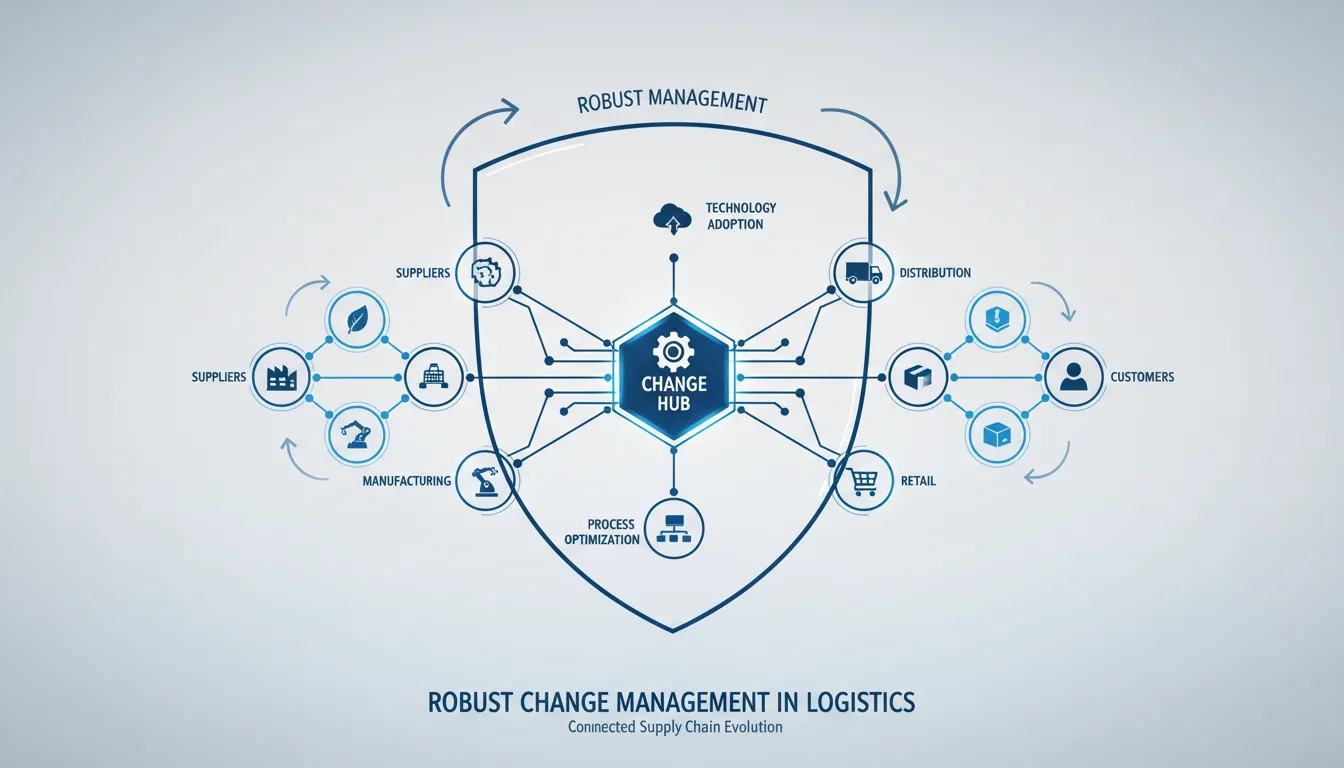
Overview
Robust change management is a strategic and systematic approach to guiding individuals, teams, and organizations through transitions. In dynamic sectors like logistics and supply chain management, where technological advancements, geopolitical shifts, and evolving customer demands are constant, effective change management is not merely beneficial but essential for survival and growth. This methodology focuses on ensuring that changes, whether organizational, technological, or process-related, are implemented smoothly and effectively, minimizing resistance, fostering stakeholder buy-in, and enhancing the potential for positive, sustainable outcomes.
Etymology and Origins
The concept of "change management" as a distinct discipline began to crystalize in the mid-20th century, emerging from earlier work in organizational psychology, industrial engineering, and group dynamics. While the term itself gained widespread usage later, its theoretical underpinnings can be traced to the 1940s and 1950s. Early pioneers like Kurt Lewin, a social psychologist, laid the groundwork with his field theory and three-step change model, which focused on overcoming resistance and establishing new norms. The term's increasing prominence in the 1960s and 1970s coincided with the rise of complex organizational structures and the need for structured approaches to adapting to market shifts and new technologies. The initial focus was often on the 'people side' of change, recognizing that technical or process improvements alone were insufficient without addressing human factors.
Historical Development
The practice of change management has evolved significantly, mirroring the increasing complexity of business operations and technological capabilities:
- 1940s-1960s: Early Models and Foundational Theories: Building on social psychology, Kurt Lewin's seminal three-stage model (unfreezing, changing, refreezing) became a cornerstone for understanding organizational transitions. During this period, the focus was primarily on psychological and sociological aspects of resistance and group dynamics. Seminal works like Edgar Schein's research on organizational culture also began to highlight the deeper forces at play in successful change.
- 1970s-1980s: Emergence of Process-Oriented Approaches: The rise of methodologies like Total Quality Management (TQM) and Business Process Reengineering (BPR) highlighted the need for continuous change and improvement, fundamentally impacting logistics through quality control measures, process optimization, and early supply chain integration efforts. Pioneers like W. Edwards Deming and Joseph Juran emphasized systematic approaches to process change and employee involvement, paving the way for more structured change management frameworks.
- 1990s: Formalization and Structured Methodologies: As globalization and information technology began to transform industries, the need for robust, repeatable change processes became apparent. John Kotter's 8-Step Process for Leading Change (1996) provided a widely adopted roadmap, emphasizing urgency, vision, communication, and empowerment. Concurrently, the development of Enterprise Resource Planning (ERP) systems necessitated systematic change management to integrate complex software across an organization's functions, including logistics, procurement, and inventory.
- 2000s: Technology Integration and Individual Focus: The widespread adoption of advanced technologies like Warehouse Management Systems (WMS) and sophisticated supply chain planning software required change management strategies to manage implementation and user adoption. Models such as Prosci's ADKAR® model (Awareness, Desire, Knowledge, Ability, Reinforcement) emerged, focusing on the individual's journey through change, complementing organizational-level approaches.
- 2010s and Beyond: Agile, Digital, and Resilient Change: The acceleration of digital transformation, coupled with disruptive events like global pandemics, has pushed change management towards more agile, iterative, and data-driven approaches. The integration of AI, IoT, and advanced analytics in logistics demands constant adaptation, with a new focus on building organizational resilience and fostering a culture of continuous learning and adaptation to navigate rapid technological shifts and unpredictable market conditions.
Core Concepts
Robust change management encompasses several interconnected core concepts, all critical for successful transitions in logistics:
- Leadership Commitment and Sponsorship: Effective change is impossible without strong leadership. Committed leaders not only endorse change initiatives but actively champion them, allocate necessary resources, and visibly participate in the change process. Their consistent messaging and behavior provide direction and reassurance.
- Clear Vision and Strategy: A well-defined vision for the future state, articulated with clear objectives, helps stakeholders understand the purpose and benefits of changes. This vision must be strategically aligned with the organization's overarching goals, providing a compelling reason for undertaking the change.
- Comprehensive Communication: Open, transparent, and consistent communication is paramount. It helps stakeholders understand why the change is happening, what it entails, and how it will affect them. Multi-channel communication strategies, addressing concerns and celebrating milestones, significantly reduce resistance and enhance buy-in.
- Stakeholder Engagement and Involvement: Actively involving those affected by the change, from warehouse staff to senior managers, fosters a sense of ownership and commitment. Engaging key stakeholders through workshops, feedback sessions, and participation in design or testing phases ensures solutions are practical and widely accepted.
- Training and Support: Providing adequate training, resources, and ongoing support ensures employees are prepared for the new processes or systems. In logistics, this often means training on new mobile warehouse management systems, order fulfillment software, or revised warehouse workflows, ensuring they possess the necessary skills and confidence to operate effectively in the changed environment.
- Resistance Management: Proactively identifying potential sources of resistance and developing strategies to mitigate them is crucial. This involves empathetic listening, addressing fears, providing clear rationale, and demonstrating benefits to individuals.
Types and Classifications
Various models and approaches exist for implementing change management, often chosen based on the nature and scale of the change:
- Top-Down Approach: Changes are initiated and mandated by upper levels of management and communicated downwards. This can be effective for implementing organizational-wide policies or urgent strategic shifts, such as adopting a new global inventory management system across multiple locations. While efficient for decisive action, it may risk lower employee engagement if not carefully managed with robust communication and support.
- Bottom-Up Approach: This approach encourages feedback, innovation, and initiatives from lower and middle levels of the organization. It often leads to more organic adoption and innovative solutions, as employees closest to the operational challenges contribute directly. This is particularly valuable for continuous improvement initiatives or process enhancements, like optimizing batch picking strategies.
- Agile Change Management: This flexible and iterative approach, inspired by agile software development, focuses on rapid, incremental changes that can be continuously adapted based on feedback and results. It's especially relevant in fast-paced logistics environments implementing new technologies or adapting to quickly shifting market demands, allowing for frequent adjustments to warehouse workflows.
- Participative Change: This approach emphasizes collaboration and consensus-building across all levels. It can be time-consuming but typically results in higher commitment and sustainability, as stakeholders feel a sense of ownership over the change. This is often used for significant transformations, such as redesigning a warehouse layout.
Industry Applications
Robust change management is crucial across various sectors within logistics and supply chain, enabling adaptation to new demands and technologies:
- Warehouse Operations: The implementation of new technologies such as automated picking systems, robotics, or mobile warehouse management systems requires careful management of employee adaptation, workflow adjustments, and re-training. For example, transitioning from manual inventory counts to cycle counting with handheld scanners requires not just new equipment but new processes and skills.
- Supply Chain Optimization: Implementing a new purchase order management system or integrating advanced visual inventory management systems across multiple partners demands a systematic approach to transition employees and external vendors to new systems and procedures without affecting service levels. Changes to supplier relationships or procurement processes also fall under this umbrella.
- Transportation and Last-Mile Delivery: Introducing new route optimization software, fleet management systems, or transitioning to electric vehicle fleets requires significant operational and behavioral changes for drivers, dispatchers, and maintenance teams. Managing these changes ensures efficient adoption and continued operational effectiveness.
- Global Logistics and Trade Compliance: Navigating changes in international trade agreements, customs regulations, or new geopolitical realities necessitates robust change management to update documentation, adjust shipping processes, and train staff on new compliance requirements to avoid costly delays and penalties.
Benefits and Advantages
Employing robust change management practices results in several key advantages that directly contribute to organizational success:
- Reduced Resistance to Change: By clearly communicating the rationale, involving stakeholders, and addressing concerns proactively, organizations can significantly decrease employee apprehension and foster a culture that is more receptive to future changes. This leads to smoother transitions and faster adoption rates.
- Increased Efficiency and Productivity: Successful change implementation leads to streamlined processes, optimized workflows, and better utilization of new technologies. For instance, proper change management during the rollout of automated pick, pack, ship software can lead to quicker order processing and fewer errors, directly boosting operational efficiency.
- Higher Employee Morale and Retention: When employees feel engaged, supported, and adequately trained during transitions, their job satisfaction and morale tend to increase. This leads to higher productivity, lower turnover rates, and a more positive work environment, especially when integrating complex systems or roles.
- Achieved Project Objectives: Organizations with effective change management are significantly more likely to meet or exceed project objectives, stay on schedule, and remain within budget. Studies by organizations like Prosci consistently show a direct correlation between strong change management and project success rates.
- Enhanced Organizational Agility and Resilience: A history of well-managed changes builds an organizational capability to adapt swiftly and effectively to future disruptions, market shifts, or technological innovations. This fosters a resilient culture ready to embrace continuous improvement rather than resisting it.
Challenges and Limitations
Implementing change management strategies can present significant challenges that require careful planning and execution:
- Resistance from Employees: This is often the most significant hurdle. Changes can evoke fear of the unknown, job insecurity, loss of control, or simply discomfort with new routines. Resistance can manifest as reduced productivity, absenteeism, or direct opposition.
- Limited Resources: Organizations may face constraints in terms of time, budget, and personnel to effectively plan, communicate, train, and support change initiatives. This can lead to rushed implementations or inadequate support, undermining success.
- Balancing Change with Daily Operations: Ensuring that ongoing operational requirements and service levels are met while simultaneously implementing significant changes poses a considerable challenge. Logistics operations, by nature, cannot simply pause for change implementation.
- Lack of Leadership Alignment and Sponsorship: If leaders are not fully aligned, committed, and visible in their support for the change, the initiative is likely to falter. Mixed messages or wavering commitment from the top can quickly erode trust and buy-in.
- Cultural Barriers: An organizational culture that is resistant to change, risk-averse, or highly bureaucratic can significantly impede even well-planned change initiatives. Changing entrenched cultural norms requires sustained effort and strong leadership.
Best Practices
To ensure effective and robust change management, organizations should consider the following best practices, tailored for the logistics environment:
- Establish a Clear Vision and Strategy: Comprehensive planning and articulate communication of change objectives are vital to align team efforts. This includes defining key performance indicators (KPIs) to measure success and ensure the change delivers intended value, for example, in optimizing bin put-away criteria.
- Engage Stakeholders Early and Continuously: Actively involving those affected by the change, from warehouse floor staff to IT teams, fosters ownership and commitment. This includes seeking input, addressing concerns, and co-creating solutions, particularly for changes impacting warehouse workflows.
- Develop a Comprehensive Communication Plan: Tailor messages to different audiences, utilize multiple channels (e.g., meetings, newsletters, digital platforms), and ensure two-way communication to foster understanding and address feedback throughout the change lifecycle. Transparency is key.
- Provide Adequate Training and Support: Equip employees with necessary skills through targeted training programs, workshops, and ongoing support mechanisms. This is critical when integrating new systems like order fulfillment technologies or new inventory practices such as managing lots and expiration dates.
- Measure and Monitor Progress: Implement metrics to track adoption rates, identify areas of resistance, and assess the impact of the change against established KPIs. Regular monitoring allows for timely adjustments and demonstrates accountability. For instance, using employee productivity tracking after a system rollout.
- Celebrate Successes and Reinforce Change: Acknowledge milestones and successful adoptions to build momentum and reinforce positive behaviors. This helps to 'refreeze' the new way of working and embed it into the organizational culture.
- Pilot Programs: For larger changes, implementing a pilot program in a small, controlled environment allows for testing, gathering feedback, and refining the change strategy before a full-scale rollout, minimizing risks and identifying unforeseen challenges.
Future Trends
The landscape of change management in logistics is continuously evolving, driven by technological innovation and global dynamics:
- Increased Technology Integration: As logistics firms implement advanced automation, Artificial Intelligence (AI), Machine Learning (ML), and Internet of Things (IoT) devices, the focus will increasingly shift to adapting change strategies to rapid technological advances. This includes managing human-robot collaboration and upskilling the workforce for data-driven decision-making.
- Emphasis on Resilience and Agility: Building resilient organizations that can swiftly respond to unexpected disruptions (e.g., global pandemics, geopolitical shifts, natural disasters) is paramount. Change management will integrate more scenario planning and develop adaptive frameworks to enable quicker pivots and less disruptive transitions.
- Data-Driven Change Management: Leveraging data analytics to predict resistance, measure change effectiveness, and personalize communication and training will become standard. This allows for more targeted interventions and a higher probability of successful outcomes.
- Focus on Employee Experience and Upskilling: With increased automation, the nature of work in logistics is changing. Future change management will prioritize reskilling and upskilling employees, managing expectations around new roles, and fostering a positive employee experience throughout the transformation journey.
- Sustainability and Ethical Considerations: As supply chains become more environmentally and socially conscious, change management will increasingly address transitions towards greener logistics practices, ethical sourcing, and responsible technology adoption, requiring shifts in operational processes and organizational values.
Related Concepts
Understanding robust change management also involves connecting with other critical logistics and business concepts:
- Continuous Improvement (CI): Emphasizing ongoing enhancement of processes, products, or services. CI methodologies like Lean and Six Sigma inherently involve continuous small-scale changes that build up to significant improvements, requiring a culture open to constant adaptation.
- Organizational Culture: Recognizing the profound influence of organizational culture on change initiatives and how it can either facilitate or inhibit successful change. A culture of innovation, transparency, and psychological safety is highly conducive to effective change management.
- Digital Transformation: The comprehensive adoption of digital technology across an organization. Digital transformation initiatives are intrinsically large-scale change management programs, often involving new business models, processes, and a fundamental shift in how work is done.
- Project Management: While distinct, change management works hand-in-hand with project management. Project management focuses on the technical aspects of delivering the solution (e.g., implementing a new WMS system), whereas change management focuses on ensuring people successfully adopt and utilize that solution.
- Lean Management: A systematic method for the elimination of waste within a manufacturing or logistics system. Lean principles promote a mindset of continuous improvement and flexibility, which are core to agile change management.
Robust change management is essential for logistics professionals to ensure that organizations can adapt to dynamic market demands, technological advancements, and unforeseen disruptions effectively, maintaining competitiveness and fostering sustainable growth.
Sources
- Mobile Warehouse Management System Overview
- Visual Inventory Management System
- Order Management System
- Pick, Pack, Ship Software
- Organizational Psychology
- Kurt Lewin's Change Theory - Simply Psychology
- Kurt Lewin's Change Management Model
- ISO 9001 quality management
- The 8-Step Process for Leading Change
- Resilience is About How You Recharge, Not How You Endure
- Change management: The leader’s edge in a fast-paced world
- Workflows Overview
- Warehouse Layout Preview
- Batch Picking Guide
- Stock Replenishment Guide
- Purchase Order Management
- Effective supply chain management requires change management
- Shipping & Fulfillment Software
- The ROI of Change Management
- Bin Put-Away Criteria
- Lots & Expiration Dates
- Productivity Tracking
- Cycle Counting Guide
- Shopify Global Inventory