Related Concepts in Warehouse Management
Exploring the fundamental concepts related to warehouse management, including operations, inventory management, and technology integration.
Updated
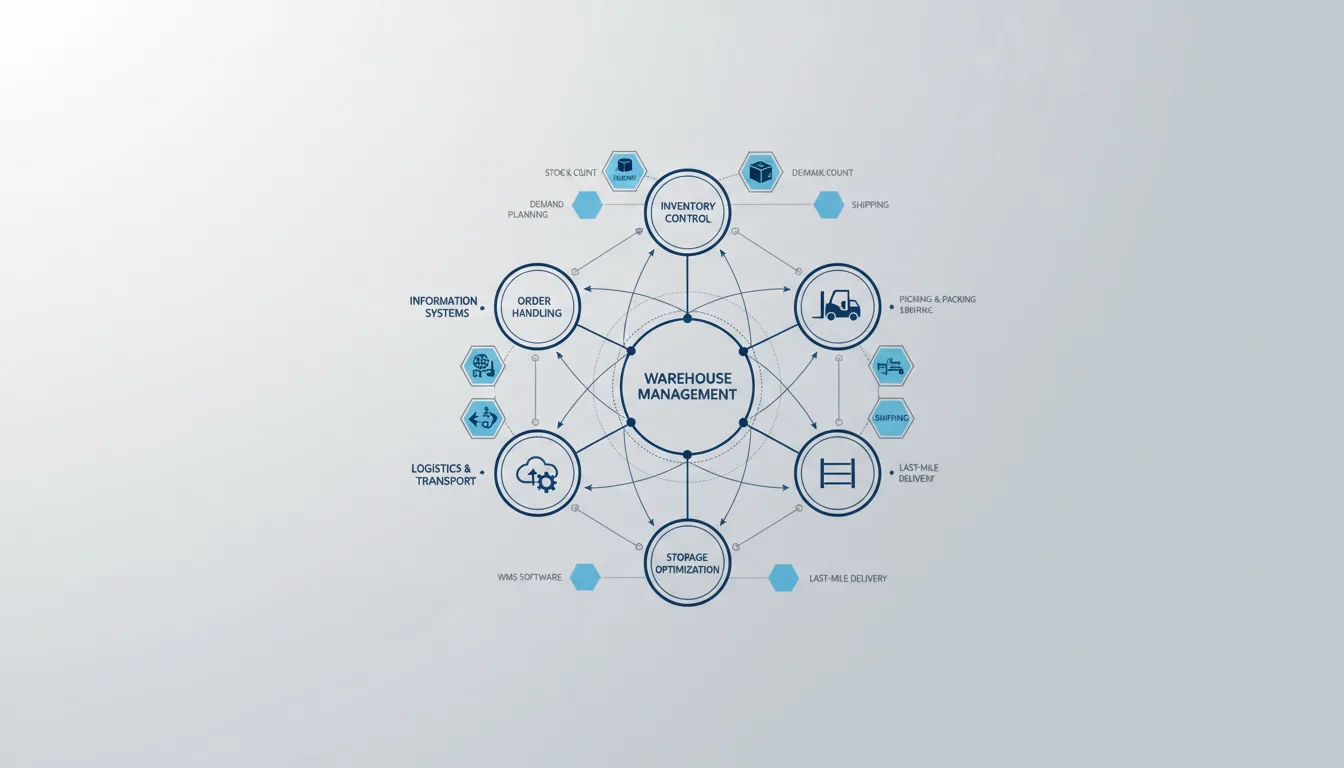
Overview
Warehouse management encompasses a variety of principles and practices crucial for maintaining efficient logistics. It involves the oversight of storage, movement, and processing of goods within a warehouse, focusing on maximizing efficiency while minimizing costs. Key elements include proper warehouse operations, inventory management, order fulfillment, and the integration of technology to streamline processes.
Etymology and Origins
The term 'warehouse' derives from the Old English word 'ware', meaning goods or merchandise, and 'haus', which translates to house. The concept of centralized storage began evolving in medieval Europe as trade expanded, with the first documented warehouses appearing in the 12th century. Historically, the terminology for various warehouse functions has adapted to reflect advances in logistics and supply chain management. The evolution of warehouse management practices can be traced back to the lexicon used in trade, where terms related to storage and processing have diversified over time.
Historical Development
The history of warehouse management can be traced back to ancient civilizations, but several significant developments occurred during the Industrial Revolution in the 18th and 19th centuries.
- 12th Century: The first documented warehouses appear in major trading areas of Europe.
- 1820s: The first general-use warehouses were established in major port cities in Europe and the United States, allowing merchants to store goods between voyages. The invention of the industrial pallet around this time greatly facilitated handling and storage.
- 1930s: The adoption of electric forklifts and pallet racking systems improved material handling efficiency, a change documented in publications such as the Warehouse Management Handbook by Gwynne Richards.
- 1970s: The concept of just-in-time inventory introduced by companies like Toyota emphasized minimizing stock while meeting demand, revolutionizing warehouse management practices. This was part of the broader adoption of Lean manufacturing principles.
- 1980s: The introduction of computerized systems for inventory management began, enhancing accuracy and efficiency in stock control, laying the groundwork for modern WMS systems that automate these processes.
The evolution of warehouse management has been punctuated by major industry events, such as the development of the ISO 9000 standards in the 1980s, which established benchmarks for quality management in manufacturing and services, including warehousing.
Core Concepts
Warehouse management systems (WMS) are crucial for supporting various operations within a warehouse. These systems enable efficient tracking of inventory, automation of order fulfillment, and integration of shipping processes. The core functions include stock replenishment, inventory transfers, and optimizing space through effective bin placement strategies.
Inventory Management
Effective inventory management involves tracking stock levels, orders, sales, and deliveries. Companies utilize quantitative techniques such as ABC analysis and cycle counting to maintain precise inventory levels, which in turn facilitates better forecasting and replenishment practices. Best practices in inventory management often involve integrating technology such as RFID and barcoding, which streamline tracking and accuracy.
Order Fulfillment
Order fulfillment is a critical element of warehouse management that includes order picking, packing, and shipping goods to customers. Efficient order fulfillment relies on systematic approaches such as batch picking and pick-to-tote methods that streamline operations. For many organizations, cross-docking mechanisms also play a key role in minimizing handling costs and reducing lead times.
Benefits and Advantages
Effective warehouse management enhances productivity, reduces operational costs, and improves customer satisfaction. Key advantages include:
- Enhanced accuracy in inventory tracking, reducing stock discrepancies. By implementing techniques like cycle counting and regular audits, warehouses can maintain clearer visibility of their asset flow.
- Improved order fulfillment speeds, resulting in higher customer satisfaction ratings, which can lead to increased repeat business.
- Greater utilization of warehouse space, leading to cost savings in storage. Implementing a robust bin-location strategy can maximize space usage significantly.
Challenges and Limitations
Warehouse management faces various challenges, including space constraints, fluctuating demand, and technological integration issues. Effective strategies often involve:
- Periodic evaluations of warehouse layout to maximize space efficiency, employing techniques derived from Lean principles.
- Adoption of scalable solutions, such as mobile warehouse management systems, to adapt to changing needs, especially in the context of e-commerce growth.
- Continuous training for employees to mitigate errors in picking and inventory management, which is crucial for maintaining accuracy and reducing labor costs.
Technology and Tools
The advancement of technology has brought forth various tools that enhance warehouse operations. Innovations such as RFID for inventory tracking and automation in order picking have transformed traditional practices. A robust WMS offers features that facilitate automation and integration with existing systems, thereby improving overall efficiency. The adoption of advanced technologies, such as IoT and machine learning, is paving the way towards smarter warehouses.
Case Studies
Recent studies demonstrate the impact of optimized warehouse management on operational efficiency. For instance, retailers who adopted automated systems reported a significant reduction in order fulfillment times and improved inventory accuracy leading to better customer retention. Companies such as Amazon have set the standard by implementing cutting-edge automation which has streamlined operations significantly.
Future Trends
As supply chain dynamics evolve, future trends in warehouse management are likely to include:
- Increased automation through robotics and AI to streamline operations, including picking, packing, and even replenishment tasks.
- Advanced data analytics for predictive inventory management, enhancing decision-making capabilities and enabling proactive rather than reactive inventory practices.
- Integration of green practices in warehousing to reduce environmental impact, a trend driven by consumer demand for sustainability.
Related Concepts
Warehouse management overlaps with several related logistics concepts, including supply chain management, transportation management, and global logistics strategies. Understanding these interconnected areas is vital for optimizing overall efficiency and effectiveness in logistics operations.