Production Planning
An essential logistics process focused on the efficient allocation of resources to meet production goals.
Updated
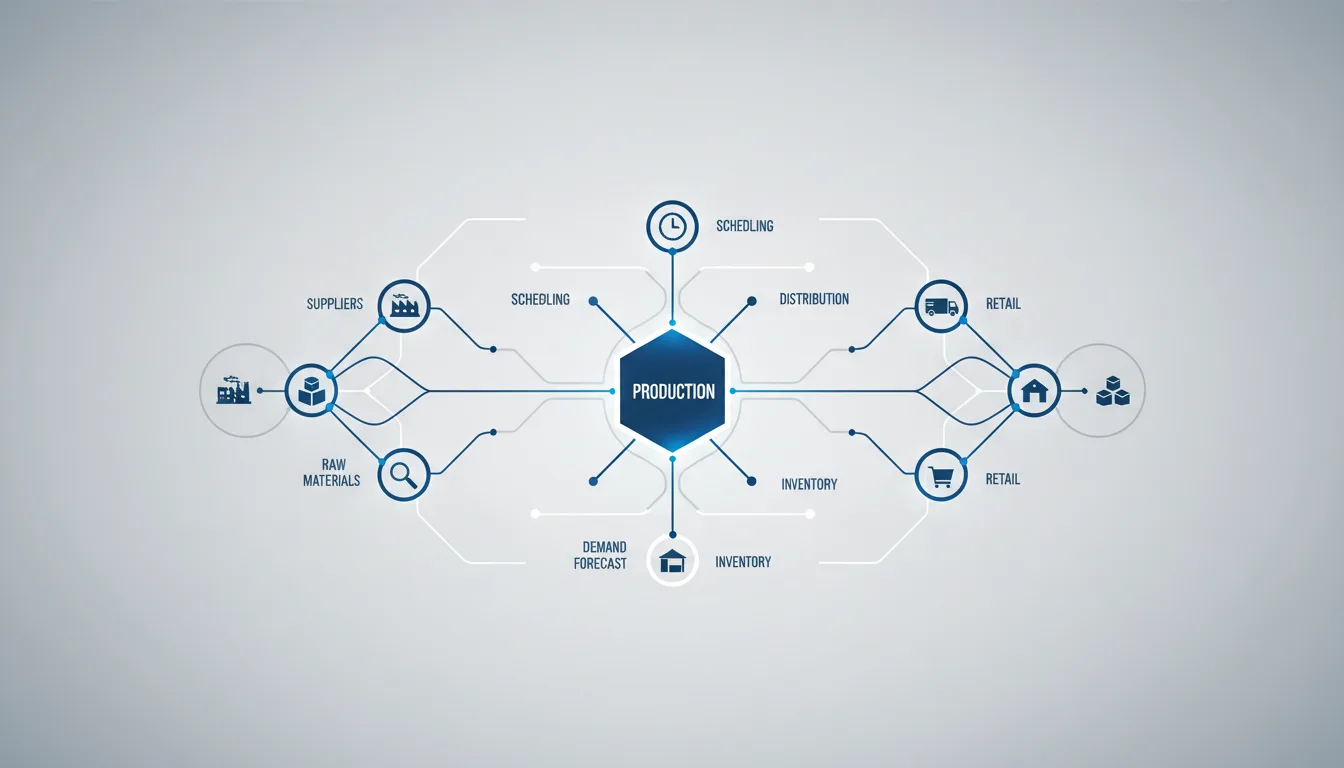
Overview
Production planning is a critical aspect of the supply chain management process that involves the careful planning and scheduling of production activities. Its primary purpose is to ensure that products are manufactured efficiently, meeting both quality standards and deadlines while optimally utilizing resources. This strategic function bridges the gap between demand forecasting and operational execution, aiming to synchronize material flow, labor, and machinery. As industries increasingly adopt Lean Principles, effective production planning has become instrumental in minimizing waste and enhancing productivity by creating a smooth and continuous flow of production.
Etymology and Origins
The term "production planning" combines two words: "production," which originates from the Latin word "producere," meaning "to bring forth, lead forth," and "planning," derived from the Old French "plan," meaning the arrangement of elements in a systematic manner. While the linguistic roots are ancient, the formal concept of "production planning" as a distinct managerial function emerged with the Industrial Revolution in the late 18th and 19th centuries. Early forms can be traced back to artisanal workshops and early factories where masters had to organize labor and materials.
The concept truly began to formalize in the early 20th century with the rise of scientific management principles, championed by pioneers like Frederick Taylor, who sought to optimize work processes through systematic study and efficiency. The first documented usage of "production planning" in a formal industrial context appeared in management literature around this period, as factories grew in complexity and scale, necessitating more structured approaches to orchestrate manufacturing operations and resource allocation systematically [5]. The term evolved to describe the process of anticipating future production needs and devising a course of action to meet them efficiently.
Historical Development
Production planning has undergone significant evolution, marked by several key milestones, transforming from rudimentary shop floor coordination to highly sophisticated, data-driven systems:
-
Pre-20th Century: Early Industrialization & Division of Labor (Late 1700s - 1800s)
- 1776: Adam Smith's "The Wealth of Nations" highlighted the economic advantages of the division of labor, a foundational concept for organized production. This implicitly required planning to coordinate specialized tasks.
- Late 1700s - Early 1800s: Figures like Eli Whitney, with his work on interchangeable parts, demonstrated the need for standardized processes and coordinated manufacturing steps, laying groundwork for future planning methodologies.
-
Early 20th Century: Scientific Management & Mass Production (1900s - 1940s)
- 1900s: The introduction of scientific management by Frederick Taylor revolutionized factory floor operations, focusing on optimizing work processes through time and motion studies, standardization, and task specialization. This led to explicit production scheduling.
- 1910s: Henry Gantt developed the Gantt chart, a visual tool for scheduling tasks and tracking progress, which became a cornerstone of project and production planning for decades [6].
- 1913: Henry Ford's assembly line for the Model T introduced continuous flow production, demanding highly precise and integrated production planning and sequencing to minimize delays and maximize throughput [7].
- World War II (1940s): The immense logistical challenges of wartime production spurred the development of Operations Research (OR) techniques, including linear programming and critical path method (CPM)/Program Evaluation and Review Technique (PERT) for complex project scheduling and resource allocation [8].
-
Mid-20th Century: Computerization & Formal Systems (1950s - 1970s)
- 1950s: Early computer applications began to be explored for inventory control and scheduling. The widespread adoption of Material Requirements Planning (MRP) systems began to formalize planning processes. Originally developed by Joseph Orlicky and George Plossl at IBM, MRP systems calculated raw material and component needs based on a master production schedule [9].
- 1970s: MRP evolved into MRP II (Manufacturing Resource Planning), integrating production planning with other business functions like finance, marketing, and engineering, providing a broader view of manufacturing operations.
-
Late 20th Century: Lean, ERP, & Supply Chain Integration (1980s - 1990s)
- 1980s: The emergence of Just-In-Time (JIT) manufacturing principles promoted by companies like Toyota shifted focus toward lean production, waste reduction, and inventory management. This emphasized pull systems over traditional push systems, requiring highly responsive production planning.
- 1990s: The rise of Enterprise Resource Planning (ERP) systems further integrated production planning with financial, human resources, and customer relationship management, creating a unified data environment for decision-making.
- Late 1990s: The concept of Supply Chain Management (SCM) gained prominence, positioning production planning as a crucial link within a larger network of suppliers, manufacturers, distributors, and customers. Advanced Planning and Scheduling (APS) systems began to emerge, offering more sophisticated optimization capabilities beyond traditional MRP/ERP.
-
21st Century and Beyond: Digitalization, AI & Resilience (2000s - Present)
- 2000s and Beyond: The integration of advanced technologies, such as cloud-based ERP systems, real-time data analytics, and later Artificial Intelligence (AI) and Machine Learning (ML), transformed production planning into a more data-driven, predictive, and agile process that facilitates real-time decision-making. Focus shifted to supply chain resilience, sustainability, and mass customization, driving the need for highly flexible and adaptive planning systems.
Core Concepts
Production planning consists of several essential components, each critical for optimizing manufacturing operations:
- Demand Forecasting: The process of estimating future customer demand for products. Accurate forecasting is foundational to effective production planning, influencing material procurement, capacity needs, and staffing levels. It typically involves using historical sales data, market trends, and statistical methods, often augmented by machine learning algorithms.
- Capacity Planning: Assessing the resources required to meet production goals, including machinery, labor, and materials. This involves comparing forecasted demand with existing production capabilities to identify potential bottlenecks or underutilized assets. Implementing effective capacity planning can prevent production delays and ensure timely output. It often involves analysis of production rates, equipment uptime, and labor availability.
- Production Scheduling: Organizing the production timeline to synchronize workflows and minimize idle time, ensuring smooth transitions between different production stages. This includes determining the sequence of operations, allocating specific tasks to machines and personnel, and setting start and completion times. Tools like Gantt charts, PERT charts, and advanced scheduling algorithms are often employed to visualize and optimize scheduling. Effective scheduling aims to meet delivery dates while optimizing resource utilization.
- Inventory Control: Maintaining optimal inventory levels to balance production rate and material cost. This involves managing raw materials, work-in-progress (WIP), and finished goods. Strategies include setting reorder points, calculating safety stock, and implementing inventory valuation methods. Practices such as cycle counting are crucial for effective inventory management and accuracy. Modern systems often use visual inventory management systems to provide real-time visibility.
- Resource Allocation: The strategic distribution of available resources (e.g., labor, machinery, capital, energy) to different production activities to achieve the most efficient output. This is closely linked to capacity planning and scheduling, ensuring that the right resources are available at the right time and place. Optimization models are frequently used to make these decisions.
Industry Applications
Production planning is vital across various industries, each with unique requirements and complexities:
- Manufacturing: In discrete and process manufacturing, production planning ensures efficiency in factories where precise resource allocation, sequencing of operations, and minimization of changeover times can significantly impact profit margins. This includes industries from automotive to electronics to textiles.
- Food & Beverage: Demand forecasting is critical to accommodate seasonal variations, promotions, and the highly perishable nature of products. Production planning must consider short shelf-lives, stringent quality controls, and cold chain logistics to prevent spoilage and ensure freshness.
- Pharmaceuticals: Stringent regulatory requirements (e.g., FDA, EMA) necessitate meticulous production planning to meet safety, quality, and compliance standards. Batch traceability, expiration date management (lots and expiration dates), and rigorous documentation are paramount, often requiring extensive validation of planning processes.
- Retail & E-commerce: Integrating production planning with logistics helps to streamline supply chains, reducing lead times for customers and preventing stockouts, particularly for fast-moving consumer goods. For e-commerce businesses, agile production planning can support rapid fulfillment models and handle fluctuating demand [10].
- Aerospace & Defense: Characterized by complex, long-lifecycle products, project-based manufacturing, and high-value components. Production planning involves intricate coordination of custom parts, highly skilled labor, and extensive quality checks, often leveraging advanced project management techniques.
Benefits and Advantages
Effective production planning provides numerous benefits, contributing significantly to a company's bottom line and operational efficiency:
- Increased Efficiency & Throughput: By streamlining processes, optimizing resource utilization, and minimizing bottlenecks, production planning reduces idle time and enhances overall production throughput. This leads to higher output with the same or fewer resources.
- Cost Reduction: Minimizing wastage (materials, time, labor), better inventory control, and optimized equipment utilization lead to significant cost savings in procurement, holding costs, and operational expenses. Proactive planning helps avoid costly last-minute orders or production halts.
- Improved Forecasting & Customer Satisfaction: Data-driven insights facilitate improved demand planning, leading to better customer satisfaction through reduced stockouts and timely order fulfillment. Meeting customer expectations consistently builds brand loyalty.
- Better Resource Utilization: Ensures that machinery, labor, and raw materials are used to their full potential, avoiding under-utilization or over-stressing resources. This leads to higher return on assets and improved labor productivity.
- Enhanced Adaptability: A well-structured production plan, when coupled with agile methodologies, allows organizations to respond more effectively to changes in demand, supply, or market conditions, maintaining operational stability and competitiveness.
Challenges and Limitations
Despite its advantages, production planning faces inherent challenges that require careful management:
- Forecasting Errors: Inaccurate demand forecasts, stemming from unpredictable market shifts, new product introductions, or external factors (e.g., economic downturns, pandemics), can lead to costly overproduction or critical stockouts.
- Resource Constraints: Limitations in machinery capacity, skilled labor availability, raw material supply, or budget can hinder production goals. Managing these constraints requires flexible planning and robust contingency strategies. Adopting a Mobile WMS can mitigate operational challenges on the shop floor by providing real-time visibility and control over inventory and labor.
- Changes in Market Dynamics: Rapid changes in consumer preferences, technological advancements, or competitive landscapes demand quick adaptability in production strategies, often requiring frequent adjustments to plans.
- Data Accuracy and Integration: The effectiveness of planning systems heavily relies on accurate and up-to-date data. Poor data quality or lack of integration between different systems (e.g., sales, inventory, production) can lead to suboptimal or erroneous plans.
- Complexity of Modern Supply Chains: Globalized supply chains introduce complexities such as geopolitical risks, extended lead times, and diverse regulatory environments, making planning significantly more intricate.
Best Practices
To maximize the effectiveness of production planning, organizations should consider implementing the following best practices:
- Utilize Advanced Technology: Invest in advanced planning systems, such as ERP, APS, and WMS software tools that promote real-time data access, predictive analytics, and optimization algorithms. A robust Order Management System can integrate various functions seamlessly, from order capture to fulfillment.
- Collaborative Planning: Involve key stakeholders—including sales, marketing, procurement, engineering, and operations—in the planning process. This fosters alignment of goals, improves forecast accuracy, and ensures feasibility of plans across departments.
- Continuous Improvement (Kaizen): Regularly assess and refine production planning processes. Incorporate lessons learned from past performance, adapt to changing market conditions, and embrace agile methodologies to continuously enhance efficiency and responsiveness. Performance metrics and KPIs are crucial here.
- Data-Driven Decision Making: Implement strong data governance and analytics capabilities. Use historical data, real-time feedback, and predictive models to inform planning decisions, rather than relying solely on intuition.
- Build Supply Chain Resilience: Develop contingency plans for potential disruptions (e.g., supplier issues, natural disasters, labor shortages). This includes diversifying suppliers, building strategic safety stock for critical components, and cross-training staff.
Future Trends
Emerging trends in production planning are largely driven by technological advancements and evolving global dynamics:
- Automation and AI: Leveraging AI and Machine Learning capabilities for predictive analytics in forecasting, dynamic scheduling, and anomaly detection. AI-powered planning tools can optimize complex trade-offs and suggest optimal production paths in real-time.
- Sustainability Initiatives: Increasing focus on sustainable production methods that reduce environmental impact (e.g., waste reduction, energy efficiency, circular economy principles). Production planning will increasingly integrate environmental objectives alongside traditional cost and efficiency goals.
- Integration of IoT & Digital Twins: The Internet of Things (IoT) in production facilities can provide real-time monitoring of machinery, inventory levels, and production progress. This data can feed into digital twin models of the production line, allowing for simulations and predictive maintenance, further optimizing processes [11].
- Cloud-Based Planning Platforms: Migration to cloud-based solutions for greater accessibility, scalability, and integration capabilities, enabling remote collaboration and faster deployment of planning tools.
- Mass Customization & Personalization: The demand for personalized products requires highly flexible and agile production planning systems capable of handling smaller batch sizes, frequent product changes, and dynamic order configurations without compromising efficiency.
Related Concepts
Production planning closely relates to other logistics and supply chain concepts, underscoring the importance of integrating these practices in today’s competitive landscape:
- Supply Chain Management (SCM): Production planning is a core component of SCM, linking upstream procurement with downstream distribution and sales.
- Inventory Control: Directly managed by production planning to ensure materials are available when needed and finished goods are stored efficiently.
- Quality Assurance: Integrated to ensure products meet specified quality standards throughout the production process.
- Logistics & Distribution: Ensures that finished products are transported and delivered efficiently to customers, often requiring synchronized planning between production and transportation.
- Warehouse Management Systems (WMS): Plays a crucial role in managing the physical flow and storage of raw materials, WIP, and finished goods, providing the operational data necessary for effective production planning (e.g., Mobile Warehouse Management System).
Sources
- Mobile Warehouse Management System Overview
- Stock Replenishment Guide
- Cycle Counting Guide
- Order Management System
- A History of Production and Operations Management
- The History of Project Management
- Ford's Assembly Line: The Origin of Modern Production
- History of Operations Research
- Material Requirements Planning (MRP) Definition
- What is E-commerce? Everything to Know About E-commerce
- How Digital Twins Are Optimizing Supply Chains