Production Management
An overview of production management, its history, core concepts, applications, and future trends in logistics and supply chain management.
Updated
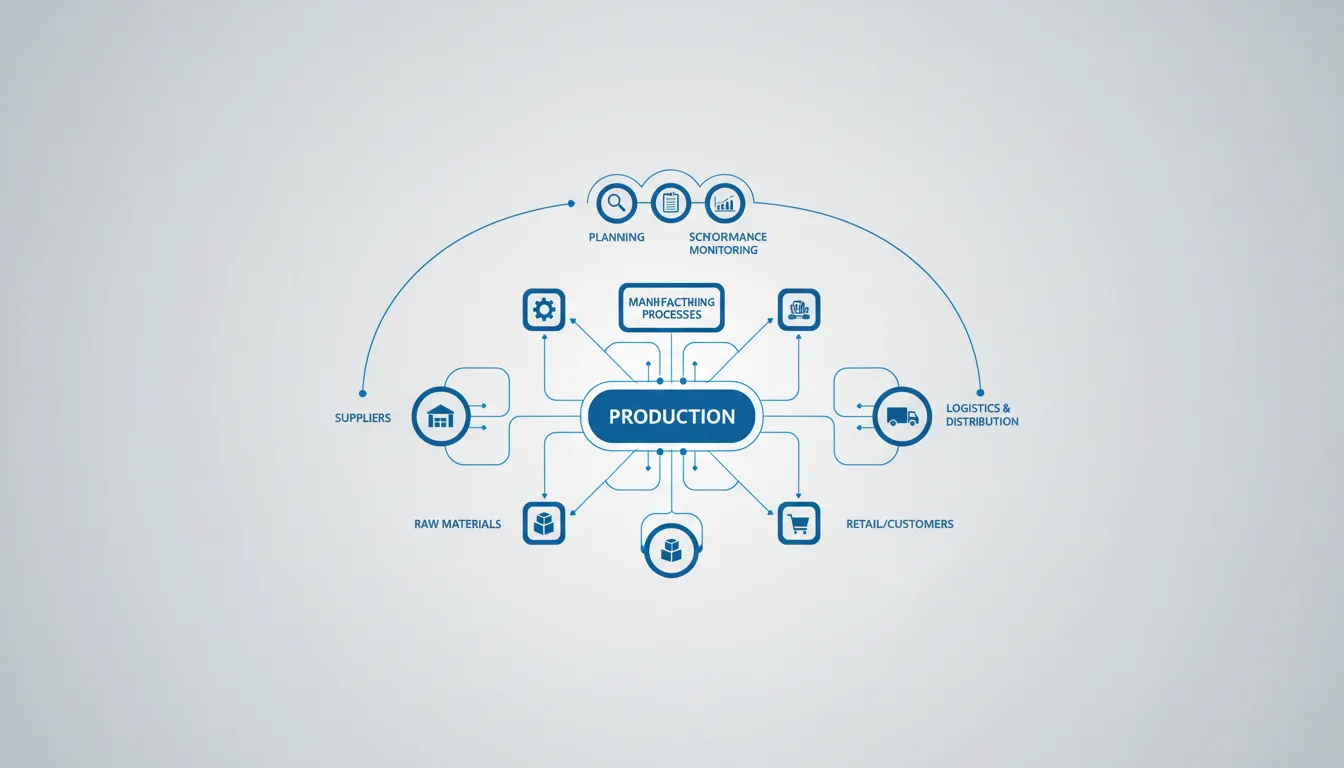
Overview
Production management encompasses the planning, organization, direction, and control of the processes involved in the production and operation of goods and services. It aims to maximize efficiency while minimizing waste and costs. Key to the success of manufacturing sectors, effective production management ensures that products are produced on time, within budget, and without compromising quality. Companies use various methods and tools to streamline processes, focusing on efficiency and customer satisfaction, evolving from simple workshop administration to complex global supply chain orchestration.
Etymology and Origins
The term "production management" emerged as a distinct discipline during the late 19th and early 20th centuries, coinciding with the rise of industrialization and scientific management principles. The word "production" itself stems from the Latin "productio," meaning "a bringing forth" or "a yielding", reflecting the creation of goods. "Management" traces its roots to the Anglo-French "ménagement," referring to "housekeeping" or "the act of guiding and directing", indicating control and oversight.
Before the formalization of this field, similar concepts were practiced under names like "workshop management" or "factory administration." The shift towards "production management" underscored a more systematic and scientific approach to managing the entire process of transforming inputs into outputs, moving beyond mere supervision to strategic planning and optimization.
Historical Development
Early Beginnings (Pre-20th Century)
Modern production management concepts have roots tracing back to the Industrial Revolution and even earlier periods of organized labor.
- 1776: Adam Smith's The Wealth of Nations introduced the concept of the division of labor, highlighting how specialization could dramatically increase productivity. This principle laid foundational groundwork for assembly line production.
- Late 18th Century: Eli Whitney's development of interchangeable parts for muskets in the U.S. facilitated mass production and standardized manufacturing.
- Late 19th - Early 20th Century: Frederick Winslow Taylor's Scientific Management, articulated in his 1911 book The Principles of Scientific Management, revolutionized factory operations. Taylor introduced time-and-motion studies, task standardization, and performance-based pay to optimize worker efficiency and production output.
- Early 20th Century: Henry Gantt developed the Gantt chart around 1910-1915, a visual tool for scheduling and project control that remains influential today.
20th Century Milestones
- 1920s-1930s: The introduction of mass production techniques by Henry Ford with the moving assembly line, notably for the Model T, revolutionized manufacturing efficiency and affordability.
- 1940s: Operations Research (OR) emerged during World War II, applying scientific methods to military logistical and strategic problems. After the war, OR techniques were adapted for industrial production planning and resource allocation.
- 1950s-1960s: The work of quality management pioneers like W. Edwards Deming and Joseph Juran, initially influential in post-war Japan, led to significant advancements in statistical process control and continuous quality improvement.
- 1960s: The development of Material Requirements Planning (MRP) systems by IBM and others marked the beginning of computerized production planning, managing raw materials and component inventories more effectively.
- 1970s: Just-in-Time (JIT) production was perfected at Toyota, focusing on eliminating waste (muda) and producing goods only when needed, significantly influencing inventory management and process flow.
- 1980s: Total Quality Management (TQM) gained widespread adoption, emphasizing customer satisfaction and continuous improvement throughout the organization. Manufacturing Resource Planning (MRP II) expanded MRP to integrate all manufacturing resources, including labor and machinery.
- 1990s: Enterprise Resource Planning (ERP) systems emerged, integrating all business functions—including production, finance, human resources, and sales—into a single system. Lean manufacturing concepts, derived from the Toyota Production System, spread globally, focusing on waste reduction. Motorola introduced Six Sigma, a data-driven methodology for process improvement.
21st Century Evolution
In recent decades, advancements in technology such as computerized systems and automation have significantly transformed production management. The 21st century has seen the rise of Industry 4.0, characterized by the Industrial Internet of Things (IIoT), Artificial Intelligence (AI), and Big Data analytics. This era emphasizes smart factories, predictive maintenance, and highly integrated, responsive supply chains.
Core Concepts
Production management involves several critical concepts essential for optimizing operations:
- Scheduling: This involves creating detailed production plans, often leveraging tools like Master Production Schedules (MPS) and Material Requirements Planning (MRP). Effective scheduling ensures that production processes align with demand forecasts, resource availability, and delivery commitments.
- Inventory Management: Managing raw materials, Work-in-Process (WIP), and finished goods is crucial to prevent excess stock (reducing carrying costs) and stockouts (avoiding lost sales). Strategies include Just-in-Time (JIT), Economic Order Quantity (EOQ), and maintaining safety stock. Visual inventory management systems and robust purchase order management are vital for this.
- Quality Control: This involves monitoring product standards throughout the production process to ensure consistency, compliance with specifications, and customer satisfaction. Techniques range from Statistical Process Control (SPC) to comprehensive Total Quality Management (TQM) programs and Six Sigma methodologies.
- Process Optimization: Continuously improving production methods to enhance efficiency, reduce costs, and improve quality. This includes identifying bottlenecks, streamlining workflows, and implementing lean principles like Value Stream Mapping and Kaizen (continuous improvement).
- Capacity Planning: Matching the production capability of an organization with anticipated demand. This ensures that the right amount of resources (equipment, labor) are available to meet production targets without over- or under-utilization.
- Facilities Layout: The efficient arrangement of workstations, equipment, and material flow within a production facility. An optimized layout minimizes movement, reduces bottlenecks, and improves overall productivity, often supported by warehouse layout preview tools.
- Maintenance: Ensuring that machinery and equipment are operational and performing optimally through preventive, predictive, and total productive maintenance (TPM) strategies to minimize downtime and disruptions.
Industry Applications
Production management is integral to various industries, driving efficiency and innovation:
- Automotive Manufacturing: Utilizes advanced robotics and Just-in-Time (JIT) delivery to produce vehicles on a massive scale. Real-time data analytics enhance inventory management and streamline production schedules to optimize operations and responsiveness to market changes.
- Food Production: Focuses on batch traceability and cold chain management to ensure product safety and quality. Implementing quality checks and lean principles helps maintain compliance with strict health standards and minimizes waste, especially through effective management of lots and expiration dates.
- Electronics Manufacturing: Characterized by rapid product lifecycles and global supply chains, requiring agile production management for rapid prototyping, high-volume precision manufacturing, and managing complex Bill of Materials (BOMs).
- Pharmaceuticals: Demands strict regulatory compliance (e.g., GMP), rigorous batch control, and extensive validation processes to ensure drug efficacy and safety. Production management here focuses on preventing contamination and ensuring audit trails.
Benefits and Advantages
Key benefits of effective production management include:
- Increased Efficiency: Streamlined processes reduce idle time, eliminate waste, and optimize resource utilization through better workflow management.
- Cost Reduction: By managing resources effectively, minimizing scrap, and optimizing inventory, companies can significantly reduce production costs and maximize profits.
- Improved Quality: Consistent quality control, often through methodologies like Six Sigma, leads to higher product standards, increased customer satisfaction, and loyalty.
- Enhanced Flexibility: Agile production systems and responsive planning enable companies to adapt quickly to changes in market demand, product designs, or supply chain disruptions, helping them stay competitive.
Challenges and Limitations
Despite its advantages, production management faces challenges such as:
- Supply Chain Disruptions: Global events (e.g., pandemics, geopolitical conflicts) can lead to delays, material shortages, and increased costs. Robust purchase order management systems and vendor portals can help mitigate some of these issues.
- Skill Gaps: There is often a shortage of skilled labor adept in modern production technologies, requiring continuous investment in employee training and development.
- Technological Integration Issues: Integrating new technologies like IoT, AI, or advanced automation into legacy systems can encounter resistance, requiring significant investment, and present implementation difficulties.
- Sustainability Pressures: Balancing production efficiency with environmental responsibility, requiring innovation in waste reduction, energy consumption, and circular economy practices.
Best Practices
To enhance production management practices, businesses should adopt methods like:
- Continuous Improvement (Kaizen): Regularly assess and enhance processes through small, incremental changes. This philosophy fosters a culture of ongoing improvement, involving all employees in identifying and solving problems.
- Lean Manufacturing Principles: Focus on systematically eliminating waste (e.g., overproduction, waiting, unnecessary transport, over-processing, excess inventory, unnecessary movement, defects) from all aspects of production. Tools like Value Stream Mapping are integral.
- Total Quality Management (TQM) & Six Sigma: Implement comprehensive quality systems that integrate customer focus, employee involvement, and continuous improvement. Six Sigma uses data-driven methodologies (DMAIC: Define, Measure, Analyze, Improve, Control) to reduce defects and variation.
- Investment in Training and Development: Invest in employee training to bridge skill gaps, foster technological literacy, and empower workers to contribute to process improvements. This includes training on new equipment, software (e.g., mobile WMS), and methodologies.
- Flexible Manufacturing Systems (FMS): Implement systems that can easily adapt to changes in product lines, volumes, or designs, providing agility and responsiveness to market demands. This often involves modular equipment and automated changeovers.
- Leveraging Technology: Adopt modern tools like Manufacturing Execution Systems (MES), Enterprise Resource Planning (ERP), and Warehouse Management Systems (WMS) to gain real-time visibility, automate processes, and enhance decision-making.
Technology and Tools
Modern production management increasingly relies on technology to optimize every stage of the production lifecycle:
- Manufacturing Execution Systems (MES): Software that monitors and controls work-in-process on the factory floor, providing real-time data on production, quality, and machine status.
- Enterprise Resource Planning (ERP) Systems: Integrated software suites that manage all core business processes, including production planning, inventory, purchasing, sales, and finance. SkuSavvy offers an alternative to larger ERP systems for inventory and fulfillment.
- Warehouse Management Systems (WMS): Systems designed to control and manage operations within a warehouse, from goods receipt and storage to order picking and dispatch. Tools such as Mobile Warehouse Management Systems help streamline operations by providing real-time information and analytics, enhancing decision-making processes in production and improving productivity.
- Internet of Things (IoT): Sensors embedded in machinery and products collect vast amounts of data, enabling predictive maintenance, real-time monitoring, and optimized resource allocation.
- Artificial Intelligence (AI) & Machine Learning (ML): Used for demand forecasting, predictive maintenance, quality inspection, and optimizing complex production schedules.
- Robotics & Automation: Industrial robots automate repetitive tasks, improving speed, precision, and safety in manufacturing and material handling, often integrated with warehouse workflows.
- Digital Twins: Utilizing digital replicas of physical production processes, products, or facilities to simulate and improve operations before implementation, predict performance, and identify potential issues.
- Advanced Analytics & Big Data: Tools for processing and analyzing large datasets from production to identify trends, optimize processes, and make informed decisions.
Future Trends
As industries evolve, several trends are anticipated in production management:
- Hyper-Automation: Increased use of robotics, AI, and process automation to manage production processes with minimal human intervention, leading to highly efficient and autonomous factories.
- Sustainability and Circular Economy: A growing emphasis on environmentally friendly production practices, minimizing waste, energy usage, and designing products for longevity, recyclability, and reuse. This includes green manufacturing principles.
- Resilience and Localized Production: Driven by recent supply chain disruptions, there's a trend towards more resilient supply chains, potentially involving regionalization or re-shoring of manufacturing to reduce lead times and risks.
- Mass Customization: Leveraging advanced manufacturing techniques like 3D printing and flexible production lines to offer highly personalized products at mass-production efficiencies.
- Cyber-Physical Systems (CPS): The core of Industry 4.0, where physical systems are deeply integrated with computational and networking capabilities, allowing for intelligent, self-organizing factories.
Related Concepts
Production management is closely related to supply chain management, operations management, and quality assurance, emphasizing the interconnected nature of modern manufacturing environments. It forms a crucial part of the broader logistics ecosystem, ensuring that products are made efficiently and effectively to meet customer demand.
These attributes collectively highlight the importance of production management, positioning it as a critical component in the success of manufacturing and service-oriented industries alike.
Sources
- Mobile Warehouse Management System
- Visual Inventory Management System
- The Age of Agile Operations
- Material Requirements Planning (MRP) Definition
- Toyota Production System: Just-in-Time
- WMS vs ERP: Between an ERP and a Hard Place
- Warehouse Layout Preview
- Purchase Order Management
- Lots & Expiration Dates
- Workflows Overview
- Employee Productivity Tracking Guide