Product Lifecycle Management
This article discusses Product Lifecycle Management (PLM), its history, core concepts, applications, and best practices in logistics and supply chain management.
Updated
Overview
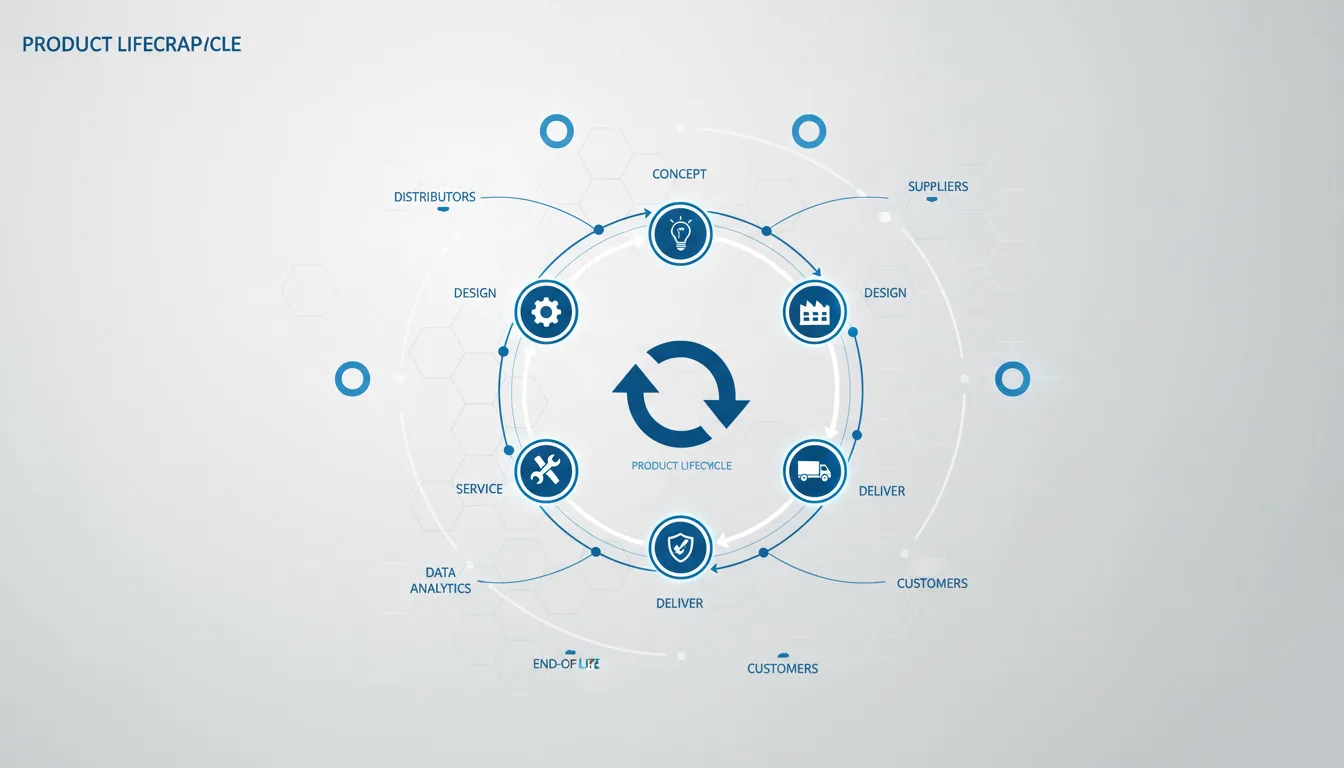
Product Lifecycle Management (PLM) is an integrated, information-driven approach that manages a product's entire lifecycle from inception, through engineering design, development, manufacturing, supply chain coordination, service, and ultimately, disposal or recycling. Primarily utilized in diverse industries such as automotive, aerospace and defense, manufacturing, retail, and consumer goods, PLM enables businesses to shorten product development cycles, reduce costs, enhance product quality, and ensure regulatory compliance. By effectively managing product data, processes, and business systems across the extended enterprise, PLM facilitates collaboration among various departments and external partners, driving innovation and productivity.
Etymology and Origins
The concept of managing a product's journey through distinct stages has roots in older disciplines like Configuration Management (CM), which emerged in the aerospace and defense sectors in the mid-20th century to control design changes and ensure product integrity [4]. The term "Product Lifecycle Management" itself gained prominence in the late 20th and early 21st centuries. The linguistic roots of "lifecycle" can be traced back to biological models, indicating the stages an organism or, in this context, a product undergoes from conception to retirement. This analogy emphasizes the dynamic, evolving nature of a product over time.
While the underlying practices evolved through Computer-Aided Design (CAD) and Product Data Management (PDM) systems in the 1980s, the term "PLM" as a distinct strategic business concept became widely adopted in the early 2000s [5]. Bernard Charlès, then CEO of Dassault Systèmes, is often credited with popularizing the term and championing the holistic vision it represents, expanding beyond mere data management to encompass the entire product value chain [6]. Early uses often appeared in analyst reports and industry white papers, solidifying its place as a comprehensive approach to product development and management.
Historical Development
Product Lifecycle Management has evolved significantly, reflecting advancements in technology and changing industrial demands.
- Pre-1980s: Foundations and Manual Era: Product development was largely manual, relying on drafting boards, physical prototypes, and paper-based Bill of Materials (BOMs). Early efforts in configuration management within the defense industry laid the groundwork for structured product information management [4].
- 1980s: The Dawn of Digital Design (CAD/PDM): The widespread adoption of Computer-Aided Design (CAD) systems revolutionized engineering, moving from 2D drafting to early 3D modeling. This led to the emergence of Product Data Management (PDM) systems, which were initially designed to manage CAD files and associated engineering documents, becoming the direct precursor to modern PLM [5]. Key players included Computervision, Intergraph, and the nascent Dassault Systèmes with CATIA.
- 1990s: PDM to PLM Transition & ERP Integration: PDM capabilities expanded to include change management, workflow, and enterprise integration. The need for a more holistic view beyond engineering data became apparent. PTC (Parametric Technology Corporation) was a pioneer, introducing Pro/ENGINEER and subsequently Windchill in 1998, which was one of the first web-native PDM systems designed for enterprise-wide collaboration, effectively bridging the gap towards PLM [7]. Integration with Enterprise Resource Planning (ERP) systems allowed for a more holistic view of product-related information, extending into manufacturing and supply chain.
- 2000s: Maturation of PLM Suites: The term "PLM" became firmly established and widely adopted, often championed by analyst firms like Gartner and major software vendors [8]. PLM software became more sophisticated with the introduction of advanced 3D modeling, simulation tools (e.g., Finite Element Analysis, Computational Fluid Dynamics), and Manufacturing Process Management (MPM). The focus shifted to global collaboration and managing products across the entire value chain, from ideation to end-of-life.
- 2010s: Cloud, Mobile, and Digital Twins: The rise of cloud computing and mobile access led to the democratization of PLM tools, making them more accessible to small and medium-sized businesses through Software-as-a-Service (SaaS) models. This decade also saw the emergence and widespread adoption of the "Digital Twin" concept, creating virtual replicas of physical products to monitor, simulate, and analyze their real-world performance [9].
- 2020s and Beyond: AI, IoT, and Sustainability: Current trends emphasize the integration of Artificial Intelligence (AI) and Machine Learning (ML) for generative design, predictive analytics, and enhanced decision-making. The Internet of Things (IoT) enables closed-loop PLM by feeding real-time product performance data back into design and development. Sustainability and circular economy principles are increasingly integrated into PLM strategies, focusing on resource efficiency and product longevity [10]. The concept of the "Digital Thread" is gaining prominence, ensuring a seamless, connected data flow across the entire product lifecycle [11].
Seminal publications such as "Product Lifecycle Management: Driving the Next Generation of Lean Thinking" by Michael Grieves (2006) have identified key strategies for effective PLM implementation and greatly influenced current practices by linking PLM to lean manufacturing principles [12].
Core Concepts
PLM encompasses several critical components that collectively ensure efficient product management:
- Product Data Management (PDM): This is the foundation of PLM, focusing on managing all product-related data, such as CAD files, specifications, and documents, ensuring data integrity and version control.
- Bill of Materials (BOM) Management: Managing the hierarchical list of raw materials, sub-assemblies, intermediate assemblies, sub-components, parts, and the quantities of each needed to manufacture an end product is central to PLM, ensuring accuracy and consistency across engineering, manufacturing, and procurement [13].
- Collaboration and Workflow Management: Effective PLM requires robust systems for managing product data and facilitating seamless information flow between departments, suppliers, and customers. This involves cross-functional teams working together through shared platforms, driving innovation and alignment on product strategy.
- Change Management: Managing design changes, engineering change orders (ECOs), and their impacts on production, supply chain, and service is crucial. Tools for effective change management are vital to minimize delays, reduce rework, and control costs.
- Product Cost Management: Tracking and optimizing product costs throughout the lifecycle, from initial design estimates to manufacturing costs and end-of-life expenses [14].
- Regulatory Compliance: Ensuring that products meet all relevant industry standards, government regulations, and safety requirements across different markets. This is particularly vital in industries like pharmaceuticals, automotive, and medical devices [15].
The integration of PLM with other enterprise systems, such as order management systems, enhances communication and data flow, optimizing logistics and fulfillment operations by providing accurate product information downstream.
Types and Classifications
There are several approaches to PLM, often categorized by their focus or architecture:
- Collaborative PLM: This approach emphasizes seamless teamwork across various organizational functions (engineering, manufacturing, sales, service) and external partners (suppliers, customers). It is often supported by cloud-based tools that allow real-time data sharing and joint decision-making, breaking down traditional silos.
- Closed-loop PLM: This type integrates feedback from products in the field (e.g., via IoT sensors, customer service reports) into the development process. This allows for continuous improvement, informing future design iterations, corrective actions, and predictive maintenance strategies.
- Flexible PLM: Designed to adapt to changing business needs, market demands, and evolving product portfolios. It scales with the organization, accommodating various product lines, complex processes, and integrates easily with other enterprise systems, often leveraging modular architectures.
- SaaS PLM: Software-as-a-Service PLM offers cloud-based solutions, reducing upfront infrastructure costs and providing greater scalability and accessibility, particularly for small and medium-sized businesses.
Industry Applications
PLM is widely applied across different sectors, each leveraging its capabilities for specific needs:
- Manufacturing: Companies like Siemens, Airbus, and Boeing utilize PLM to manage complex product assemblies, intricate Bill of Materials, and extensive global supply chains for aircraft and industrial machinery. PLM helps them coordinate thousands of parts and sub-assemblies, manage engineering changes, and ensure long-term product support.
- Consumer Goods: Retailers and brands such as Procter & Gamble and Adidas leverage PLM for rapid new product development, packaging design, formula management, and managing seasonal collections to remain competitive in fast-moving markets. It helps streamline the process from trend identification to product launch.
- Pharmaceuticals and Life Sciences: Organizations in this sector employ PLM practices to ensure stringent regulatory compliance (e.g., FDA, EMA), manage clinical trial data, and streamline efficient drug development processes from research to manufacturing and post-market surveillance. It's critical for managing intellectual property and batch records.
- Automotive: Manufacturers like BMW and Tesla use PLM to manage the design, engineering, and manufacturing of highly complex vehicles, including electrical systems, software integration, and vehicle variants. PLM supports their transition to electric vehicles and autonomous driving technologies.
Benefits and Advantages
Implementing PLM offers numerous benefits that contribute to business success:
- Improved Product Quality and Innovation: By centralizing and streamlining product data, organizations can enhance product quality, reduce design errors, and foster an environment for innovation. PLM ensures that design specifications are accurately translated into manufacturing processes.
- Faster Time-to-Market: Efficient PLM processes significantly shorten the duration from product idea conception to market launch. Streamlined workflows, improved collaboration, and automated data management grant companies a competitive advantage by allowing them to respond more quickly to market demands.
- Cost Savings and Efficiency: By optimally managing resources, reducing rework due to errors, and minimizing waste throughout the product development and manufacturing phases, PLM leads to substantial overall production and operational cost reductions.
- Enhanced Collaboration: PLM tools break down departmental silos, enabling seamless collaboration between engineering, manufacturing, supply chain, sales, and service teams, as well as external partners and suppliers. This leads to better decision-making and fewer communication breakdowns.
- Better Regulatory Compliance: PLM systems provide robust traceability and documentation capabilities, making it easier for companies to meet stringent industry standards and government regulations, reducing risks and avoiding costly penalties.
Challenges and Limitations
Despite its advantages, PLM also presents challenges that organizations must address for successful implementation:
- Resistance to Change: Employees may resist adopting new PLM systems or processes due especially to changes in established workflows and the learning curve associated with new software. This requires strong change management and comprehensive training.
- Integration Issues: Merging PLM with existing legacy ERP systems, Manufacturing Execution Systems (MES), or Customer Relationship Management (CRM) systems can pose significant technical difficulties and require complex data mapping. Solutions such as a Mobile WMS can facilitate smoother integration by handling operational data and interfacing with broader enterprise systems.
- Data Management Complexity: Handling vast amounts of diverse product data effectively, from CAD files to service reports, requires robust data governance, master data management strategies, and scalable IT infrastructure. Data quality and consistency are paramount.
- High Initial Investment: Implementing a comprehensive PLM system often requires a significant upfront investment in software licenses, infrastructure, customization, and training, which can be a barrier for smaller organizations.
- Scope Definition: Clearly defining the scope of PLM implementation can be challenging. An overly ambitious or poorly defined scope can lead to project delays, cost overruns, and failure to meet business objectives.
Best Practices
For effective PLM implementation and long-term success, organizations should consider several best practices:
- Executive Sponsorship and Stakeholder Engagement: Strong executive buy-in and active involvement of all relevant stakeholders (from engineering to IT to procurement) early in the process fosters buy-in, ensures alignment, and generates valuable insights.
- Phased Implementation: Adopt a phased approach, starting with critical functionalities or a specific product line, to manage complexity, demonstrate early value, and allow for iterative learning and adjustment.
- Standardize Processes: Before implementing PLM software, standardize and optimize existing product development processes. PLM amplifies efficient processes but can also magnify inefficient ones.
- Comprehensive Training and Change Management: Invest in continuous education and hands-on training for staff on new PLM tools and processes. A structured change management program helps mitigate resistance and accelerates user adoption.
- Establish Clear Metrics and KPIs: Define clear Key Performance Indicators (KPIs) to measure the success of PLM implementation, such as time-to-market reduction, error rate decrease, or cost savings, to demonstrate ROI.
- Data Governance and Quality: Implement robust data governance policies and ensure data quality from the outset. Clean, accurate, and consistent data is foundational for effective PLM.
- Adoption of Agile Methodologies: Utilizing agile methodologies within PLM can enhance adaptability and responsiveness to market changes, allowing for quicker iterations and better alignment with customer needs.
Technology and Tools
Modern PLM solutions incorporate advanced technologies to support complex product lifecycles:
- Cloud Computing: Enables scalable, on-demand access to PLM tools, reducing infrastructure costs and enhancing accessibility for businesses of all sizes, often delivered as SaaS.
- Collaboration Platforms: Integrated tools (e.g., social PLM features, secure file sharing, virtual meeting spaces) that enhance teamwork across geographically dispersed teams, helping organizations to break down silos and improve communication.
- Artificial Intelligence (AI) and Machine Learning (ML): Used for generative design (automatically creating design alternatives), predictive analytics (forecasting product performance, maintenance needs, or market trends), and automating routine tasks, significantly accelerating design cycles and improving decision-making.
- Digital Twin and Digital Thread: The Digital Twin creates a virtual replica of a physical product, allowing for real-time monitoring, simulation, and analysis. The Digital Thread ensures a seamless, traceable flow of data and information across all stages of the product lifecycle, connecting the digital twin to various enterprise systems [11].
- Integrated Simulation and Analysis: Advanced CAE tools (FEA, CFD, Multiphysics) are integrated into PLM to simulate product performance, test designs virtually, and optimize characteristics before physical prototyping, saving time and cost.
- IoT Integration: Connecting PLM systems with Internet of Things (IoT) sensors on physical products allows for real-time performance data feedback, enabling closed-loop product improvement, predictive maintenance, and optimized service strategies.
Implementing these technologies alongside effective stock replenishment strategies can further optimize logistics processes by ensuring that product designs are aligned with supply chain realities and inventory needs.
Future Trends
As industries evolve and technology advances, PLM continues to transform:
- Hyper-Automation and Autonomous Design: Increased automation, driven by AI and robotics, will further streamline workflows, from generative design that autonomously creates optimal product variants to automated change validation and compliance checks, significantly reducing manual tasks and errors.
- Deep Integration of AI and Advanced Analytics: AI will move beyond predictive analytics to prescriptive and cognitive capabilities, offering intelligent recommendations for product design, material selection, manufacturing processes, and even market positioning. This will enable truly data-driven decision-making throughout the entire lifecycle.
- Digital Thread and Digital Twin Ubiquity: The concept of the "Digital Thread" will become the standard, creating a fully connected, end-to-end data backbone across the entire product lifecycle, linking design, manufacturing, supply chain, and service in real-time. Digital Twins will become more sophisticated, incorporating multi-physics simulations and AI to represent product behavior with unprecedented accuracy [11].
- Sustainability and Circular Economy Focus: Companies will place greater emphasis on designing products for sustainability, recyclability, and longevity, driven by consumer demand, regulatory requirements, and resource scarcity. PLM systems will incorporate tools for cradle-to-cradle design, material traceability, environmental impact assessment, and end-of-life management to support circular economy principles [10].
- Low-Code/No-Code PLM Platforms: The emergence of low-code/no-code development platforms will enable business users, rather than specialized developers, to customize and extend PLM functionalities, making the systems more agile and adaptable to specific enterprise needs.
- Enhanced Cybersecurity: With increased connectivity and data sharing, robust cybersecurity measures will be paramount to protect intellectual property and sensitive product data across the extended PLM ecosystem.
In conclusion, Product Lifecycle Management is a critical and evolving framework that enables organizations to manage the complex lifecycles of their products more effectively. By embracing technological advancements and best practices, PLM facilitates better collaboration, drives innovation, ensures compliance, and enhances efficiency across various sectors, ultimately contributing to a company's competitive advantage and long-term success.
Sources
- Order Management System
- Mobile Warehouse Management System
- Stock Replenishment Guide
- What is Configuration Management?
- Product Data Management (PDM) - An Overview
- Dassault Systèmes' Bernard Charlès on the 3D Experience
- PTC Windchill History
- Gartner - Product Lifecycle Management
- What is a Digital Twin?
- What is the circular economy?
- What is Digital Thread?
- Product Lifecycle Management: Driving the Next Generation of Lean Thinking
- Bill of Materials (BOM)
- Product Cost Management Process Overview
- What is regulatory compliance?