Optimization Problems in Logistics
An overview of optimization problems in logistics, their historical development, core concepts, applications, and best practices.
Updated
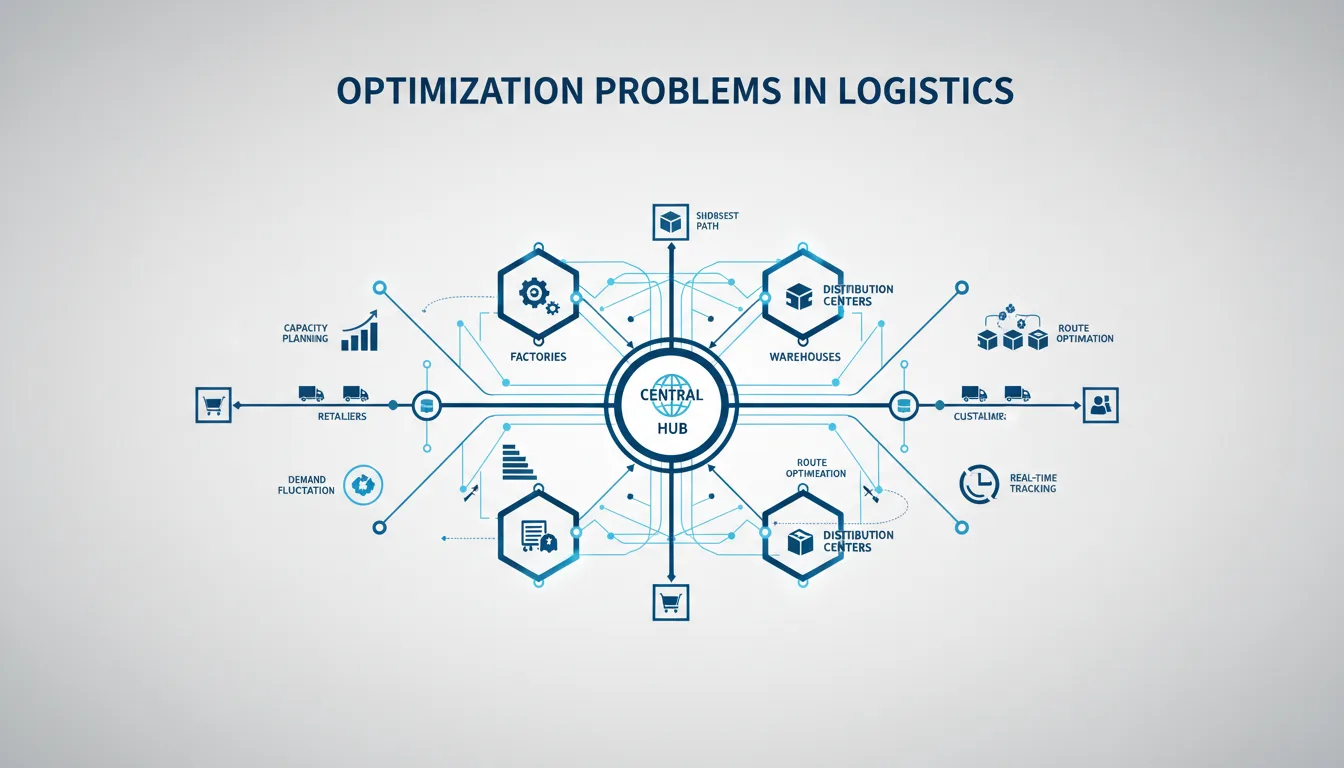
Overview
Optimization problems in logistics refer to the mathematical and computational strategies employed to improve efficiency in various supply chain operations. These problems are critical as they help organizations minimize costs, maximize service levels, and streamline operations. The importance of optimization in logistics cannot be overstated; it enables better decision-making and resource allocation, which is vital for maintaining competitiveness in the dynamic supply chain landscape. It is a cornerstone of modern supply chain management, driving continuous improvement and resilience.
Etymology and Origins
The term "optimization" originates from the Latin word "optimus," meaning 'best.' While root concepts of optimization date back to ancient mathematics, such as Euclid's geometric problems and early economic theories, its formal introduction to logistics occurred in the mid-20th century, alongside the rise of operations research (OR). During and immediately after World War II, military strategists and scientists applied mathematical methods to complex logistical challenges, such as resource allocation, troop deployment, and supply chain coordination, giving birth to this interdisciplinary field. Early works on this topic, such as George Dantzig's formulation of the simplex method in 1947, laid the groundwork for modern optimization techniques used in logistics, transforming it from an intuitive art into a quantitative science. This era marked the first time that systematic, quantitative approaches were widely applied to complex decision-making problems in logistics and management across military and industrial sectors.
Historical Development
The evolution of logistics optimization is closely tied to advancements in mathematics, computing, and management philosophies:
- 1940s-1950s: The Dawn of Operations Research: The post-World War II period saw the formalization of Operations Research (OR) as an academic discipline. George Dantzig's pioneering work on linear programming and the simplex algorithm provided the first efficient method for solving a wide class of optimization problems, initially for military logistics and later for industrial planning. Early applications focused on resource allocation, production scheduling, and transportation planning, moving away from heuristic-based solutions.
- 1960s-1970s: The Rise of Computing and MRP: The advent of mainframe computers allowed for the computational power needed to solve larger and more complex optimization problems. This era saw the development and widespread adoption of Material Requirements Planning (MRP) systems, pioneered by companies like IBM to manage manufacturing inventory and scheduling. Network models, such as those for shortest path and maximum flow, also became crucial for optimizing transportation and distribution networks, benefiting from increased computing capabilities.
- 1980s: Just-In-Time and ERP Integration: The Japanese manufacturing revolution, particularly the Toyota Production System and its Just-In-Time (JIT) philosophy, profoundly influenced logistics optimization by emphasizing waste reduction and efficiency throughout the value chain. Concurrently, MRP evolved into Manufacturing Resource Planning (MRP II) and later into comprehensive Enterprise Resource Planning (ERP) systems, integrating various business functions, including logistics, into a single platform.
- 1990s: Supply Chain Management and Advanced Planning Systems: The concept of Supply Chain Management (SCM) gained prominence, shifting the focus from individual company optimization to end-to-end supply chain efficiency and collaboration. This decade saw the proliferation of specialized Advanced Planning and Scheduling (APS) systems and early dedicated Warehouse Management Systems (WMS) that enabled more sophisticated optimization of inventory, warehousing, and transportation, often using sophisticated algorithms.
- 2000s: Internet, Globalization, and Real-time Data: The widespread adoption of the internet facilitated real-time data exchange across increasingly global supply chains, enabling more dynamic optimization approaches. The explosion of e-commerce demanded faster, more efficient fulfillment, pushing the boundaries of route optimization and optimal inventory placement for rapid delivery.
- 2010s and beyond: AI, Big Data, and Predictive Analytics: Innovations in artificial intelligence (AI), machine learning (ML), and the explosion of Big Data revolutionized optimization problems. This era focuses on predictive analytics for highly accurate demand forecasting, prescriptive analytics for automated decision-making, and the integration of IoT (Internet of Things) devices for real-time visibility and control across complex networks. Seminal publications like "Linear Programming and Extensions" by George Dantzig and numerous academic contributions from institutions like MIT and Georgia Tech have heavily influenced this field over the decades. Additionally, the rise of automated tools and software solutions has significantly streamlined logistics processes, creating efficiencies that were previously unattainable.
Core Concepts
Optimization problems in logistics can encompass several areas, often interconnected, requiring a holistic approach:
- Transportation Optimization: Aimed at determining the most efficient routes, modes of transport, and fleet utilization to minimize costs, transit times, and environmental impact while meeting constraints of delivery times and service levels. Key problems include the Vehicle Routing Problem (VRP) and the Traveling Salesman Problem (TSP), which seek the optimal paths for deliveries and collections. This often involves freight consolidation, multi-modal transport planning, and dynamic route adjustments in real-time.
- Warehouse Operations Optimization: Focuses on maximizing space utilization, improving material flow, and enhancing picking efficiency within a warehouse. This encompasses layout optimization, which can enhance storage procedures and increase picking efficiency. Techniques like slotting (strategically placing items in optimal locations based on demand, size, or picking frequency) and picking path optimization (determining the most efficient sequence for pickers to retrieve items) are crucial for labor productivity. Efficient bin packing algorithms ensure maximum utilization of shipping containers, pallets, and storage bins.
- Inventory Management: Techniques like economic order quantity (EOQ), safety stock calculation, and just-in-time inventory management can be optimized to reduce holding costs, prevent stockouts, and improve turnover rates. Software solutions provide tools for effective visual inventory management and detailed tracking of lots and expiration dates, facilitating efficient cycle counting and maintaining high inventory accuracy.
- Network Design Optimization: Involves strategically locating facilities such as warehouses, distribution centers, and production plants to minimize overall supply chain costs (transportation, inventory, facility costs) and improve service levels. This can also include decisions on capacity planning, the allocation of demand to specific facilities, and determining the optimal number of facilities in a network.
Types and Classifications
Various optimization models are commonly used in logistics, each suited for different problem structures and complexities:
- Linear Programming (LP): Utilized for problems where relationships among variables are linear, meaning objective functions (e.g., minimize cost, maximize profit) and constraints (e.g., capacity limits, demand requirements) can be expressed as linear equations or inequalities. Example: determining the optimal product mix to maximize profit given limited production resources or allocating shipments across various routes to minimize total transportation cost.
- Integer Programming (IP): An extension of LP where some or all decision variables must take on integer values. This is suitable for discrete logistics operations where fractional units are not meaningful, such as deciding the number of vehicles to dispatch, the location of warehouses (you can't open half a warehouse), or the assignment of specific orders to specific trucks.
- Dynamic Programming (DP): Applicable in scenarios where decisions must be made sequentially over time, and the optimal solution for a larger problem can be found by combining optimal solutions to subproblems. Example: optimal inventory control policies over multiple periods, complex multi-stage production scheduling, or resource allocation problems where future decisions depend on current actions.
- Stochastic Models: Address uncertainties inherent in supply chains by incorporating random variables for elements like demand, lead times, supply disruptions, or weather conditions. These models help in developing robust strategies that perform well under various uncertain conditions, such as determining optimal safety stock levels given fluctuating demand patterns or planning capacity under variable lead times.
- Heuristics and Metaheuristics: For highly complex, NP-hard problems (e.g., very large Vehicle Routing Problems with many constraints) where finding an exact optimal solution is computationally intractable within a reasonable timeframe, heuristics (rule-of-thumb methods that find good, but not necessarily optimal, solutions quickly) and metaheuristics (higher-level procedures for finding, generating, or selecting a heuristic that may provide a sufficiently good solution) are employed. Examples include genetic algorithms, simulated annealing, and tabu search, frequently used for practical, large-scale routing and scheduling problems.
Industry Applications
Industries across the spectrum utilize optimization to gain a competitive edge and operational excellence:
- E-commerce: Optimization ensures efficient order fulfillment, critical for meeting customer expectations for fast and accurate delivery. This includes optimizing last-mile delivery routes, selecting the most cost-effective shipping carriers through automated rate selection, and managing warehouse picking paths. Mobile order fulfillment software empowers warehouse teams to execute optimized workflows, reducing picking errors and speeding up processing.
- Manufacturing: Production scheduling optimization minimizes idle time, reduces work-in-process inventory, and maximizes machine utilization, directly impacting efficiency and resource wastage. It also extends to optimizing raw material procurement, supplier selection, and supply synchronization to production lines.
- Healthcare: Logistics optimization guarantees timely and temperature-controlled delivery of medical supplies, pharmaceuticals, and critical equipment, essential for patient care and operational efficiency, especially for cold chain logistics, vaccine distribution, and emergency response planning.
- Retail: Supply chain optimizations help maintain optimal inventory levels across multiple store locations, reduce stockouts, and minimize transportation costs for replenishment. It also supports omnichannel fulfillment strategies, balancing online and in-store inventory to meet customer demand from the most efficient source.
- Humanitarian Logistics: Optimization is crucial for disaster relief efforts, ensuring the rapid and efficient distribution of aid, food, and medical supplies to affected areas, often under highly uncertain, resource-constrained, and dynamic conditions, where every second counts.
- Case Study: Amazon: A prime example of an organization built on logistics optimization. Amazon extensively uses sophisticated algorithms for warehouse layout, robot path planning, inventory placement, delivery route optimization, and even predicting demand to pre-position inventory closer to customers. Their continuous innovation in optimization contributes directly to their market leadership, customer satisfaction, and operational efficiency.
Benefits and Advantages
The primary benefits of logistics optimization are far-reaching and impactful, contributing significantly to a company's bottom line and competitive position:
- Enhanced Operational Efficiency: Leading to significant cost reductions in transportation, warehousing, inventory holding, and labor. This can be quantified by calculating the ROI on logistics technology investments.
- Improved Customer Satisfaction: Through faster, more reliable, and more accurate deliveries, better order fulfillment rates, and enhanced service quality, fostering customer loyalty.
- Better Resource Utilization: By eliminating redundancies, optimizing asset usage (e.g., vehicles, warehouse space, personnel), and reducing waste across the supply chain.
- Data-Driven Decision-Making: Facilitated through advanced analytics and software tools, enabling proactive rather than reactive management and allowing for strategic planning based on accurate insights.
- Increased Supply Chain Resilience: By identifying potential bottlenecks, simulating various disruption scenarios, and developing contingency plans, optimization helps mitigate risks and respond effectively to unforeseen events.
- Reduced Environmental Impact: Through optimized routes (fewer miles driven), efficient warehouse operations (reduced energy consumption), and less waste, contributing significantly to sustainability goals and corporate social responsibility.
Challenges and Limitations
Despite its benefits, several challenges persist in logistics optimization, requiring careful consideration and strategic approaches:
- Data Quality and Availability: Accurate optimization relies heavily on high-quality, real-time data. Missing, inaccurate, or inconsistent data (e.g., outdated inventory counts, incorrect addresses, unreliable demand forecasts) can significantly skew results, leading to suboptimal or erroneous decisions. Establishing robust data governance practices is crucial.
- Computational Complexity: Many real-world optimization problems, especially those involving large networks, numerous variables, and complex constraints (e.g., large-scale VRPs with time windows and multiple depots), are NP-hard, meaning finding exact optimal solutions within a reasonable timeframe is often impossible. Heuristics and metaheuristics are frequently used, but they provide good, rather than guaranteed optimal, solutions.
- Dynamic and Uncertain Environments: Logistics environments are constantly changing due to fluctuating demand, traffic congestion, weather events, fuel price volatility, and geopolitical disruptions. Static optimization models can quickly become outdated, necessitating dynamic, adaptive, and stochastic optimization approaches that can react to real-time information.
- Implementation and Change Management: Transitioning to optimized systems often requires substantial changes to existing processes, technology infrastructure, and organizational structures. Resistance from stakeholders, lack of skilled personnel, and integration complexities with legacy systems can complicate successful adoption. Effective change management and comprehensive employee training and development are vital for successful implementation.
- Integration with Existing Systems: Optimization software must seamlessly integrate with ERP, WMS (mobile warehouse management system), TMS, and other enterprise systems to leverage comprehensive data and execute optimized plans without creating data silos.
- Cost of Technology and Expertise: Investing in advanced optimization software, analytical tools, and the specialized expertise (e.g., data scientists, operations research analysts) required to implement, customize, and manage it can be a significant upfront and ongoing cost for businesses.
To mitigate these issues, businesses adopt best practices and utilize efficient software, such as pick, pack, and ship software, to streamline their processes and ensure data integrity.
Best Practices
To effectively approach optimization problems in logistics and overcome inherent challenges, consider the following best practices:
- Leverage Integrated Technology Platforms: Implement comprehensive software solutions, such as a mobile warehouse management system and robust order management systems, that provide real-time insights, advanced analytical capabilities, and support customizable workflows to enhance decision-making processes and automate tasks effectively.
- Embrace Data Governance and Quality: Prioritize collecting, cleaning, and maintaining high-quality data. Implement clear data governance policies, regular data audits, and standardized data entry procedures to ensure the accuracy and reliability of inputs for optimization models. This foundational step is critical for meaningful results.
- Adopt a Continuous Improvement Mindset: Regularly review and refine processes, models, and technologies. Employ an agile approach to optimization, allowing for iterative improvements, A/B testing of different strategies, and adaptability to changing market conditions, customer demands, and technological advancements.
- Invest in Training and Development: Ensure staff are adequately trained in using optimization tools, interpreting results, and understanding the methodologies behind them. Foster a data-driven culture where employees at all levels recognize the value of optimized processes and contribute to their success.
- Foster Cross-Functional Collaboration: Engage different departments—from procurement and production to sales and customer service—in optimization efforts. This holistic approach, often facilitated by Sales and Operations Planning (S&OP), ensures that optimization goals align with overall business objectives and addresses interdependencies across the entire supply chain.
- Start Small, Scale Up: Begin with pilot projects or smaller, manageable optimization problems to demonstrate tangible value, build internal expertise, and gain stakeholder buy-in before scaling to more complex, enterprise-wide initiatives. This iterative approach minimizes risk and maximizes learning.
Future Trends
The future of logistics optimization is rapidly evolving, driven by technological advancements, increasing data availability, and shifting market demands for speed, efficiency, and sustainability:
- Artificial Intelligence and Machine Learning: AI will facilitate advanced predictive analytics for highly accurate demand forecasting, proactive maintenance of logistics assets, and even autonomous decision-making in areas like dynamic pricing, real-time route re-optimization, and automated warehouse robotics. Cognitive logistics systems will learn and adapt to changing conditions with minimal human intervention.
- Big Data Analytics and IoT: With the increasing availability of Big Data from IoT sensors (e.g., fleet telematics, warehouse robots, smart containers), optimization models will utilize broader, real-time datasets to improve accuracy, efficacy, and visibility across the entire supply chain, enabling more granular and responsive decision-making.
- Sustainability and Green Logistics: As companies increasingly focus on environmental, social, and governance (ESG) goals, optimization processes will incorporate environmental impact considerations into logistics decisions, such as minimizing carbon emissions through efficient routing, vehicle choice, and sustainable packaging. This includes optimizing for circular economy principles and waste reduction throughout the product lifecycle.
- Digital Twins and Simulation: The creation of digital twins—virtual replicas of physical logistics systems—will allow for sophisticated simulation and 'what-if' analyses, enabling companies to test optimization strategies, evaluate new infrastructure, and predict performance in a risk-free environment before costly physical deployment.
- Blockchain for Transparency and Traceability: While not directly an optimization technique, blockchain technology provides immutable records and enhanced transparency across supply chains. This improved data quality and trustworthiness are critical inputs for more accurate and effective optimization models, especially in complex global networks.
- Autonomous Logistics: The development of autonomous vehicles (trucks, drones) and advanced robotics in warehouses will necessitate and enable new forms of optimization, focusing on seamless coordination, dynamic scheduling, human-robot collaboration, and completely automated operations, pushing the boundaries of logistics efficiency.
Sources
- Warehouse Layout Preview
- Order Management System
- Pick, Pack, Ship Software
- Visual Inventory Management System
- History of Operations Research: The Cold War and the Development of a Science
- Simplex Algorithm and Linear Programming: A Historical Perspective
- Linear Programming and Its Impact on Logistics Optimization
- The Evolution of Material Requirements Planning (MRP)
- Logistics and Supply Chain Management: Core Principles and Best Practices
- Designing and Managing the Supply Chain: Concepts, Strategies, and Cases
- How Amazon Built the World's Most Efficient Supply Chain
- Sales and Operations Planning (S&OP)
- How to Calculate ROI on a Shopify Inventory Management App
- Mobile Warehouse Management System Overview
- Bin Put-Away Criteria Guide
- Batch Picking Guide
- Bin Packing Visualizer
- Lots & Expiration Dates Tracking Guide
- Cycle Counting Guide
- Mobile Order Fulfillment Software
- Automated Rate Selection Guide
- Quick Start Guide
- Employee Management Guide
- Workflows Overview