Material Requirements Planning (MRP)
Material Requirements Planning (MRP) is a production planning, scheduling, and inventory control system used to manage manufacturing processes effectively.
Updated
Overview
Material Requirements Planning (MRP) is a systematic approach used in manufacturing and supply chain management to ensure that materials are available for production and finished products are available for delivery to customers. MRP helps organizations plan manufacturing, inventory management, purchasing, and scheduling activities efficiently, thereby optimizing resources and minimizing waste. The primary purpose of MRP is to maintain the necessary inventory levels while reducing excess stock, mitigating stockouts, and preventing production downtime. By coordinating these critical functions, MRP serves as the backbone for efficient production and procurement processes.
Etymology and Origins
The term 'Material Requirements Planning' emerged in the mid-1960s, a period marked by increasing complexity in manufacturing and a growing need for more sophisticated inventory control than traditional reorder point methods could offer. The concept's linguistic roots are straightforward, combining "material" (referring to components and raw goods), "requirements" (what is needed), and "planning" (the systematic determination of these needs).
The foundational work for modern MRP systems is largely attributed to Joseph Orlicky, an engineer at IBM. Orlicky observed the limitations of earlier statistical inventory management techniques, which treated each item independently, failing to account for the dependent demand inherent in complex products. His seminal work, "Material Requirements Planning: The New Way of Life in Production and Inventory Management," published in 1975, formalized the concepts and computational logic that underpinned the first MRP systems. This established MRP as a distinct and powerful approach to managing components and sub-assemblies based on a master production schedule, marking a significant evolution from simpler inventory control mechanisms.
Historical Development
Material Requirements Planning originated during the post-World War II industrial expansion, when manufacturers faced surging demand for consumer goods and increasingly complex product structures. The initial push for MRP was driven by the need to manage vast quantities of materials efficiently and reduce excess inventory that tied up capital.
Key milestones in MRP development include:
- 1950s - Early 1960s: Precursors to MRP, primarily inventory control systems utilizing basic computer processing for reorder points. Early software like the IBM "Bill of Material Processor" laid some groundwork.
- 1960s: The formalization of MRP concepts. Joseph Orlicky at IBM developed the core logic, moving beyond simple reorder points to a time-phased planning approach based on a master production schedule. This period saw the introduction of early MRP systems focusing on inventory and production planning for dependent demand items. Jean-Paul B. van der Meer at IBM was also a key figure in these early developments.
- 1970s: Widespread adoption began, especially after Orlicky's 1975 book. The advent of more powerful and affordable computer technology made MRP practical for more companies. This decade focused on refining the planning logic and integrating it more deeply into manufacturing operations.
- 1980s (MRP II - Manufacturing Resource Planning): Recognizing that material planning alone was insufficient, the concept evolved into MRP II. Pioneered by thought leaders like Oliver Wight and George Plossl, MRP II incorporated additional resources, including labor, machine capacity, and financial planning, creating a closed-loop system for the entire manufacturing process. This marked a significant expansion from mere material planning to comprehensive business planning.
- 1990s and Beyond (ERP - Enterprise Resource Planning): MRP II further integrated with other enterprise functions such as finance, human resources, sales, and supply chain management, giving rise to Enterprise Resource Planning (ERP) systems. ERP systems provided a holistic view of business operations, centralizing data and processes across the entire organization. The SkuSavvy blog provides a detailed analysis of WMS vs. ERP systems.
- 2000s - Present: The incorporation of advanced technologies such as RFID, cloud computing, big data analytics, artificial intelligence (AI), and the Internet of Things (IoT) has further enhanced MRP/ERP capabilities. These technologies enable real-time data collection, predictive analytics, and greater automation, leading to more responsive and intelligent planning.
Seminal publications that shaped MRP include Joseph Orlicky's 1975 book, and various contributions to journals from the APICS Supply Chain Council (now ASCM), which played a crucial role in standardizing terminology and promoting best practices in production and inventory management.
Core Concepts
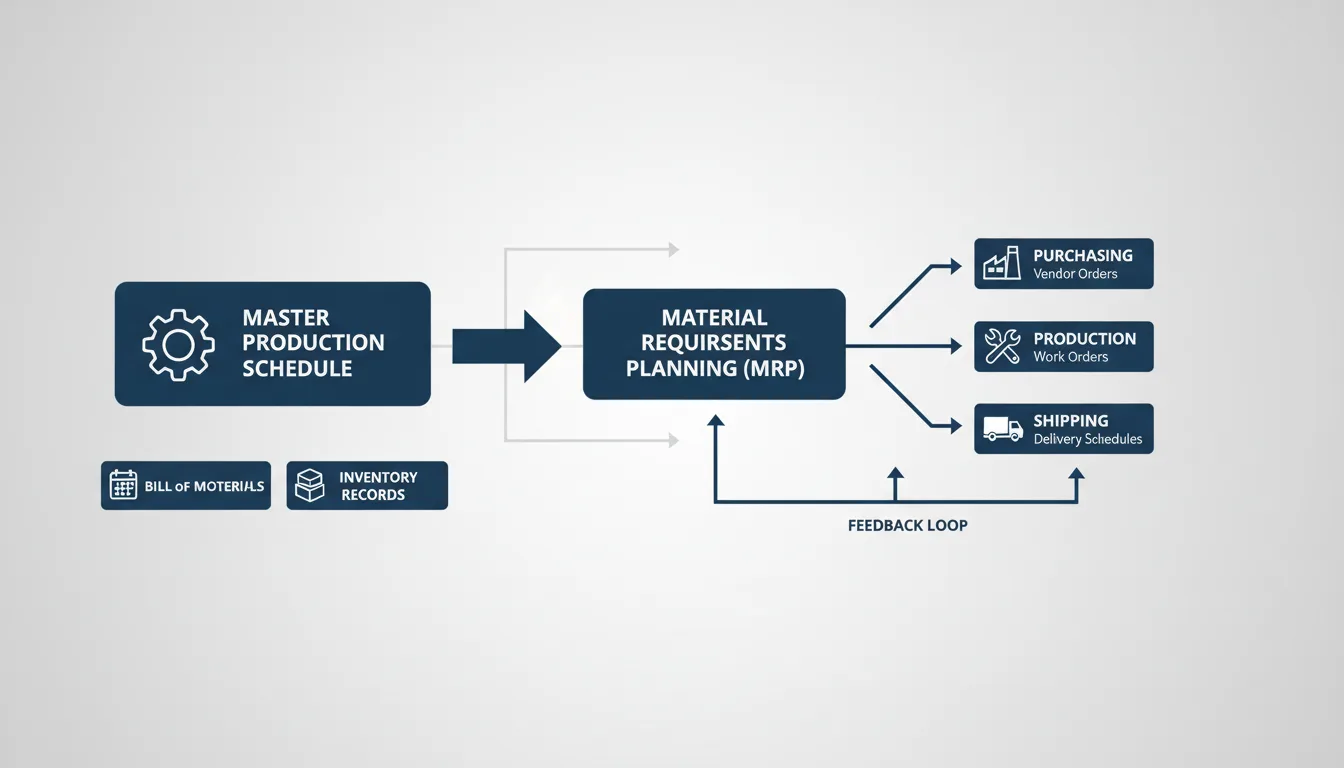
MRP operates based on three primary inputs: the Master Production Schedule (MPS), Bill of Materials (BOM), and Inventory Records. Here's how they interconnect:
- Master Production Schedule (MPS): This is the core input, specifying what finished products are to be made, in what quantities, and when they are needed. It serves as a statement of anticipated production, often derived from sales forecasts and customer orders.
- Bill of Materials (BOM): The BOM, sometimes called a product structure tree, is a comprehensive list of all the raw materials, components, sub-assemblies, and quantities required to produce one unit of a finished product. For complex products, BOMs can be multi-level, detailing components of sub-assemblies. Kitting processes are often directly tied to BOMs.
- Inventory Records (Item Master Data): These records provide crucial information about each item, including existing on-hand quantities, allocated inventory, scheduled receipts (open purchase or production orders), lead times for procurement or production, safety stock levels, and unit of measure details. Maintaining accurate visual inventory management systems is paramount for MRP's success.
Using these inputs, the MRP system performs a process called "netting" and "offsetting." Netting calculates gross requirements based on the MPS and BOM, then subtracts available inventory and scheduled receipts to determine the net requirements. Offsetting applies lead times to these net requirements to determine when purchase orders (for raw materials) or production orders (for sub-assemblies) need to be released to meet the MPS due dates. The outputs guide purchase order management and production scheduling, helping match production output with customer demand and minimizing lead times.
Types and Classifications
The evolution of Material Requirements Planning has led to distinct classifications, each expanding upon the capabilities of its predecessor:
- MRP I (Material Requirements Planning): This is the original form, primarily focused on inventory control and the management of dependent demand materials. Its core function is to translate a master production schedule into time-phased requirements for components and raw materials, generating planned orders for purchasing and production. It answers the questions: "What do we need?" and "When do we need it?"
- MRP II (Manufacturing Resource Planning): Emerging in the 1980s, MRP II represents a significant expansion. It not only handles material planning but also integrates other manufacturing resources like labor hours, machine capacity, tooling, and financial considerations. MRP II provides a closed-loop system, meaning it feeds back information from actual production to adjust plans. It enables detailed capacity planning, shop floor control, and financial reporting, making it a comprehensive system for managing all resources involved in manufacturing.
- ERP (Enterprise Resource Planning): Building on MRP II, ERP systems, which became prominent in the 1990s, integrate nearly all facets of an enterprise. Beyond manufacturing and resources, ERP encompasses functions like accounting, human resources, sales, customer relationship management (CRM), and supply chain management. The goal of ERP is to provide a unified, real-time view of the business, facilitating cross-functional collaboration and data consistency across the entire organization. Modern ERPs often incorporate advanced features, including integration with order management systems and sophisticated analytics.
Industry Applications
MRP is a versatile planning tool widely utilized across various sectors where precise material and production planning are crucial:
- Discrete Manufacturing: Industries producing distinct, countable items (e.g., automotive, electronics, aerospace) rely heavily on MRP to manage complex Bills of Materials and assembly processes. For instance, in the Automotive sector, MRP ensures the precise timing and quantity of thousands of parts are available for assembly lines, preventing costly stoppages.
- Process Manufacturing: While often using variations (e.g., formula-based planning), sectors like Pharmaceuticals and chemicals use MRP to manage raw material inventories, track lots and expiration dates, and ensure compliance with stringent regulatory standards, producing medicines and other goods in batches.
- Aerospace & Defense: The extremely high cost, long lead times, and rigorous quality and compliance requirements in Aerospace necessitate advanced MRP/ERP systems to manage complex part needs, maintenance, repair, and overhaul (MRO) operations.
- Consumer Goods: Companies producing consumer electronics, appliances, and furniture leverage MRP to optimize production schedules, manage components, and ensure timely product delivery to meet fluctuating market demand.
Benefits and Advantages
The implementation of an MRP system offers substantial advantages for manufacturing and distribution organizations:
- Improved Inventory Accuracy and Reduction: By precisely calculating material requirements, MRP helps reduce excess inventory and associated carrying costs while minimizing the risk of stockouts. This leads to more accurate inventory records and better cash flow.
- Enhanced Production Planning and Scheduling: MRP provides a clear, time-phased production plan, enabling businesses to meet demand more efficiently. This results in smoother production flows, optimized resource utilization, and improved on-time delivery rates.
- Lower Manufacturing Costs: Through optimized resource allocation, reduced waste, and minimized downtime due to material shortages, MRP directly contributes to lower overall manufacturing costs. It also streamlines purchase order management, potentially leading to better supplier negotiations and reduced expediting fees.
- Increased Responsiveness to Market Changes: With better visibility into material requirements and production capacity, companies can respond more quickly to changes in customer demand, supply disruptions, or shifts in market conditions. This agility can be a significant competitive advantage.
- Better Customer Service: By ensuring products are available when promised and reducing lead times, MRP helps enhance customer satisfaction and build stronger customer relationships.
Challenges and Limitations
While MRP systems offer significant benefits, there are inherent challenges that can hinder their effectiveness if not properly addressed:
- Data Accuracy Dependency: MRP is highly dependent on the accuracy of its input data (MPS, BOM, and Inventory Records). Inaccurate data, often referred to as "garbage in, garbage out," can lead to erroneous plans, causing stockouts, excess inventory, or production delays. Maintaining precise inventory levels and BOMs is a continuous effort.
- Complexity of Implementation: Implementing an MRP system can be a complex and resource-intensive undertaking, especially in organizations with intricate manufacturing processes or custom product lines. It requires significant investment in software, hardware, and employee training.
- Assumptions of Fixed Lead Times: Traditional MRP assumes fixed lead times for procurement and production. In reality, lead times can fluctuate due to supplier issues, transportation delays, or capacity constraints, which can throw off the plan. Modern MRP/ERP systems attempt to mitigate this with dynamic lead time adjustments and simulation capabilities.
- Limited Flexibility in Rapidly Changing Markets: Without careful adaptation and continuous updates, a rigid MRP system can struggle in highly volatile markets or environments with frequent product changes and demand shifts. It may not always optimally handle unexpected events or sudden spikes in demand without manual intervention.
Best Practices
Adopting key best practices is crucial for maximizing the effectiveness of MRP systems and overcoming their inherent challenges:
- Ensure Data Integrity: Regularly audit and update all input data—MPS, BOMs, and inventory records—to guarantee accuracy. Implement processes for continuous data validation and error correction. Tools like mobile warehouse management systems can facilitate real-time data capture.
- Comprehensive Training and User Adoption: Adequately train all staff involved in planning, procurement, and production on the MRP system's functionalities and their roles in maintaining data accuracy. User buy-in is critical for successful implementation.
- Integrate with Other Systems: Connect MRP with other enterprise systems like CRM, WMS, and finance for seamless data flow and a holistic view of operations. This creates a more robust ERP ecosystem.
- Continuous Improvement and Optimization: Regularly review MRP outputs, analyze deviations, and adjust planning parameters (e.g., safety stock, lead times) to optimize performance. Embrace a culture of continuous improvement, perhaps using methodologies like Lean or Six Sigma.
- Leverage Advanced Planning Capabilities: Utilize features such as capacity requirements planning (CRP) within MRP II or advanced planning and scheduling (APS) systems to balance material availability with production capacity constraints effectively. Use outputs to drive efficient stock replenishment.
Technology and Tools
Advancements in technology have significantly enhanced the capabilities of MRP systems, transforming them from standalone planning tools into integral components of sophisticated enterprise solutions. Modern MRP solutions often leverage:
- Cloud Computing: Enables real-time data access, scalability, and flexibility, allowing businesses to access MRP functionalities from anywhere, reducing IT infrastructure costs and improving collaboration.
- Advanced Analytics and Business Intelligence (BI): Beyond basic reporting, modern systems incorporate predictive analytics for better demand forecasting, prescriptive analytics to suggest optimal actions, and robust BI dashboards for insightful performance monitoring.
- Integration with Warehouse Management Systems (WMS): Tight integration with a mobile warehouse management system is crucial. WMS enhances inventory accuracy, facilitates efficient stock handling, and provides real-time visibility into physical inventory movements, directly feeding accurate data back to MRP. The Warehouse Operations guide details how these systems work together.
- Enterprise Resource Planning (ERP): As discussed, ERP evolved from MRP II, providing a holistic view of business operations by integrating various functions across the enterprise, including finance, HR, sales, and supply chain. This comprehensive integration ensures consistency and efficiency across all departments.
- Purchase Order Management Software: MRP directly generates planned purchase orders, making integrated PO management software essential for automating procurement, managing supplier relationships, and tracking incoming materials.
Future Trends
The future of MRP systems is characterized by increased automation, intelligence, and interconnectedness, driven by emerging technologies:
- Artificial Intelligence (AI) and Machine Learning (ML): These technologies are being increasingly utilized to enhance predictive capabilities in demand forecasting, optimize inventory levels, identify potential supply chain disruptions, and automate decision-making processes within MRP.
- Integration with Internet of Things (IoT) Devices: IoT sensors on production lines, in warehouses, and even on transportation vehicles will provide real-time data collection and monitoring, enabling more precise inventory tracking, machine maintenance, and immediate adjustments to production schedules.
- Digital Twins and Simulation: The creation of virtual replicas (digital twins) of physical supply chains and manufacturing processes will allow businesses to simulate various scenarios, test different planning strategies, and optimize operations before implementing them in the real world.
- Enhanced Customization and User Experience: MRP software will become even more adaptable to specific business workflows, offering highly configurable modules and intuitive user interfaces that cater to diverse organizational needs and improve user efficiency.
- Blockchain for Supply Chain Transparency: While still nascent, blockchain technology holds promise for enhancing transparency, traceability, and security in the supply chain, which could significantly impact how material movements and transactions are recorded and verified within an MRP context.
Conclusion
Material Requirements Planning (MRP) has undergone a profound evolution, transforming from a basic material tracking method into sophisticated systems integrated with virtually every aspect of manufacturing and supply chain processes. From its origins in the mid-20th century to its contemporary role within comprehensive ERP platforms, MRP has consistently aimed to optimize resource utilization and minimize waste. By leveraging modern technology, embracing best practices, and continuously adapting to new challenges, businesses can effectively utilize MRP to drive efficiency, enhance responsiveness, and maintain profitability in today's dynamic global market. The ongoing integration of AI, IoT, and advanced analytics promises an even more intelligent and autonomous future for material and resource planning.
Sources
- Visual Inventory System
- Order Fulfillment Guide
- Barcodes Guide
- APICS Dictionary, 16th Edition
- What is Material Requirements Planning (MRP)?
- Material Requirements Planning: The New Way of Life in Production and Inventory Management
- IBM Archives: Bill of Material Processor (BOMP) Program
- MRP II: The Next Step in Manufacturing Planning
- WMS vs ERP: What's the Difference?
- Artificial Intelligence in Supply Chain Management: An Overview
- Purchase Order Management
- How MRP is Used in the Automotive Industry
- Aerospace and Defense ERP Solutions
- The Importance of Data Accuracy in Inventory Management
- IoT in Logistics and Supply Chain Management