Material Requirements Planning
Material Requirements Planning (MRP) is a production planning and inventory control system that drives supply chain efficiencies.
Updated
Overview
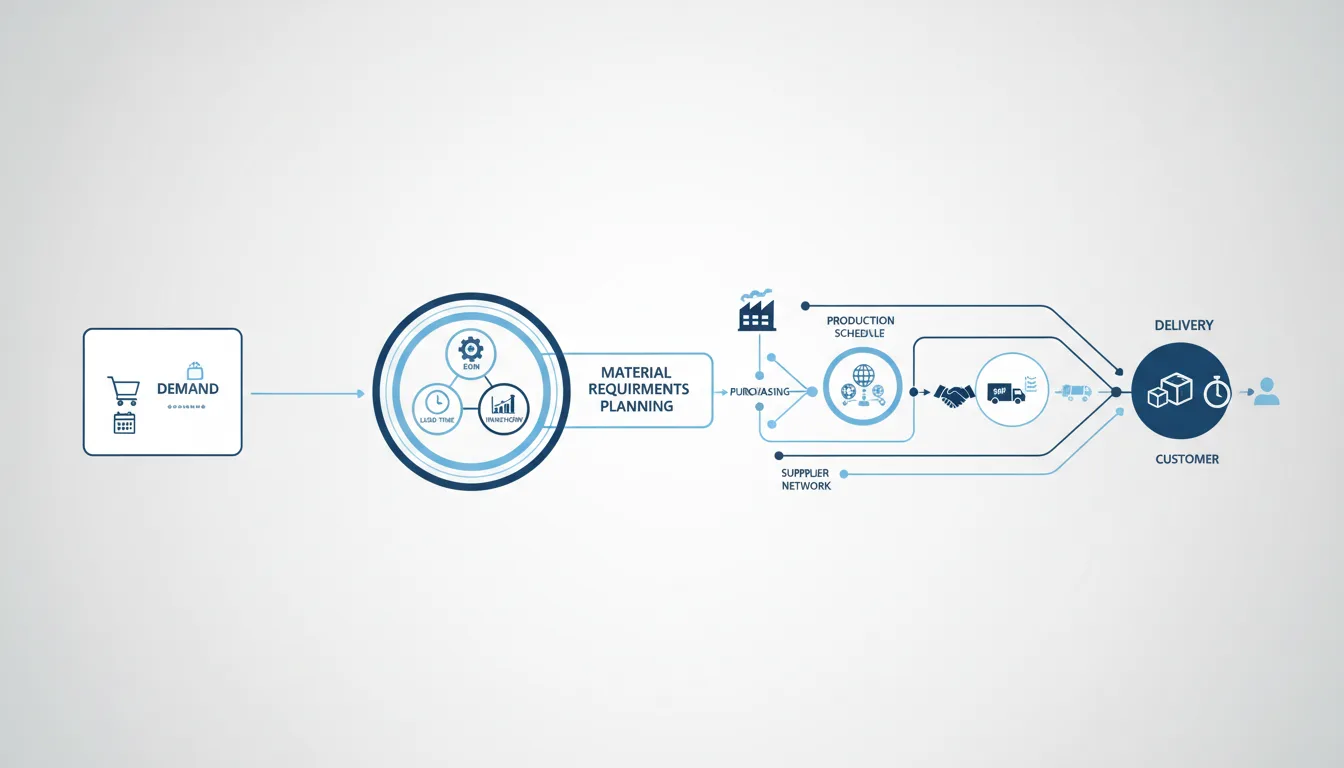
Material Requirements Planning (MRP) is a production planning and inventory control system designed to manage manufacturing processes and optimize supply chain operations. Developed to efficiently allocate resources, MRP aims to ensure that the right materials are available at the right time for production while keeping inventory costs low. By calculating material requirements based on forecasted production schedules and Bills of Material (BOM), MRP helps organizations minimize excess inventory, avoid stockouts, and streamline production. It serves as a fundamental component for effective supply chain management in various industries.
Etymology and Origins
The term "Material Requirements Planning" began to solidify in its modern interpretation during the late 1960s and early 1970s as businesses started leveraging nascent computer technology for production optimization. Linguistically, "material" refers to the physical components or raw goods required for manufacturing a product, while "requirements" signifies the precise quantities and timing needed, derived from a master production schedule (MPS). The concept represented a significant shift from traditional reorder point systems, which focused on aggregate inventory levels, to a time-phased, dependent demand approach that considered the specific components needed for scheduled final products.
This necessity for systematic material management arose from the increasing complexity of manufacturing post-World War II, with more intricate product designs and multi-level bills of materials. Early forms of material planning, often manual, underscored the need for a structured system. However, it was the advent of data processing capabilities that enabled the detailed calculations required for effective MRP, laying the groundwork for the term's widespread adoption and the institutionalization of these concepts within manufacturing organizations.
Historical Development
The evolution of MRP is a testament to the continuous drive for efficiency in manufacturing, spanning several distinct phases:
-
Pre-MRP Inventory Control (1950s-1960s): Before formal MRP, inventory management primarily relied on Economic Order Quantity (EOQ) models and reorder point systems. These methods focused on independent demand items and stock replenishment based on historical consumption, often leading to excess inventory or stockouts for dependent demand components. As manufacturing processes grew more complex, the limitations of these aggregate approaches became apparent, especially with multi-level Bills of Material (BOM).
-
MRP I (Material Requirements Planning) - 1960s-1970s: The foundational ideas of MRP were conceptualized and formalized by pioneers such as Joseph Orlicky at IBM and George Plossl. Their work, alongside others like Oliver Wight, led to the widespread adoption of the first generation of MRP systems. Orlicky's seminal 1975 work, Materials Requirement Planning: The New Way of Life in Production and Inventory Management, provided the definitive framework. MRP I focused on calculating net requirements for components and raw materials based on a master production schedule (MPS), Bill of Materials (BOM), and inventory records, using mainframe computers to process the complex logic. This allowed for time-phased planning, ensuring materials were available when needed for production.
-
MRP II (Manufacturing Resource Planning) - 1980s: As computing power increased, MRP evolved into MRP II. This second generation expanded beyond just materials to integrate planning for all manufacturing resources, including capacity, labor, machine time, and financial aspects. Companies like IBM played a crucial role in enhancing MRP systems by integrating them with computerized material management applications and production scheduling. MRP II facilitated a more holistic business planning approach by connecting production schedules with other functions like sales, finance, and marketing, providing feedback loops for better operational control and financial forecasting. This stage began to bridge the gap toward enterprise-wide integration.
-
ERP (Enterprise Resource Planning) - 1990s and Beyond: The natural evolution of MRP II led to Enterprise Resource Planning (ERP). ERP systems integrated virtually all business functions—including MRP, finance, human resources, customer relations, and supply chain management—into a single, comprehensive software suite. This allowed for real-time data access, improved cross-departmental collaboration, and greater operational visibility. Key players like SAP and Oracle emerged as leaders in the ERP market, solidifying the integration of material planning within broader business processes. The transition from manual processes to computerized systems in the 1970s, followed by advancements to automated and AI-driven applications in the 2000s, marked significant technology evolution milestones that reshaped the logistics and supply chain landscape.
-
Modern Advancements (2000s-Present): Contemporary MRP, often embedded within modern ERP or supply chain management (SCM) systems, leverages advanced technologies. Major industry events, such as the establishment of ISO standards in manufacturing and the widespread implementation of lean manufacturing practices, have further propelled the adoption of sophisticated MRP methodologies worldwide. The integration of cloud computing, Artificial Intelligence (AI) for predictive analytics, and the Internet of Things (IoT) for real-time data capture are transforming MRP into a highly responsive and adaptive planning tool.
Core Concepts
MRP operates through a series of interconnected components that govern production and inventory management. The primary function of MRP includes:
- Master Production Schedule (MPS): The foundational input for MRP, the MPS specifies what products are to be produced, when, and in what quantities. It serves as a commitment to customer orders and forecasts.
- Bill of Materials (BOM): A detailed listing of all raw materials, components, sub-assemblies, and quantities required to manufacture a finished product. The BOM structure is hierarchical, illustrating the parent-component relationships.
- Inventory Levels: Accurate and up-to-date records of current stock on hand, including work-in-process (WIP) and materials on order. This data is critical for determining net requirements. Modern systems like a visual inventory management system or platforms with mobile warehouse management system capabilities provide real-time inventory visibility.
- Lead Times: The time required to acquire (purchase lead time) or produce (manufacturing lead time) an item. MRP uses lead times to offset planned orders, ensuring materials arrive exactly when needed.
- Production Schedule (MRP Run): The process of translating the MPS into time-phased requirements for all components and raw materials, considering BOM, inventory, and lead times. This generates planned orders for purchasing and production.
Through these concepts, MRP systems provide organizations the necessary insights to optimize production while minimizing waste and costs, aligning material flow with production demands.
Industry Applications
MRP is widely used across various sectors due to its ability to manage complex production processes and material flows:
- Manufacturing: Essential for optimizing production lines by ensuring the timely procurement of materials, thus reducing lead times, minimizing downtime, and lowering operational costs. Examples include the automotive industry (e.g., Ford, Toyota) for managing thousands of parts in vehicle assembly, and electronics manufacturers (e.g., Intel, Samsung) for precise component scheduling in complex printed circuit board production.
- Retail (with Manufacturing Components): While primarily focused on sales, retailers with private label products or assembly operations utilize MRP to align stock with anticipated customer demand. For instance, major retailers like Walmart utilize sophisticated supply chain systems that integrate principles of MRP for managing their private-label product manufacturing and coordinating supplier deliveries.
- Aerospace and Defense: In industries with extremely complex supply chains, stringent quality requirements, and long lead times, MRP assists in managing intricate components, ensuring regulatory compliance, and maintaining strict production schedules. Critical for manufacturers such as Boeing and Airbus, where accuracy in component delivery is essential for safety and project timelines.
- Pharmaceuticals: MRP helps manage raw material procurement, track batch production, and adhere to strict regulatory guidelines (e.g., FDA requirements) by ensuring precise material availability and traceability for every drug formulation.
Benefits and Advantages
Implementing an MRP system can yield several key benefits that enhance operational efficiency and profitability:
- Improved Inventory Management: By accurately forecasting and scheduling material needs, businesses can minimize excess stock, reduce carrying costs, and prevent costly stockouts. This also allows for optimized warehouse space utilization and better cash flow management.
- Enhanced Production Efficiency: Streamlining the production process through precise material availability leads to faster turnaround times, reduced idle time, and increased throughput. This often results in improved Overall Equipment Effectiveness (OEE) and consistent adherence to production schedules.
- Better Customer Service: With the ability to meet demand consistently and deliver products on time, businesses can significantly improve customer satisfaction and loyalty. This is crucial for maintaining higher service levels and fulfilling customer expectations in a competitive market.
- Cost Reduction: Beyond inventory, MRP helps reduce costs associated with expedited shipping, production delays, and inefficient labor utilization by optimizing material flow and resource allocation.
Challenges and Limitations
Despite its advantages, MRP systems come with inherent challenges and limitations:
- Data Accuracy: The effectiveness of MRP is highly dependent on the accuracy of its input data, including BOMs, inventory records, lead times, and master production schedules. Erroneous information can lead to the "garbage in, garbage out" phenomenon, resulting in inefficiencies, stockouts, or excess inventory and increased production costs. Maintaining inventory accuracy through cycle counting and robust data management is paramount.
- Complexity: Implementing and maintaining a robust MRP system can be complex, particularly for businesses with diverse product lines, multi-level BOMs, and rapidly changing demand patterns. The initial investment in software, hardware, and extensive training can be substantial. Many SMEs struggled with initial MRP software adoption in the 2010s due to their intricate inventory needs and lack of dedicated IT resources.
- Rigidity: Some traditional MRP systems can be inflexible in adapting to sudden changes in production schedules, unexpected disruptions in the supply chain (e.g., supplier delays, geopolitical events), or fluctuating customer demand. This rigidity was particularly evident during global crises, like the COVID-19 pandemic, which highlighted the need for more agile planning systems.
- Integration Challenges: While modern MRP is often part of ERP, integrating MRP with other disparate systems (e.g., legacy systems, supplier portals, customer relationship management) can be technically challenging and costly, impacting data flow and real-time visibility.
Technology and Tools
Modern MRP tools have evolved significantly, moving from standalone systems to integrated platforms that leverage advanced technologies. Key advancements include:
- Integration with ERP Systems: Most MRP functionalities are now embedded within broader Enterprise Resource Planning (ERP) suites, providing a single source of truth for planning, finance, sales, and operations. This integration allows for a seamless flow of data across departments.
- Advanced Planning and Scheduling (APS): Modern MRP often works in conjunction with APS systems to optimize production sequences and resource allocation, considering finite capacity constraints. This moves beyond basic infinite capacity planning of earlier MRP versions.
- Real-time Data and Analytics: The transition from manual planning to automated solutions powered by data analytics allows organizations to make informed decisions rapidly. Systems like a mobile warehouse management system facilitate real-time inventory updates and operational insights that feed directly into MRP, improving its accuracy and responsiveness.
- Visual Inventory and Warehouse Management: Solutions such as visual inventory management systems play a vital role in facilitating data collection, tracking, and reporting for MRP processes by providing intuitive interfaces for stock levels and locations. Efficient purchase order management systems are also crucial outputs of an MRP run, ensuring that planned orders are effectively communicated and executed with suppliers.
Future Trends
The future of MRP systems is continuously being shaped by technological advancements and evolving supply chain demands:
- Artificial Intelligence (AI) and Machine Learning (ML): Leveraging AI for predictive analytics can significantly enhance demand forecasting accuracy, optimize inventory management by identifying patterns, and suggest dynamic adjustments to production schedules based on real-time data and unforeseen events. ML algorithms can analyze historical trends and external factors to improve planning reliability.
- Cloud Computing: Moving MRP systems to cloud platforms increases accessibility, scalability, and collaboration among stakeholders across distributed supply chains. Cloud-based solutions decrease costs related to IT infrastructure and maintenance, offering greater flexibility and faster deployment.
- Integration with Internet of Things (IoT): Incorporating IoT devices for real-time monitoring of inventory levels, equipment status, and production processes can provide granular data directly to MRP systems. This enhances operational visibility, enables proactive maintenance, and improves responsiveness to bottlenecks or disruptions.
- Digital Twins: Creating virtual replicas of physical production processes and supply chains allows for simulation and optimization of MRP scenarios without disrupting actual operations. This enables businesses to test different planning strategies and forecast their impact more effectively.
- Blockchain for Supply Chain Transparency: While still emerging, blockchain technology holds promise for enhancing data integrity and transparency across the supply chain, which could significantly improve the reliability of information feeding into MRP systems, especially for multi-enterprise collaboration.
Related Concepts
MRP is intricately linked to several other logistics and supply chain concepts, often serving as a foundational element:
- Just-in-Time (JIT): A manufacturing methodology closely related to MRP, focusing on producing goods only when needed and in the exact quantities required, thereby reducing inventory holding costs and waste. MRP helps achieve JIT by scheduling material deliveries precisely.
- Demand Planning: Involves forecasting future demand for products based on historical data, market intelligence, and statistical models. Accurate demand planning is crucial as it feeds into the Master Production Schedule (MPS), which is the primary input for MRP.
- Capacity Requirements Planning (CRP): An extension of MRP II, CRP takes the planned orders from MRP and translates them into required workload for various work centers and machines, ensuring that the production plan is feasible given available capacity. This helps identify and address bottlenecks.
- Enterprise Resource Planning (ERP): As discussed, MRP is often a core module or component of broader ERP systems that support the entire spectrum of business operations, integrating planning with finance, sales, and human resources.
- Advanced Planning and Scheduling (APS): Systems that provide more sophisticated optimization capabilities than traditional MRP, often considering complex constraints (e.g., machine availability, labor skills) to create highly optimized production schedules.
Sources
- Visual Inventory System
- WMS vs ERP Analysis
- Materials Requirement Planning: The New Way of Life in Production and Inventory Management
- Material Requirements Planning
- The Historical Evolution of Production Management Systems
- A Guide to Modern MRP Systems
- MRP's Integration with ERP Systems
- The Advantages of Modern Inventory Systems
- What is IoT?
- Mobile Warehouse Management System
- Purchase Order Management
- Cycle Counting Guide
- Between an ERP and a Hard Place: Why your WMS must integrate (and not compete) with your ERP
- What is OEE? - OEE.com
- What is Lean Manufacturing?
- Master Production Schedule (MPS): Definition, Steps, and Benefits
- Supply Chain Management (SCM): How It Works, Aims, and Importance
- ISO Standards
- Walmart's tech strategy to automate supply chain, labor with robotics
- Economic Order Quantity (EOQ): Formula, Example, and Limitations