Manufacturing Resource Planning
A comprehensive overview of Manufacturing Resource Planning (MRP II), its history, key concepts, applications, and benefits in today's manufacturing landscape.
Updated
Overview
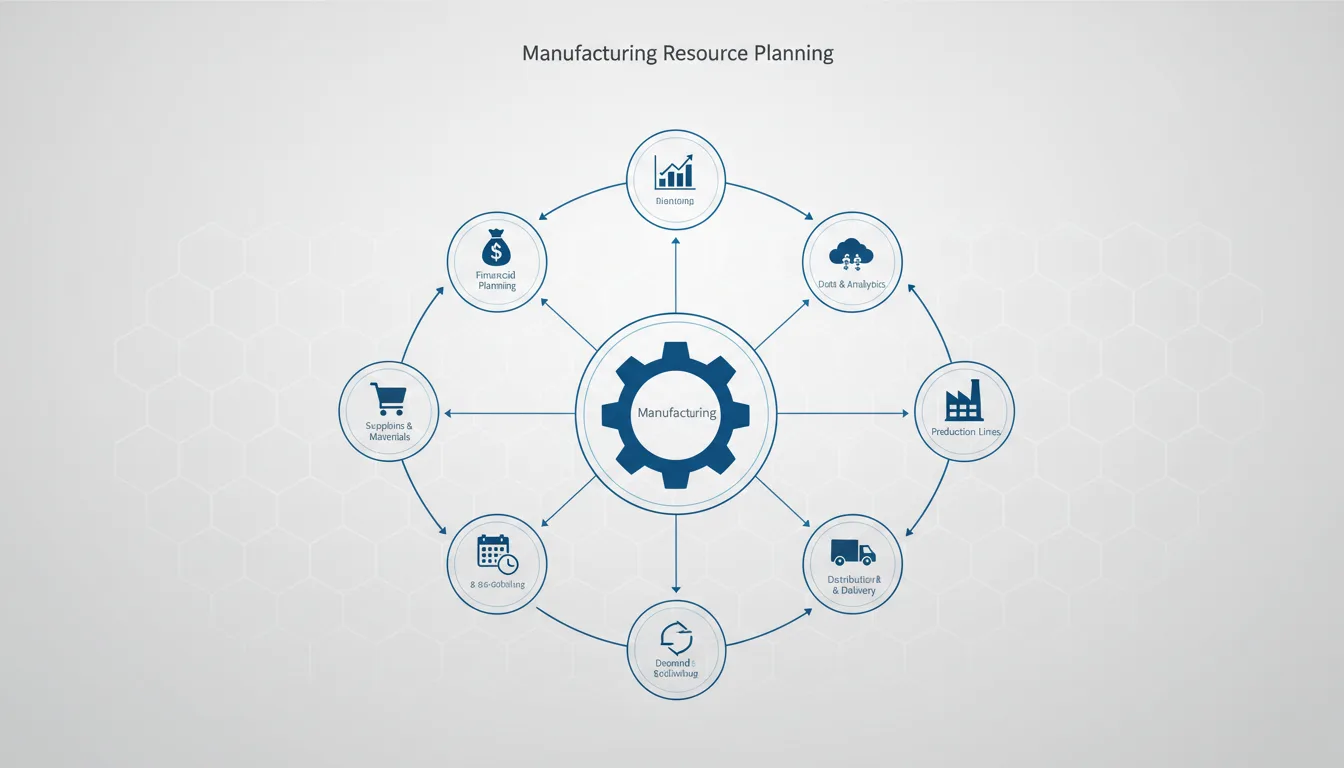
Manufacturing Resource Planning (MRP II) is an integrated approach to managing manufacturing processes and resources that evolved from Material Requirements Planning (MRP). It encompasses a broader range of business functions, including production scheduling, inventory management, capacity planning, and financial management, into a unified system [5]. MRP II aims to enhance operational efficiency, reduce costs, optimize resource utilization, and improve decision-making across the entire manufacturing enterprise, leading to better customer service and faster response times to market demands [6].
Etymology and Origins
The term "Manufacturing Resource Planning" (MRP II) was coined in the early 1980s by Oliver Wight, a prominent figure in production and inventory management [7]. It emerged as a significant evolution from the original Material Requirements Planning (MRP) systems of the 1960s. The "resource planning" aspect was deliberately chosen to reflect a broadened scope, moving beyond merely managing materials to encompassing the planning and control of all manufacturing resources, including machinery, labor, tools, and cash [8].
The linguistic roots trace back to the concept of "planning" for production, which, through MRP, initially focused on the materials needed. As the complexity of manufacturing grew and businesses sought more comprehensive control, the realization emerged that planning materials in isolation was insufficient. The integration of capacity, finance, and shop floor control became essential, thus leading to the designation of "Resource Planning" to signify this holistic view of the manufacturing enterprise [9]. This evolution marked a shift from an inventory management tool to a full-fledged business operating system for manufacturing companies.
Historical Development
The evolution of MRP II is a cornerstone in the history of operations management and can be traced through several distinct phases:
-
1950s - Early 1960s: Pre-MRP Era Before the advent of MRP, inventory management relied on traditional methods like Economic Order Quantity (EOQ) and reorder points, which were often inadequate for complex manufacturing with multiple components and multi-level bills of material (BOMs). As product complexity increased, especially in industries like aerospace and defense, the need for a more structured approach became evident [10].
-
Late 1960s - 1970s: The Rise of MRP (Material Requirements Planning) The first MRP systems emerged in the mid-1960s, largely pioneered by Joseph Orlicky at IBM, in collaboration with companies like J.I. Case and Caterpillar [11]. Orlicky's seminal work, Material Requirements Planning: The New Way of Life in Production and Inventory Management (1975), codified the principles of MRP. These early systems, often running on mainframe computers, focused on calculating the precise quantities of raw materials and components needed, and when they were needed, based on a Master Production Schedule (MPS) and Bills of Material (BOMs). The American Production and Inventory Control Society (APICS), now ASCM, played a crucial role in promoting and standardizing MRP concepts during this period [12]. MRP addressed inventory management challenges, streamlining the ordering of materials based on production schedules and minimizing excess stock.
-
Early 1980s: Emergence of MRP II (Manufacturing Resource Planning) By the early 1980s, it became clear that while MRP excelled at material planning, it lacked crucial links to other business functions like capacity planning, financial forecasting, and sales. Oliver Wight and George Plossl were instrumental in developing and popularizing the concept of MRP II. Wight's book, MRP II: Unlocking America's Productivity Potential (1984), became a guiding text [7]. MRP II was developed as a comprehensive extension of MRP, integrating financial planning, capacity planning, work-in-process tracking, shop floor control, and even sales and marketing considerations. This marked a shift from a departmental tool to an enterprise-wide planning system. Notable industry players like SAP and Oracle began to establish standardized, integrated software solutions that would later form the foundation of ERP [3].
-
1990s: Transition to Client-Server and ERP Integration With the rise of more powerful personal computers and client-server architectures, MRP II systems shifted from mainframe-based platforms to more accessible and user-friendly applications. This era also saw the concept of Enterprise Resource Planning (ERP) emerge, building upon MRP II by integrating even broader organizational processes beyond manufacturing, such as human resources, customer relationship management, and broader supply chain functions [3]. ERP became the successor concept, absorbing and extending the functionalities of MRP II.
-
2000s - Present: Cloud, AI, and IoT Integration In the 21st century, MRP II functionalities, largely embedded within modern ERP systems, have continued to evolve. The advent of cloud computing has enabled real-time data access, collaboration, and scalability, moving systems away from on-premise installations. Advanced analytics, Artificial Intelligence (AI), and Machine Learning (ML) are being integrated for predictive forecasting, optimized scheduling, and proactive problem-solving. The Internet of Things (IoT) connects machines and sensors on the shop floor, providing real-time data for enhanced monitoring and control, further improving decision-making and coordination across departments [13]. Mobile solutions, including mobile warehouse management systems, now provide on-the-go management capabilities for various operational processes.
Core Concepts
MRP II operates on several crucial, integrated principles:
-
Master Production Schedule (MPS): This is the central driver of the entire MRP II system. The MPS specifies what products will be manufactured, when they will be produced, and in what quantities, based on sales forecasts, customer orders, and available resources. It acts as the production plan for end items [14].
-
Material Requirements Planning (MRP) Subsystem: At its heart, MRP II still performs the core MRP function. It uses the MPS, Bills of Material (BOMs), and inventory records to calculate the precise quantities of raw materials and components needed, along with their due dates. This ensures materials are available when required for production, preventing delays and reducing holding costs [15]. Systems can manage lots and expiration dates for specific materials.
-
Capacity Requirements Planning (CRP): This function takes the planned orders from the MRP subsystem and translates them into a load on each work center and labor group. CRP checks the feasibility of the MPS by comparing required capacity against available capacity. If an imbalance exists, it helps identify bottlenecks and suggests adjustments to production schedules or capacity levels (e.g., overtime, additional shifts) [16].
-
Shop Floor Control (SFC): This module manages the actual execution of the production plan. It releases production orders, dispatches jobs to work centers, tracks work-in-process (WIP), and monitors job progress against schedules. SFC systems provide real-time visibility into production status and enable quick responses to deviations [17].
-
Financial Planning & Control: MRP II integrates production plans with financial data, including cost accounting, budgeting, and profit forecasting. It allows for detailed cost analysis of products, production runs, and resource usage, providing insights into profitability and enabling better financial control [8]. This integration facilitates real-time insights and enhanced coordination across functions.
-
Demand Management: This component bridges the gap between market demand and internal production capabilities. It involves forecasting customer demand, processing sales orders, and translating these into the MPS. Accurate demand forecasting is critical for optimizing inventory levels and production schedules, and can be supported by advanced analytics [18].
-
Purchasing and Vendor Management: MRP II extends to generating purchase orders for raw materials and components identified by the MRP system. It helps manage vendor relationships, track purchase order status, and optimize procurement processes. Modern systems offer capabilities like purchase order management and automated purchase quantity recommendations [19].
Industry Applications
MRP II's comprehensive capabilities make it indispensable across diverse manufacturing sectors, providing structure and efficiency to complex operations:
-
Automotive Manufacturing: Major manufacturers like Toyota and General Motors extensively apply MRP II principles, often integrated within their broader ERP systems, to manage the intricate supply chains for thousands of components. This supports lean production techniques, Just-In-Time (JIT) inventory, and minimization of waste by synchronizing parts delivery with assembly schedules [20].
-
Electronics Manufacturing: Companies such as Apple and Samsung leverage MRP II to coordinate highly complex global supply chains. This ensures timely delivery of a vast array of components from various suppliers, managing rapid product lifecycles, and enabling efficient assembly of high-tech devices, often balancing inventory costs with the risk of obsolescence [21].
-
Aerospace and Defense: Firms like Boeing and Lockheed Martin employ MRP II for intricate project management and resource scheduling. Given the multi-year production timelines, strict regulatory requirements, and high value of components, MRP II helps in managing long lead times, ensuring compliance, and coordinating the assembly of highly complex products [22].
-
Industrial Equipment and Machinery: Manufacturers of heavy machinery, agricultural equipment, and industrial tools use MRP II to manage custom orders, handle variations in product configurations, and plan for the large-scale production of durable goods. This includes managing complex Bills of Material and ensuring the availability of specialized parts [23].
-
Consumer Packaged Goods (CPG): Companies producing food, beverages, and household items utilize MRP II to manage high-volume production, perishable inventory (where lots and expiration dates are critical), and demand forecasting for fast-moving consumer items. This helps in optimizing production runs and distribution [24].
Benefits and Advantages
Implementing MRP II offers significant strategic and operational advantages for manufacturing enterprises:
-
Improved Production Efficiency: By synchronizing production activities, capacity, and material availability, MRP II minimizes downtime, reduces bottlenecks, and optimizes throughput. This leads to more consistent adherence to production schedules and improved overall productivity [6].
-
Enhanced Inventory Control: MRP II's precise material planning capabilities enable manufacturers to significantly reduce excess inventory levels, cutting holding costs, minimizing waste, and preventing obsolescence. Simultaneously, it ensures sufficient stock of necessary components for production, avoiding costly stockouts and production delays. Tools like visual inventory management systems further enhance control and visibility [25].
-
Optimal Resource Utilization: Organizations can allocate labor, machinery, and other resources more effectively by balancing capacity with demand. This minimizes idle time for equipment and personnel, maximizes the utilization of valuable assets, and reduces operational expenses [16].
-
Better Customer Service: Reliable production schedules and improved on-time delivery rates translate directly into higher customer satisfaction. MRP II helps in providing more accurate lead times and meeting promised delivery dates consistently [26].
-
Accurate Costing and Financial Planning: The integration of financial data with production planning allows for more accurate cost estimation per product and production run. This facilitates better budgeting, profitability analysis, and informed financial decision-making [8].
-
Streamlined Purchasing: MRP II automates the generation of purchase orders based on real production needs, reducing manual effort and errors. It supports strategic sourcing and supplier management, often leading to better negotiation power and more reliable supply chains. Purchase order management systems are key to this [19].
-
Improved Decision-Making: By providing a unified view of manufacturing operations and real-time data, MRP II empowers management with better insights to make strategic and tactical decisions regarding production, inventory, and resource allocation [13].
Challenges and Limitations
While MRP II presents numerous benefits, its successful implementation and operation come with notable challenges:
-
Complexity of Implementation: Transitioning from traditional methods to a comprehensive MRP II system can be highly complex, requiring significant investment in time, resources, and expertise. It often involves extensive data migration, system configuration, and integration with existing legacy systems. This can be cumbersome and prone to delays [27].
-
High Initial Cost: The acquisition of software licenses, hardware, implementation services, and training can represent a substantial upfront financial commitment, particularly for small to medium-sized enterprises [28].
-
Data Dependency and Accuracy: MRP II systems rely heavily on accurate and up-to-date data for Bills of Material, inventory records, lead times, and Master Production Schedules. Poor data quality can lead to erroneous forecasts, inaccurate scheduling, stockouts, or excess inventory, undermining the system's effectiveness. Maintaining data integrity is paramount [29].
-
Resistance to Change: Employees may resist adopting new systems and processes due to unfamiliarity, fear of job displacement, or reluctance to abandon established routines. Overcoming organizational resistance through effective change management, training, and clear communication is crucial for successful implementation [30].
-
Need for Continuous Training: As systems evolve and new functionalities are introduced, ongoing training for users is necessary to ensure the system is utilized to its full potential and to adapt to best practices. Many advanced features, like automated purchase quantity, require users to understand underlying logic.
-
Customization Challenges: While some customization may be necessary to fit unique business processes, excessive customization can increase implementation costs, complicate upgrades, and reduce system stability, making it difficult to leverage standard best practices [31].
Technology and Tools
Modern MRP II functionalities, often embedded within comprehensive ERP systems, leverage advanced technologies to enhance their capabilities:
-
Cloud Computing: Cloud-based MRP II/ERP systems offer significant advantages, including scalability, reduced IT infrastructure costs, and enhanced accessibility. They allow for real-time data access and collaboration among stakeholders across different locations, supporting distributed manufacturing and supply chains [32].
-
Artificial Intelligence (AI) and Machine Learning (ML): AI is increasingly integrated into MRP II for predictive analytics, significantly enhancing demand forecasting accuracy by analyzing historical data and external factors. ML algorithms can optimize production schedules, identify potential bottlenecks, and recommend preventive maintenance, leading to more robust planning and execution [13].
-
Internet of Things (IoT): IoT devices embedded in machinery and inventory provide real-time data on asset performance, production status, and inventory levels. This constant stream of data feeds directly into MRP II systems, enabling more accurate capacity planning, proactive maintenance scheduling, and dynamic adjustments to production plans based on actual conditions [13].
-
Mobile Applications: The proliferation of mobile devices has led to the development of mobile warehouse management systems and production tracking apps. These tools allow for on-the-go management of inventory, production orders, quality checks, and shipping, providing flexibility and real-time visibility to shop floor personnel and managers [1].
-
Advanced Analytics and Business Intelligence (BI): Modern systems incorporate powerful analytics tools and customizable dashboards. These provide deep insights into operational performance, financial metrics, and supply chain health, enabling data-driven decision-making and continuous process improvement [33].
-
Robotics and Automation: While not directly part of the software, the planning capabilities of MRP II are crucial for coordinating automated manufacturing processes and robotic work cells. The system can schedule tasks for robots, manage their maintenance, and track their output, integrating seamlessly with physical automation [34].
-
Visual Management Tools: Modern systems offer visual dashboards and interfaces for easier understanding of complex data, such as visual inventory management systems or graphical representations of production schedules and capacity loading [25].
Future Trends
The future of MRP II, largely within the broader ERP landscape, looks promising with the following developments poised to further revolutionize manufacturing operations:
-
Hyper-Automation: Ongoing advancements in automation and robotics, coupled with AI and ML, will lead to increasingly automated planning, scheduling, and execution within manufacturing. This includes self-optimizing production lines and autonomous material handling [34].
-
Digital Twins: The creation of virtual replicas of physical assets, processes, and entire factories will allow for real-time monitoring, simulation of production scenarios, predictive maintenance, and optimization of operations before changes are implemented in the physical world. This will significantly enhance the planning and control capabilities derived from MRP II principles [35].
-
Blockchain for Supply Chain Transparency: Blockchain technology offers the potential for immutable, transparent records across the supply chain. This can improve traceability of materials, enhance trust between partners, and streamline compliance, providing more reliable data inputs for MRP II systems [36].
-
Increased Interoperability with IoT: The Internet of Things (IoT) will continue to deepen its integration with planning systems, providing granular real-time data from every machine and sensor. This will promote smarter, more responsive decision-making and dynamic resource allocation, moving towards truly adaptive manufacturing [13].
-
Sustainability and Circular Economy Focus: Future MRP II systems will increasingly incorporate metrics and planning for environmental impact, resource efficiency, waste reduction, and support for circular economy models, helping manufacturers meet sustainability goals and regulatory requirements [37].
Related Concepts
MRP II is a foundational concept closely related to several other logistics and manufacturing methodologies:
-
Material Requirements Planning (MRP): As the predecessor, MRP focuses specifically on managing raw materials and components needed for production, driven by the Master Production Schedule. MRP II builds directly upon and subsumes these functionalities [15].
-
Enterprise Resource Planning (ERP): ERP is a wider organizational framework that integrates all aspects of a business, including manufacturing (where MRP II functions reside), finance, human resources, supply chain management, and customer relationship management. MRP II is effectively the manufacturing component within a comprehensive ERP system [3]. SkuSavvy provides tools that can integrate with or complement an ERP system, particularly for warehouse and inventory functions [2].
-
Advanced Planning and Scheduling (APS): APS systems often work in conjunction with or as an extension of ERP/MRP II. They use sophisticated algorithms and optimization techniques to create more precise and efficient production schedules, especially in complex environments with multiple constraints [38].
-
Supply Chain Management (SCM): SCM encompasses the entire flow of goods and services, from raw materials to end consumers. While MRP II focuses on internal manufacturing operations, it provides crucial data and plans that feed into and are informed by broader SCM strategies [39].
-
Just-In-Time (JIT): A production strategy aiming to reduce inventory costs and increase efficiency by receiving goods only as they are needed for production. MRP II systems are often configured to support JIT principles by optimizing material delivery schedules [20].
In summary, Manufacturing Resource Planning (MRP II) represents a critical evolutionary step in manufacturing management, transitioning from simple material tracking to a holistic, integrated system. Its development over the past several decades has profoundly influenced how manufacturers optimize their operations, integrate various business functions, and adapt to changing market demands. While often now integrated into broader ERP solutions, the core principles of MRP II remain vital for efficient and effective manufacturing in the contemporary industrial landscape.
Sources
- Mobile WMS Overview
- WMS vs ERP Analysis
- ERP Defined
- MRP and ERP Definitions
- Manufacturing Resource Planning (MRP II)
- MRP II: The Evolution of Manufacturing Planning
- MRP II: Unlocking America's Productivity Potential
- The APICS Dictionary, 16th Edition
- What is MRP II? A Complete Guide to Manufacturing Resource Planning
- A History of Production and Operations Management
- Material Requirements Planning: The New Way of Life in Production and Inventory Management
- APICS - Association for Supply Chain Management
- How IIoT, AI/ML, and Cloud Transform MRP II in Smart Manufacturing
- Master Production Schedule (MPS): Definition, Importance, and Examples
- Material Requirements Planning (MRP): Benefits, Challenges, and Examples
- Capacity Requirements Planning (CRP) Explained
- Shop Floor Control: Definition, Modules, and Benefits
- Demand Management: Definition, Process, and Strategy
- Purchase Order Management
- Just-in-Time (JIT) Inventory System: Toyota's Manufacturing Strategy
- How Apple Manages its Supply Chain
- Aerospace & Defense Industry Solutions
- ERP for Industrial Machinery Manufacturing
- ERP for Consumer Packaged Goods (CPG)
- Visual Inventory Management System
- MRP and ERP for Manufacturing: Key Differences and Benefits
- MRP II Challenges and How to Overcome Them
- The True Cost of an ERP System
- Cycle Counting Guide
- Overcoming Resistance to Change in ERP Implementation
- ERP Customization vs. Configuration: What's the Difference?
- Cloud ERP: What it is and how it benefits your business
- Business Intelligence (BI) in Manufacturing: Driving Efficiency with Data
- The Role of Robotics and Automation in Manufacturing
- Digital Twin: A Comprehensive Guide
- Blockchain in Supply Chain Management
- Sustainable Manufacturing: Integrating Environmental and Social Aspects
- Advanced Planning and Scheduling (APS) System
- Supply Chain Management (SCM): What It Is and Why It's Important