Manual Planning in Logistics
Manual planning in logistics involves traditional methods for managing inventory, order fulfillment, and warehouse operations without automated systems.
Updated
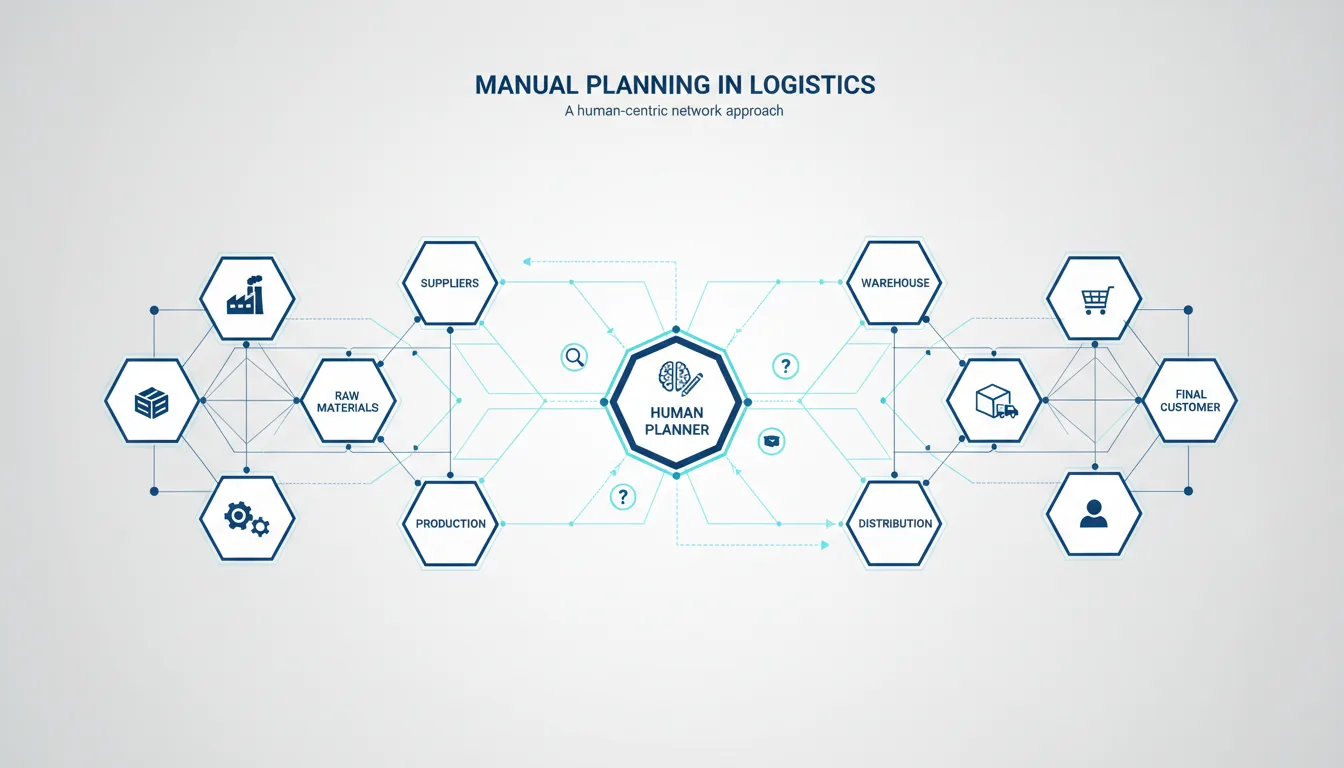
Manual Planning in Logistics
Overview
Manual planning in logistics is the practice of managing supply chain processes through non-automated methods, primarily relying on human decision-making, physical records, and basic tools. This approach typically involves individuals or small teams making decisions for tasks such as inventory management, order fulfillment, and transportation scheduling. While manual planning can offer significant flexibility and cost-efficiency for smaller operations, allowing for quick adaptations to unforeseen circumstances without complex software reconfigurations, it also presents notable challenges. These include inherent inefficiencies, the potential for human error, and limitations in scalability and data analysis. Many logistics professionals regard manual planning not just as a historical artifact, but as an essential foundational understanding for more advanced automated systems, and a viable operational model for specific niche businesses.
Etymology and Origins
The term "manual planning" inherently signifies human direct involvement in logistical processes, differentiating it from mechanized or automated methods. The word "manual" originates from the Latin manuālis, meaning "of the hand," reflecting the direct, physical action of individuals. Its linguistic roots trace back to manus (hand) and -alis (pertaining to). While the concept of human-led planning in supply and movement of goods is as old as civilization—evident in ancient military campaigns and trade routes—the specific term "manual planning" gained prominence as a descriptor in the late 19th and early 20th centuries. This period saw the rise of industrialization and scientific management, where the alternative of systematic, machine-assisted, or later, computer-assisted planning began to emerge, thus necessitating a distinction for human-centric methods [5]. The term evolved as a contrast to the burgeoning fields of operations research and early computerization, which sought to optimize and automate planning functions that had historically been solely human-driven.
Historical Development
The history of logistics is, in essence, the history of manual planning, as automation is a relatively recent development. Key milestones in its evolution and the subsequent shift away from purely manual methods include:
-
Ancient and Classical Eras: Early logistics were entirely manual, with planning often based on oral traditions, rudimentary maps, and visual cues. Examples include the elaborate supply lines of the Roman legions and the meticulously planned campaigns of Genghis Khan's Mongol armies, which relied on human couriers, animal transport, and extensive manual coordination of resources.
-
Industrial Revolution (18th-19th Century): The growth of factories, canals, and railways demanded more sophisticated manual planning. Factory managers used handwritten ledgers, stock books, and visual scheduling boards to coordinate production, raw materials, and distribution. This period saw the beginnings of systematic, though still manual, management techniques to cope with increased scale.
-
Early 20th Century & Scientific Management (1900s-1940s): Pioneers like Frederick Winslow Taylor and Henry Gantt introduced structured manual planning tools. Gantt charts, for instance, provided a visual method for project scheduling and resource allocation, widely adopted for factory production and large-scale engineering projects, all executed through manual drawing and updates. World War I and II further spurred innovation in military logistics planning, refining manual methods for managing vast quantities of matériel and personnel through centralized commands and detailed, paper-based operational plans.
-
Post-WWII & Operations Research (1940s-1950s): Originating from military efforts, Operations Research (OR) applied scientific methods to decision-making. Initial OR techniques like linear programming and queuing theory, while analytical, were often executed through manual calculations, slide rules, and early mechanical calculators, which laid the theoretical groundwork for optimization, even when the execution remained largely manual.
-
1960s-1970s: Emergence of Computerization: This decade marked the first significant shift away from purely manual planning for larger enterprises. The development of Material Requirements Planning (MRP I) by Joseph Orlicky at IBM in the late 1960s provided the first widely adopted computer-based system to plan and control inventory and production. While revolutionary, its adoption was gradual, and many smaller firms and specific processes continued with manual planning.
-
1980s-1990s: JIT and ERP Systems: The widespread adoption of Just-in-Time (JIT) manufacturing by Toyota, though highly sophisticated, still relied heavily on visual management tools like Kanban cards—a form of advanced manual/visual planning for pulling inventory through the production process. Concurrently, the evolution of MRP into Manufacturing Resource Planning (MRP II) and then Enterprise Resource Planning (ERP) systems began to integrate various business functions, making comprehensive manual planning for large, complex organizations increasingly impractical. Nonetheless, departmental-level manual planning persisted in many areas.
-
2000s Onwards: With the rise of advanced Warehouse Management Systems (WMS), Transportation Management Systems (TMS), and sophisticated supply chain software, manual planning has increasingly become either a baseline for smaller, nascent operations, a fallback for system failures, or a strategic choice for highly specialized or constrained environments. Seminal publications, such as The Logistics Handbook (published in 1998) and Supply Chain Management: Strategy, Planning, and Operation (published in 2001), discuss the historical role and diminishing scope of manual planning in modern, integrated logistics frameworks.
Core Concepts
Manual planning encompasses several core functions, relying heavily on human decision-making, direct observation, and non-digital record-keeping:
-
Inventory Management: This involves physical counts, tracking stock levels using ledger books, stock cards, or basic spreadsheets. Calculating reorder points, safety stock, and demand forecasts are often performed manually, based on historical sales data and intuition. Techniques such as cycle counting are crucial for reconciling physical and recorded inventories, often executed with paper forms and clipboards.
-
Order Fulfillment: This process typically involves receiving orders via phone, email, or fax, then transcribing them onto paper forms. Pickers use printed pick lists to locate items manually in the warehouse, often relying on familiar layouts or simple bin labeling. Packing slips are manually generated, and shipping labels might be handwritten or printed one-by-one from a basic desktop application, impacting speed and accuracy compared to automated order fulfillment software.
-
Transportation Management: Scheduling deliveries and shipments through manual methods involves significant coordination, often via phone calls, emails, and faxes with carriers and drivers. Route planning might use physical maps or simple spreadsheet-based calculations. Load optimization, carrier selection, and freight negotiation are heavily reliant on individual experience and communication, rather than automated algorithms.
Types and Classifications
Manual planning can be classified into several types based on operational focus and time horizons, even within its non-automated framework:
- Short-term Planning: This typically involves day-to-day management, such as allocating resources for immediate tasks, managing incoming and outgoing shipments, and processing orders based on current stock levels. It often relies on daily team huddles, visual boards, and immediate human responses to changes.
- Medium-term Planning: Covers weekly or monthly forecasts, stock requirements, and labor scheduling. This might involve reviewing past performance data (from spreadsheets or sales records), anticipating seasonal demand changes, and manually adjusting purchasing or production plans. It's crucial for managing cash flow and avoiding stockouts or overstocking.
- Long-term Planning: Focuses on strategic decisions over several months or years, such as supplier relationship management, warehouse location decisions, and major equipment purchases. These plans are developed through market research, expert consultations, and projections based on aggregated historical data, all compiled and analyzed manually or with very basic computational aids.
Industry Applications
Manual planning is primarily found in contexts where the scale of operations, budget constraints, or specific operational requirements make sophisticated automated systems impractical or unnecessary.
- Small to Medium-sized Enterprises (SMEs): Many SMEs, especially startups or those with limited capital, initially rely on manual planning due to lower upfront costs and simpler operational needs. This often includes local retail stores, independent craftspeople, small-scale food producers, and nascent e-commerce businesses managing inventory from a home office or small warehouse. For example, a local grocery store may oversee inventory through basic ledger systems or spreadsheets to track stock rather than using an advanced inventory management system.
- Niche or Highly Specialized Operations: Businesses dealing with unique, high-value, or custom products often find manual oversight beneficial. Art galleries managing unique pieces, custom furniture makers, or specialized agricultural producers may prefer direct human control over inventory and fulfillment processes.
- Remote or Low-Tech Environments: In regions with limited infrastructure or internet access, manual planning remains the most viable option. Disaster relief operations, initial stages of humanitarian aid, or operations in underdeveloped areas often depend on robust manual systems due to unpredictable conditions and limited technological resources.
Case Study Example: A small, independent bookstore uses a ledger book to track incoming shipments, a whiteboard to manage customer special orders, and simple visual cues on shelves for restocking. The owner performs weekly manual counts and uses a basic spreadsheet to calculate reorder quantities based on historical sales and personal experience with customer preferences. This system provides sufficient control for their scale and unique inventory profile, leveraging the owner's deep product knowledge.
Benefits and Advantages
Despite the clear limitations, manual planning offers several compelling advantages, particularly for specific operational contexts:
- Flexibility and Adaptability: Manual systems allow for immediate, on-the-fly adaptations to changing demands, unexpected issues, or special customer requests without the need for complex software reconfigurations or system updates. Human decision-makers can quickly interpret unusual circumstances and devise novel solutions.
- Cost-Efficient: It involves lower upfront costs as there's no need for expensive software licenses, hardware, IT infrastructure, or specialized technical staff. This makes it an attractive option for startups, small businesses, or operations with tight budgets that may not justify the investment in automated systems.
- Human Insight and Intuition: Experienced logistics professionals bring valuable intuition, qualitative assessment, and pattern recognition that automated systems might overlook. They can detect subtle issues, anticipate non-quantifiable risks, and foster stronger relationships with suppliers and customers through direct communication. This human element is crucial for handling exceptions and nuanced situations.
- Accessibility: Manual processes require minimal technical skills and can be easily understood and executed by a wide range of personnel. This reduces training overhead and makes operations less dependent on specialized IT knowledge.
- Control and Transparency (for small teams): For very small operations, everyone involved often has a clear, direct understanding of the entire process, fostering a sense of control and enabling quick identification of bottlenecks through direct observation.
Challenges and Limitations
Manual planning faces significant difficulties, which typically become more pronounced as operations scale or complexity increases:
- Inefficiencies and Time Consumption: Processes are often laborious and time-consuming, requiring significant human effort for data entry, verification, and coordination. This leads to slower processing times for orders, inventory updates, and reporting, hindering overall operational velocity.
- High Risk of Human Error: Manual data entry, calculations, and decision-making are inherently prone to mistakes, leading to incorrect stock levels, misrouted shipments, order discrepancies, and inaccurate forecasting. These errors can result in significant financial losses, customer dissatisfaction, and supply chain disruptions.
- Limited Scalability: As operations grow in volume, product diversity, or geographical spread, manual methods become increasingly unmanageable. The exponential increase in data, tasks, and coordination required quickly overwhelms human capacity, necessitating a transition to more robust warehouse management systems or other automated solutions.
- Poor Data Visibility and Analysis: The lack of integrated systems and real-time data makes it difficult to gain comprehensive insights into performance. Trends are hard to identify, root causes of problems are obscured, and data-driven decision-making is severely limited. This reliance on gut feeling rather than analytics can impede strategic growth.
- Dependence on Institutional Knowledge: Manual systems often rely heavily on the tacit knowledge and experience of a few key individuals. If these individuals leave the organization, critical operational knowledge can be lost, creating significant operational vulnerabilities.
- Lack of Real-time Information: Updates to inventory levels, order statuses, or shipment progress are often delayed, leading to blind spots and hindering proactive problem-solving. This lack of real-time visibility can result in missed opportunities and delayed responses to market changes.
Best Practices
To enhance the effectiveness of manual planning and mitigate its inherent drawbacks, organizations can adopt several best practices, some of which involve leveraging simple technological aids:
- Standard Operating Procedures (SOPs): Documenting clear, step-by-step procedures for every task (inventory counts, order processing, returns) ensures consistency, reduces errors, and facilitates training for new staff. This reduces reliance on individual memory and promotes operational uniformity.
- Regular Training and Cross-training: Continuously training staff on best practices for manual processes and cross-training individuals on multiple roles helps build redundancy, reduces single points of failure, and enhances overall team flexibility.
- Visual Management Systems: Employing visual aids like whiteboards, shadow boards, physical Kanban cards, and color-coded bins can significantly improve clarity, communication, and efficiency in manual operations. These tools make the status of tasks and inventory immediately apparent.
- Routine Audits and Reconciliation: Conducting frequent physical inventory counts (cycle counting) and regularly reconciling manual records with physical stock helps identify and correct discrepancies early, improving data accuracy.
- Leveraging Simple Technology: Gradually incorporating accessible and cost-effective technological tools can significantly augment manual processes without full automation. Examples include using basic spreadsheets for forecasting and tracking, simple barcode scanners for inventory check-ins to reduce manual transcription errors, and cloud-based document sharing for collaborative planning. Even a basic Purchase Order Management system can automate part of the procurement process while allowing for manual oversight.
- Clear Communication Channels: Establishing efficient and clear communication protocols between team members, suppliers, and customers reduces misunderstandings and speeds up problem resolution.
Future Trends
As technology continues to advance, the landscape for manual planning is evolving rapidly. Increasingly, there will be a focus on hybrid systems, where core manual processes are augmented by automation to enhance speed, accuracy, and data visibility without entirely relinquishing human oversight.
- Augmented Manual Planning: This trend involves using accessible, user-friendly digital tools to support and improve manual tasks. Examples include mobile apps for simplified inventory data entry, cloud-based spreadsheets with basic formulas for collaborative planning, or digital checklists. These tools reduce manual effort while keeping humans in the loop for decision-making.
- Low-Code/No-Code Platforms: The rise of low-code/no-code development platforms will empower businesses to build custom, semi-automated tools that bridge the gap between purely manual systems and full-fledged enterprise solutions. This allows for tailored automation of repetitive tasks while maintaining human control over critical decisions.
- Increased Data Literacy for Manual Planners: Even with augmented tools, the ability of human planners to interpret basic data, understand simple analytics, and make informed decisions will become increasingly crucial. Training in data literacy will enable better use of even rudimentary digital tools.
- Focus on Exception Management: As routine tasks become automated, human planners will increasingly focus on managing exceptions, handling complex customer queries, and applying creative problem-solving to unforeseen supply chain disruptions—areas where human intuition and flexibility remain indispensable.
In conclusion, while manual planning forms a fundamental aspect of logistics history and remains a viable, often preferred, option for specific operational contexts, its limitations highlight the continuous need for innovation. The future points towards a synergistic relationship where human expertise and judgment are enhanced by accessible technology, streamlining processes and driving organizations toward more sophisticated, yet still human-centric, solutions.
Sources
- Cycle Counting Guide
- Visual Inventory System
- Mobile Warehouse Management System
- Mobile Order Fulfillment
- Online Etymology Dictionary
- Cambridge University Press - Military Logistics from the Roman Empire to the Nineteenth Century
- Britannica - Operations Research
- SkuSavvy Documentation: Barcodes Guide
- SkuSavvy: Purchase Order Management
- Gartner - Low-Code Application Platform (LCAP)