Management Principles in Logistics
Exploring essential management principles for logistics and supply chain professionals, focusing on strategies, challenges, and best practices.
Updated
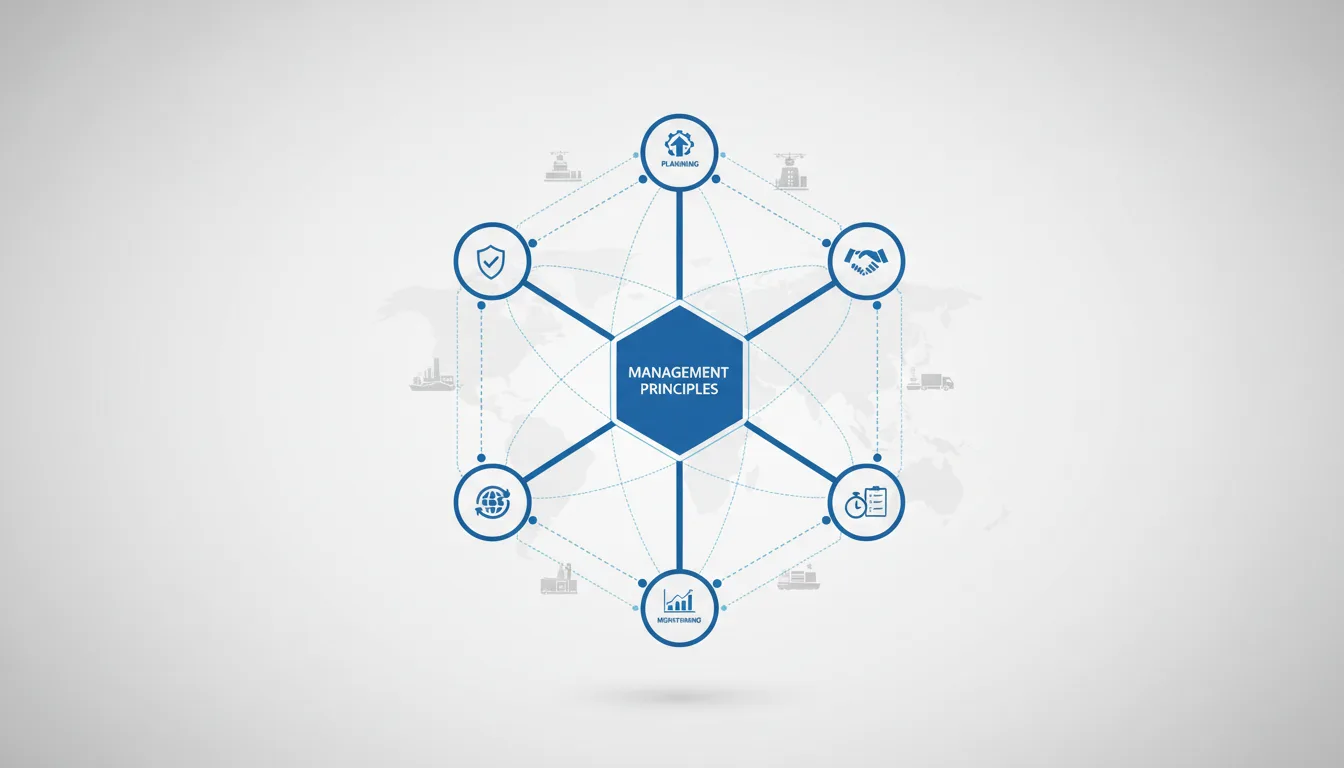
Management Principles in Logistics
Overview
Management principles in logistics refer to the fundamental ideas and strategies that govern effective organization and operation within the logistics sector. These principles ensure that goods are moved, stored, and managed efficiently to meet customer demands while optimizing cost and service levels. The implementation of these principles is critical for enhancing productivity, reducing waste, and achieving operational excellence in supply chain management. Effective logistics management integrates various functions, from transportation and warehousing to inventory control and order fulfillment, all guided by these foundational principles.
Etymology and Origins
The term 'management' originates from the Latin word manu actus, meaning "to lead by hand" or "to direct," emphasizing control and coordination [5]. This concept has evolved significantly from simple oversight to intricate methodologies that drive strategic decision-making. The historical roots of management principles can be traced back to the contributions of pioneers like Henri Fayol and Frederick Taylor in the late 19th and early 20th centuries, who introduced theories on efficiency, administrative functions, and workflow optimization that remain foundational to modern management thought [6].
The term "logistics" itself has a distinct etymological path. It derives from the Ancient Greek word logistikos (λογιστικός), meaning "skilled in calculating" or "accountant" [7]. This term passed into Latin as logisticus and later into French as logistique, which, by the early 19th century, was primarily used in a military context. Antoine-Henri Jomini, a Swiss general and military theorist, is often credited with popularizing logistique in his writings, defining it as the practical art of moving, housing, and supplying armies [8].
The application of "logistics" to business operations began to emerge in the mid-20th century, particularly after World War II. The complexities of wartime supply chains and military organization demonstrated the need for systematic planning and execution in moving goods. By the 1950s and 1960s, the term started appearing in academic and business literature, signifying the formalization of managing the flow and storage of goods, services, and information within commercial enterprises [9]. The convergence of general management principles with this specialized focus on material flow gave rise to the discipline of "management principles in logistics."
Historical Development
Early Foundations (Late 19th Century - Mid 20th Century)
The turn of the 20th century saw the emergence of modern management practices that laid the groundwork for contemporary logistics. Frederick Winslow Taylor's scientific management, detailed in his 1911 work The Principles of Scientific Management, focused on optimizing workflow by analyzing and synthesizing tasks, aiming to improve economic efficiency, especially labor productivity [10]. Concurrently, Henri Fayol's administrative theory proposed 14 principles of management, including division of work, authority, discipline, and unity of command, which provided a framework for organizational structure and coordination [11].
These theories influenced industrial giants like Henry Ford, who revolutionized manufacturing with the introduction of the moving assembly line in 1913. Ford's integrated production system, from raw materials to finished vehicles, embodied early concepts of supply chain synchronization and efficiency, laying the groundwork for mass production techniques and the modern supply chain [12]. Early military logistics, refined during World War I and II, also provided invaluable lessons in large-scale resource allocation, transportation, and inventory management, which later transferred to the commercial sector.
The 1960s to 1980s: Formalization and Systems Thinking
During the post-war period, the academic and industrial focus shifted towards more integrated approaches. The 1960s saw the establishment of the National Council of Physical Distribution Management (NCPDM), later renamed the Council of Supply Chain Management Professionals (CSCMP), marking a formal recognition of physical distribution as a distinct management function [13]. This era emphasized total cost analysis and the trade-offs between transportation, warehousing, and inventory costs.
Seminal concepts like Just-In-Time (JIT) inventory emerged in Japan, pioneered by companies such as Toyota. Developed by Taichi Ohno and Shigeo Shingo, JIT aimed to reduce waste and improve efficiency by receiving goods only as they are needed for production, drastically minimizing inventory holding costs and improving responsiveness [14]. This created a new framework for managing logistics and inventory more efficiently.
In the realm of planning, the development of Material Requirements Planning (MRP) systems in the 1970s, notably championed by Joseph Orlicky and Oliver Wight, transformed manufacturing. These computerized systems helped plan production, scheduling, and inventory control for complex products, coordinating components across the supply chain. MRP evolved into Manufacturing Resource Planning (MRP II) by the 1980s, integrating more business functions [15]. Academic and industry publications, such as Logistics Management and Distribution Report, began to outline best practices and theories specific to the burgeoning logistics field.
The 1990s Onwards: Digitalization and Globalization
With the advent of advanced computing and the internet, the late 20th century introduced sophisticated computerized inventory management systems and Enterprise Resource Planning (ERP) solutions, enhancing data accuracy, real-time tracking capabilities, and cross-functional integration [16]. The term "Supply Chain Management (SCM)" gained prominence, emphasizing the strategic coordination of business functions within and across organizations [17].
Noteworthy innovations included the development of advanced automation in warehouses, such as automated storage and retrieval systems (AS/RS) and conveyor belts, and the widespread adoption of warehouse management systems (WMS). These systems revolutionized how logistics operations were conducted by providing granular control over inventory, labor, and space utilization within a warehouse [18]. The rise of e-commerce in the late 1990s further accelerated the need for efficient logistics, driving innovations in order fulfillment and last-mile delivery.
21st Century: Hyper-Connectivity and Intelligence
The 21st century has been characterized by hyper-connectivity, big data, and increasing automation. The growth of global supply chains and the demanding nature of omnichannel retail have pushed logistics management to embrace technologies like the Internet of Things (IoT), Artificial Intelligence (AI), Machine Learning (ML), and blockchain [19]. These technologies enable predictive analytics, real-time visibility across vast networks, autonomous vehicles, and enhanced security and traceability, fundamentally reshaping logistics processes and decision-making.
Core Concepts
At the heart of logistics management principles lie several core concepts that ensure efficient and effective operations:
-
Supply Chain Collaboration - Successful logistics requires seamless collaboration among all stakeholders, from suppliers and manufacturers to distributors, retailers, and even customers. This involves sharing information, coordinating activities, and aligning goals to optimize the entire supply chain. Integrating order fulfillment systems that can communicate across different partners allows for streamlined processes, improved responsiveness, and reduced lead times. Vendor portals and shared platforms facilitate this critical information exchange, fostering stronger relationships and mutual benefits.
-
Inventory Optimization - Efficient inventory management is crucial for balancing supply with demand, minimizing carrying costs, and avoiding stockouts. This involves employing various techniques such as setting appropriate safety stock levels, utilizing ABC analysis to prioritize inventory management efforts, and implementing precise cycle counting programs. Modern approaches leverage predictive analytics to forecast demand more accurately and determine optimal reorder points, often supported by visual inventory management systems that provide real-time insights into stock levels and locations.
-
Process Improvement (Lean Principles) - Lean methodologies, originating from the Toyota Production System, focus on continuous improvement and waste elimination (Muda) across all logistics processes [20]. This includes identifying and eliminating non-value-added activities such as excessive waiting, unnecessary movement, overproduction, and defects. The goal is to ensure that every step in the logistics chain adds value, leading to increased efficiency, reduced costs, and higher quality. Implementing structured workflows and conducting regular process audits are key to sustained improvement.
-
Technology Integration - Implementing advanced logistics technologies is no longer an option but a necessity. These technologies enhance accuracy, efficiency, and visibility throughout the supply chain. Examples include automated data capture via barcoding systems and RFID, sophisticated Warehouse Management Systems (WMS), Transportation Management Systems (TMS), and predictive analytics platforms. Proper integration of these systems is crucial to create a cohesive and responsive logistics network, enabling capabilities like automated rate selection and optimized routing.
Types and Classifications
Various management principles can significantly impact logistics operations, offering different frameworks for achieving operational goals:
- Lean Management - Beyond just waste reduction, Lean logistics aims to create maximum value for the customer with minimum resource consumption. This involves streamlining processes, optimizing flow, pulling inventory through the system based on demand rather than pushing it, and continuous improvement. In logistics, this translates to minimizing inventory, optimizing warehouse layouts for efficient picking (bin packing), and reducing transportation mileage.
- Agile Management - Promotes flexibility and responsiveness to rapidly adapt to changing market demands, customer requirements, and unexpected disruptions. Agile logistics emphasizes short planning cycles, cross-functional teams, and the ability to quickly reconfigure supply chain assets and processes. This is particularly vital in volatile markets or for products with short life cycles.
- Total Quality Management (TQM) - Focuses on long-term success through customer satisfaction, achieved by consistent quality improvement across all organizational processes. In logistics, TQM ensures reliable delivery, accurate order fulfillment, damage prevention, and continuous enhancement of service quality. This involves establishing quality metrics, empowering employees, and fostering a culture of continuous feedback.
- Six Sigma - A data-driven methodology used to eliminate defects (errors) in any process. It seeks to improve the quality of process outputs by identifying and removing the causes of defects and minimizing variability in manufacturing and business processes [21]. Applying Six Sigma in logistics can reduce errors in order picking, improve delivery time predictability, and minimize transportation damages, leading to higher customer satisfaction and lower operational costs.
Industry Applications
Management principles are utilized across several sectors, adapting to their unique operational needs:
- Retail - Efficient inventory management principles are paramount for retailers to maintain optimal stock levels, manage product assortments, and prevent stockouts or overstock. Lean principles minimize holding costs, while agile approaches allow rapid response to fashion trends or promotional activities. Automation, such as efficient multi-box shipping algorithms and mobile warehouse management systems, streamlines fulfillment for both physical stores and e-commerce operations. Shopify WMS integration is a specific example that helps retailers manage inventory and fulfillment directly within their e-commerce platform.
- Manufacturing - Lean methodologies are deeply embedded in manufacturing logistics, improving production efficiency by reducing waste, optimizing material flow, and implementing Just-In-Time practices to minimize inventory costs for raw materials and work-in-progress. Management principles also guide the effective deployment of batch picking and kitting strategies, ensuring that components are available precisely when and where they are needed on the assembly line. Purchase order management systems are critical here for managing supplier relationships and inbound logistics.
- E-commerce - The fast-paced e-commerce sector demands highly responsive and accurate logistics. Principles here focus on speed, efficiency, and customer satisfaction. Real-time tracking systems, effective distribution strategies, and optimized last-mile delivery are critical. Mobile order fulfillment software and automated picking processes enable rapid turnaround times, while robust order management systems ensure order accuracy and efficient processing from click to delivery. Managing returns (reverse logistics) is another significant application where these principles apply.
Benefits and Advantages
The systematic implementation of sound management principles in logistics yields numerous benefits, contributing significantly to a company's bottom line and competitive advantage:
- Cost Reduction - Streamlined processes, optimized inventory levels, and efficient resource allocation directly lead to lower operational costs. By eliminating waste, reducing fuel consumption, and optimizing warehouse space, companies can achieve substantial savings. For instance, cycle counting can reduce the need for costly annual physical inventories.
- Enhanced Efficiency and Productivity - Better resource allocation, optimized routes, and automated processes enhance overall productivity. Technologies like mobile WMS can significantly improve worker productivity by providing real-time instructions and reducing manual data entry. Productivity tracking allows for continuous monitoring and improvement of individual and team performance.
- Improved Customer Satisfaction - Timely and accurate delivery, combined with effective communication, builds strong customer relationships and loyalty. Meeting customer expectations for speed and reliability, particularly in e-commerce, is a direct outcome of well-managed logistics. Consistent service quality, often guided by TQM principles, also contributes to this.
- Greater Supply Chain Visibility - Modern logistics principles, supported by technology, provide end-to-end visibility across the supply chain. This transparency allows managers to identify bottlenecks, track shipments in real-time, and make proactive decisions, leading to better risk management and greater responsiveness.
- Increased Agility and Resilience - By adopting agile principles, organizations can quickly adapt to market changes, demand fluctuations, and unforeseen disruptions. This resilience is crucial for maintaining operations in a dynamic global environment, preventing significant financial losses during crises.
Challenges and Limitations
Despite the clear advantages, implementing and maintaining robust logistics management principles comes with its own set of challenges:
- Technology Integration Complexity - Implementing new systems (like ERP, WMS, or TMS) can be costly, time-consuming, and require significant technical expertise. Ensuring seamless integration between disparate systems from different vendors is a major hurdle. Legacy systems often complicate this process, requiring careful planning and substantial investment.
- Supply Chain Disruptions - External factors such as natural disasters, geopolitical tensions, trade wars, pandemics, or sudden shifts in consumer demand can severely impact logistics operations. Even the most optimized supply chains can struggle to maintain continuity during major disruptions, highlighting the need for robust contingency planning and resilient network design.
- Change Management and Resistance - Adopting new management principles or technologies often requires significant changes to established processes and employee roles. Resistance to change within organizations, cultural barriers, and a lack of proper training can hinder the successful adoption of new practices, potentially undermining the benefits.
- Data Overload and Analytics Capability - While technology provides vast amounts of data, extracting meaningful insights requires sophisticated analytics capabilities and skilled personnel. Without proper data governance and analytical tools, companies can suffer from data overload, making it difficult to identify actionable intelligence.
- Balancing Cost, Service, and Sustainability - Achieving an optimal balance between minimizing costs, maximizing service levels, and adhering to growing sustainability demands (e.g., reducing carbon footprint, ethical sourcing) is a complex challenge. Trade-offs often exist, requiring strategic decision-making and careful optimization across multiple objectives.
Best Practices
To successfully apply management principles in logistics and overcome associated challenges, consider the following best practices:
- Invest in Continuous Training and Development - Continuous training of employees in new technologies, lean methodologies, and evolving best practices enhances adoption rates and improves overall competency. This includes training on WMS usage, barcode scanning techniques, and process improvement tools. Empowering employees with knowledge fosters a culture of continuous improvement.
- Utilize Key Performance Indicators (KPIs) and Analytics - Regularly monitoring and analyzing relevant KPIs (e.g., order fulfillment cycle time, inventory turnover, on-time delivery rates, perfect order rate) provides critical insights into performance and areas for improvement. Data-driven decision-making, supported by tools like productivity tracking, is essential for identifying bottlenecks and optimizing processes.
- Foster Collaboration and Transparency Across the Supply Chain - Engaging all stakeholders, including suppliers, carriers, and customers, promotes a transparent and responsive supply chain. Sharing information, collaborating on forecasting, and aligning objectives through tools like vendor portals build stronger relationships and improve overall network efficiency.
- Embrace Technology and Automation Strategically - Implement advanced logistics technologies where they offer the greatest return on investment. This includes mobile warehouse management systems, IoT for real-time tracking, AI for demand forecasting, and automation for repetitive tasks. Focus on integrated solutions that provide end-to-end visibility.
- Adopt a Continuous Improvement Mindset (Kaizen) - Cultivate a culture of continuous improvement (Kaizen). Regularly review processes, solicit feedback, and implement small, incremental changes to drive efficiency and quality over time. This proactive approach helps maintain competitiveness and adaptability.
Future Trends
Looking ahead, the logistics landscape will continue to be shaped by technological advancements and evolving global demands. Trends such as the increased adoption of Artificial Intelligence (AI) and Machine Learning (ML) in logistics management are anticipated to reshape operations significantly. These technologies will enable more accurate predictive decision-making, dynamic routing, and automated warehouse operations. The Internet of Things (IoT) will provide unprecedented real-time visibility into inventory and asset location, condition, and movement.
Other key trends include the widespread implementation of robotics and autonomous vehicles in warehousing and transportation, increasing demands for sustainable logistics practices (e.g., green logistics, circular economy models), and the continued rise of omnichannel fulfillment requiring highly flexible and integrated systems. Data analytics for prescriptive decision-making and enhancing real-time visibility will become increasingly valuable, driving the evolution towards hyper-connected, intelligent, and resilient supply chains.
Related Concepts
Management principles in logistics are closely connected to various other concepts, including broader supply chain management, quality control, operations research, and process optimization. Understanding these relationships and how they intertwine can enrich a logistics professional's capability to implement effective strategies within their organization. Concepts like lean manufacturing, six sigma, and strategic sourcing all fall under the umbrella of effective logistics and supply chain management, highlighting the multidisciplinary nature of the field.
Sources
- Mobile Warehouse Management System
- Order Management System
- Multi-Box Shipping
- Barcodes Guide
- Henri Fayol
- Frederick W. Taylor
- Logistics | Etymology, origin and meaning of logistics by etymonline
- Antoine-Henri, Baron de Jomini
- The Evolution of Supply Chain Management
- Scientific Management
- Fayol's Principles of Management: A Guide to Management Theory
- Mass Production
- CSCMP History
- Lean Lexicon: Taiichi Ohno
- Material Requirements Planning (MRP) definition & history
- A brief history of ERP
- What is Supply Chain Management? | CSCMP
- Mobile WMS Overview
- How IoT is Revolutionizing Supply Chain Logistics
- Lean Manufacturing - The 7 Wastes (Muda)
- What is Six Sigma?
- Vendor Portal
- Cycle Counting Guide
- Visual Inventory Management System
- Workflows Overview
- Automated Rate Selection
- Bin Packing Visualizer
- Shopify WMS Overview
- Batch Picking Guide
- Kitting Guide
- Purchase Order Management
- Mobile Order Fulfillment Software
- Productivity Tracking
- Achieving operational excellence in the supply chain
- Just-in-Time (JIT) Inventory System
- AI and advanced analytics in supply chains
- The Future of Robotics and Automation in Logistics