Load Optimization in Logistics
Load optimization is a critical process in logistics ensuring efficient space utilization and cost management in transportation.
Updated
Overview
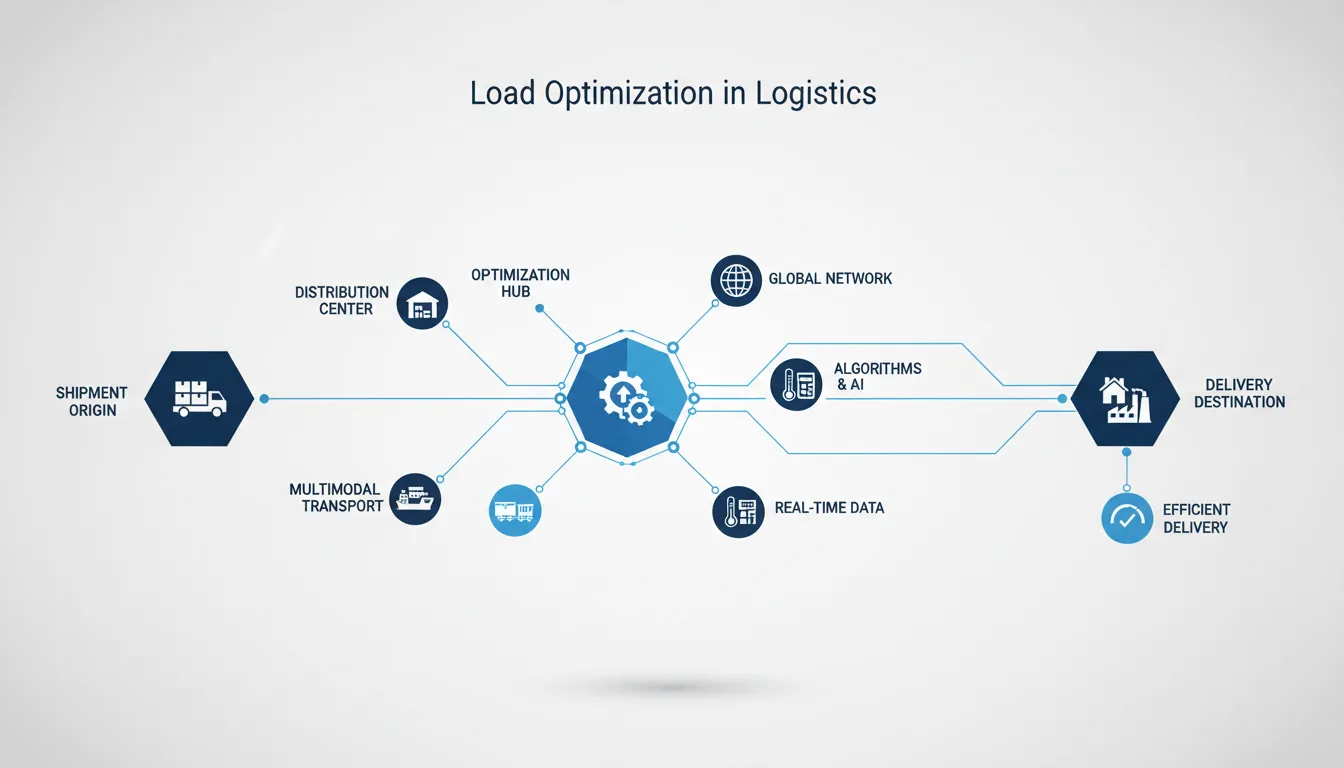
Load optimization refers to the strategic methodology of maximizing the use of available space within transportation vehicles, such as trucks, containers, ships, and aircraft, while simultaneously minimizing shipping costs and increasing delivery efficiency. This process is critical for modern supply chains, extending beyond simple volumetric calculations to encompass factors like weight distribution, route planning, and cargo compatibility. Effective load optimization can significantly reduce the carbon footprint associated with transportation, enhance customer satisfaction through improved delivery times and reduced damages, and improve overall supply chain performance by lowering operational expenses and increasing asset utilization.
Etymology and Origins
The term load optimization is derived from the interplay between 'load'—referring to the cargo being transported—and 'optimization,' which implies the refinement of a system to achieve maximum efficiency. While the individual words have ancient roots (e.g., 'load' from Old English 'lad' meaning 'journey' or 'course,' and 'optimize' from the Latin 'optimus' meaning 'best'), their coupling in a systematic, quantitative logistics context is more recent.
The earliest applications of systematic load planning can be traced back to the burgeoning railway industry in the 19th century, where maximizing cargo per car was crucial for profitability. However, the conceptualization of 'load optimization' as a distinct, problem-solving discipline gained prominence with the rise of commercial shipping and logistics in the early 20th century, particularly during the post-World War II economic expansion when global trade increased significantly, demanding more sophisticated logistical approaches. Early forms involved manual calculations and visual spatial reasoning, aiming to fit as much product as possible into a given conveyance. The term itself became more formalized with the advent of operations research techniques in the mid-20th century, coinciding with the development of linear programming and combinatorial optimization methods aimed at solving complex industrial problems.
Historical Development
The concept of load optimization has evolved dramatically over decades, driven by technological advancements and increasing global trade complexity:
-
Pre-1950s: Manual & Heuristic Methods
Prior to widespread computerization, load planning was primarily a manual process, relying on human experience, visual estimation, and simple heuristics. Warehouse workers and freight loaders used their judgment to arrange cargo, often leading to inefficiencies and suboptimal space utilization. The advent of rail and truck freight in the early 20th century saw initial efforts to standardize packing, but these were largely empirical. Early shipping manifest systems, while documenting cargo, offered little in the way of optimization. Freight loading manuals from the 1930s and 40s provided guidelines, but the actual optimization was left to skilled laborers. -
1950s-1960s: Containerization and Operations Research
This era marked a significant turning point. The advent of containerization in the mid-1950s, championed by Malcolm McLean, revolutionized shipping by standardizing cargo units. This standardization immediately introduced the need for more strategic and mathematical load planning to maximize the utilization of these new, uniform containers. Concurrently, the field of operations research (OR) began to apply scientific methods to management problems, including logistics. Early OR models for resource allocation and space packing laid the theoretical groundwork for load optimization algorithms. The International Organization for Standardization (ISO) played a crucial role in setting standards for shipping containers (ISO 6346 for identification, for example) that enhanced intermodal transport efficiency and provided common dimensions for load planning. -
1970s-1980s: Early Computer-Aided Planning
As computing power became more accessible, logistics began to leverage early information technology. The 1970s saw the development of the first computer-aided design (CAD) systems, which, while initially for engineering, inspired similar visual planning tools for cargo. This period also saw the emergence of rudimentary Warehouse Management Systems (WMS), which, though basic, allowed logistics professionals to track inventory and simulate simple load configurations. H.D. Ransome is known for his foundational work on load planning algorithms during the 1970s, particularly in developing heuristic approaches to solve the intractable bin-packing problem for real-world scenarios. Early academic papers on the Vehicle Routing Problem (VRP) also emerged, directly influencing multi-stop load optimization. -
1990s: Advanced Software and Algorithm Refinements
The rapid advancements in computing power and the development of more sophisticated algorithms marked a significant milestone. The introduction of advanced software solutions, often integrated into Transportation Management Systems (TMS), allowed for complex load configurations to be generated and optimized in near real-time. These systems moved beyond simple volume calculations to consider factors like weight distribution, axle loads, and stacking constraints. The rise of enterprise resource planning (ERP) systems also integrated logistics functions, further professionalizing load planning. -
2000s to Present: AI, Machine Learning, and Real-time Optimization
The current era is defined by the integration of artificial intelligence (AI), machine learning (ML), and real-time data from IoT devices. These technologies have propelled load optimization to new heights, enabling dynamic routing and load planning. Predictive analytics, powered by ML, can forecast demand and traffic patterns, allowing for proactive load adjustments. AI-driven algorithms can solve highly complex, multi-variable optimization problems, adapting to unforeseen events like traffic jams or sudden order changes. The proliferation of mobile devices and cloud computing has made these advanced tools accessible to a wider range of businesses, from large enterprises to small and medium-sized businesses.
Core Concepts
Load optimization works on several technical principles, often involving complex mathematical models and algorithms:
-
Space Utilization (Bin Packing Problem): This is the fundamental challenge of fitting various-sized items into a fixed-capacity container. Properly organizing cargo in defined spaces can drastically cut down on transportation costs. Tools like bin packing visualizers offer visual aids to determine the best arrangement of items, considering dimensions (length, width, height), orientation constraints, and item stackability. The underlying mathematical challenge is often referred to as the Bin Packing Problem, a classic NP-hard combinatorial optimization problem.
-
Weight Distribution and Axle Load Compliance: Maintaining proper weight balance is crucial for vehicle safety, fuel efficiency, and compliance with legal road limits. Overloaded axles can lead to fines, vehicle damage, and accidents. Load planners use distribution guidelines to ensure optimal weight balance and stability, calculating the center of gravity and distributing weight evenly across axles. This often involves specialized software that considers the weight and position of each item, ensuring adherence to Department of Transportation (DOT) regulations in many countries.
-
Multi-Box Shipping & Consolidation: Combining multiple individual shipments or orders into one larger container or vehicle is a key strategy for cost reduction. Multi-box shipping strategies allow for more efficient transportation of goods by leveraging economies of scale. This concept also extends to freight consolidation, where smaller, less-than-truckload (LTL) shipments are combined from multiple shippers going to similar destinations into a single full-truckload (FTL) shipment, reducing per-unit shipping costs.
-
Stackability and Compatibility: Not all cargo can be stacked, and certain goods cannot be placed near others (e.g., hazardous materials with food items, or fragile items under heavy ones). Load optimization algorithms must account for these constraints, often using predefined rules or item attributes to prevent damage and ensure safety. This also includes consideration of product kitting or pre-assembly that might affect the final load dimensions.
-
Vehicle Characteristics: Different vehicles have different internal dimensions, weight capacities, door clearances, and even suspension characteristics. Advanced optimization considers the specific vehicle model being used to ensure a practical and safe load plan.
Industry Applications
Load optimization is a universally applicable principle across various industries, significantly impacting their operational efficiency and profitability:
-
E-commerce and Retail: Companies like Amazon utilize sophisticated load optimization software, often integrated with their order management systems, to minimize shipment costs while maximizing delivery speed. For instance, during peak seasons, optimizing parcel loads in delivery vans is critical to fulfilling millions of orders daily, reducing the number of vehicles required, and improving final-mile efficiency. Retailers also optimize loads for replenishing store inventory from distribution centers, using techniques like cross-docking to streamline movement.
-
Manufacturing: Just-in-time (JIT) manufacturing processes heavily leverage optimized inbound loads to ensure timely deliveries of raw materials and components, minimizing inventory holding costs. For outbound logistics, optimizing loads of finished goods from factories to distribution centers or directly to customers is crucial. A major automotive manufacturer, for example, might optimize the loading of car parts from various suppliers into a single truck, ensuring precise sequencing for the assembly line and maximum space utilization.
-
3PL Providers (Third-Party Logistics): As core business is managing logistics for others, 3PL providers are at the forefront of employing load optimization software. They use these tools to enhance their shipping efficiency, offer competitive pricing, and improve service levels for their diverse client base. This includes optimizing multi-client loads on shared routes, a key differentiator in their service offering.
-
Food & Beverage: This sector faces unique challenges like refrigeration requirements, short shelf-lives, and varied product sizes. Load optimization helps ensure that chilled and frozen goods are transported efficiently, minimizing spoilage and maximizing capacity within temperature-controlled environments. Companies like Sysco or PepsiCo continuously optimize their delivery routes and truck loads to serve a vast network of restaurants and stores daily.
-
Construction & Heavy Industry: Transporting heavy, often irregularly shaped, and oversized equipment or materials requires specialized load planning. Optimization ensures legal weight limits are respected, special permits are obtained, and loads are secured safely, maximizing the payload for expensive specialized transport vehicles.
Benefits and Advantages
Implementing effective load optimization practices yields numerous strategic and operational benefits:
-
Significant Cost Reduction: This is often the primary driver. By maximizing the cargo carried per trip, businesses can reduce the total number of trips, directly lowering fuel costs, driver wages, vehicle maintenance, and tolls. Studies suggest that even a 10% improvement in load utilization can lead to substantial savings, directly impacting the bottom line.
-
Improved Time Efficiency: Efficient load planning means faster processing times at loading docks and quicker transit times due to fewer required trips. This leads to improved delivery schedules, faster order fulfillment, and ultimately, higher customer satisfaction due to timely deliveries.
-
Enhanced Environmental Impact (Sustainability): Fewer trips resulting from optimized loads directly contribute to lower greenhouse gas emissions and reduced fuel consumption, aligning with corporate social responsibility and sustainability goals. This also often leads to reduced road congestion.
-
Reduced Product Damage: Proper load planning ensures cargo is secured and distributed correctly, minimizing shifting during transit. This reduces the risk of product damage, which in turn lowers replacement costs, reduces waste, and improves customer perception.
-
Increased Asset Utilization: Maximizing the use of each vehicle means that existing fleet assets are working harder and more efficiently, potentially delaying the need for new vehicle purchases and improving return on investment for transportation equipment.
Challenges and Limitations
While load optimization presents numerous advantages, there are inherent challenges that organizations must address:
-
Data Accuracy and Completeness: Optimal load plans rely heavily on precise, real-time data regarding item weights, dimensions (length, width, height, cubic volume), stacking constraints, and destination details. Inaccurate or outdated data, often from legacy systems or manual input, can lead to inefficient planning, wasted space, or even unsafe loads. Organizations must invest in robust data collection and management systems, such as advanced visual inventory management systems.
-
Complexity in Algorithms and Software Investment: Advanced optimization software, especially those utilizing AI and machine learning, can require significant initial investment in licenses, hardware, and integration. Furthermore, configuring and maintaining these complex algorithms, which often need to solve NP-hard problems, requires specialized expertise. Staff training is crucial to ensure effective utilization of these sophisticated tools.
-
Dynamic Variables and Real-time Adaptability: Logistics environments are highly dynamic. Factors like sudden customer demand fluctuations, unexpected traffic conditions, vehicle breakdowns, weather events, or last-minute order changes can disrupt meticulously planned loads. Static load plans become obsolete quickly, requiring systems that can adapt and re-optimize in real-time, which is a significant technological and operational challenge.
-
Irregular Shapes and Mixed Cargo: While simpler for uniformly shaped boxes, optimizing loads with irregularly shaped items (e.g., machinery, furniture) or a mix of different product types with varying handling requirements (e.g., fragile, hazardous, temperature-sensitive) significantly increases complexity. Manual override and expert judgment may still be necessary, even with advanced software.
-
Integration with Other Systems: For true end-to-end optimization, load planning software needs seamless integration with WMS, TMS, ERP, and order management systems. Poor integration can lead to data silos, errors, and an inability to leverage the full power of optimization tools.
Best Practices
To achieve effective and sustainable load optimization, logistics professionals should adhere to the following best practices:
-
Leverage Advanced Software Tools: Invest in and fully utilize dedicated load optimization software or modules within a comprehensive Transportation Management System (TMS) or a robust WMS that offers mobile warehouse management capabilities. These systems can handle complex calculations, visualize load plans (e.g., with bin packing previews), and integrate with other supply chain functions.
-
Prioritize Data Quality and Accuracy: Implement stringent data governance for product master data, including precise dimensions, weights, and handling characteristics. Utilize scanning technologies (barcode systems) and automated measurement tools to capture accurate data at the source. Regular audits and updates are essential to maintain data integrity.
-
Regular Training and Continuous Education: Ensure that logistics staff, from planners to warehouse operators, are thoroughly trained on the latest optimization software, techniques, and safety protocols. Continuous learning about new technologies and best practices in the industry is vital for maximizing system capabilities and adapting to evolving challenges.
-
Implement Continuous Monitoring and Feedback Loops: Establish key performance indicators (KPIs) such as vehicle utilization rate, fuel efficiency, and on-time delivery rates. Analyze performance metrics frequently to identify bottlenecks, refine load strategies, and apply lessons learned. This iterative process, often supported by business intelligence tools, ensures that optimization efforts remain effective and improve over time.
-
Collaboration Across the Supply Chain: Foster strong communication and data sharing between internal departments (sales, warehouse, transportation) and external partners (carriers, 3PLs, suppliers). Collaborative planning can lead to opportunities for freight consolidation, backhauling, and shared logistics resources, further enhancing load optimization efforts.
-
Standardize Packaging Where Possible: While not always feasible, standardizing packaging dimensions for products can significantly simplify load planning and improve space utilization. This allows for more efficient stacking and less wasted space within containers.
Technology and Tools
Modern load optimization relies heavily on sophisticated technology:
-
AI and Machine Learning (AI/ML): These technologies move beyond rule-based systems to learn from historical data, predict optimal load patterns, and adapt to dynamic conditions. AI can optimize complex vehicle routing problems (VRP) in real-time, considering traffic, weather, and delivery windows. Machine learning models can predict freight demand, enabling proactive consolidation and load planning.
-
Load Planning Software (LPS) & Transportation Management Systems (TMS): These dedicated software solutions are the backbone of modern load optimization. They provide functionalities for:
- 3D Visualization: Allowing planners to see how items fit into a container before loading.
- Algorithm-Driven Optimization: Solving complex bin-packing and weight distribution problems.
- Constraint Management: Incorporating rules for stacking, hazardous materials, temperature control, and axle weight limits.
- Integration: Seamlessly connecting with Warehouse Management Systems (WMS), ERPs, and shipping and fulfillment software.
- Reporting and Analytics: Providing insights into utilization rates and cost savings. SkuSavvy’s order management system integrates aspects of inventory and shipping, which are foundational for effective load planning by providing accurate product data and order details.
-
Internet of Things (IoT) and Telematics: IoT sensors on vehicles and cargo provide real-time data on location, speed, temperature, humidity, and even impacts. Telematics systems track vehicle performance and driver behavior. This data feeds into optimization systems, allowing for immediate adjustments to routes or load plans in response to unforeseen events, enhancing agility and responsiveness.
-
Mobile Technology: Handheld devices with specialized apps allow warehouse staff to confirm loads, track progress, and communicate issues in real-time, enhancing accuracy and reducing errors at the loading dock. Mobile solutions are integral to mobile order fulfillment and warehouse management.
Future Trends
As logistics continues to evolve, automation and data analytics will lead the way in load optimization. Trends such as:
- Autonomous Vehicles and Drones: While still developing, these could fundamentally change load planning, potentially allowing for more flexible, smaller, and highly optimized loads delivered more frequently.
- Hyper-personalization of Deliveries: Increased customer demand for precise delivery windows will necessitate more dynamic, real-time, and granular load optimization, often involving smaller, more frequent deliveries.
- Blockchain for Supply Chain Transparency: While not directly optimizing loads, blockchain could enhance the security and integrity of data (e.g., origin, dimensions, certifications), which is crucial for compliant and accurate load planning, especially for sensitive goods.
- Predictive Maintenance for Fleets: Integrating maintenance schedules into load planning systems can prevent vehicle breakdowns, ensuring that optimized loads are transported without unexpected delays.
- Digital Twins and Simulation: Creating virtual replicas of logistics operations allows for simulating various load scenarios, testing optimization algorithms, and predicting outcomes before physical implementation, leading to more robust and efficient plans.
These advancements will provide logistics professionals with unprecedented tools to maximize efficiency, minimize costs, and improve sustainability across the entire transportation network.
Related Concepts
Load optimization is closely related to several critical logistics concepts. A well-optimized load requires coordination with:
- Inventory Management: Ensuring products are accurately accounted for and ready for delivery when needed, influencing what can be loaded onto a vehicle. Systems like a visual inventory management system provide the necessary data for load planning.
- Warehouse Layout and Operations: The efficiency of loading and unloading is heavily influenced by the warehouse layout and processes like batch picking or pick-to-tote that consolidate items for shipment.
- Shipping Methodologies and Routing: This includes decisions on Less-than-Truckload (LTL) vs. Full-Truckload (FTL), intermodal transport, and dynamic routing algorithms that determine the sequence of deliveries to maximize efficiency once a load is optimized.
- Demand Forecasting: Accurate predictions of future orders allow for proactive load consolidation and planning, preventing last-minute rushed loads or underutilized vehicles. This is often supported by integrated purchase order management systems.
- Packaging Design: The design of product packaging directly impacts its stackability and space utilization, a crucial factor considered during load optimization.
Effective load optimization is a holistic process that integrates these various elements to achieve superior logistical performance.
Sources
- Visual Warehouse Layout
- Mobile WMS Overview
- Multi-box Shipping
- Shipping & Fulfillment Software
- Order Management System
- Cross-Docking Guide
- The Railway Revolution in England
- A note on packing problems
- What is Operations Research?
- Visual Inventory Management System
- Barcodes Guide
- Mobile Order Fulfillment Software
- Pick-to-Tote Guide
- Purchase Order Management
- Kitting Guide