Label Printing Software in Logistics and Supply Chain Management
Label printing software streamlines logistics operations, enhancing accuracy and efficiency in inventory management and shipping processes.
Updated
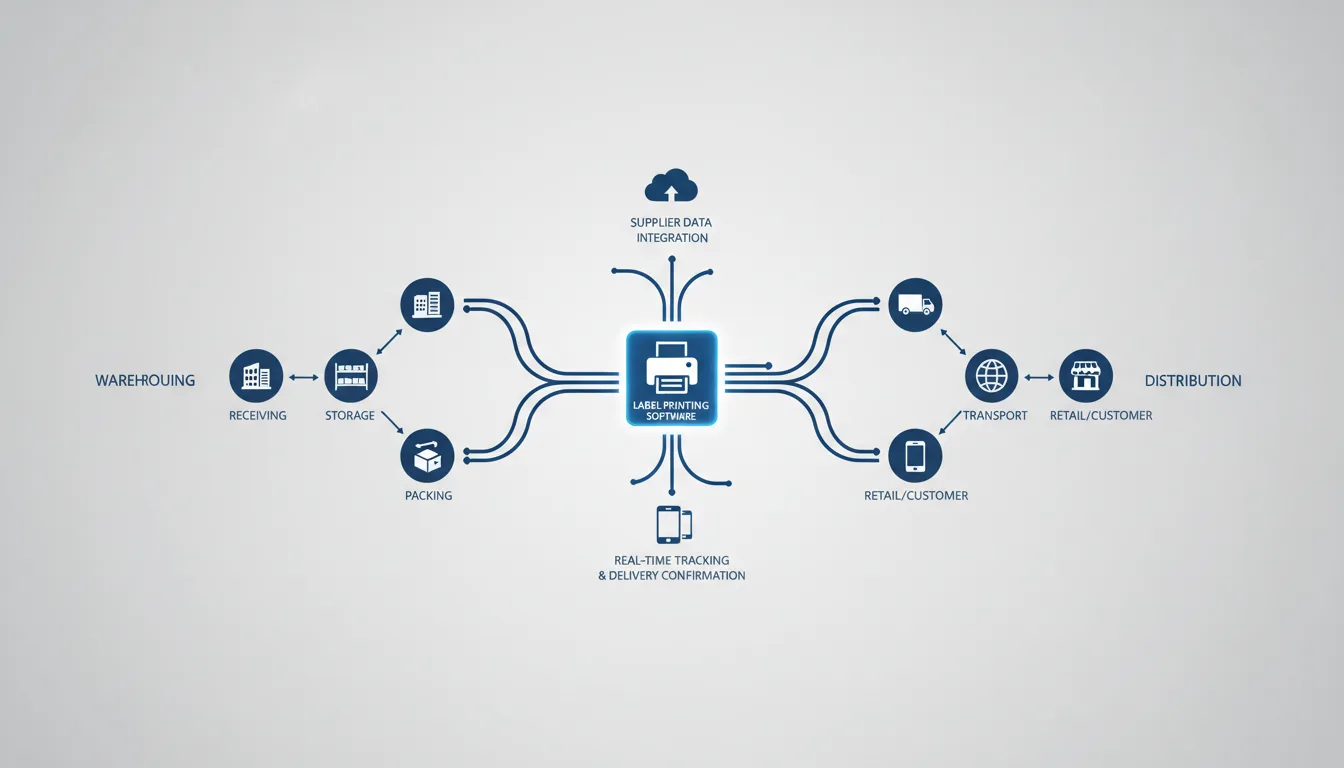
Label Printing Software in Logistics and Supply Chain Management
Overview
Label printing software is a specialized application designed to create, manage, and print labels used in various logistics and supply chain processes. Its primary purpose is to facilitate effective tracking, identification, and organization of products, goods, and shipments. This software enhances operational efficiency, reduces errors, and supports compliance with industry regulations in the logistics sector. Proper utilization of label printing software can significantly improve inventory accuracy and overall workflow productivity. For instance, companies implementing a mobile warehouse management system typically experience a decrease in labeling errors and faster processing times.
Etymology and Origins
The word 'label' traces its roots to the Middle English label, meaning a "slip of paper or cloth," which itself stems from the Old French label, signifying 'a strip or a ribbon'. Further back, it can be linked to the Vulgar Latin labellum, a diminutive of labrum, meaning 'lip' or 'edge', originally referring to small tags or strips used for identification [1]. Historically, labels served as simple markers for ownership, contents, or destination, evolving from handwritten tags on ancient goods to printed seals on medieval merchandise.
The concept of "label printing software" as a distinct application emerged in the late 1970s and early 1980s, driven by the commercial adoption of barcode technology. Prior to this, labels were largely pre-printed or manually created. The need to dynamically generate machine-readable symbols, coupled with variable data (e.g., product codes, expiration dates), spurred the development of specialized programs. Early iterations were often proprietary software bundled with dedicated barcode printers (like those from Monarch Marking or Intermec). As personal computers became prevalent, general-purpose label design and printing utilities, precursors to modern barcode label creator tools, started appearing, allowing businesses greater control over their labeling processes. This shift reflected the increasing demands of evolving supply chains for standardized, accurate, and efficient identification.
Historical Development
The evolution of label printing software in logistics mirrors the broader advancements in information technology and supply chain complexity, transitioning from manual, error-prone methods to highly automated, data-driven systems.
-
Pre-1970s: Manual and Mechanical Foundations Prior to the digital age, labeling was a labor-intensive process. Products were often marked with stenciled information, handwritten tags, or pre-printed adhesive labels applied manually. Early mechanical label makers and printing presses produced static, batch-printed labels, often requiring significant manual effort to apply and manage. While effective for simple identification, these methods lacked the flexibility and data density required for complex inventory and shipping operations [2].
-
1970s: The Dawn of Barcoding and Standardization A pivotal moment arrived with the commercialization of the barcode. The adoption of the Universal Product Code (UPC) in 1974 for retail items revolutionized inventory management. This period saw the emergence of dedicated barcode printers from pioneers like Monarch Marking Systems and Intermec, often bundled with rudimentary software to generate these machine-readable symbols. Concurrently, the growth of Electronic Data Interchange (EDI) for standardized digital communication between trading partners highlighted the need for corresponding standardized physical labels to ensure seamless goods reception and processing [3].
-
1980s: MRP II, JIT, and PC-Based Printing The decade witnessed significant strides with the widespread adoption of Manufacturing Resource Planning (MRP II) systems, which expanded upon earlier MRP concepts to integrate manufacturing, sales, and finance. These systems, including those developed by IBM, required sophisticated labeling for components, work-in-progress, and finished goods to manage production flows efficiently. The rise of Just-in-Time (JIT) manufacturing, pioneered by Toyota, further emphasized the critical role of accurate and timely labeling for smooth material flow and inventory reduction [4]. The proliferation of personal computers also enabled smaller businesses to adopt PC-based label design software, moving away from proprietary printer interfaces and toward more flexible, in-house label generation, often utilizing early versions of barcode label creator tools.
-
1990s: WMS Integration and Thermal Printing Dominance The 1990s marked the maturation of Warehouse Management Systems (WMS). Label printing software evolved from standalone applications into integral modules of WMS, automating the creation of various labels—from receiving and put-away labels to picking and shipping labels. Companies like SAP and Oracle began offering comprehensive ERP solutions that included robust WMS functionalities, making label generation a seamless part of enterprise-wide operations. This era also saw thermal transfer and direct thermal printing become the standard for logistics, offering durability, speed, and cost-effectiveness for on-demand label production [5]. These printers enabled the creation of high-quality, long-lasting labels crucial for effective inventory accuracy and tracking.
-
2000s: Global Standards, RFID, and Internet Connectivity With increasing globalization, international standardization became paramount. GS1 (formerly EAN International and Uniform Code Council) standards, such as the Serial Shipping Container Code (SSCC) and Global Trade Item Number (GTIN), mandated consistent labeling for global supply chains. The early 2000s also saw the introduction of Radio-Frequency Identification (RFID) technology, with mandates from major retailers like Walmart and the Department of Defense. While RFID offered unprecedented automation in tracking, physical labels often remained necessary for human readability and visual verification, leading to hybrid labeling solutions. The internet facilitated web-based label design and remote printing capabilities, further decentralizing and streamlining operations.
-
2010s and Beyond: Cloud, Mobile, AI, and IoT Integration The last decade has seen label printing software embrace cloud computing (SaaS models), offering greater scalability, accessibility, and reduced IT overhead. The proliferation of mobile devices in warehouses led to the development of mobile warehouse management systems that allow for on-demand label printing directly from handheld scanners or tablets, enabling greater flexibility in operations. Artificial intelligence (AI) and machine learning (ML) are now being applied to optimize label placement, predict labeling needs, and automate data validation. The Internet of Things (IoT) is driving the integration of "smart labels" with embedded sensors, allowing for real-time condition monitoring (e.g., temperature, humidity) throughout the supply chain [6]. Companies like Amazon and Walmart continuously push the boundaries, utilizing sophisticated, AI-driven labeling systems to maintain their vast, intricate supply chain efficiencies.
Industry Insights and Best Practices
Modern label printing goes beyond mere identification; it's a critical component of data integrity and operational flow. Key industry insights and best practices include:
- Standardization: Adhering to international standards (e.g., GS1) and internal company standards ensures consistency and interoperability across the supply chain, facilitating smoother exchanges with partners and carriers.
- Data Integrity: Integrating label printing software directly with WMS, ERP, or inventory management systems minimizes manual data entry errors. Dynamic data population from a single source of truth is crucial.
- Compliance: Ensuring labels meet regulatory requirements (e.g., hazmat, food safety, customs declarations) and carrier-specific guidelines (e.g., UPS, FedEx, USPS) is non-negotiable to avoid delays and fines.
- Durability and Readability: Selecting appropriate label materials and ribbons for the operating environment (temperature extremes, moisture, abrasion) ensures labels remain scannable and legible throughout their lifecycle. Regular printer maintenance and calibration are also essential for print quality.
- Batch and On-Demand Printing: The capability to print labels in large batches for pre-planned activities (e.g., incoming shipments, large production runs) and on-demand for ad-hoc needs (e.g., returns, damaged labels, cross-docking items) significantly enhances operational agility.
- Template Management: Utilizing flexible templates allows for quick adaptation to new product lines, regulatory changes, or customer-specific labeling requirements without extensive reprogramming.
- Security and Audit Trails: For sensitive goods or regulated industries, the software should provide secure access controls and audit trails for label generation, tracking who printed what and when.
- Multi-Language Support: For global logistics, the ability to print labels in multiple languages or with internationally recognized symbols is increasingly vital.
- Continuous Optimization: Regularly reviewing label designs, materials, and printing processes can identify bottlenecks and areas for efficiency gains. For instance, using a barcode label creator tool can streamline the design and deployment of new label formats.
The integration of AI-driven analytics for predictive inventory management has emerged as a best practice, enabling companies to anticipate stock needs more effectively and ensuring that the correct labels are available precisely when required. Organizations using AI for inventory management can reduce costs by up to 30%, underscoring the vital link between advanced analytics and reliable label printing in maintaining operational efficiency.
Conclusion
Label printing software remains an integral component of effective logistics and supply chain management. By leveraging the latest technological advancements, businesses can ensure their label printing processes are efficient, accurate, and compliant with regulatory standards.
Sources
- IBM MRP Systems
- McKinsey & Company on AI in Inventory Management
- SkuSavvy Printing Guide
- SkuSavvy Mobile Warehouse Management
- IBM MRP Systems
- McKinsey & Company on AI in Inventory Management
- SkuSavvy Printing Guide
- SkuSavvy Mobile Warehouse Management
- Label (n.)
- History of Barcodes
- The Toyota Way: 14 Management Principles from the World's Greatest Manufacturer
- Digital Transformation in Supply Chain: A Guide to the Future
- Barcode Label Creator
- Visual Inventory Management System