Kaizen in Logistics and Supply Chain Management
An extensive overview of Kaizen, its history, core concepts, applications, and its impact within logistics and supply chain management.
Updated
Overview
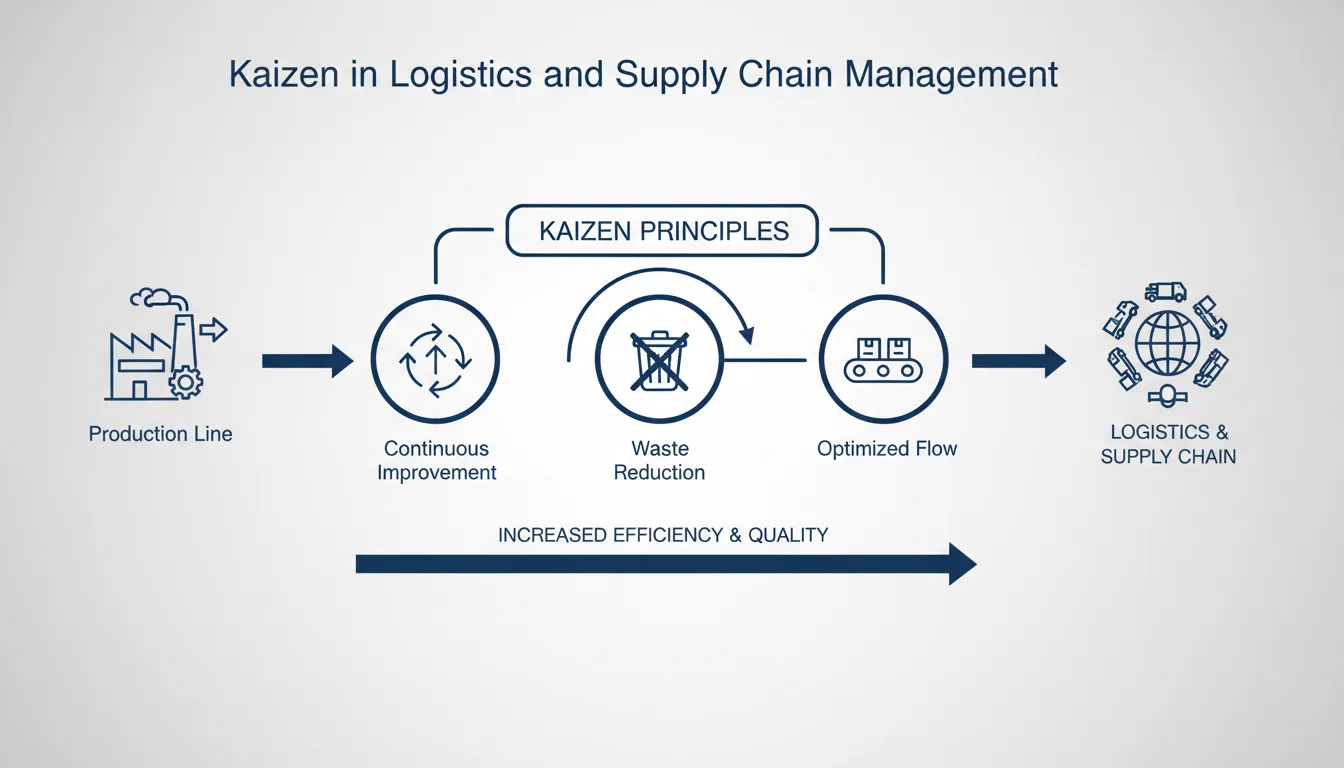
Kaizen is a Japanese term meaning "continuous improvement." It represents a philosophy and set of practices focused on continuously improving processes, products, and services through incremental advancements. Often translated as "change for the better," Kaizen emphasizes ongoing, small, positive changes rather than radical overhauls. In the context of logistics and supply chain management, Kaizen principles can help organizations enhance their operations, reduce waste, and improve efficiency by fostering a culture where every employee is empowered to identify and implement improvements daily.
Etymology and Origins
The word Kaizen is derived from two Japanese characters: "kai" (改), meaning change or to correct, and "zen" (善), meaning good or for the better. Thus, Kaizen literally translates to "change for good" or "improvement." The concept's roots can be traced to post-World War II Japan, where it emerged as a critical component of economic reconstruction and industrial quality improvement [5].
Its development was significantly influenced by American management and quality control experts who visited Japan. W. Edwards Deming, an American statistician and consultant, played a pivotal role, teaching Japanese executives and engineers about statistical process control and quality management from 1950 onwards [6]. His teachings, alongside those of Joseph Juran, laid the foundational groundwork for the growth of methodologies that would later coalesce into the Kaizen philosophy in manufacturing and beyond.
Historical Development
Emergence of Kaizen in Japan
Kaizen emerged as a formal approach in Japan during the 1950s, particularly within the nascent automotive industry, striving to catch up with Western industrial capabilities. Following Deming's seminars in 1950, Japanese companies, notably Toyota, began to systematically implement continuous improvement techniques. These techniques were later formalized and integrated into what became known as the Toyota Production System (TPS) [7]. TPS, with Kaizen at its heart, focused on eliminating waste (muda), unevenness (mura), and overburden (muri) across all production processes, fundamentally reshaping manufacturing paradigms.
Pioneers of Kaizen
Key figures instrumental in the establishment and popularization of Kaizen practices include:
- W. Edwards Deming: Introduced the importance of statistical quality control and systematic improvement to Japanese industry, emphasizing a systems-thinking approach and the Plan-Do-Check-Act (PDCA) cycle, which is central to Kaizen [6].
- Joseph Juran: Another American quality expert who, alongside Deming, influenced Japanese quality management. Juran focused on quality management from a broader organizational perspective, including setting quality goals and planning for quality improvement [8].
- Taiichi Ohno: A Japanese industrial engineer at Toyota, widely regarded as the father of the Toyota Production System. Ohno developed many of the core concepts of TPS, including Just-in-Time (JIT) production and Jidoka (autonomation), which are deeply intertwined with the Kaizen philosophy of continuous improvement [7].
- Shigeo Shingo: Another key contributor to TPS, known for developing concepts like SMED (Single-Minute Exchange of Dies) and Poka-Yoke (mistake-proofing), both direct applications of Kaizen principles aimed at reducing setup times and preventing errors [9].
- Masaaki Imai: Credited with introducing Kaizen to the Western world through his seminal 1986 book, Kaizen: The Key to Japan's Competitive Success. Imai's work provided a comprehensive framework and practical guide to implementing continuous improvement, bridging the gap between Japanese practices and global industries [10].
Major Milestones
- 1950s-1960s: Adoption and refinement of Kaizen principles within Japanese industries, particularly through the development and spread of the Toyota Production System.
- 1980s-1990s: Globalization of Kaizen methodologies. Masaaki Imai's book played a crucial role in disseminating these practices, leading to widespread adoption in Western manufacturing and other sectors facing intense international competition.
- Present: Expansion of Kaizen beyond manufacturing into a diverse array of sectors, including logistics, healthcare, finance, and service industries, often integrated with other lean methodologies like Six Sigma and Agile. The advent of digital tools and data analytics has further accelerated its application.
Seminal Publications
In the 1980s, the book Kaizen: The Key to Japan's Competitive Success by Masaaki Imai (1986) became the foundational text that introduced the concept of Kaizen to the Western world [10]. Later, in the 2000s, The Toyota Way by Jeffrey Liker (2004) further documented the key principles of the Toyota Production System, solidifying Kaizen's reputation as an essential strategy for organizational excellence.
Core Concepts
At its core, Kaizen involves a synergy of people, processes, and tools to foster a culture of continuous improvement. The philosophy is built upon several fundamental principles:
- Employee Engagement (Gemba Kaizen): Kaizen emphasizes that improvement ideas can and should come from all employees, from the factory floor to upper management. This concept, often referred to as Gemba Kaizen (improvement at the actual workplace), encourages workers closest to the process to identify inefficiencies and propose solutions. This active involvement boosts morale and fosters a sense of ownership [10].
- Small Incremental Changes: Rather than focusing on large, revolutionary changes that can be disruptive and risky, Kaizen advocates for numerous small, gradual improvements. These cumulative changes, though seemingly minor individually, lead to significant overall enhancements over time with minimal investment and lower risk [5].
- Waste Elimination (Muda): A central tenet derived from TPS, Kaizen relentlessly seeks to identify and eliminate all forms of waste (e.g., overproduction, waiting, unnecessary transport, over-processing, excess inventory, unnecessary motion, defects, and unused talent) in processes [7].
- Standardization: Once a beneficial change or improvement has been implemented and proven effective, it is standardized to ensure consistency, prevent regression, and serve as a baseline for future improvements. This involves documenting new procedures and training employees [9].
- Visual Management: Making processes, performance, and problems visible to everyone involved to facilitate quick understanding and action. Tools like Kanban boards and performance dashboards are examples.
- Plan-Do-Check-Act (PDCA Cycle): The iterative four-step management method used for the control and continuous improvement of processes and products. It provides a structured approach for problem-solving and implementing changes.
Industry Applications
Kaizen is widely applicable across various sectors, demonstrating its versatility in driving operational excellence:
- Manufacturing: Classic application involves streamlining production lines, reducing defects, and optimizing machine utilization to reduce waste and improve quality. For example, implementing SMED to drastically cut changeover times on production equipment [9].
- Logistics and Supply Chain Management: Kaizen provides a robust framework for enhancing the flow of goods and information. Specific applications include:
- Warehouse Optimization: Improving warehouse layout to minimize travel time, optimizing picking strategies like batch picking or pick-to-tote, and streamlining bin put-away criteria to enhance storage efficiency. Regular cycle counting can also be continuously improved to maintain higher inventory accuracy [11].
- Order Fulfillment: Continuously refining processes from order receipt through pick, pack, and ship. This can involve analyzing order fulfillment workflows to identify bottlenecks, reducing packing errors, and optimizing shipping routes to enhance delivery speed and accuracy [12].
- Inventory Management: Implementing better forecasting techniques, optimizing stock levels, and refining visual inventory management systems to reduce carrying costs and prevent stockouts. This also includes improving processes for stock replenishment and handling lots and expiration dates.
- Transportation: Optimizing routing, vehicle loading, and delivery schedules to reduce fuel consumption, transit times, and associated costs.
- Purchasing and Procurement: Streamlining purchase order management processes, improving vendor relations, and optimizing lead times for incoming goods [13].
- Healthcare: Improving patient care processes, reducing wait times, optimizing hospital logistics (e.g., movement of equipment and supplies), and enhancing administrative efficiency.
- Service Industries: Streamlining customer service operations, reducing processing times for requests, and improving service quality and delivery.
Benefits and Advantages
Implementing Kaizen in an organization leads to several significant benefits:
- Enhanced Efficiency and Productivity: By continuously identifying and eliminating waste, processes become leaner and more efficient, leading to higher output with fewer resources. This results in streamlined workflows and increased throughput [14].
- Cost Savings: Incremental improvements across operations, from reduced waste in manufacturing to optimized logistics and inventory management, contribute to significant cost reductions over time [5].
- Improved Quality: A focus on defect prevention and continuous refinement of processes naturally leads to higher quality products and services, reducing rework and customer complaints.
- Increased Employee Morale and Engagement: Engaging employees at all levels in the improvement process fosters a sense of ownership, empowerment, and job satisfaction. This collaborative environment encourages proactive problem-solving and innovation [10].
- Stronger Competitive Advantage: Organizations that embed Kaizen become more agile, responsive, and innovative, enabling them to adapt quickly to market changes and outperform competitors.
- Safety Improvements: Regularly reviewing and improving processes often leads to identifying and mitigating safety hazards, creating a safer working environment.
Challenges and Limitations
Despite its profound benefits, Kaizen can face several challenges and limitations during implementation:
- Resistance to Change: Employees may be reluctant to alter established processes, especially if they do not understand the benefits or feel their current methods are sufficient. Overcoming this requires strong leadership, clear communication, and consistent training [10].
- Sustaining Momentum: Continuous improvement requires sustained commitment from leadership and employees. Without ongoing support, training, and recognition, initial enthusiasm can wane, leading to a return to old habits and complacency.
- Lack of Resources: Implementing and sustaining Kaizen requires dedicated time, training, and sometimes initial investment in tools or technology. Organizations with limited resources may struggle to allocate these effectively.
- Misinterpretation and Superficial Application: Kaizen can be misunderstood as merely a suggestion system or a series of one-off projects. If not embedded as a fundamental cultural philosophy, its impact will be superficial and short-lived.
- Overemphasis on Small Changes: While incremental changes are the core, sometimes a larger, more revolutionary change (Kaikaku) is necessary. An exclusive focus on small changes might delay or prevent addressing systemic, fundamental issues that require a more drastic overhaul.
- Measurement and Attribution: Quantifying the impact of many small, incremental improvements can be challenging, making it difficult to attribute specific cost savings or efficiency gains directly to Kaizen efforts, which can undermine motivation.
Best Practices
To successfully implement and sustain Kaizen principles in logistics and supply chain management, consider the following best practices:
- Leadership Commitment: Secure unwavering support from top management, who must champion the philosophy and allocate necessary resources. Leaders should actively participate and lead by example.
- Regular Training and Education: Equip employees with the skills and knowledge to identify problems, analyze processes, and implement improvements. This includes training in lean tools, problem-solving techniques, and the PDCA cycle [8].
- Encourage Open Communication and Collaboration: Create a culture where feedback is valued, ideas are openly shared, and cross-functional teams collaborate on problem-solving. Establish formal channels for suggestions and improvement proposals.
- Implement a Structured Approach (PDCA): Utilize the Plan-Do-Check-Act (PDCA) cycle for every improvement initiative, no matter how small. This provides a systematic way to test, evaluate, and standardize changes.
- Use of Metrics and Visual Management: Develop clear, measurable goals (KPIs) to assess the effectiveness of implemented changes. Use visual dashboards and visual inventory management systems to track performance, highlight problems, and celebrate successes, making progress tangible and motivating [11].
- Empower Frontline Employees: Decentralize decision-making power where appropriate, allowing those closest to the work (Gemba) to implement immediate improvements. Provide them with the tools and authority to make changes.
- Standardize and Document: Once an improvement is verified, standardize the new process and document it clearly. This prevents backsliding and ensures that the improvement becomes the new baseline [9].
- Celebrate Small Wins: Acknowledge and reward employees for their contributions, reinforcing positive behaviors and maintaining enthusiasm for continuous improvement.
Technology and Tools
Technological advancements are crucial enablers for modern Kaizen applications in logistics. They provide the data, visibility, and automation necessary to identify areas for improvement and implement changes efficiently:
- Warehouse Management Systems (WMS): Modern Mobile Warehouse Management Systems enhance inventory accuracy, optimize storage, guide picking processes, and track employee productivity. They provide real-time data crucial for identifying bottlenecks and areas for Kaizen. SkuSavvy, for instance, offers features that support visual warehouse layout and workflow management, allowing for continuous optimization of physical space and operational procedures.
- Order Management Systems (OMS): An Order Management System centralizes order processing, inventory visibility, and fulfillment orchestration, enabling continuous improvement in order lead times, accuracy, and customer satisfaction [12].
- Data Analytics and Business Intelligence (BI): These tools process vast amounts of operational data to identify trends, root causes of problems, and potential areas for improvement that might not be obvious through manual observation. They help quantify the impact of Kaizen initiatives.
- Automation Technologies: Robotics, Automated Guided Vehicles (AGVs), and Automated Storage and Retrieval Systems (AS/RS) in warehouses can be part of Kaizen by automating repetitive tasks, reducing errors, and improving speed. Kaizen then focuses on optimizing the integration and utilization of these technologies.
- Enterprise Resource Planning (ERP) Systems: Integrated ERP solutions provide a holistic view of operations, connecting logistics with other business functions, facilitating data-driven decision-making for continuous improvement across the enterprise [15].
- Simulation Software: Allows logistics managers to model proposed changes to processes or layouts before physical implementation, predicting their impact and refining them in a virtual environment to minimize disruption and risk.
Future Trends
As organizations increasingly adopt digital tools, the integration of data-driven decision-making with Kaizen practices will become even more prominent. The approach is expected to evolve alongside advancements in Artificial Intelligence (AI) and Machine Learning (ML), further optimizing processes across the supply chain. AI and ML can automate the identification of inefficiencies, predict potential issues before they occur, and even suggest optimal solutions for incremental improvements.
Furthermore, the concept of a "Digital Twin" of a supply chain or warehouse will allow for real-time monitoring and simulation of Kaizen initiatives. This will enable faster testing of changes and more precise measurement of their impact. The future of Kaizen in logistics will likely see a blend of traditional human-centric continuous improvement with sophisticated technological capabilities, leading to hyper-optimized, resilient, and adaptive supply chain operations.
Sources
- Order Fulfillment Guide
- Mobile Warehouse Management System
- WMS vs ERP Analysis
- A Guide to Kaizen Strategy in Logistics
- W. Edwards Deming and the Genesis of Total Quality Management
- The Toyota Production System: Lean.org
- Joseph Juran and the Quality Handbook
- Shigeo Shingo: Toyota's forgotten genius
- Kaizen: The Key to Japan's Competitive Success (Book)
- Visual Inventory Management System
- Order Management System
- Purchase Order Management
- Workflows Overview
- WMS vs ERP Analysis