Inventory Optimization Software
Inventory optimization software enhances supply chain efficiency by optimizing stock levels, reducing costs, and improving service levels within logistics operations.
Updated
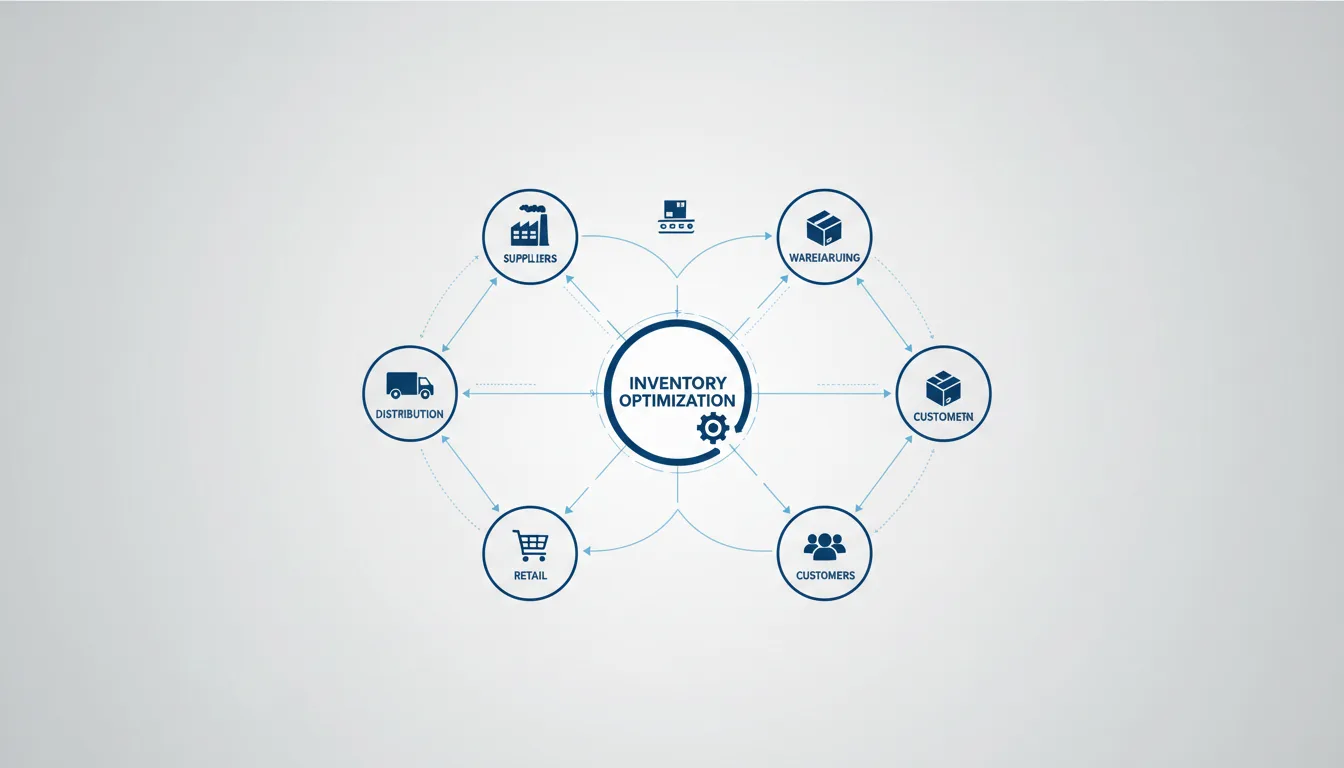
Inventory Optimization Software
Overview
Inventory optimization software (IOS) plays a crucial role in supply chain management by enabling businesses to maintain optimal inventory levels while minimizing costs and maximizing service levels. This sophisticated software integrates various quantitative techniques and algorithms to forecast demand, manage stock replenishment, and enhance visibility across the entire supply chain. The primary goal of inventory optimization is to strike a delicate balance: ensuring sufficient stock to meet customer demands and prevent stockouts, without incurring the excessive carrying costs, obsolescence risk, and capital tie-up associated with overstocking. For instance, the implementation of visual inventory management systems allows companies to better track inventory levels, identify slow-moving items, and reduce errors in real-time. Modern IOS solutions often incorporate advanced analytics to model complex supply chain dynamics, including lead times, supplier variability, and customer service level targets, thereby providing dynamic safety stock calculations and optimized reorder points. This proactive approach helps businesses achieve significant improvements in cash flow and operational efficiency.
Etymology and Origins
The term 'inventory optimization' stems from the evolving practices of inventory management and operations research, which gained significant traction in the latter half of the 20th century. Linguistically, 'inventory' originates from the Latin inventarium, meaning a list of goods or a discovery, while 'optimization' is derived from the Latin optimus, signifying 'best'. This etymological combination perfectly reflects the objective: to achieve the best possible balance of inventory to meet business objectives. While the concepts of optimizing stock levels have existed for centuries, formalized approaches began to emerge with the advent of scientific management principles in the early 20th century. The phrase 'inventory optimization' itself began to be explicitly used in academic and industry circles in the late 1980s and early 1990s, coinciding with the rise of integrated supply chain systems and a more holistic view of inventory beyond simple stock control. Early discussions often appeared in publications focused on production and inventory management, emphasizing quantitative methods for achieving better stock efficiency.
Historical Development
The evolution of inventory optimization software is deeply intertwined with advancements in mathematics, computing technology, and logistics theory, progressing from manual systems to highly intelligent, AI-driven solutions:
-
Early 20th Century: Foundations of Inventory Theory (Pre-1950s)
- The foundational concept of Economic Order Quantity (EOQ) was developed by Ford Whitman Harris in 1913, providing a mathematical model to minimize inventory holding and ordering costs. This marked the first scientific attempt at inventory optimization. However, its application was largely manual or calculator-based.
- Post-World War II, operations research techniques applied to logistics became more sophisticated, with early methods for forecasting and statistical quality control influencing inventory decisions.
-
1950s - 1970s: The Dawn of Computerized Inventory Control
- The advent of mainframe computers in the 1950s enabled the automation of basic inventory tracking and accounting tasks. Early systems could process large volumes of data, moving beyond manual ledger systems.
- The development of Material Requirements Planning (MRP) in the 1960s by Joseph Orlicky at IBM was a seminal moment. MRP systems planned production and procurement based on a master production schedule, effectively optimizing component inventory by ensuring materials were available just in time for manufacturing, rather than stockpiled. This represented a shift from reactive to proactive inventory management.
- The first applications offered basic inventory tracking and management features, often integrated with nascent enterprise systems. The introduction of barcode systems in the 1970s further streamlined inventory data capture, enhancing accuracy and speed in warehousing.
-
1980s: Just-In-Time and Distribution Requirements Planning
- Inspired by the Toyota Production System, Just-In-Time (JIT) manufacturing principles gained widespread adoption. JIT focused on minimizing inventory and reducing waste by aligning production with actual demand, significantly influencing inventory optimization strategies. This era saw companies like Toyota demonstrate the power of lean inventory practices.
- Distribution Requirements Planning (DRP), an extension of MRP to the distribution network, emerged to manage inventory across multiple warehouse locations, laying groundwork for multi-echelon optimization.
-
1990s: Integrated Supply Chain Management and ERP Systems
- The concept of Supply Chain Management (SCM) gained prominence, emphasizing the integration of all processes from raw material acquisition to final customer delivery. This necessitated a more holistic view of inventory across the entire chain.
- The widespread adoption of Enterprise Resource Planning (ERP) systems from companies like SAP and Oracle allowed for more sophisticated, real-time inventory management by integrating inventory data with finance, production, and sales. This marked a significant step towards true inventory optimization software as distinct from mere inventory control.
- Advanced Planning and Scheduling (APS) systems began to offer more sophisticated algorithms for demand forecasting and inventory placement.
- The introduction of just-in-time (JIT) systems during this decade greatly enhanced inventory practices by aligning production schedules with demand forecasts. The rise of global commerce further necessitated innovative solutions to inventory challenges, leading to the development of more intricate algorithms and software solutions.
-
2000s: Cloud, SaaS, and Multi-Echelon Optimization
- The rise of the internet and Software-as-a-Service (SaaS) models made sophisticated inventory optimization accessible to a wider range of businesses, reducing the need for heavy on-premise IT infrastructure.
- Multi-echelon inventory optimization (MEIO) became a key focus, optimizing inventory levels across all stages of the supply chain (e.g., raw materials, work-in-progress, finished goods, distribution centers, retail stores) rather than just individual nodes. This was crucial for global supply chains.
- The adoption of mobile warehouse management systems enabled businesses to manage inventory in real-time from various locations, thus improving operational efficiency and data accuracy.
-
2010s - Present: Big Data, AI, and Predictive Analytics
- The explosion of Big Data and advancements in artificial intelligence (AI) and machine learning (ML) revolutionized demand forecasting. Algorithms can now analyze vast datasets, including external factors like weather, social media trends, and economic indicators, to provide highly accurate, predictive inventory recommendations.
- Real-time inventory visibility and Internet of Things (IoT) sensors provide unprecedented accuracy in tracking stock movements and conditions.
- Focus shifted to resilience and agility, with optimization models incorporating risk assessment, scenario planning, and dynamic adjustments to supply chain disruptions.
Core Functionalities and Techniques
Inventory optimization software typically encompasses several key functionalities to achieve its goals:
- Demand Forecasting: Utilizes statistical models (e.g., time series, regression) and increasingly, machine learning algorithms, to predict future demand with high accuracy. This includes handling seasonality, trends, and promotions. Modern systems can also perform demand sensing to detect real-time shifts in demand.
- Replenishment Planning: Calculates optimal order quantities and reorder points. This considers lead times, supplier constraints, carrying costs, and desired service levels. Features often include automated purchase quantity recommendations and dynamic adjustments based on real-time data.
- Safety Stock Calculation: Determines the optimal amount of buffer stock needed to mitigate uncertainty in demand and supply. This is crucial for maintaining desired service levels and avoiding stockouts, using probabilistic models.
- Multi-Echelon Inventory Optimization (MEIO): Optimizes inventory levels across the entire supply chain network, considering interdependencies between different locations (e.g., factory, distribution center, retail store). This holistic approach minimizes total system-wide inventory while meeting service targets.
- Inventory Segmentation: Categorizes inventory (e.g., using ABC analysis or Pareto analysis) based on value, velocity, or criticality. This allows for differentiated optimization strategies, focusing resources on the most impactful items.
- What-If Scenario Analysis: Enables users to simulate the impact of various changes (e.g., increased lead times, demand spikes, promotions) on inventory levels and costs, facilitating strategic decision-making.
- Supplier and Vendor Management: Integrates with purchase order management systems to streamline procurement processes, manage vendor performance, and ensure timely replenishment.
Best Practices and Industry Insights
Implementing inventory optimization software effectively requires more than just deploying the technology; it demands strategic planning and adherence to best practices:
- Data Quality is Paramount: The accuracy of inventory optimization outputs is directly proportional to the quality of input data. Ensuring clean, accurate, and real-time data for sales history, lead times, and current stock levels is critical. Regular cycle counting and robust data governance are essential.
- Define Clear Service Level Targets: Businesses must clearly define their desired service levels for different product categories or customer segments. This informs the optimization algorithms and helps balance cost versus customer satisfaction.
- Integrate Across the Supply Chain: For true optimization, the software should integrate seamlessly with ERP, WMS, and order management systems to provide a single source of truth for inventory data and facilitate end-to-end visibility.
- Embrace Predictive Analytics: Leverage AI/ML-driven forecasting to move beyond historical averages and anticipate future demand more accurately, incorporating external factors.
- Segment and Differentiate: Apply different optimization strategies based on inventory segmentation. High-value, high-velocity items may require tighter control and more frequent review compared to low-value, slow-moving items.
- Continuous Improvement: Inventory optimization is not a one-time project. Regular review of parameters, model adjustments, and performance metrics (e.g., stockout rate, inventory turns, carrying costs) is necessary for continuous improvement.
- Training and Adoption: Ensure that staff across planning, purchasing, warehouse, and sales are well-trained on the software and understand the importance of data accuracy and optimized decision-making.
Practical Examples and Case Studies
- E-commerce Retailer: A growing e-commerce business struggles with frequent stockouts during peak seasons and excessive holding costs for slow-moving items. By implementing IOS, they use machine learning to forecast demand more accurately, leading to a 20% reduction in stockouts and a 15% decrease in inventory carrying costs, while maintaining high customer satisfaction. Their Shopify inventory management becomes significantly more efficient, reducing manual adjustments.
- Manufacturing Company: A manufacturer with a complex bill of materials and multiple production stages uses MEIO to optimize raw material, work-in-progress, and finished goods inventory across several plants and distribution centers. This results in reduced production delays due to material shortages and a 10% improvement in inventory turns.
- Healthcare Provider: A hospital network utilizes IOS to manage critical medical supplies and pharmaceuticals. The software helps them maintain optimal stock levels for essential items, minimizing expiration waste and ensuring availability during emergencies, while also reducing the overall inventory value by 12% across their network.
References
- Inventory Optimization: A Framework for Effective Supply Chain Management.
- Warehouse Stock Replenishment Guide
- Visual Inventory Management System
- Shopify Inventory Management
- Barcodes Guide
- Mobile Warehouse Management System
- Purchase Order Management
- Order Management System
- Cycle Counting Guide
Sources
- Warehouse Stock Replenishment Guide
- Visual Inventory Management System
- Shopify Inventory Management
- Dynamic safety stocks for demand and supply uncertainty
- Supply Chain Optimization Redefined
- The Original Theory of Management
- Production and Inventory Management Journal (PIM)
- How Many Parts to Make at Once
- The Attic - Joseph Orlicky and MRP
- Kanban, Toyota's approach to just-in-time
- Distribution Requirements Planning: The New Tool for Today's Distribution Manager
- The History of SAP
- Advanced Planning and Scheduling Systems: A Review
- Multi-Echelon Inventory Optimization in Supply Chains: A Literature Review
- Automated Purchase Quantity
- Demand Sensing
- A Review of Inventory Optimization Models
- Purchase Order Management
- Cycle Counting Guide
- Order Management System