Freight Management
Freight management encompasses the planning, execution, and optimization of goods transport. This pivotal logistics function enhances supply chain efficiency.
Updated
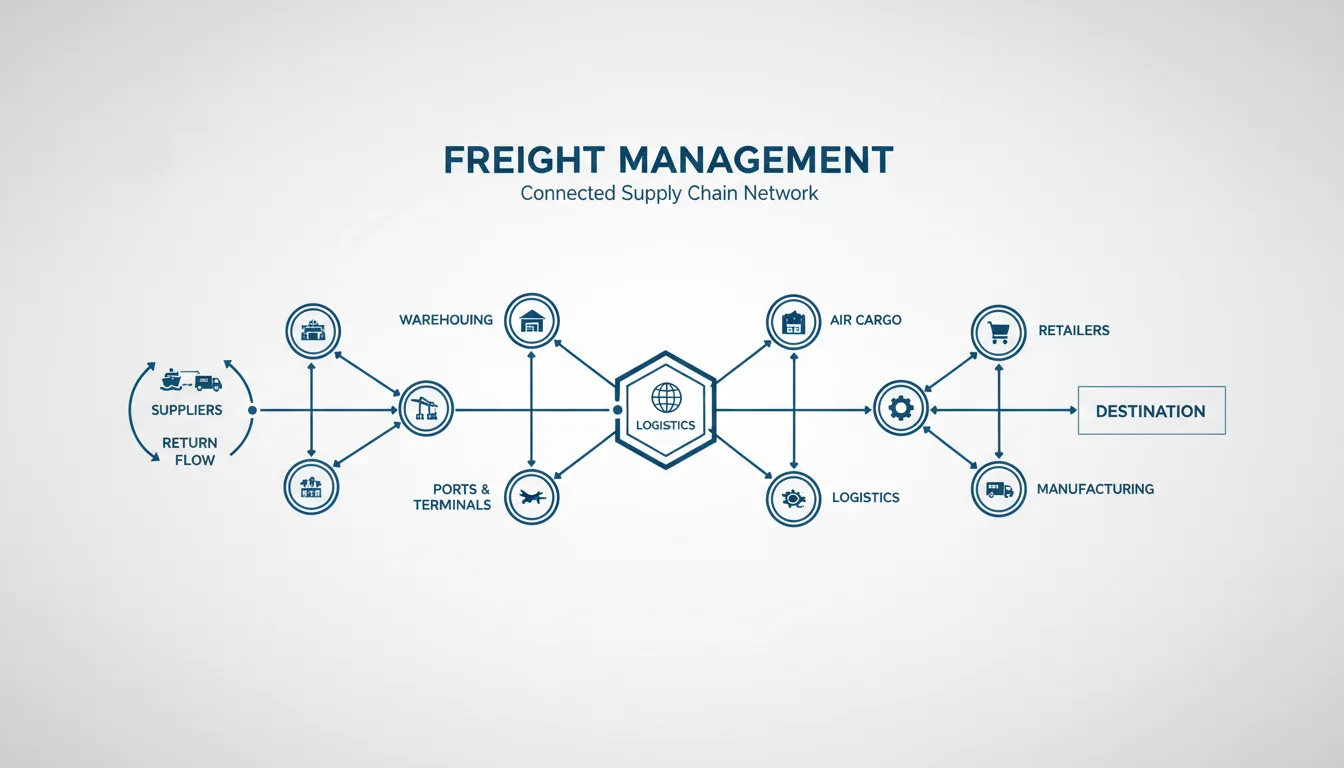
Freight Management
Overview
Freight management refers to the comprehensive coordination and oversight of the movement of goods across the entire supply chain. This encompasses a broad range of activities from strategic planning and procurement of transport services to operational execution, tracking, and post-delivery analysis related to the physical transportation of cargo Order Management System. Its primary goal is to ensure that freight moves smoothly, efficiently, and cost-effectively, meeting delivery deadlines and customer expectations while minimizing risks and optimizing resource utilization.
Efficient freight management is a critical pillar of modern supply chains, significantly enhancing overall supply chain efficiency by reducing transportation costs, improving service levels, and providing greater visibility and control over goods in transit. It combines elements of logistics, warehousing, and inventory management to streamline processes, mitigate disruptions, and improve overall operational and financial performance. Strategic freight management can be a key differentiator, offering a competitive advantage through reliable and optimized product delivery according to SupplyChain Dive.
Etymology and Origins
The term "freight" originates from the Middle Dutch word vrecht or vracht, which denotes the loading or cargo of a ship, as well as the payment for carriage. This term further traces back to the Proto-Germanic fra-aihtiz, meaning 'possessions' or 'property carried.' The linguistic journey reflects the early importance of transporting valuable goods. The Latin word fractus, meaning to break or crush (as in breaking bulk for loading), is often mistakenly cited as a direct root, though the concept of handling cargo certainly aligns according to the Oxford English Dictionary.
The phrase "freight management" emerged more formally in the early 20th century, coinciding with the professionalization of logistics and the increasing complexity of global trade. As transportation networks grew more intricate with the advent of rail, road, and air transport, the need for a dedicated discipline to oversee and optimize these movements became apparent. Early forms of freight management were largely manual and administrative, focusing on booking space, customs documentation, and tracking shipments. Over the years, the term has evolved to encapsulate a vast array of practices, technologies, and strategic approaches designed to optimize the movement and management of cargo in an increasingly complex and interconnected global supply chain network Investopedia on Freight Management.
Historical Development
The concept of managing goods movement has a rich history, dating back to the establishment of early trade routes. Ancient civilizations utilized river systems, rudimentary roads, and maritime pathways for commerce, with early forms of "freight management" involving caravanserai, port authorities, and merchant guilds organizing transport from the Handbook of Logistics and Supply Chain Management. However, true freight management as a distinct discipline began to take shape with the Industrial Revolution.
18th - 19th Century: The Dawn of Modern Transportation The 18th and 19th centuries saw significant innovations with the development of canals, steamships, and mechanized railroads. These advancements drastically increased the volume and speed of cargo transport. Early freight forwarding companies emerged to consolidate shipments and manage complex routes, laying the groundwork for modern logistics. The expansion of railway networks, particularly in North America and Europe, standardized shipping practices and enabled the movement of goods over vast distances as noted in "The History of Logistics".
Early 20th Century: Trucking and Integrated Logistics With the invention of the internal combustion engine, trucking gained prominence in the early 20th century, offering flexible door-to-door delivery. World War I and II further highlighted the critical importance of efficient military logistics, leading to advancements in planning, inventory control, and supply chain coordination that later translated into commercial practices. Large corporations began to establish dedicated logistics departments, integrating transportation, warehousing, and distribution functions according to the Council of Supply Chain Management Professionals (CSCMP).
Mid-20th Century (1950s-1970s): Containerization and Intermodal Revolution The 1950s marked a pivotal moment with the introduction of containerization by Malcolm McLean. This innovation revolutionized cargo transport by standardizing freight units, dramatically reducing handling times, labor costs, and pilferage. Containerization facilitated the seamless transfer of goods between ships, trains, and trucks (intermodal transport), creating a global interconnected logistics network. Around this time, the U.S. Interstate Highway System was developed, further enhancing road freight efficiency. The emergence of Just-In-Time (JIT) methodologies at Toyota in the 1970s emphasized lean principles and precise synchronization of supply, significantly influencing freight logistics by demanding smaller, more frequent, and highly reliable deliveries.
Late 20th Century (1980s-1990s): Deregulation and Digital Transformation The 1980s saw significant deregulation of the transportation industry (e.g., the Motor Carrier Act of 1980 in the US), fostering competition and innovation among carriers. This period also witnessed the rise of computer technology, leading to the development and widespread adoption of Material Requirements Planning (MRP) and later Enterprise Resource Planning (ERP) systems. Companies like IBM played a crucial role in providing computing power and software solutions that transformed inventory management, order processing, and early freight planning. The introduction of dedicated Transportation Management Systems (TMS) and Warehouse Management Systems (WMS) began to automate and optimize various aspects of freight operations, improving tracking and data analysis ResearchGate on Logistics Purpose.
21st Century: Globalization, E-commerce, and Advanced Technology The turn of the century brought rapid globalization, the explosion of e-commerce, and heightened customer expectations for speed and transparency. This era necessitated even more sophisticated freight management solutions. Modern freight management systems now leverage advanced technologies such as artificial intelligence (AI), machine learning (ML), Internet of Things (IoT), and big data analytics. Capabilities such as real-time tracking, predictive analytics for demand forecasting and route optimization, automated rate selection, and blockchain for enhanced transparency allow companies to optimize routing, inventory levels, and overall supply chain visibility. The "Amazon effect," driven by its innovative and technology-driven logistics strategies, has profoundly influenced the e-commerce sector, setting new benchmarks for delivery speed and efficiency DHL on Amazon Effect, pushing all businesses to adopt more robust freight management practices.
Key Components of Freight Management
Effective freight management involves several critical components working in concert:
- Transportation Planning: This includes selecting the optimal modes of transport (road, rail, air, sea, intermodal), determining routing, and choosing appropriate carriers based on cost, speed, reliability, and capacity. It also involves optimizing load configurations and consolidation opportunities.
- Carrier Management: Establishing strong relationships with a network of reliable carriers, negotiating contracts, managing service level agreements, and monitoring performance are essential for consistent and cost-effective transportation.
- Documentation and Compliance: Handling complex international and domestic shipping documentation, customs declarations, trade regulations, and hazardous materials compliance is a core function, ensuring legal and smooth movement of goods.
- Freight Tracking and Visibility: Utilizing technology to monitor shipments in real-time, providing transparency on their location and status from origin to destination. This includes managing exceptions and proactive communication about potential delays.
- Cost Management and Optimization: Analyzing freight spend, identifying opportunities for cost reduction through route optimization, consolidation, backhaul utilization, and efficient rate negotiation. This often involves leveraging Shipping & Fulfillment Software with strong analytical capabilities.
- Auditing and Payment: Ensuring freight invoices are accurate, auditing for discrepancies, and managing payment processes to carriers.
- Risk Management: Identifying and mitigating potential disruptions such as weather events, geopolitical issues, port congestion, or carrier failures.
Best Practices in Freight Management
-
Utilizing Advanced Technology: Implementing a robust Transportation Management System (TMS) alongside modern WMS systems is paramount. TMS platforms automate processes from load tendering and dispatch to tracking and payment, optimizing routes, and providing real-time visibility. Integrating these systems with ERPs and purchase order management tools ensures end-to-end data flow and process automation through custom workflows.
-
Leveraging Data Analytics for Strategic Insights: Beyond basic tracking, employ advanced data analytics to glean actionable insights. This includes predictive analytics for demand forecasting, identifying peak shipping seasons, optimizing carrier performance, and recognizing cost-saving opportunities. Businesses should utilize Shipping & Fulfillment Software that allows for detailed analytics on freight spend, on-time performance, and carbon footprint. Analyzing key performance indicators (KPIs) like transit time, cost per mile, and damage rates drives continuous improvement as advised by Supply Chain Management Review.
-
Fostering Collaboration and Strategic Partnerships: Effective freight management relies heavily on collaboration. This involves strong partnerships with third-party logistics (3PL) providers, individual carriers, suppliers, and even customers. Shared information, integrated systems, and collaborative planning can lead to streamlined operations, better capacity utilization, and reduced costs. For instance, collaborating with carriers on volume commitments can secure better rates and service levels.
-
Proactive Risk Management and Resiliency Planning: Develop comprehensive strategies to identify, assess, and mitigate supply chain risks. This includes diversifying carrier bases, having contingency plans for unexpected disruptions (e.g., port closures, labor strikes, natural disasters), and leveraging technology for early warning systems. Building a resilient freight network is crucial in today's volatile global environment according to McKinsey.
-
Focus on Sustainability and Green Logistics: Integrate environmental considerations into freight planning. This involves optimizing routes to minimize fuel consumption and emissions, utilizing intermodal transport, exploring alternative fuels, and selecting carriers with strong sustainability practices. Green logistics not only reduces environmental impact but can also lead to cost savings and enhanced brand reputation.
-
Continuous Improvement and Agility: Freight markets and regulations are constantly evolving. Companies must continuously assess their freight performance metrics, review processes, and adapt to changing market conditions, technological advancements, and customer demands. This iterative approach, often supported by agile methodologies, ensures that freight management strategies remain optimized and responsive.
Conclusion
Freight management is an indispensable and increasingly complex component of modern supply chain operations. From its ancient origins rooted in the simple movement of goods to its current state as a sophisticated, technology-driven discipline, it has continuously adapted to global trade dynamics. By harnessing advanced technology, embracing strategic data analytics, fostering strong collaborations, managing risks proactively, and committing to continuous improvement, companies can optimize their freight processes. This not only leads to significant cost savings and enhanced operational efficiency but also drives higher customer satisfaction and contributes to a competitive edge in the global marketplace.
Sources
- Containerization
- The JIT Puzzle
- The Purpose of Logistics
- Logistics Innovation in E-Commerce
- Investopedia on Freight Management
- ScienceDirect on Containerization
- Harvard Business Review on JIT
- ResearchGate on Logistics Purpose
- DHL on Amazon Effect
- Freight Logistics
- Oxford English Dictionary: Freight
- Handbook of Logistics and Supply Chain Management
- The History of Logistics
- History of CSCMP
- Transportation Management Systems (TMS)
- The Power of Data Analytics in Supply Chain Management
- Building Supply Chain Resilience
- Purchase Order Management
- Workflows Overview