Financial Management in Logistics
An overview of financial management strategies and their importance in logistics and supply chain.
Updated
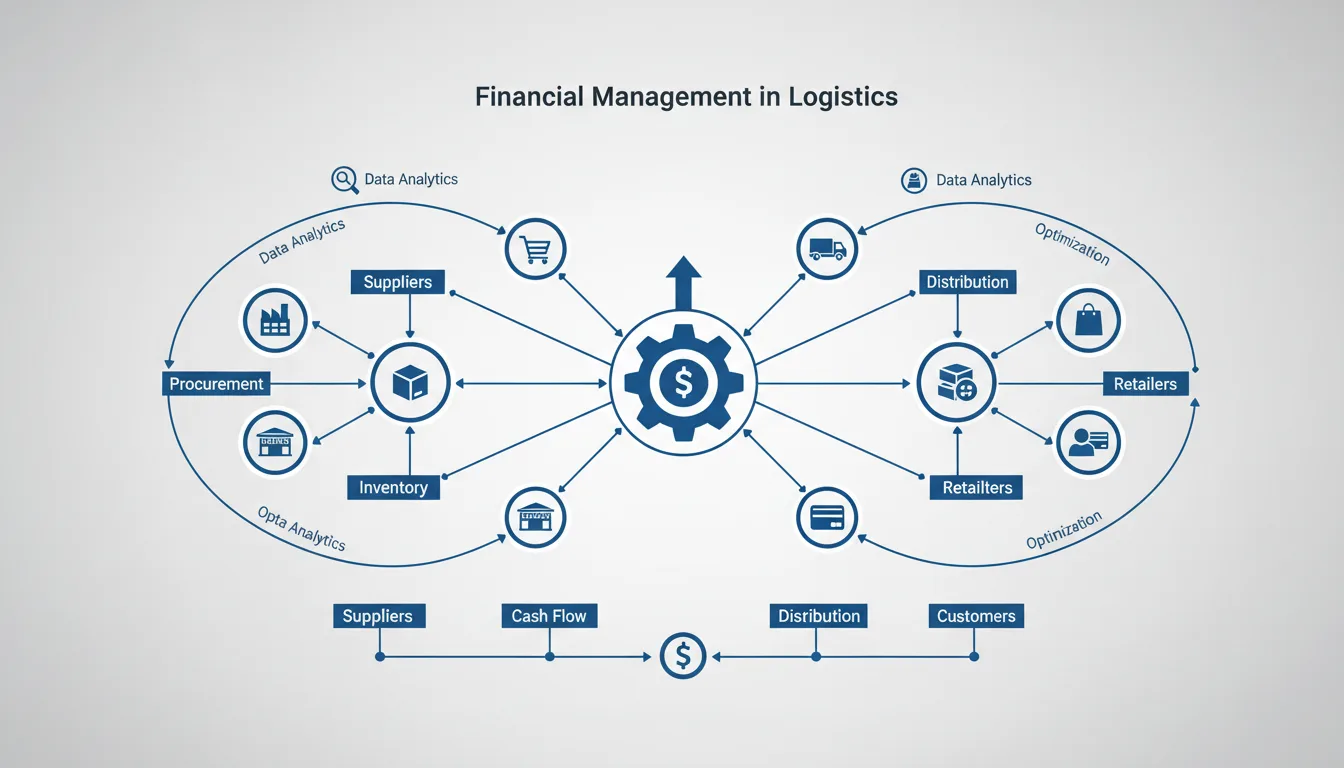
Overview
Financial management in logistics is the deliberate practice of managing monetary resources and investments effectively to ensure optimal performance, efficiency, and profitability across all supply chain operations [3]. It encompasses crucial activities such as budgeting, financial forecasting, cost analysis, and capital allocation specifically tailored to the unique demands of the logistics sector. Effective financial management is paramount as it directly influences an organization's profitability, sustainability, and scalability, enabling businesses to navigate market volatility and strategic growth [4].
Etymology and Origins
The term "financial management" is a compound derived from distinct historical concepts. "Financial" originates from the Old French "finance," referring to an end or settlement, particularly in a monetary sense, evolving to mean the management of money and wealth by the 18th century [5]. "Management" stems from the Latin "manu agere," meaning "to lead by hand," and later from the Old French "ménagement," signifying the art of conducting or directing [6].
The formal usage of "financial management" as a distinct discipline began to coalesce in the late 19th and early 20th centuries. The rapid industrialization, growth of large corporations, and the emergence of modern accounting principles necessitated a more sophisticated approach to handling business finances [7]. Initially, it was largely descriptive, focusing on capital acquisition and corporate finance. However, with the increasing complexity of global trade and manufacturing, the need for effective financial oversight of operational elements, including logistics, became evident. While not a standalone discipline initially, the principles of cost control, asset utilization, and investment decision-making laid the groundwork for its application within the nascent field of logistics and supply chain management.
Historical Development
The evolution of financial management in logistics is intrinsically linked to advancements in both financial theory and broader supply chain management practices, marked by several distinct phases:
-
Late 19th - Early 20th Century: Cost Accounting and Efficiency Drives
The rise of scientific management, spearheaded by pioneers like Frederick Winslow Taylor, emphasized efficiency and cost reduction in production [8]. Early applications in logistics focused on basic cost accounting for freight, warehousing, and inventory. Companies like Ford Motor Company were early adopters, implementing rigorous financial controls to minimize inventory holding costs and optimize assembly line material flow [9]. Railway systems, being early complex logistics networks, developed sophisticated costing models to manage vast infrastructures and varied freight rates [10]. -
Mid-20th Century (1940s-1960s): Operations Research and EDP
Post-World War II, operations research (OR) techniques, initially developed for military logistics, began to be applied to commercial problems [11]. This led to more analytical approaches in inventory control (e.g., Economic Order Quantity - EOQ), transportation routing, and network design, all with direct financial implications. The introduction of Electronic Data Processing (EDP) and early mainframe computers in the 1960s revolutionized financial planning, enabling rudimentary forecasting and analysis of large datasets for logistics operations [12]. -
Late 20th Century (1970s-1990s): Integrated Logistics and JIT
The 1970s saw logistics emerge as a recognized business function, moving beyond just transportation and warehousing to encompass a broader view of material flow. The adoption of Manufacturing Resource Planning (MRP II) systems, which evolved from earlier MRP systems, provided better integration of production, inventory, and financial planning [13]. The 1980s were pivotal with the widespread adoption of Just-in-Time (JIT) inventory systems, pioneered by Toyota, which dramatically impacted capital tied up in inventory and cash flow management [14]. This era emphasized total cost concepts and the integration of logistics principles into corporate financial strategies, highlighting the trade-offs between logistics costs and customer service [15]. Seminal publications such as Strategic Logistics Management (1987) by James C. Johnson and Donald F. Wood, and Principles of Logistics (1987) by John J. Coyle, Edward J. Bardi, and C. John Langley Jr., documented these trends and established logistics financial management as a critical area of study. -
21st Century (2000s-Present): Supply Chain Management and Digital Transformation
The turn of the millennium saw logistics evolve into Supply Chain Management (SCM), emphasizing end-to-end integration across multiple firms. Enterprise Resource Planning (ERP) systems became widespread, providing comprehensive financial, operational, and logistical data integration. The 2000s ushered in sophisticated software solutions, leveraging advanced algorithms for dynamic pricing, cost optimization, and real-time financial visibility across complex, global supply chains [16]. Cloud computing, big data analytics, and mobile technologies further enhanced financial management capabilities, enabling better risk assessment and performance measurement. Modern Warehouse Management Systems (WMS) and Order Management Systems (OMS) now integrate financial insights directly into operational workflows, providing granular control over logistics costs and asset utilization [17].
Core Concepts
Key components of financial management in logistics are designed to optimize resource allocation and ensure fiscal prudence:
Budgeting
Budgeting in logistics is the comprehensive process of creating detailed financial plans that project revenues and expenses over a specific period, informing strategic and operational decisions. It's critical for managing costs effectively across various logistics functions, such as transportation, warehousing, inventory holding, and order processing. Effective budgeting often involves:
- Operating Budgets: Covering day-to-day expenses like labor, fuel, and facility maintenance.
- Capital Budgets: Allocating resources for significant long-term investments, such as new distribution centers, automated material handling equipment, or fleet expansion.
- Zero-Based Budgeting (ZBB): Requiring justification for every expenditure, regardless of prior year budgets, to eliminate wasteful spending.
Organizations frequently leverage robust tools like an Order Management System to track and manage order-related costs against budget, ensuring fiscal discipline in fulfillment processes.
Cost Analysis
Understanding and dissecting all costs associated with logistics operations is fundamental. This includes identifying and categorizing fixed expenses (e.g., warehouse rent, depreciation) and variable expenses (e.g., fuel, direct labor, packaging materials) [18]. Advanced techniques like Activity-Based Costing (ABC) are often employed to assign costs more accurately to specific logistics activities (e.g., picking, packing, shipping a particular item), rather than broad categories. Regular cost analysis helps companies identify areas for efficiency gains, optimize service levels, negotiate better rates with suppliers (e.g., via a Purchase Order Management system), and ultimately enhance overall financial health.
Financial Forecasting
Financial forecasting involves predicting future financial outcomes based on historical data, market trends, economic conditions, and strategic initiatives. In logistics, accurate forecasting is crucial for:
- Demand Forecasting: Predicting future customer orders, which directly impacts inventory levels, warehousing space requirements, and transportation capacity, thus influencing cash flow and capital expenditure.
- Cost Forecasting: Anticipating changes in fuel prices, labor costs, and raw material costs.
- Revenue Forecasting: Projecting income from logistics services or product sales, vital for financial planning and budgeting cycles.
Logistics firms utilize sophisticated models, often incorporating machine learning, to predict these variables, allowing for proactive adjustments in operations and financial strategy.
Financial Reporting
Generating accurate and timely financial statements, such as balance sheets, income statements, and cash flow statements, is foundational to financial management. These reports provide transparent insights into an organization's financial health and performance. For logistics managers, these documents, combined with specialized logistics Key Performance Indicators (KPIs), offer critical data for informed operational decisions, such as:
- Inventory Turnover: Indicating how efficiently inventory is managed (e.g., supported by a Visual Inventory Management System).
- Logistics Costs as a Percentage of Sales: Measuring overall logistics efficiency.
- Perfect Order Rate: Reflecting customer service quality and its financial implications.
- On-Time Delivery Rate: Impacting customer satisfaction and potential revenue.
Detailed reporting supports accountability, compliance, and strategic planning, helping identify financial bottlenecks or opportunities for improvement.
Types and Classifications
Financial management in logistics can be broadly categorized by its scope and time horizon:
- Strategic Financial Management: Focuses on long-term planning and investment decisions that shape the future direction and competitive advantage of the logistics function. This includes decisions on major capital expenditures (e.g., building a new automated warehouse), mergers and acquisitions of logistics providers, and long-term financial structuring to support global supply chain expansion.
- Tactical Financial Management: Involves medium-term planning, typically spanning several months to a year, to implement strategic goals. Examples include optimizing transportation routes and modes, negotiating carrier contracts, managing working capital tied up in inventory, and optimizing warehouse staffing levels.
- Operational Financial Management: Concerns the day-to-day management of financial resources and operational costs. This involves managing cash flow, overseeing daily expenditure, controlling fuel consumption, optimizing picking and packing labor efficiency (e.g., with Pick, Pack, Ship Software), and ensuring invoice accuracy. This level directly impacts immediate profitability and service delivery.
- Capital Budgeting: A critical sub-discipline of strategic financial management, specifically involving the process of evaluating and selecting long-term investment projects. For logistics, this means assessing the financial viability of investments in infrastructure (e.g., new distribution centers, cross-docking facilities), technology (e.g., WMS, automation, IoT devices), and transportation assets (e.g., new fleet vehicles). Techniques like Net Present Value (NPV), Internal Rate of Return (IRR), and Payback Period are commonly used to make these high-stakes decisions.
Industry Applications
Financial management strategies are uniquely tailored across various sectors to address specific logistics complexities:
- E-commerce: Companies leverage advanced financial analytics tools, often integrated into their Mobile Warehouse Management Systems, to optimize inventory turnover, minimize holding costs, and manage the financial implications of high return rates. Amazon, for example, is renowned for its sophisticated financial models that optimize warehouse placement, delivery routes, and pricing strategies to achieve rapid, cost-effective fulfillment.
- Manufacturing: Focuses on managing the financial aspects of inbound raw materials, work-in-progress, and outbound finished goods. This includes optimizing inventory financing, managing the costs of lean manufacturing practices like JIT, and performing cost-benefit analyses for new production facilities or supplier networks.
- Retail: Emphasizes efficient inventory management, markdown optimization, and the financial impact of omnichannel fulfillment. Retailers use financial data to decide on optimal stock levels across stores and distribution centers, balancing carrying costs with potential lost sales.
- Third-Party Logistics (3PL): 3PL providers utilize robust financial management to price services competitively, manage diverse client contracts, optimize asset utilization (e.g., fleet, warehouse space), and ensure profitability across multiple service offerings, from warehousing to freight forwarding. Their financial health is directly tied to efficient resource allocation and cost control.
Benefits and Advantages
Effective financial management in logistics yields substantial benefits for organizations, fostering resilience and growth:
- Enhanced Profitability: By systematically identifying and reducing unnecessary costs across the supply chain (e.g., through optimized transportation, warehousing, and inventory holding costs), and by implementing strategic pricing, companies can significantly improve their net margins. This includes optimizing freight spend through efficient shipping and fulfillment software.
- Improved Cash Flow: Strategic management of working capital, particularly inventory levels (reducing capital tied up in slow-moving stock) and payment terms with suppliers and customers, ensures healthier cash reserves. This allows for timely reinvestment in critical logistics capabilities, such as new technology or infrastructure, and provides financial stability during market downturns.
- Risk Mitigation: Proactive financial planning and forecasting help identify potential financial risks, such as supply chain disruptions, fluctuating fuel costs, or currency exchange rate volatility. This enables organizations to develop contingency plans and hedging strategies, protecting financial stability.
- Strategic Partnerships and Supplier Relations: Financial insights inform decisions about forming and maintaining partnerships with suppliers, carriers, and 3PL providers. By understanding the financial impact of these relationships, companies can negotiate favorable terms, ensure cost-effectiveness, and build stronger, more reliable supply chains, which can be managed partly through a Vendor Portal.
- Competitive Advantage: Companies that excel in financial management within their logistics operations can offer more competitive pricing, superior service levels, or faster delivery times due to lower operational costs and greater financial agility. This translates into increased market share and stronger customer loyalty.
- Optimized Asset Utilization: Financial management ensures that investments in physical assets (warehouses, vehicles, equipment) and technology are justified and optimally utilized, maximizing their return on investment. For example, calculating ROI on inventory management apps helps validate tech investments.
Challenges and Limitations
Despite its critical advantages, effective financial management in logistics faces several inherent challenges:
- Data Overload and Integration: The modern supply chain generates vast amounts of data from diverse sources (WMS, TMS, ERP, IoT devices, e-commerce platforms). Integrating this disparate data into a unified, coherent financial view can be complex, often overwhelming systems and complicating analysis and decision-making [21]. Inaccurate or siloed data can lead to flawed financial strategies.
- Market Volatility and Geopolitical Risks: Fluctuations in global markets (e.g., fuel prices, exchange rates), geopolitical events (e.g., trade wars, conflicts), and natural disasters can significantly impact budgeting and forecasting accuracy. These external factors require constant adjustments to financial plans and robust risk management strategies.
- Regulatory Compliance and Global Complexity: Operating in a globalized logistics environment means navigating a complex web of international trade regulations, customs duties, taxes, and environmental mandates. Ensuring financial compliance across multiple jurisdictions adds layers of complexity and potential costs.
- Talent Shortage: A scarcity of professionals with combined expertise in both logistics operations and financial management can hinder effective implementation of sophisticated financial strategies. The demand for logistics finance specialists is growing but supply is often limited.
- Balancing Cost Reduction with Service Levels: A perpetual challenge is to reduce logistics costs without compromising customer service levels. Over-aggressive cost-cutting can lead to slower deliveries, increased errors, or stockouts, ultimately damaging customer satisfaction and long-term profitability.
- Capital Intensity: Logistics, particularly for asset-heavy operations like warehousing and transportation, is often capital-intensive. Making large-scale investment decisions for infrastructure and technology requires careful capital budgeting and long-term financial commitment, with significant risks if projections are inaccurate.
Future Trends
The financial management landscape in logistics is poised for significant transformation, driven by technological advancements and evolving supply chain dynamics:
- Increased Use of AI and Machine Learning: AI and ML will increasingly power predictive analytics for demand forecasting, dynamic pricing, and risk assessment [22]. These technologies will enable more accurate budgeting, intelligent inventory optimization, and automated fraud detection, moving beyond traditional statistical methods to uncover hidden patterns in vast datasets. For example, AI can optimize inventory levels based on real-time sales data and external factors, directly impacting holding costs and cash flow.
- Blockchain for Transparency and Auditability: Blockchain technology offers the potential for unprecedented transparency and immutability in financial transactions across the supply chain. This can streamline payment processes, reduce disputes, enhance financial auditability, and facilitate supply chain financing by providing verifiable records of goods movement and ownership [23]. Smart contracts, enabled by blockchain, can automate payments upon delivery, improving cash flow predictability.
- Advanced Financial Modeling and Digital Twins: More sophisticated financial models, often integrated with digital twin technology, will allow logistics managers to simulate various operational scenarios and their financial impacts before actual implementation. This includes modeling the financial implications of network design changes, automation investments, or new shipping routes, leading to more informed and less risky financial decisions [24].
- Sustainability Costing and ESG Reporting: As environmental, social, and governance (ESG) factors become more critical, financial management will increasingly incorporate the costs and benefits of sustainable logistics practices. This includes accounting for carbon emissions, waste reduction, and ethical sourcing, influencing investment decisions and public reporting. Financial models will need to quantify the ROI of green initiatives.
- Real-time Financial Visibility and Control Towers: The proliferation of IoT sensors and advanced analytics will enable near real-time financial visibility across the entire supply chain. "Control towers" will integrate financial data with operational data, providing a holistic view of costs, revenues, and risks, allowing for immediate corrective actions and proactive financial management [25].
- Hyper-Personalized Financial Services: As logistics data becomes richer, financial service providers will offer more tailored financing, insurance, and payment solutions specifically designed for the unique cash flow patterns and risk profiles of different logistics businesses.
Conclusion
Financial management in logistics is an indispensable discipline that ensures organizations optimize their financial resources, navigate complexities, and achieve strategic business objectives. From its early roots in basic cost accounting to its current state of sophisticated analytical tools and AI-driven forecasting, its evolution mirrors the increasing strategic importance of logistics itself. As the logistics industry continues its rapid transformation, marked by globalization, technological innovation, and evolving customer expectations, adopting proactive and innovative financial management practices becomes increasingly crucial for maintaining competitive advantages, ensuring operational efficiency, and fostering long-term sustainability.
Sources
- Order Management System
- Mobile Warehouse Management System
- Logistics and Supply Chain Management
- Financial Management in Supply Chain - The Role of Logistics
- Etymology of Finance
- Etymology of Management
- The History of Financial Management
- The Principles of Scientific Management
- My Life and Work - Henry Ford
- Railway Economics
- Operations Research and Management Science: An Introductory Guide
- A History of Computing in the Twentieth Century
- Manufacturing Resource Planning (MRP II)
- The Toyota Way: 14 Management Principles from the World's Greatest Manufacturer
- Strategic Logistics Management
- The Rise of Supply Chain Management Software
- Mobile WMS Overview
- Logistics Cost Analysis and Control
- Demand Forecasting in Supply Chain Management
- Warehouse Management Systems for E-commerce
- Big Data in Supply Chain Management: A Review
- AI in Supply Chain Management: A Comprehensive Review
- Blockchain in Supply Chain Management: A Comprehensive Review
- Digital Twins in Logistics and Supply Chain Management
- The Rise of Supply Chain Control Towers
- Purchase Order Management
- Visual Inventory Management System
- Pick, Pack, Ship Software
- Shipping & Fulfillment Software
- Vendor Portal
- How to Calculate ROI on Shopify Inventory Management App