Enterprise Content Management
Enterprise Content Management (ECM) focuses on effectively managing an organization's documents, records, and content throughout their lifecycle to enhance productivity and compliance.
Updated
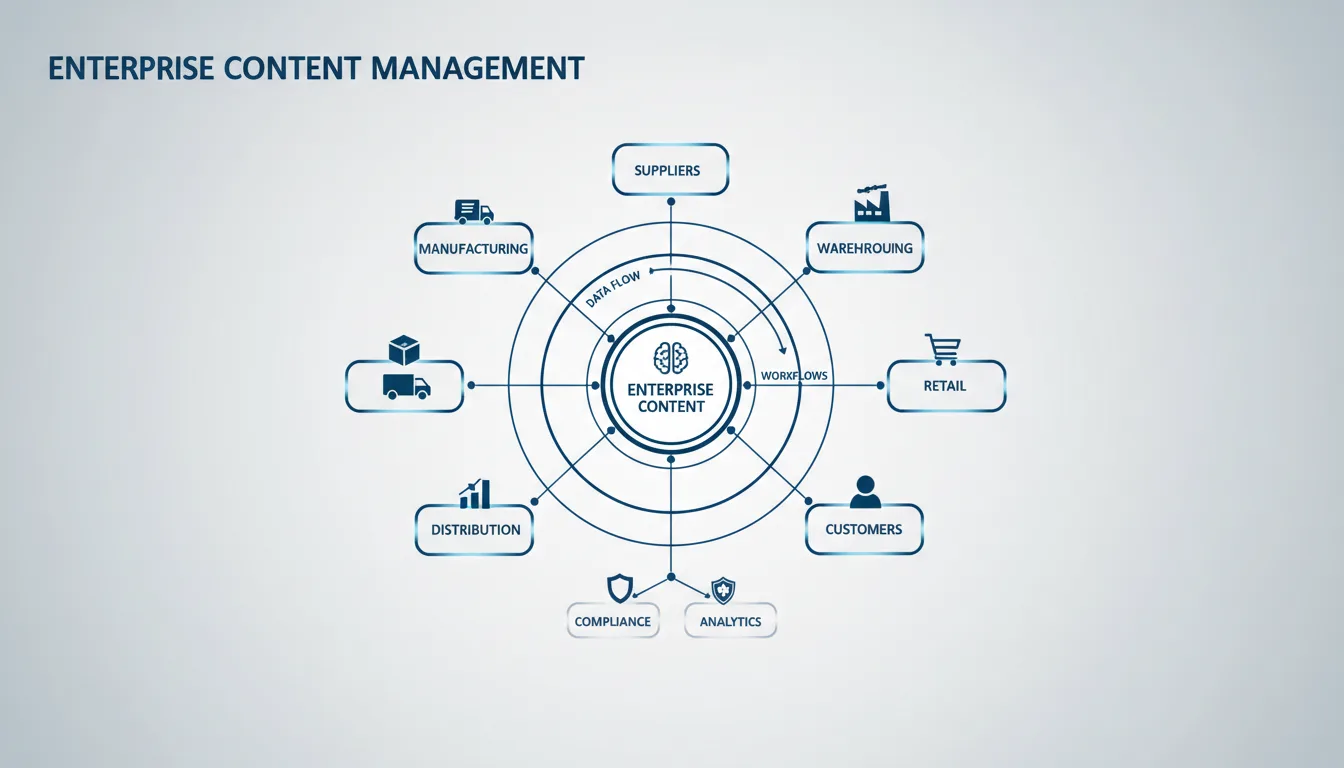
Enterprise Content Management
Overview
Enterprise Content Management (ECM) is a systematic approach to managing an organization's content and documents from creation to disposal. It encompasses strategies, methods, and tools used to capture, manage, store, preserve, and deliver information supporting organizational processes throughout its lifecycle. This involves the capture, storage, management, and distribution of various forms of content, ensuring that information is readily accessible, secure, and compliant with relevant regulations [3]. The importance of ECM lies in improving operational efficiency, facilitating collaboration, enhancing decision-making across organizational levels, and ensuring regulatory compliance.
Etymology and Origins
The term Enterprise Content Management emerged in the early 2000s, specifically around 2000-2002, as the Association for Information and Image Management (AIIM) sought to unify various disparate information management disciplines [4]. The roots of ECM can be traced back to earlier technologies and concepts:
- Document Management Systems (DMS): Developed in the 1980s, these systems focused on controlling documents through their lifecycle, including version control, check-in/check-out, and search capabilities.
- Workflow Systems: Alongside DMS, workflow automation tools became prevalent in the 1990s, allowing for the automation of business processes involving documents.
- Web Content Management (WCM): With the rise of the internet in the late 1990s, managing digital content for websites became critical, leading to WCM systems.
The evolution of terminology reflects the shift from simple document storage and retrieval to a comprehensive approach that integrates diverse content types (documents, images, audio, video, web content), business processes, and principles of data governance and compliance management. AIIM's initial definition of ECM included five key components: Capture, Manage, Store, Preserve, and Deliver, which broadened the scope beyond traditional document management.
Historical Development
1980s–1990s: Dawn of Document Management
The practice of managing documents digitally dates back to the advent of personal computers and local area networks in the 1980s. Early forms of document management systems (DMS) began evolving, primarily addressing the need to digitize paper records and control their access. Key figures during this period include Joan M. McKown, who in 1991 published influential work on managing electronic documents, highlighting early challenges and best practices in a then-nascent field [5]. Companies like Wang Laboratories and IBM began offering early imaging and document management solutions, though they were often proprietary and expensive.
Early 2000s: The ECM Framework Emerges
In the early 2000s, the term ECM gained traction, largely popularized by AIIM, as companies sought integrated solutions to tackle increasing volumes of digital data from various sources. AIIM officially defined ECM in 2001-2002, encompassing the full information lifecycle [4]. This period saw significant consolidation and expansion, with companies like IBM (via acquisitions like FileNet and Documentum), OpenText, and Microsoft pioneering enterprise solutions that encompassed document management, workflow automation, and knowledge management. The focus shifted from merely storing documents to managing all forms of organizational content as strategic assets.
2010s: Technology Integration and Cloud Adoption
The 2010s saw significant milestones in technology integration within ECM. The widespread adoption of cloud-based platforms revolutionized accessibility and collaboration, moving away from purely on-premises solutions. Mobile access to content became essential, allowing employees to work remotely and access information from anywhere. Standards like ISO 15489 for records management began influencing ECM practices more significantly around this period, emphasizing the need for robust record-keeping for legal and compliance reasons. The concept of Content Services Platforms (CSP) also began to emerge as a more modular and flexible alternative to monolithic ECM suites, often delivered via the cloud.
2020s and Beyond: Intelligent Content Services
Today, ECM is rapidly evolving into what many analysts, like Gartner, refer to as Content Services Platforms (CSPs). This shift emphasizes agile, cloud-native, and API-driven content management, moving beyond repository-centric systems to dynamic content services. The integration of advanced technologies like artificial intelligence (AI) for intelligent data extraction, machine learning (ML) for content classification and search, and Robotic Process Automation (RPA) for hyperautomation is a key trend. These intelligent content services aim to automate routine tasks, provide deeper insights from unstructured content, and support complex business processes more effectively.
Core Concepts
ECM operates under several core concepts aiming to streamline content workflows and lifecycle management:
- Capture: This involves collecting content from various sources, such as paper documents, emails, forms, social media, and digital files. Techniques such as Optical Character Recognition (OCR) for converting scanned images into searchable text, Intelligent Character Recognition (ICR), and forms processing enable the digitization and automated indexing of content for easier management.
- Manage: Once captured, content is organized, versioned, and controlled. This includes document management, workflow management, web content management, records management, and collaborative tools. Metadata, version control, and access permissions are critical for effective content control.
- Store: Effective ECM solutions prioritize storing data in secure, scalable, and retrievable environments. This can involve structured repositories, archives for long-term preservation, and various storage strategies (cloud, on-premises, or hybrid) depending on regulatory requirements and access needs.
- Preserve: This concept ensures the long-term accessibility and integrity of information, particularly for regulatory compliance, legal discovery, and historical purposes. It involves strategies for archiving, migrating data formats, and ensuring content remains authentic and readable over decades.
- Deliver (Distribution): Delivering content involves making the right information available to the right personnel at the right time, in the right context. This is often facilitated through search functionalities, portals, integration with other business applications (like ERP or CRM), and role-based access controls to maintain security and relevance.
Industry Applications
ECM is utilized across various industries, offering tailored solutions for sector-specific content challenges:
- Healthcare: Managing patient records (Electronic Health Records - EHR), consent forms, billing documents, and compliance documentation with privacy regulations like HIPAA. ECM ensures secure access and audit trails.
- Finance: Ensuring regulatory compliance (e.g., SOX, GDPR) and secure management of sensitive financial records, contracts, customer onboarding documents, and audit trails. It helps automate loan processing and manage investment portfolios.
- Government: Facilitating transparency, public access to documents, managing permits and licenses, and efficiently handling vast quantities of government records in compliance with freedom of information acts and archival mandates.
- Legal: Managing case files, contracts, intellectual property documents, and discovery processes. ECM systems provide secure repositories, version control, and efficient search capabilities crucial for legal practice.
- Manufacturing: Managing product specifications, engineering drawings, quality control documents, supplier contracts, and maintenance manuals. ECM helps streamline product lifecycle management (PLM) and ensures adherence to industry standards.
- Retail: Managing product information (PIM), marketing collateral, supplier agreements, sales contracts, and customer service interactions. ECM supports consistent brand messaging and efficient back-office operations.
Benefits and Advantages
Implementing a robust ECM system offers numerous organizational benefits:
- Improved Operational Efficiency: Streamlines content-intensive business processes and workflows, reducing manual effort and processing times. This can be directly linked to the efficiency gains seen in areas like automated purchase quantity.
- Enhanced Collaboration: Provides centralized access to up-to-date content, enabling better teamwork and information sharing across departments and geographically dispersed teams. This is akin to how modern workflow management tools facilitate content flow.
- Better Compliance and Risk Management: Helps organizations meet regulatory requirements (e.g., GDPR, HIPAA, SOX, ISO 15489) by ensuring proper record-keeping, audit trails, and data retention policies, thereby reducing legal and financial risks.
- Improved Decision-Making: Provides timely access to accurate and comprehensive information, empowering employees and leaders to make more informed decisions.
- Reduced Costs: Lowers costs associated with paper storage, printing, manual document handling, and lost information. Automated processes also contribute to cost savings.
- Enhanced Security: Protects sensitive information through access controls, encryption, and audit logging, minimizing the risk of data breaches.
Challenges and Limitations
Despite its advantages, ECM also presents challenges that organizations must address:
- Integration Complexity: Integrating ECM with existing enterprise systems (ERP, CRM, HRIS, etc.) can be technically challenging, resource-intensive, and require significant customization, potentially leading to increased costs and project delays.
- User Adoption and Training: Ensuring that all employees are trained on new ECM systems and adhere to new processes can be a lengthy process. Resistance to change and a lack of proper training can hinder successful implementation.
- Data Migration: Migrating legacy content from older systems or physical archives to a new ECM system can be complex, time-consuming, and prone to errors, especially for large volumes of data.
- Cost of Ownership: Beyond initial implementation, ongoing costs include licensing, maintenance, upgrades, and specialized IT personnel, which can be substantial.
- Vendor Lock-in: Choosing a comprehensive ECM suite can lead to dependence on a single vendor, making it difficult and expensive to switch providers or integrate best-of-breed solutions in the future.
- Information Overload: Without proper governance and classification, an ECM system can become a 'digital landfill,' making it difficult to find relevant information amidst a vast amount of content.
Technology and Tools
Modern ECM systems often incorporate a suite of technologies and tools, evolving from monolithic suites to more modular Content Services Platforms:
- Document Management Systems (DMS): Core functionality for version control, check-in/check-out, security, and indexing.
- Workflow and Business Process Management (BPM) Tools: Automate content-centric business processes, routing documents and tasks according to defined rules. This is similar to SkuSavvy's workflow capabilities for warehouse operations.
- Records Management Systems (RMS): Ensure compliance with legal and regulatory retention schedules, managing the lifecycle of records from creation to disposition.
- Web Content Management (WCM): Manages content for websites, intranets, and extranets, including authoring, publishing, and content delivery.
- Digital Asset Management (DAM): Specializes in managing rich media content like images, videos, and audio files, including metadata, rights management, and distribution.
- Advanced Capture Technologies: Includes OCR, ICR, barcode recognition, and intelligent document processing (IDP) powered by AI to automate data extraction from various document types.
- Artificial Intelligence (AI) and Machine Learning (ML): Used for intelligent data extraction, automated content classification, enhanced search capabilities, sentiment analysis, and predictive analytics to provide deeper insights into unstructured content.
- Cloud Computing: Provides scalable, flexible, and accessible infrastructure for content storage and services, reducing IT overhead.
- Mobile Access: Allows users to access, review, and approve content from mobile devices, enhancing productivity and remote work capabilities.
These tools often integrate with enterprise resource planning (ERP) systems, customer relationship management (CRM) systems, and other business applications to provide a unified information environment.
Future Trends
Looking forward, ECM is anticipated to evolve further with several key trends transforming how organizations manage information:
- Increased Automation and Hyperautomation: Leveraging AI, ML, and Robotic Process Automation (RPA) to automate even more content-centric processes, from data capture and classification to routing and disposition. This aims to create highly efficient, end-to-end digital workflows.
- Enhanced AI and Analytics: Deeper integration of AI and machine learning for advanced content intelligence, including semantic search, natural language processing (NLP) for understanding content context, and predictive analytics to forecast information needs or compliance risks.
- Cloud-Native and Microservices Architectures: A continued shift towards highly scalable, flexible, and resilient cloud-native Content Services Platforms built on microservices, allowing for greater modularity and easier integration with other enterprise applications.
- Experience-Centric Design: Focus on improving the user experience for content creators and consumers, providing intuitive interfaces and personalized content delivery across various touchpoints.
- Blockchain for Content Integrity: Exploration of blockchain technology for ensuring the immutability, authenticity, and verifiable audit trails of critical documents and records, particularly in highly regulated industries.
- Low-Code/No-Code Platforms: Empowering business users to configure and customize content workflows and applications without extensive programming knowledge, accelerating digital transformation initiatives.
- Mobile and Edge Computing: Further optimization for mobile access and the processing of content closer to its source (edge computing) to improve performance and enable new use cases, especially in field services.
Related Concepts
ECM is closely related to and often overlaps with several other information management disciplines. Understanding these connections can help organizations build a robust content management strategy:
- Document Management Systems (DMS): Focuses primarily on managing documents through their lifecycle, including storage, version control, and security. DMS is a foundational component within a broader ECM strategy.
- Records Management (RM): Concerned with the systematic control of an organization's records throughout their lifecycle, from creation to disposition, to meet legal, regulatory, and operational requirements. RM is a critical aspect of ECM for compliance.
- Workflow Automation / Business Process Management (BPM): These disciplines focus on designing, executing, monitoring, and optimizing business processes. ECM systems often include workflow capabilities to automate content-centric processes, such as invoice approval or contract review, leveraging tools like SkuSavvy's workflows.
- Information Governance (IG): An overarching framework for managing information across an entire organization, ensuring its availability, usability, integrity, and security, while complying with policies and regulations. ECM is a key technology enabler for achieving IG objectives.
- Knowledge Management (KM): The process of creating, sharing, using, and managing the knowledge and information of an organization. ECM provides the infrastructure for storing and accessing much of this organizational knowledge.
Sources
- Workflows Overview
- Mobile WMS Overview
- What is Information Governance?
- A brief history of ECM (and what's next)
- Document Management: A Brief History
- ISO 15489-1:2016 Information and documentation — Records management — Part 1: Concepts and principles
- Critical Capabilities for Content Services Platforms
- ECM Moves to the Cloud: Why and How
- What is OCR (Optical Character Recognition)?
- Automated Purchase Quantity