Echelon Inventory Optimization
Echelon Inventory Optimization is a strategic approach to managing inventory across various tiers to enhance efficiency and reduce costs.
Updated
Overview
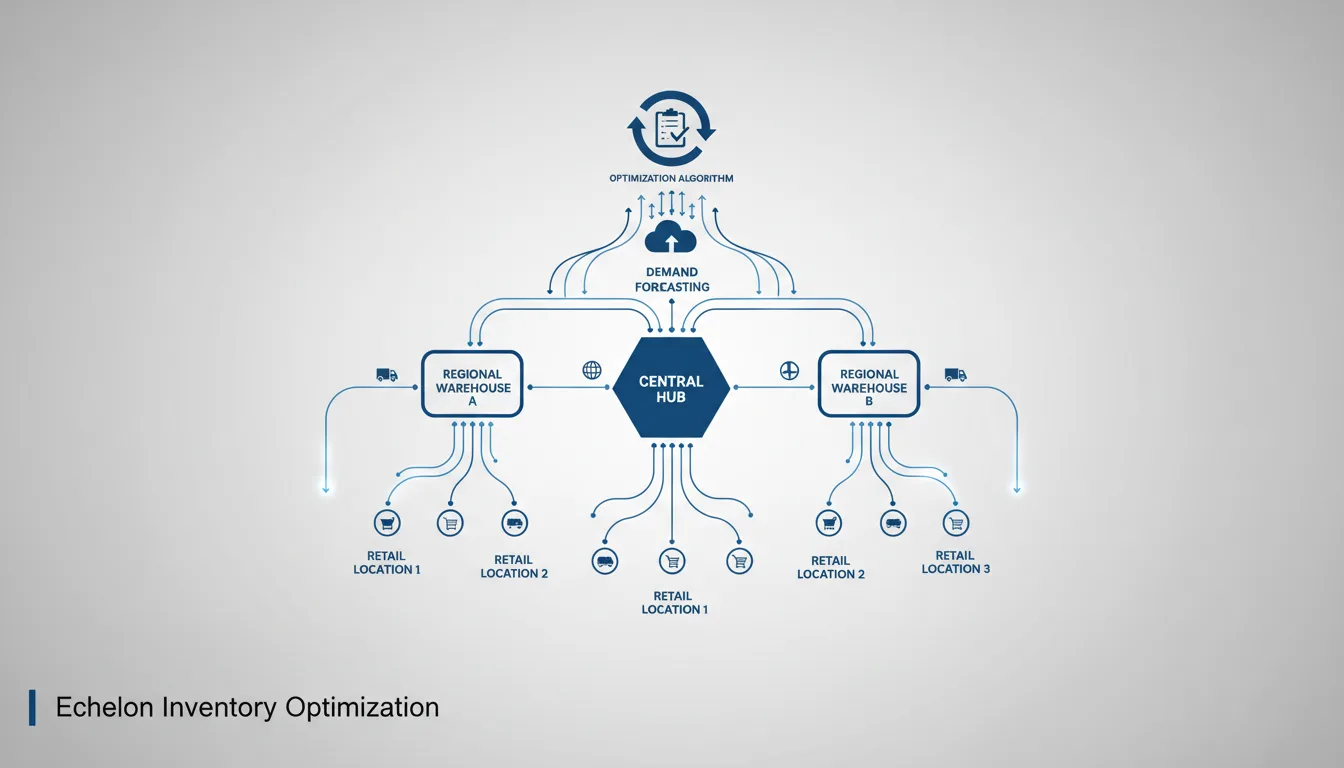
Echelon Inventory Optimization refers to the sophisticated and systematic approach of managing inventory across several interconnected layers or tiers within a supply chain network. This strategy views the supply chain as a single, integrated system rather than a collection of independent inventory points. The primary objective is to align inventory levels with fluctuating consumer demand while minimizing the total system-wide costs associated with holding, ordering, and potential stockouts across all echelons [1].
Echelon optimization is pivotal for businesses that manage extensive inventories across multiple geographical locations, from raw material suppliers to distribution centers, and finally to retail outlets or end-customers. It ensures that products are available at the right place and time, optimizing cash flow and maintaining high operational efficiency. For instance, major retailers effectively leverage this concept to streamline stock levels across their central warehouses, regional distribution centers, and individual retail stores, significantly enhancing their order fulfillment efficiency and customer satisfaction.
Etymology and Origins
The term "echelon" originates from the Old French word "eschelon" and later "échelon," meaning a step or rung of a ladder. It gained widespread military usage to describe troops or ships arranged in a staggered, step-like formation [4]. This military context of a structured, layered approach for strategic deployment directly influenced its adoption in logistics.
In logistics and inventory management, "echelon" describes the hierarchical structure of inventory levels, flowing from raw material suppliers through manufacturing, distribution centers, and ultimately to end-users or retail points. While the term's linguistic roots are ancient, the application of "echelon" to formal inventory theory emerged much later. Early theoretical groundwork for multi-echelon inventory systems began in the late 1950s and early 1960s, shifting from simpler single-location inventory models to a more complex, networked perspective [5].
Historical Development
The evolution of Echelon Inventory Optimization is deeply intertwined with the development of operations research, supply chain management, and information technology.
Early Models & Theoretical Foundations (1950s-1960s)
Prior to the mid-20th century, inventory management largely focused on independent, single-location optimization using models like the Economic Order Quantity (EOQ). However, as supply chains grew more complex, the need for a holistic view became apparent. The true theoretical genesis of multi-echelon inventory optimization can be attributed to pioneering work in operations research. Notably, the seminal paper by Andrew Clark and Herbert Scarf in 1960 laid the mathematical foundation for analyzing optimal policies in multi-echelon inventory systems, often referred to as the "Clark and Scarf model" [5]. Their work introduced concepts like the echelon stock policy, which considers all stock downstream of a particular point, including stock in transit and at lower echelons, in decision-making.
Material Requirements Planning (MRP) & Early Computerization (1970s-1980s)
The 1970s saw the widespread adoption of Material Requirements Planning (MRP) systems in manufacturing. While not directly multi-echelon optimization in the mathematical sense, MRP systems brought structured planning and coordination across different stages of production and procurement, effectively managing inventory dependencies within a manufacturing bill of materials. Concurrently, the 1980s heralded the popularization of Just-in-Time (JIT) manufacturing principles, championed by companies like Toyota Production System (TPS). JIT emphasized lean inventories, continuous flow, and rapid response to demand, implicitly fostering a multi-echelon mindset of reducing buffers throughout the supply chain [6].
ERP and Advanced Planning Systems (1990s-2000s)
The 1990s witnessed a surge in the development of sophisticated software systems, moving from isolated MRP modules to integrated Enterprise Resource Planning (ERP) systems. ERP systems consolidated various business functions, including inventory, procurement, and sales, into a single platform, providing better visibility and control over inventory flows across multiple locations. Following this, Advanced Planning Systems (APS) emerged, offering more advanced algorithms for demand forecasting, production scheduling, and multi-echelon inventory optimization, going beyond the transactional capabilities of ERP systems [7].
Data-Driven & AI/ML Era (2010s-Present)
The 2010s and beyond have been characterized by the explosion of big data analytics, cloud computing, and advancements in artificial intelligence and machine learning. These technologies have revolutionized multi-echelon inventory optimization by enabling highly accurate demand forecasting, real-time inventory visibility, and dynamic adjustment of stock levels across the network. Modern Warehouse Management Systems (WMS) and Supply Chain Planning (SCP) solutions now incorporate sophisticated algorithms to model uncertainty, optimize safety stock, and automate replenishment decisions across all echelons.
Key Pioneers:
- Andrew Clark & Herbert Scarf: Seminal work in the 1960s on multi-echelon inventory theory [5].
- Stephen C. Graves: His extensive research in the 1980s and 1990s significantly advanced practical applications and modeling techniques for multi-echelon inventory systems, particularly in large-scale industrial settings [8].
- Toyota: Through the development and popularization of the Toyota Production System, they demonstrated the immense benefits of lean inventory practices and flow management across their complex supply chain [6].
Core Concepts
Echelon Inventory Optimization operates under several core principles:
- Network-wide Perspective: Instead of optimizing individual locations independently, decisions are made considering the impact on the entire supply chain network, from supplier to end-customer.
- Decentralized Execution with Centralized Coordination: While inventory may be physically managed at multiple tiers, the optimization strategy and replenishment policies are centrally coordinated to achieve overall system goals. This allows quicker responses to local demand changes while maintaining network-wide efficiency.
- Forecasting Accuracy at Each Echelon: Advanced predictive analytics and demand planning are critical to forecast demand accurately across different tiers, from aggregate forecasts at the manufacturing level to granular forecasts at the retail level, thereby reducing surplus or shortages.
- Echelon Stock Logic: This refers to the total amount of inventory at a given location plus all inventory downstream from it (e.g., in transit, at lower distribution points, or at retail stores). Optimization decisions are often made based on this comprehensive "echelon stock" rather than just local physical stock.
- Collaboration & Information Sharing: Close coordination and transparent information exchange between suppliers, manufacturers, distribution centers, and retailers are essential to ensure timely replenishment of stock and synchronized operations. This includes shared demand forecasts, production schedules, and inventory statuses.
- Service Level Differentiation: Recognizing that not all products or locations require the same service level. Higher-value, critical, or fast-moving items might receive higher service level targets and corresponding safety stock allocations across various echelons.
Industry Applications
Various sectors extensively employ Echelon Inventory Optimization to manage their complex supply chains effectively:
- Retail: Large chains like Walmart and Amazon utilize this strategy for seamless inventory flow between central distribution centers, regional fulfillment centers, and individual retail outlets or last-mile delivery hubs. This ensures products are always on shelves or readily available for quick delivery, minimizing lost sales and reducing markdowns.
- Manufacturing: Complex manufacturing firms optimize raw materials, work-in-progress (WIP), and finished goods across different production stages, assembly lines, and component warehouses. This ensures just-in-time availability for assembly, minimizes production delays, and optimizes stock replenishment for critical components.
- E-Commerce & 3PLs: Companies managing extensive online inventories and third-party logistics (3PL) providers need to optimize stock levels across multiple fulfillment centers to meet fluctuating consumer demands rapidly and cost-effectively. This is crucial for managing shipping costs and delivery times, especially for geographically dispersed customer bases.
- Pharmaceutical & Healthcare: The distribution of medicines, vaccines, and medical devices often involves strict cold chain requirements and expiration dates. Echelon inventory optimization ensures critical supplies are available across central depots, regional hospitals, and local pharmacies, minimizing waste due to expiry and preventing stockouts of life-saving drugs [9].
- Automotive & Aerospace: Managing vast networks of spare parts for vehicle maintenance or aircraft repair requires highly sophisticated multi-echelon strategies. Optimizing the availability of parts at dealerships, service centers, and maintenance depots is crucial for minimizing downtime and ensuring customer satisfaction.
Benefits and Advantages
Implementing Echelon Inventory Optimization offers several key benefits that significantly impact a business's bottom line and operational capabilities:
- Significant Cost Reduction: By optimizing inventory levels across the entire network, businesses can achieve lower overall holding costs, reduced obsolescence, and minimized transportation expenses through better consolidation and routing. It allows for strategic positioning of safety stock.
- Increased Service Levels & Customer Satisfaction: Enhanced ability to meet customer demands accurately and efficiently across all sales channels, leading to fewer stockouts, faster delivery times, and ultimately, higher customer loyalty.
- Improved Capital Utilization: Optimizing inventory frees up working capital that would otherwise be tied up in excess stock, allowing businesses to invest in other growth opportunities.
- Enhanced Supply Chain Resilience: A well-optimized multi-echelon system can better withstand supply chain disruptions (e.g., supplier delays, natural disasters) by strategically positioning buffer stock at critical nodes, without overstocking the entire system.
- Dynamic Inventory Control: Allows businesses to respond proactively and agilely to market changes, seasonal fluctuations, and evolving customer preferences based on real-time data analysis and predictive models.
- Better Visibility and Control: Provides a comprehensive, network-wide view of inventory, enabling more informed decision-making and precise management of stock movements.
Challenges and Limitations
Despite its advantages, implementing and maintaining Echelon Inventory Optimization can present significant challenges:
- Complexity in Modeling and Management: Managing multiple inventory levels and their interdependencies requires sophisticated mathematical models, advanced software, and a robust operational strategy. The number of variables and constraints can quickly become overwhelming [10].
- High Initial Investment Costs: Acquiring and implementing advanced technologies such as Advanced Planning Systems (APS), sophisticated Warehouse Management Systems (WMS), and integrating them with existing ERP systems can involve substantial upfront costs.
- Data Quality and Availability: Effective optimization heavily relies on accurate and timely data, including demand forecasts, lead times, inventory levels, and costs. Poor data quality can lead to suboptimal decisions and negate the benefits of the system.
- Organizational Silos and Resistance to Change: Different departments (e.g., sales, manufacturing, procurement) often have conflicting objectives. Achieving network-wide optimization requires breaking down these silos and fostering a collaborative culture, which can be challenging.
- Uncertainty and Variability: Real-world supply chains are inherently uncertain (e.g., demand fluctuations, supplier reliability, transportation delays). Accurately modeling and managing this uncertainty across multiple echelons remains a significant challenge.
- System Integration Issues: Integrating various software systems (ERP, WMS, TMS, APS) across different echelons can be technically complex and costly, leading to data inconsistencies and operational bottlenecks.
Addressing Challenges:
Businesses often turn to integrated solutions like warehouse management systems and visual inventory management systems for solutions that streamline inventory processes, improve data accuracy, and provide real-time tracking across all tiers. Robust purchase order management is also critical for effective upstream inventory control.
Best Practices
Adopting Echelon Inventory Optimization successfully requires a strategic approach and adherence to several best practices:
- Robust Data Infrastructure & Analytics: Invest in tools and processes to collect, clean, and analyze high-quality data. Leverage advanced analytics, machine learning, and AI for more accurate demand forecasting and predictive insights across all echelons. Tools like a visual inventory management system can greatly enhance data visibility.
- Integrated Technology Stack: Implement an integrated suite of systems, including ERP, WMS, and APS, that can communicate seamlessly to provide a holistic view of the supply chain. Ensure that systems for stock replenishment are automated and tied to demand signals.
- Cross-Functional Collaboration: Establish formal Sales and Operations Planning (S&OP) processes to align demand forecasts, production plans, and inventory strategies across different departments and echelons. Foster a culture of transparency and shared goals.
- Supplier Relationship Management: Develop strong, collaborative relationships with key suppliers. Share demand forecasts and production plans to improve their responsiveness and reliability, which directly impacts upstream inventory levels. Utilize robust purchase order management systems for better vendor coordination.
- Segmented Inventory Policies: Don't treat all inventory equally. Segment products by value, demand variability, and criticality (e.g., ABC analysis) and apply differentiated inventory policies and service level targets across echelons. This ensures critical items are prioritized without overstocking slower-moving goods.
- Continuous Monitoring & Optimization: Regularly review and audit inventory levels, forecast accuracy, and system performance. Use simulation and what-if analysis to evaluate different scenarios and continuously refine optimization parameters. Conduct cycle counting to maintain inventory accuracy.
- Lead Time Reduction & Variability Management: Focus on reducing lead times and their variability at all stages of the supply chain, as this directly reduces the need for safety stock across the echelons.
- Talent and Expertise: Invest in training and developing a team with strong analytical skills in inventory management, operations research, and supply chain technology.
Future Trends
Looking forward, Echelon Inventory Optimization is expected to increasingly incorporate advanced technologies and methodologies to address growing supply chain complexity and volatility:
- Artificial Intelligence (AI) and Machine Learning (ML): AI models will further enhance demand forecasting accuracy, moving beyond historical data to incorporate external factors (e.g., social media trends, weather, economic indicators). This will enable more dynamic and predictive inventory adjustments across all echelons, optimizing stock replenishment in real-time.
- Digital Twins: Creating virtual replicas of the entire supply chain network will allow businesses to simulate various scenarios, test different inventory policies, and predict the impact of disruptions before they occur, leading to more robust and resilient echelon strategies.
- Blockchain Technology: Providing transparent, immutable, and real-time tracking of inventory levels and movements across the entire supply chain. This improves data integrity, reduces fraud, and enhances overall efficiency and trust among supply chain partners [11].
- Internet of Things (IoT) and Edge Computing: IoT sensors embedded in warehouses, vehicles, and even products will provide granular, real-time data on inventory location, condition (e.g., temperature for cold chain), and movement. Edge computing will process this data locally, enabling faster, more localized inventory decisions within each echelon.
- Predictive Analytics for Disruption: Beyond demand forecasting, AI-powered predictive analytics will anticipate potential supply chain disruptions (e.g., supplier failures, port congestion, geopolitical events) and proactively suggest optimal inventory re-positioning or safety stock adjustments across the echelon network.
- Robotic Process Automation (RPA) & Autonomous Systems: RPA can automate routine inventory management tasks, such as order processing, data entry, and even basic replenishment triggers. Autonomous vehicles and drones within warehouses can perform inventory counts and movements, contributing to real-time data accuracy.
Related Concepts
Echelon Inventory Optimization relates closely to other critical logistics and supply chain concepts:
- Supply chain management: The overarching framework within which echelon optimization operates.
- Inventory Turnover: A key performance indicator (KPI) often improved through effective echelon optimization.
- Demand Planning & Forecasting: The foundation for accurate inventory decisions at each echelon.
- Safety Stock: The buffer inventory held at various echelons to guard against uncertainty in demand or lead time.
- Lead Time: The time taken for an order to be delivered, a critical factor in determining inventory levels across echelons.
- Service Level: The probability of not stocking out, often differentiated across echelons and products.
- Visual Inventory Management: Providing graphical representations of inventory data across the network for better decision-making.
- Stock Replenishment: The process of refilling inventory at each echelon, directly informed by optimization strategies.
- Purchase Order Management: Managing the flow of goods from suppliers into the first echelons of the supply chain.
Mastery of these connections will equip logistics professionals with a comprehensive understanding of effective inventory strategies and robust supply chain design.
Sources
- Order Fulfillment Guide
- Mobile WMS Overview
- Supply Chain Inventory Management
- Echelon (military)
- Optimal Policies for a Multi-Echelon Inventory Problem
- Toyota Production System
- The Value of Advanced Planning and Scheduling Systems
- Operations Research in Production and Inventory Management: A Tutorial
- Supply Chain Management in Healthcare: A Review
- Multi-Echelon Inventory Optimization: Challenges and Opportunities
- Blockchain in Supply Chain Management: A Review
- Visual Inventory Management System
- Stock Replenishment Guide
- Purchase Order Management
- How to calculate ROI on Shopify Inventory Management App
- Warehouse Layout Preview
- Cycle Counting Guide
- The New Science of Demand Forecasting
- Multi-Echelon Inventory Optimization: Challenges and Opportunities