Delivery Density in Logistics and Supply Chain Management
Delivery density is a critical metric in logistics that assesses the efficiency of distribution networks by analyzing delivery frequency against area served.
Updated
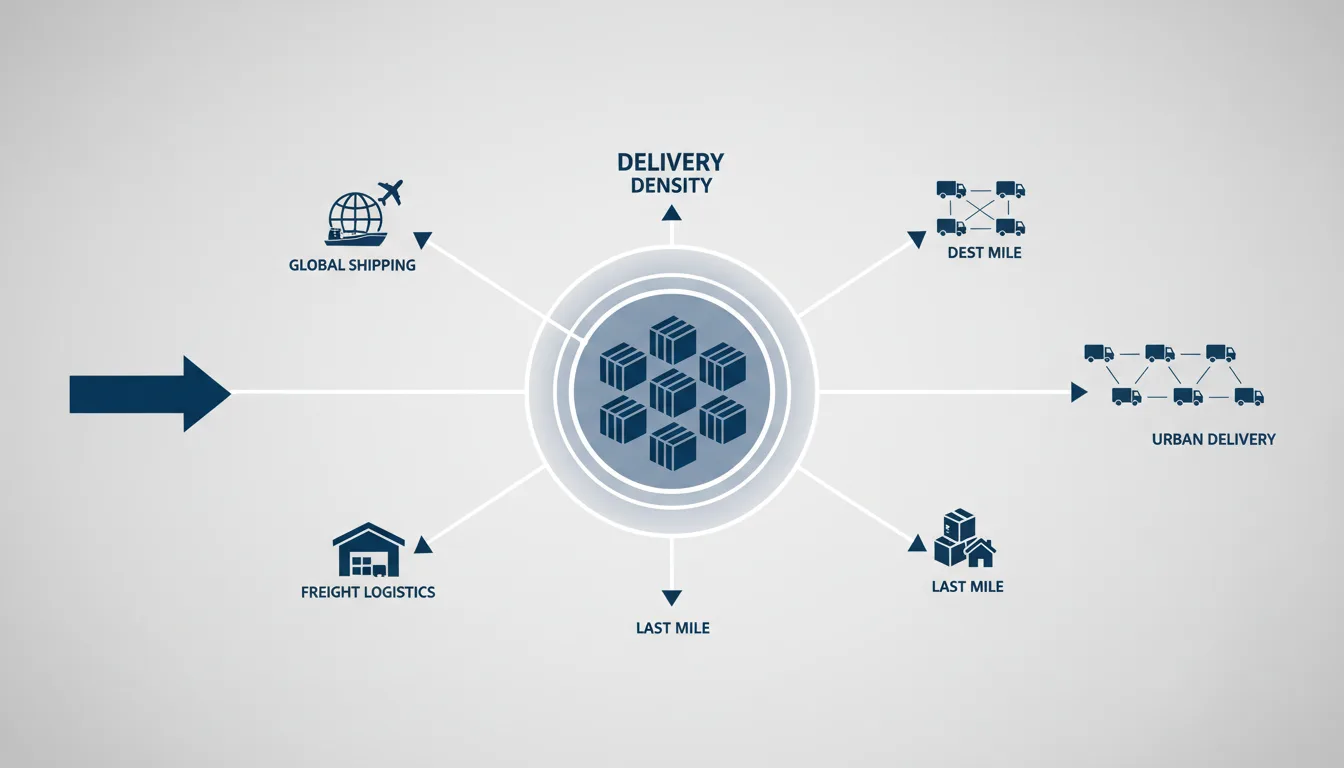
Delivery Density in Logistics and Supply Chain Management
Overview
Delivery density refers to the measure of delivery frequency relative to the geographical area served. It plays a crucial role in logistics and supply chain management as it directly influences cost efficiency, sustainability, and customer satisfaction. A higher delivery density indicates an efficient distribution network where multiple deliveries can be made in close proximity, reducing transportation costs and time. This metric is a cornerstone for strategic planning in modern supply chains.
Effective delivery density analysis helps organizations optimize their delivery routes and schedules, thus ensuring timely services while minimizing fuel consumption and operational costs. This focus on efficiency is paramount in today's competitive market, where customer demands for faster deliveries are ever-increasing, often requiring sophisticated order management systems to keep pace.
Etymology and Origins
The term "delivery density" combines two fundamental concepts: "delivery" and "density." "Delivery" stems from the Old French "delivrer," meaning to set free, later evolving to mean the act of conveying goods. "Density" originates from the Latin "densus," referring to compactness or the degree to which something is concentrated in a given area. While the individual terms have ancient roots, their specific combination into "delivery density" as a logistical metric is a more recent phenomenon.
The concept of optimizing routes based on customer concentration has existed since early operations research, particularly with the development of the Traveling Salesman Problem (TSP) in the 1930s and 40s. However, the specific term "delivery density" began to emerge in logistics literature in the late 1980s and early 1990s as companies started to quantify and analyze delivery efficiency more rigorously. It gained significant emphasis in the 2000s with the rise of e-commerce and the subsequent demand for quick shipping solutions, influencing and evolving complexities in logistics operations, as explored in academic works like "Exploring the Concept of Delivery Density in Routing Optimization".
Historical Development
Foundations in Operations Research (Mid-20th Century)
The underlying principles of delivery density are rooted in operations research developed post-World War II. Mathematicians like George Dantzig pioneered linear programming and the Vehicle Routing Problem (VRP) in the 1950s, which sought to find the most efficient routes for fleets of vehicles. Although the term "delivery density" wasn't used explicitly, these foundational models provided the mathematical framework for understanding how geographic concentration of demand impacts routing efficiency.
Emergence in Modern Logistics (1980s-1990s)
As global supply chains grew in complexity, driven by concepts like Just-in-Time (JIT) manufacturing (pioneered by Toyota) and the widespread adoption of Enterprise Resource Planning (ERP) and Materials Requirements Planning (MRP) systems (championed by companies like IBM and SAP), the need to optimize physical distribution became critical. Logistics strategies shifted towards optimizing routes and costs in response to increased market competitiveness. Early commercial route optimization software began to appear, incorporating algorithms to group deliveries geographically, implicitly addressing delivery density. Publications started to explore mathematical models for optimizing delivery routes, exemplified by works such as Transportation Science and Computers & Operations Research.
Technology-Driven Expansion (2000s-2010s)
The turn of the millennium brought the e-commerce boom, dramatically increasing parcel volumes and customer expectations for faster deliveries. This era saw significant advancements in Geographical Information Systems (GIS) and the widespread adoption of GPS technology, which provided the geospatial data necessary for precise delivery density calculations. Logistics companies and researchers focused on integrating these technologies. By the 2010s, technology advancements in GIS and route optimization software accelerated its practical application in real-world operations. Key developments included algorithms to automatically compute delivery routes and schedule timelines, such as those presented in Logistics and Supply Chain Management by Martin Christopher.
The introduction of cloud-based mobile warehouse management systems and advanced optimization tools revolutionized how businesses could integrate delivery density metrics into their broader supply chain performance. Companies like DHL implemented such technologies to enhance their global logistics operations effectively.
Advanced Analytics and Automation (2010s-Present)
The past decade has seen a surge in the use of Artificial Intelligence (AI) and Machine Learning (ML) for predictive analytics and dynamic route optimization, further refining the application of delivery density. Modern systems can analyze vast datasets to predict demand patterns, optimize routes in real-time, and adapt to unforeseen disruptions. This era emphasizes real-time visibility and inventory accuracy to support hyper-efficient delivery networks.
Publications and Standards
Seminal works like Logistics Management and Strategy by Alan Harrison and Remko van Hoek detail how delivery density impacts logistics performance and include relevant case studies on successful implementations. The Council of Supply Chain Management Professionals (CSCMP) published guidelines in 2018 emphasizing efficiency reliant on enhanced delivery density understanding, showcasing how organizations could adapt their strategies to improve delivery speed and reduce costs.
Core Concepts
Delivery density is typically calculated by dividing the number of deliveries by the service area (usually in square miles or kilometers). For example, if 100 deliveries are made within a 10-square-mile radius, the delivery density is 10 deliveries per square mile. This metric helps in:
- Understanding the compactness and efficiency of delivery routes within a defined area.
- Evaluating the feasibility of service areas based on existing or potential market demand, informing strategic decisions for expansion or contraction.
- Supporting decision-making in warehouse location and layout planning, ensuring proximity to high-density zones for optimized last-mile operations.
- Identifying opportunities for route consolidation and dynamic routing to maximize vehicle utilization and minimize costs.
Industry Applications
Delivery density metrics find applications across various sectors, demonstrating its versatility and importance:
- E-commerce: Online retailers leverage delivery density to ensure quick shipping and manage the surge in parcel volumes. For instance, Amazon meticulously optimizes its delivery networks based on local demands and population density, integrating advanced technology into their last-mile logistics strategy. This includes strategically locating fulfillment centers and using dynamic routing.
- Food and Beverage: Companies like Uber Eats and local grocery delivery services have seen improved efficiency by analyzing delivery densities to reduce delivery times and costs, leading to better customer retention rates. They often use heat maps to visualize demand density and allocate drivers accordingly.
- Healthcare: Logistics firms are vital in delivering medical supplies, pharmaceuticals, and even emergency services. This sector necessitates a high delivery density for efficiency and reliability, particularly for time-sensitive deliveries. This aspect of logistics is critically outlined in Healthcare Logistics: Improving Efficiency Can Deliver Life-Saving Drugs.
- Field Service & Maintenance: Organizations managing service technicians (e.g., HVAC repair, telecom installations) use delivery density principles to cluster appointments geographically, reducing travel time between jobs and improving technician productivity. This is essentially optimizing their 'service call density.'
Benefits and Advantages
High delivery density offers significant advantages, directly impacting a company's bottom line and competitive standing:
- Cost Savings: By optimizing routes and minimizing travel distances, companies can significantly reduce fuel consumption, vehicle maintenance costs, and driver labor hours. Examples include FedEx's implementation of density-based routing algorithms, leading to substantial operational cost reductions. Studies suggest that route optimization alone can yield savings of 10-30% in transportation costs.
- Improved Customer Satisfaction: Faster and more reliable delivery times are a direct outcome of optimized density, enhancing customer experience, which is crucial in e-commerce sectors. Retailers like Walmart have prioritized density strategies to ensure same-day or next-day delivery promises are met, directly impacting loyalty.
- Environmental Impact: Reduced travel distances and fewer vehicle miles traveled contribute to lower carbon emissions and reduced traffic congestion, aligning with corporate sustainability goals and regulatory compliance. Studies indicate that optimizing delivery density can decrease overall fleet emissions by up to 30%.
- Increased Capacity Utilization: Higher density allows more stops per route and better utilization of vehicle capacity, meaning fewer vehicles are needed to service the same number of deliveries, leading to greater operational scalability.
Challenges and Limitations
Although focusing on delivery density is beneficial, it poses challenges such as:
- Geographical Variance: Different regions present inherent limitations. Urban areas typically support high density due to concentrated populations and infrastructure, while rural zones often struggle with lower delivery frequencies and longer travel distances between stops, necessitating different strategies.
- Data Interpretation: Accurately interpreting delivery density metrics requires sophisticated data analytics capabilities and often necessitates integration with systems like a Mobile Order Fulfillment system, which provides real-time operational insights. Poor data quality or insufficient analytical tools can lead to suboptimal routing decisions.
- Infrastructure Limitations: Road networks, traffic congestion, parking availability, and regulatory restrictions (e.g., delivery windows) can limit the practical achievable density, especially in dense urban cores.
- Dynamic Demand: Delivery density can fluctuate significantly with time of day, day of week, or seasonal demand shifts, requiring agile and dynamic optimization rather than static route planning.
Best Practices
To maximize delivery density efficiency and gain a competitive edge, organizations should consider the following best practices:
- Adopting Advanced Route Optimization Tools: Implementing advanced software solutions that integrate GIS data, real-time traffic information, and predictive analytics can significantly improve route planning and execution. These tools can automatically calculate optimal routes, considering factors like time windows, vehicle capacity, and driver availability, leading to significant operational improvements as shown in case studies of logistics firms implementing comprehensive order fulfillment systems.
- Leveraging a Visual Inventory Management System: Efficient internal warehouse operations directly impact external delivery density. A visual inventory management system ensures accurate stock levels and quick picking, allowing for faster dispatch and tighter delivery windows, which supports higher delivery density.
- Regularly Reviewing Service Areas and Network Design: Companies should continuously evaluate their delivery zones and entire distribution network design to ensure they meet evolving market needs. This includes adapting plans in real-time based on customer demand shifts, seasonal peaks, and competitive landscape changes. Strategic placement of micro-fulfillment centers in high-density areas is an example.
- Investing in Integrated Technology Stacks: Upgrading from manual systems to automated solutions such as an Order Management System integrated with WMS and route optimization software can significantly enhance delivery performance by providing end-to-end visibility and automating various supply chain functions into a seamless operation.
- Utilizing Data-Driven Decision Making: Implement robust data collection and analytics to continuously monitor key performance indicators (KPIs) related to delivery density, such as drops per hour, average distance per delivery, and cost per delivery. Use these insights for continuous improvement.
Future Trends
As e-commerce continues its rapid growth and urban populations expand, the emphasis on delivery density will likely increase. Future innovations poised to transform this area include:
- AI and Machine Learning: Predictive analytics for optimizing delivery routes pre-emptively based on historical data, real-time traffic, and even weather patterns will become standard practice, allowing companies to automate decision-making processes for unparalleled efficiency and adaptability.
- Autonomous Deliveries (Drones and Robots): Emerging technologies like drone deliveries and autonomous ground vehicles promise to increase delivery density in hard-to-reach areas and dense urban environments, potentially transforming last-mile logistics significantly by enabling more frequent and localized deliveries.
- Smart Lockers and Micro-fulfillment Centers: These solutions facilitate high-density deliveries by allowing staggered collection points for consumers, reducing individual home deliveries and enhancing overall delivery capabilities, particularly in urban settings. This allows carriers to make fewer, larger drops to central points.
- Hyperlocal Logistics: The development of highly localized delivery networks that utilize a combination of traditional vehicles, bicycles, and walking couriers for ultra-fast, high-density service within small geographic zones.
Related Concepts
Understanding delivery density also ties into various logistics concepts, as it is an interwoven metric within the broader supply chain framework:
- Route Optimization: Closely related, focusing on how best to navigate delivery routes efficiently, with density being a primary input for these algorithms.
- Last-Mile Delivery: The final and often most expensive step of the delivery process, where delivery density matters most for cost-effectiveness and speed.
- Distribution Network Design: Structuring the entire supply chain, including warehouse and fulfillment center placement, to maximize efficiency and cost-effectiveness, often with delivery density as a critical design parameter.
- Vehicle Utilization: Maximizing the capacity and operational time of delivery vehicles, which is directly enhanced by higher delivery density.
In conclusion, delivery density is a pivotal measure that influences the entire logistics and supply chain framework. As technology continues to evolve and customer expectations for speed and sustainability grow, its importance in strategic planning and operational execution will only continue to increase.
Sources
- Visual Warehouse Layout
- Order Management System
- Mobile Order Fulfillment
- Exploring the Concept of Delivery Density in Routing Optimization
- Healthcare Logistics: Improving Efficiency Can Deliver Life-Saving Drugs
- Reducing Logistics Emissions: Analyzing the Impact of Delivery Density
- Exploring the Concept of Delivery Density in Routing Optimization
- Healthcare Logistics: Improving Efficiency Can Deliver Life-Saving Drugs
- Reducing Logistics Emissions: Analyzing the Impact of Delivery Density
- A brief history of the traveling salesman problem
- The father of linear programming
- Last-mile delivery: The next frontier for logistics
- The ROI of Route Optimization
- Visual Inventory Management System