Crucial Role in Logistics and Supply Chain Management
The crucial role of logistics in supply chain management underscores its significance in ensuring efficient operation, responsiveness, and strategic advantage.
Updated
Crucial Role in Logistics and Supply Chain Management
Overview
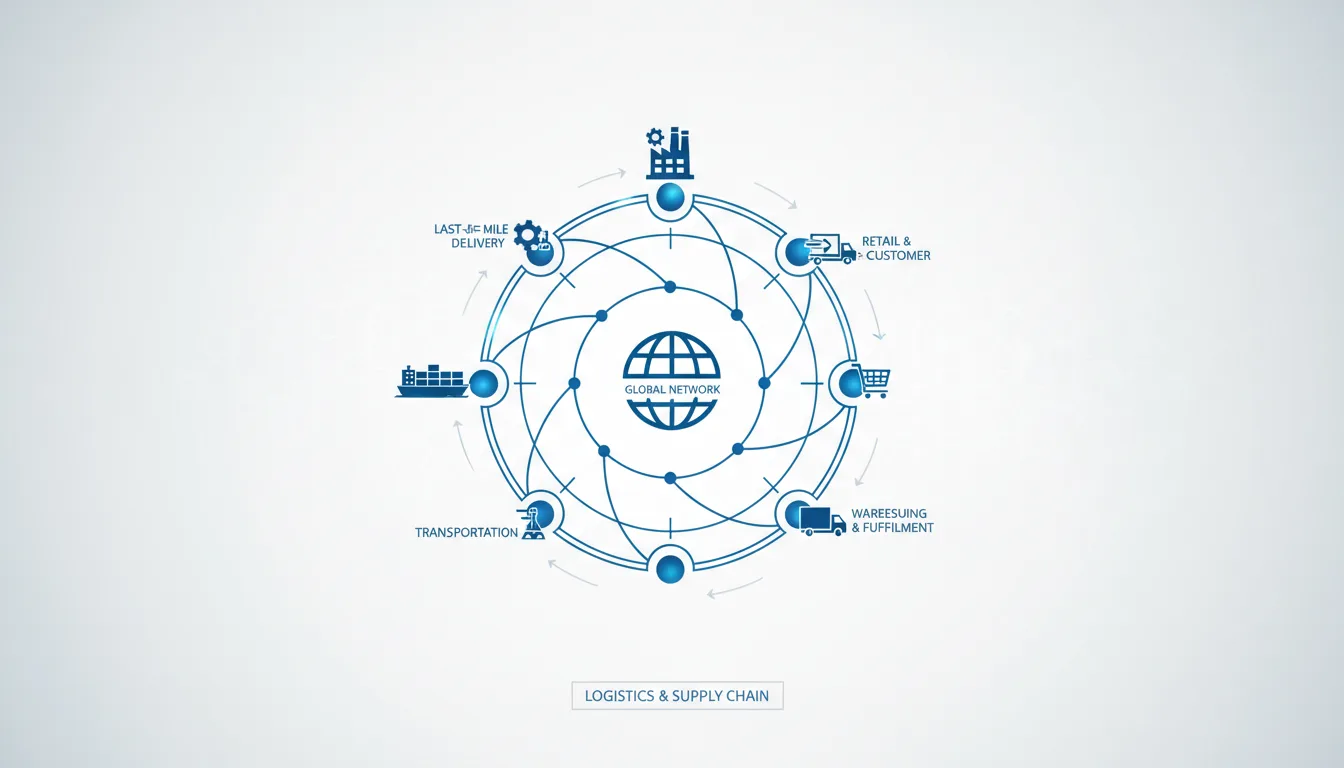
The crucial role of logistics in the supply chain is indispensable for both the operational and strategic aspects of businesses today. Logistics encompasses the planning, implementation, and control of the efficient and effective forward and reverse flow and storage of goods, services, and related information between the point of origin and the point of consumption. Its primary purpose is to ensure timely delivery, minimize costs, and maximize efficiency, directly impacting customer satisfaction and business profitability.
As global supply chains become increasingly complex and interconnected, logistics has evolved beyond mere transportation and warehousing to include sophisticated functionalities such as inventory management, order processing, distribution network design, and even reverse logistics. Modern logistics is not just about moving goods; it's a strategic function that leverages data, technology, and advanced processes to create competitive advantage, enhance supply chain resilience, and meet evolving customer demands for speed and transparency. Solutions like mobile warehouse management systems exemplify this technological advancement, optimizing operations from receiving to dispatch. The ability to visualize and manage operations, from warehouse layout preview to pick, pack, and ship software, is central to this strategic evolution.
Etymology and Origins
The term "logistics" has a rich history, primarily rooted in military science before transitioning into commercial use. Its etymological journey can be traced back to ancient Greek, where logos (λόγος) referred to reason, speech, or calculation, providing the foundation for the term logistics. This root later influenced the French term logistique, which became prominent in military contexts, initially meaning the art of quartering troops and later broadening to include their supply and movement.
One of the earliest documented uses of "logistics" in a military sense is attributed to Antoine-Henri Jomini, a Swiss officer who served in the Napoleonic Wars. In his 1838 book, "Précis de l'Art de la Guerre" (The Art of War), Jomini defined logistics as "the practical art of moving armies," meticulously detailing the planning, provisioning, quartering, and transportation of troops and supplies. He distinguished it from strategy and tactics, emphasizing the critical role of supply lines and strategic movement in warfare, directly influencing the outcome of conflicts. Other military theorists, such as Carl von Clausewitz, also implicitly acknowledged the importance of logistical support, though Jomini is often credited with coining and popularizing the term in a military context.
The transition of "logistics" from military strategy to business management began in the mid-20th century, particularly after World War II. Industrialists and management thinkers recognized the parallels between military supply chain challenges and the complexities of managing materials, production, and distribution in large corporations. The post-war economic boom and the rise of multinational corporations necessitated more sophisticated approaches to inventory control, transportation, and warehousing. By the 1960s, the term was increasingly adopted in the business world, initially referring to physical distribution but later evolving to encompass a broader scope of supply chain activities, recognizing logistics as a critical factor in competitive market dynamics.
Historical Development
Logistics, in practice, has existed for as long as humans have organized trade, warfare, or large-scale projects. However, its formal recognition and systematic study evolved significantly over time:
-
Ancient Roots: Early forms of logistics can be observed in ancient civilizations. The Roman Empire's vast infrastructure of roads, warehouses, and naval fleets was a sophisticated system for moving troops, supplies, and goods across its territories. Similarly, the Incas developed an impressive road network and storage system (tambos) to manage resources and disseminate information across their expansive empire, demonstrating early principles of distribution and resource allocation.
-
Military Dominance (18th - 19th Century): As previously mentioned, Napoleonic warfare formalized logistics as a distinct military discipline. Figures like Antoine-Henri Jomini and Carl von Clausewitz emphasized the strategic importance of supply lines and the movement of forces, highlighting how efficient logistics could be a decisive factor in military campaigns. This period cemented logistics as crucial for military success.
-
Post-WWII and Physical Distribution (1950s-1970s): The industrial expansion following World War II led to significant growth in consumer goods production and distribution. Businesses began to optimize what was then called "physical distribution," focusing on inbound transportation, warehousing, materials handling, and outbound shipping to reduce costs. This era saw the professionalization of the field, with organizations like the Council of Logistics Management (CLM), founded in 1963 (now the Council of Supply Chain Management Professionals - CSCMP), playing a crucial role in advancing logistics education and practice. The objective was primarily cost reduction through improved operational efficiency in moving and storing goods.
-
Rise of Materials Management and MRP (1970s-1980s): The energy crises and increased global competition of the 1970s pushed companies to seek internal cost efficiencies. This period saw the rise of "materials management," integrating purchasing, production planning, and inventory control. The development of Material Requirements Planning (MRP) systems, notably pioneered by companies like IBM in the 1960s and widely adopted in the 1970s, provided computerized tools for production scheduling and inventory management, significantly improving manufacturing efficiency by ensuring components were available precisely when needed.
-
Just-in-Time and Lean (1980s): The success of Japanese manufacturers, particularly Toyota's Production System, introduced the concepts of Just-in-Time (JIT) and Lean manufacturing. These philosophies emphasized minimizing waste, reducing inventory (e.g., through techniques like cycle counting and stock replenishment), and improving efficiency throughout the production and supply process, fundamentally altering how companies viewed their supply chains by promoting continuous improvement and value stream mapping.
-
Emergence of Supply Chain Management (1990s): The term "supply chain management" gained prominence in the 1990s, broadening logistics from an internal, operational function to a strategic, cross-organizational discipline. This era saw the rapid adoption of Enterprise Resource Planning (ERP) systems, which integrated various business functions, including logistics, into a single system. The rise of globalization and information technology further interconnected supply chain partners, highlighting the need for end-to-end visibility and collaboration. While ERPs provide a broad suite, specialized solutions like SkuSavvy offer focused approaches to warehouse and inventory management that can integrate with broader ERP systems, as discussed in detail in analyses like WMS vs ERP.
-
Digital Transformation and Resilience (22nd Century): The 21st century has been characterized by the explosion of e-commerce, which dramatically increased demand for rapid and flexible delivery options. This has driven the adoption of advanced technologies such as mobile warehouse management systems, visual inventory management systems, automation (robotics, Automated Guided Vehicles (AGVs)), the Internet of Things (IoT), big data analytics, Artificial Intelligence (AI), and Machine Learning (ML) to optimize logistics operations. Modern logistics systems now manage complex processes like order fulfillment, purchase order management, and batch picking with unprecedented precision and agility. The integration of predictive analytics allows for proactive decision-making, such as optimizing bin packing or managing kitting operations. Recent global disruptions, such as the COVID-19 pandemic, have also underscored the critical importance of supply chain resilience, risk management, and sustainability, positioning logistics as a strategic imperative for business continuity and competitive advantage. The ability to manage complex workflows and adapt quickly is paramount for success in this dynamic environment.
Sources
- Visual Warehouse Layout
- Mobile WMS Overview
- Order Management System
- Visual Inventory Management System
- logistics (n.)
- Jomini's The Art of War: A Summary
- A Review on the Historical Development of Logistics and Supply Chain Management
- The Logistics of the Roman Army: From Movement to Maintenance
- Inca Road System
- Council of Supply Chain Management Professionals (CSCMP) Glossary
- MRP: Making It Work
- The Toyota Production System: An Overview
- What is ERP? The ultimate guide to enterprise resource planning
- Digital Transformation in Logistics and Supply Chain Management: An Overview
- WMS vs ERP: Between an ERP and a Hard Place
- Mobile WMS Overview
- Visual Inventory Management System
- Order Fulfillment Guide
- Purchase Order Management
- Workflows Overview
- What is ERP? The ultimate guide to enterprise resource planning
- WMS vs ERP: Between an ERP and a Hard Place
- Digital Transformation in Logistics and Supply Chain Management: An Overview
- Warehouse Layout Preview
- Pick, Pack, Ship Software
- Carl von Clausewitz
- What is MRP?
- Cycle Counting Guide
- Stock Replenishment Guide
- Batch Picking Guide
- Bin Packing Visualizer
- Kitting Guide