Critical Consideration in Logistics and Supply Chain Management
This article explores the concept of critical consideration within logistics and supply chain management, highlighting its importance, origins, development, and best practices.
Updated
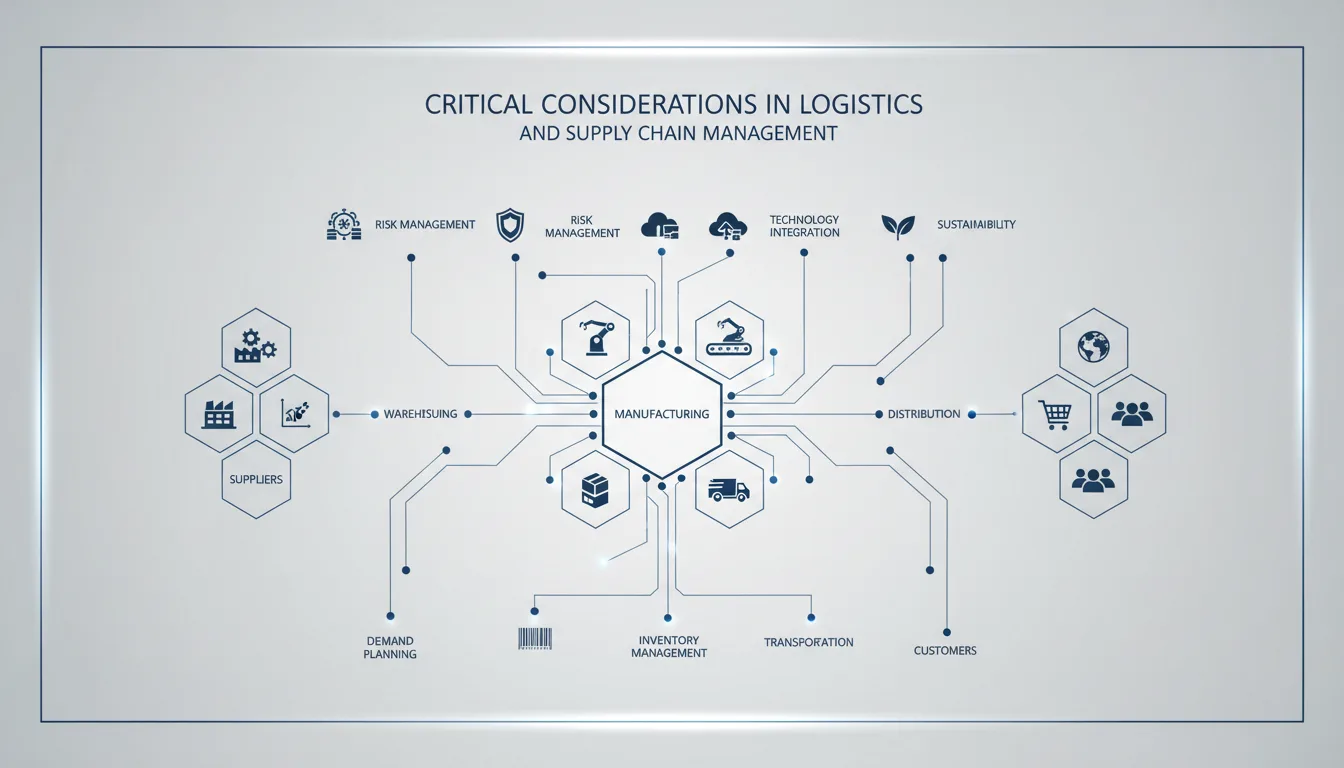
Critical Consideration in Logistics and Supply Chain Management
Overview
Critical consideration in logistics refers to the careful analysis and evaluation of various factors that can impact the efficiency and effectiveness of supply chain operations. This concept underscores the importance of decision-making processes, where logistics professionals assess situations and make informed choices to optimize operations. Proper critical consideration can lead to improvements in cost efficiency, service quality, and overall supply chain performance.
Etymology and Origins
The term 'critical consideration' combines 'critical', which derives from the Greek word kritikos, meaning ‘to judge’, and 'consideration', from the Latin consideratio, meaning ‘the act of regarding’. The linguistic roots reflect the evaluative nature of the term, which has been increasingly applied in logistics and supply chain contexts as complexities and market demands have evolved. Notably, the first documented usage of the term in the context of logistics appears in industry publications during the early 1980s as the field began recognizing the need for strategic evaluation in operations.
Historical Development
Emergence of the Concept
The practice of critical consideration in logistics began gaining traction in the late 20th century as global supply chains expanded. Early documentation of the importance of strategic decision-making can be traced back to the introduction of just-in-time inventory in the 1970s, which emphasized efficiency and responsiveness in inventory management.
Key Figures and Milestones
- Eli Goldratt, an Israeli physicist and business consultant, introduced the Theory of Constraints in his seminal book, The Goal (1984), which emphasized critical consideration in identifying bottlenecks in manufacturing processes. His methodology is credited with fundamentally changing how supply chain efficiency is viewed. [5]
- In the 1990s, advancements in technology, including early Enterprise Resource Planning (ERP) systems, prompted logistics managers to adopt more data-driven critical consideration approaches, reflecting a significant shift from intuition-based to analytical decision-making. Key publications during this era, such as Global Logistics and Supply Chain Management by John Mentzer (2001), helped crystallize the importance of strategic logistics management. [6]
Technological Evolution
The evolution of technology has played a crucial role in enhancing critical consideration in logistics. For instance, the adoption of RFID technology in the late 1990s enabled real-time inventory tracking, allowing professionals to make timely, informed decisions. Furthermore, the rise of Big Data analytics in the 2010s introduced more sophisticated modeling techniques, enabling logistics managers to optimize routes, improve forecasting accuracy, and enhance customer service.
Core Concepts
Critical consideration encompasses several key elements:
- Data Analysis: Utilizing advanced data analytics tools helps identify trends and anomalies that impact logistics decisions. For instance, transportation management systems can analyze delivery patterns to optimize routes.
- Scenario Planning: Evaluating various potential outcomes allows managers to anticipate challenges and respond proactively. In this context, tools like supply chain simulators can be invaluable.
- Stakeholder Input: Engaging stakeholders provides invaluable insights that inform critical logistics decisions. A case study from the automotive industry illustrates how input from suppliers reduced lead times significantly.
Practical examples include using data from warehouse management systems to forecast demand, optimizing inventory levels, and ensuring timely deliveries.
Benefits and Advantages
Implementing critical consideration frameworks leads to significant benefits:
- Enhanced Efficiency: Streamlined operations reduce lead times and costs, demonstrated through increasing the use of cross-docking strategies.
- Improved Customer Satisfaction: Accurate and timely deliveries enhance the customer experience, as shown by organizations using customer feedback loops to refine logistics operations.
- Greater Flexibility: Organizations become adept at adjusting to market fluctuations and supply chain disruptions, fostering resilience, particularly evident in firms that adopted agile supply chain principles during the COVID-19 pandemic.
Challenges and Limitations
Despite its advantages, embracing critical consideration in logistics presents challenges:
- Data Overload: The influx of data can overwhelm decision-makers, complicating effective evaluations; companies may struggle to integrate disparate data sources effectively.
- Resistance to Change: Organizations may struggle with adopting new technologies or methodologies, often requiring comprehensive change management strategies to overcome inertia. An example is companies that implemented cloud-based solutions experiencing pushback from traditional logistics employees.
Addressing these challenges requires ongoing training and a cultural shift towards data-driven decision-making, as evidenced by companies investing in professional development programs.
Best Practices
To effectively implement critical consideration:
- Invest in Technology: Leverage tools such as visual inventory management systems and forecasting software to enhance data-driven decision-making. Continuous investment in technology can provide a competitive edge.
- Encourage Collaboration: Foster a culture of communication and collaboration among stakeholders to gather diverse perspectives. Successful companies often create cross-functional teams to enhance information flow.
- Regular Training: Continually update the skills of logistics professionals to adapt to emerging trends and technologies, ensuring a team that is well-versed in new analytical tools and methods.
Future Trends
Critical consideration in logistics is poised for further evolution, particularly with advancements in:
- Artificial Intelligence (AI): AI-driven analytics are likely to play an increasingly pivotal role in decision-making processes, enabling more sophisticated forecasting and risk management strategies.
- Sustainability Metrics: The growing focus on sustainability will necessitate new critical considerations related to eco-friendly practices and compliance with regulations, highlighting the intersection of ethical practices and supply chain efficiency.
In summary, critical consideration is an essential aspect of logistics and supply chain management, combining analytical rigor with operational insight to achieve optimal performance and resilience in an ever-evolving landscape.