Control Strategies in Logistics and Supply Chain Management
Explore the diverse control strategies used in logistics to optimize supply chain efficiency and management.
Updated
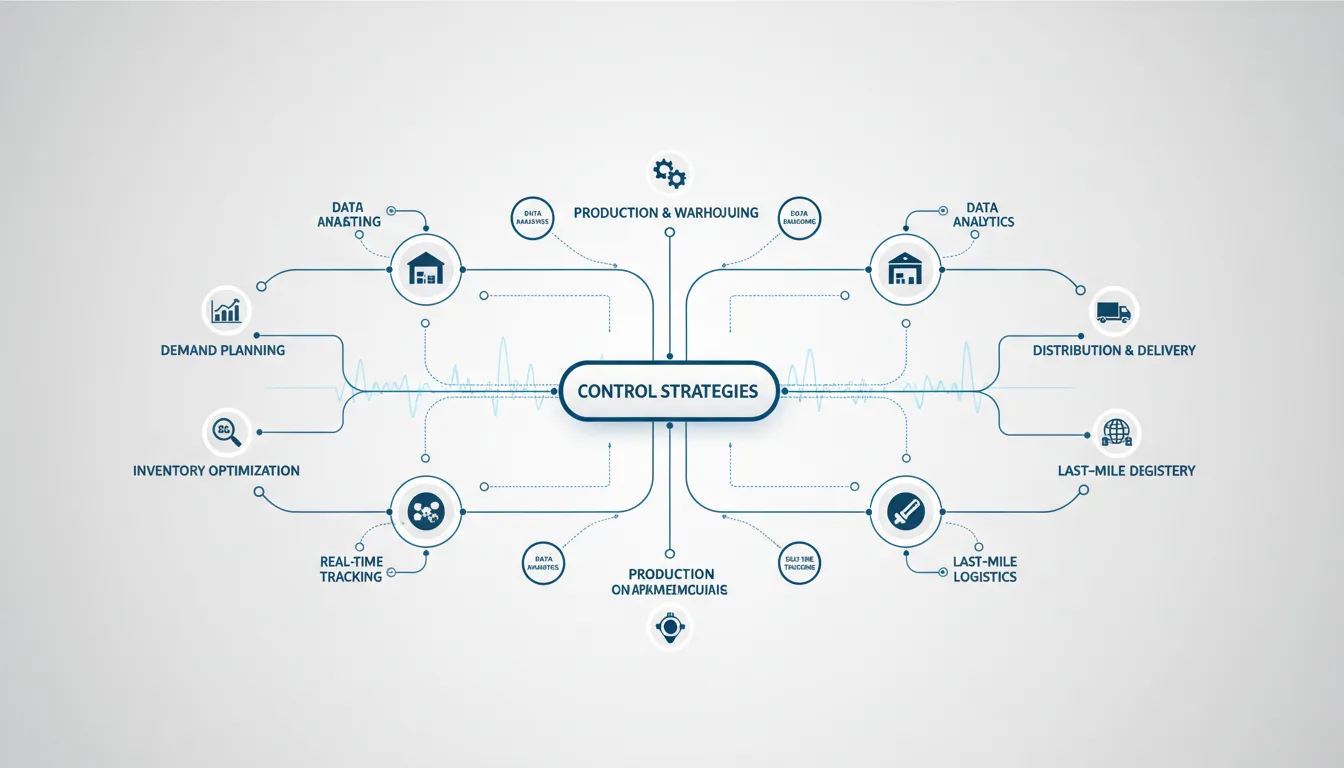
Control Strategies in Logistics and Supply Chain Management
Overview
Control strategies in logistics encompass a range of approaches designed to optimize the efficiency and effectiveness of supply chain operations. These strategies are crucial for managing the flow of goods, information, and finances from suppliers to customers. Effective control strategies not only reduce costs but also enhance customer satisfaction by ensuring timely delivery and accurate inventory levels.
Etymology and Origins
The term 'control' in logistics can be traced back to the Latin word computare, meaning to calculate. Initially used in financial contexts, the concept expanded during the Industrial Revolution as businesses sought methods to streamline operations. The first documented usage of control specifically in logistics appears in literature during the 1950s, coinciding with the rise of complex supply chains and increased reliance on technology to manage logistics functions. As technology evolved, the meaning of control also shifted towards systems and processes that ensure operational efficiency and reliability (Schmenner, 2004).
Historical Development
The evolution of control strategies in logistics has been influenced by technological advancements and changing market needs. In the 1960s, the introduction of inventory management systems marked a significant milestone, enabling more accurate tracking of stock levels. As logistics became increasingly globalized in the 1980s, companies like Toyota adopted just-in-time (JIT) methodologies to enhance operational control and reduce waste. This was part of their efforts to minimize costs while maximizing efficiency, which ultimately contributed to their competitive advantage (Monden, 2011).
The leap towards computerized systems in the 1990s, such as the advent of Enterprise Resource Planning (ERP) software, revolutionized logistics management. Dr. Michael Porter emphasized the importance of integrating supply chain processes for competitive advantage, marking this era as critical for operational efficiency.
Key events such as the establishment of ISO 9000 standards in the late 1980s also played a pivotal role in shaping the logistics industry by emphasizing quality management as a crucial aspect of supply chain control. In the early 2000s, companies began adopting advanced technologies like radio-frequency identification (RFID) to track inventory in real-time, further enhancing control capabilities. More recently, the integration of artificial intelligence (AI) into logistics systems has signaled a new era in smart supply chain management (Naylor et al., 1999).
Core Concepts
Control strategies in logistics primarily focus on three areas: inventory control, demand forecasting, and supplier management. Inventory control ensures that stock levels are maintained optimally, minimizing both overstock and shortages. Demand forecasting techniques utilize historical sales data to predict future needs, enabling better planning and resource allocation. Meanwhile, supplier management involves selecting and assessing suppliers to ensure they meet the required standards for cost, quality, and reliability.
Types and Classifications
Several types of control strategies are widely implemented in logistics, including:
- Pull Systems: Strategies like JIT manufacturing that focus on producing based on actual demand.
- Push Systems: Forecast-driven methods where inventory is pushed through the supply chain based on anticipated demand.
- Hybrid Systems: Combining both pull and push strategies to balance flexibility and efficiency.
Industry Applications
Control strategies are employed across various industries:
- In retail, cross-docking techniques minimize storage time and improve delivery speed.
- In manufacturing, precise inventory control through automated systems can prevent production delays and reduce holding costs. An example is the automotive industry, where just-in-time approaches are used extensively to manage components efficiently (Womack et al., 1990).
- The e-commerce sector utilizes automated rate selection to optimize shipping methods based on cost and time.
Benefits and Advantages
Implementing effective control strategies provides multiple benefits including:
- Enhanced supply chain efficiency by reducing lead times.
- Improved accuracy in order fulfillment, resulting in higher customer satisfaction rates.
- Lower operational costs through better inventory management and reduced waste.
Challenges and Limitations
Despite their benefits, control strategies also face challenges:
- Rapid changes in consumer demand can render forecasting methods ineffective.
- Supply chain disruptions, as seen during global crises, pose risks to maintaining control (Hugos, 2018).
- Integration of new technologies may require significant investment and employee training.
Best Practices
To maximize the effectiveness of control strategies, organizations should consider:
- Regularly updating forecasting models in response to market trends.
- Utilizing mobile warehouse management systems for real-time inventory tracking.
- Conducting periodic audits to assess supplier performance and risk management capabilities.
- Engaging in continuous improvement practices, as showcased by companies like Trudeau Corporation that regularly assess their supply chain processes for efficiency.
Future Trends
Looking ahead, control strategies will increasingly incorporate advanced technologies such as artificial intelligence (AI) and machine learning to enhance predictive analytics and automate decision-making processes. Furthermore, the rise of blockchain technology is expected to improve transparency and traceability across supply chains, changing how companies approach control strategies in logistics (Kouhizadeh & Sarkis, 2018).
Related Concepts
Control strategies intersect with various logistics concepts including inventory management, order fulfillment, and supplier relationship management. Integrating these areas effectively can lead to a more agile and responsive supply chain.