Configuration Management in Logistics
An in-depth exploration of configuration management, its history, core concepts, applications, and best practices within the logistics industry.
Updated
Overview
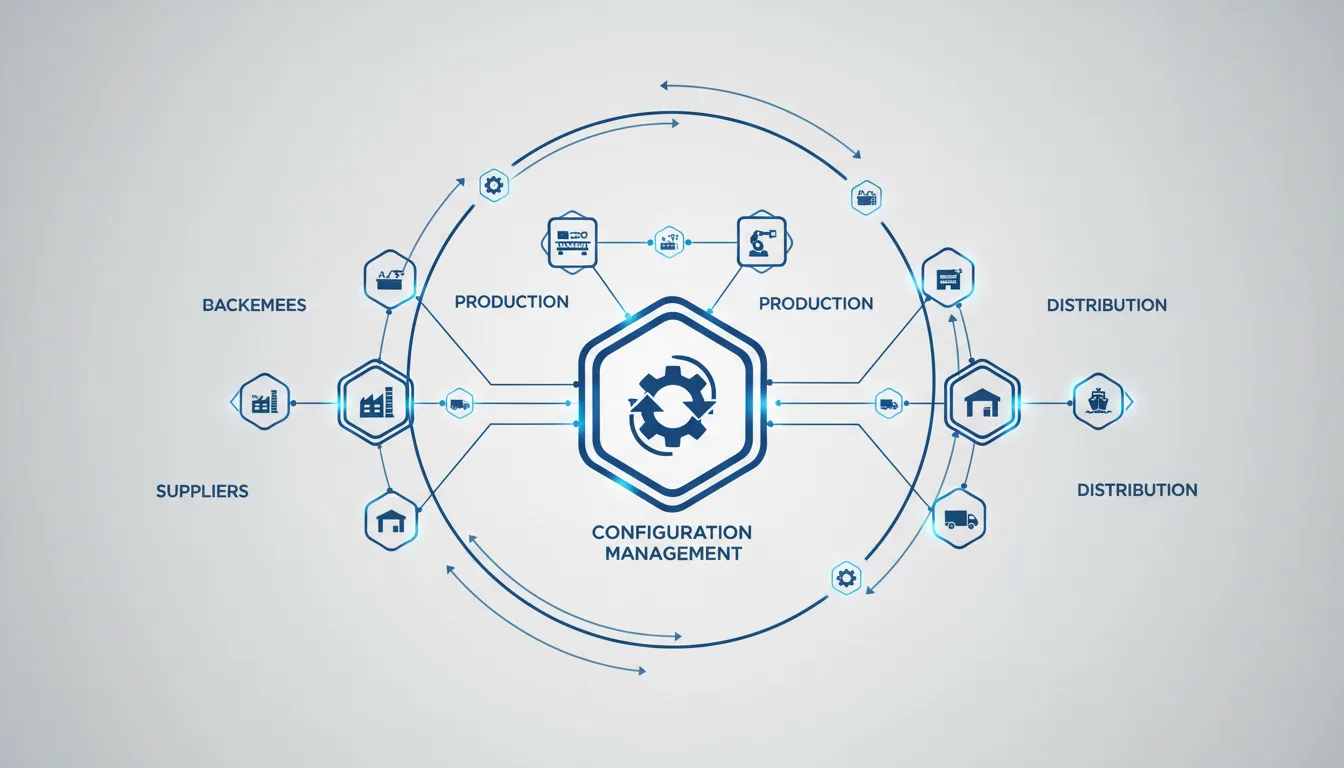
Configuration management (CM) is a crucial discipline within logistics that focuses on maintaining the functional and physical attributes of a system throughout its life cycle. This practice is vital for ensuring that operational efficiencies are maximized, systems remain reliable, and any changes are systematically managed. Configuration management is increasingly important in logistics as it encompasses aspects ranging from inventory management to software deployment, requiring a disciplined approach to track and control changes, particularly in complex and dynamic supply chain environments.
Etymology and Origins
The term "configuration management" derives from engineering and operations management, with its roots firmly planted in the military and aerospace industries of the mid-20th century. The word "configuration" refers to the specific arrangement of interconnected components that form a system, while "management" encompasses the systematic processes involved in overseeing and controlling these arrangements over time.
The concept first gained prominence in the United States in the 1950s and 1960s, primarily during complex defense projects such as the Minuteman Intercontinental Ballistic Missile Program. The sheer complexity and criticality of these systems demanded a rigorous approach to ensure that all components, from hardware to documentation, were precisely known, controlled, and traceable. Early applications were heavily hardware-centric, focusing on engineering drawings, specifications, and physical components. The relevance of CM in logistics began to evolve as supply chains became more complex and reliant on interconnected systems, emphasizing the need for systematic documentation and control beyond just physical products.
Historical Development
The concept of configuration management, initially a response to the challenges of complex defense projects, started to gain broader traction, particularly in software engineering, during the 1970s. Here are some key historical milestones and their impact on logistics:
- 1950s-1960s: Military & Aerospace Origins: The formalization of CM began with the U.S. Air Force in the late 1950s to manage the thousands of parts, changes, and documentation for large-scale weapon systems. Early standards, like MIL-STD-480 (Configuration Control — Engineering Changes, Deviations and Waivers) published in 1968, laid the groundwork for defining and controlling product baselines. This era established the foundational principles of identification, control, status accounting, and verification. While focused on defense, these principles were inherently applicable to managing complex product structures, an early form of supply chain visibility.
- 1970s: Expansion to Software: As software became a critical component of defense systems, the principles of hardware CM were adapted. In 1975, the U.S. Department of Defense implemented formal CM processes for software development with MIL-STD-483 (Configuration Management Practices for Systems, Equipment, Munitions, and Computer Programs), marking a significant transition to structured CM in various industries, including those supporting logistics operations with nascent software systems.
- 1980s: Commercial Adoption & Quality Movements: The 1980s saw CM principles move beyond government contracts into commercial software development. The Software Engineering Institute's Capability Maturity Model (CMM), published in 1987, established guidelines for improving CM processes and integrating them into broader quality management frameworks. This period also coincided with the rise of Just-In-Time (JIT) and Total Quality Management (TQM) philosophies, which implicitly required rigorous control over product configurations and component specifications to ensure supply chain efficiency and quality, thereby foreshadowing CM's logistics role.
- 1990s: Automation and ERP Integration: The introduction of automated CM tools allowed for more efficient tracking of configurations and changes. Early Product Lifecycle Management (PLM) systems emerged, incorporating CM functionalities for managing product data across its entire lifecycle. This era also saw CM branching into other domains, including enterprise resource planning (ERP) systems, which became central to logistics and supply chain management. The growing complexity of global supply chains made manual configuration tracking untenable, pushing for automated solutions.
- 2000s and beyond: Digitalization and Supply Chain Integration: As logistics and supply chain management became increasingly digitized, CM frameworks adapted to include technological advancements like Order Management Systems and Warehouse Management Systems. The rise of e-commerce, global sourcing, and increased demand for real-time visibility necessitated robust CM practices for managing everything from product master data and inventory attributes to shipping configurations and warehouse layouts. The focus shifted from merely tracking changes to proactively managing the entire digital and physical configuration of the supply chain.
Core Concepts
Configuration management involves several key principles, often referred to as the four pillars of CM, which ensure systematic control over all aspects of a system throughout its lifecycle:
- Identification: This involves precisely defining and documenting the functional and physical characteristics of configuration items (CIs) within the logistics system. A CI can be any deliverable or component requiring independent configuration management, from a specific product SKU and its packaging dimensions to a warehouse rack location or a software module in a WMS. It includes assigning unique identifiers, creating baselines (a formally agreed-upon snapshot of the configuration), and establishing version control. For instance, clearly identifying a specific product variant with a unique SKU and its associated unit of measure is a critical CM identification step.
- Control: This pillar focuses on systematically managing changes to CIs. No change should occur without proper authorization. It involves establishing a formal change control process, often overseen by a Change Control Board (CCB), to evaluate, approve, and track all modifications. This ensures that only authorized and validated changes are implemented, preventing unauthorized alterations that could disrupt operations or compromise product integrity. In logistics, this could apply to changes in bin put-away criteria, a new shipping carrier integration, or an update to a picking algorithm.
- Status Accounting: This principle involves maintaining accurate and up-to-date records of the status of each configuration item, including its current version, revision history, and the status of any proposed or implemented changes. A robust Configuration Management Database (CMDB) is typically used for this purpose. It provides a complete audit trail, allowing logistics managers to quickly ascertain what is where, what state it's in, and how it got there. For example, tracking the specific lot numbers and expiration dates of sensitive inventory.
- Verification and Audit: This final principle ensures that the actual configuration of CIs matches their documented records and that CM processes are being followed. Verification checks that a newly implemented configuration meets its functional and performance requirements. Audits, on the other hand, are formal examinations to confirm compliance with CM standards and procedures. In logistics, this might involve cycle counting to verify physical inventory against system records, or auditing the process for updating product master data.
Types and Classifications
Configuration management can be classified into several types, each vital for comprehensive logistical oversight:
- Software Configuration Management (SCM): Focuses on managing changes in software applications that are critical to logistics operations, such as WMS, OMS, TMS, and ERP systems. This includes version control for code, managing releases, and ensuring consistent deployment across different operational environments. For example, ensuring that all mobile scanning devices in a warehouse run the same approved version of the mobile WMS application.
- Hardware Configuration Management: Involves the tracking of physical hardware components deployed in logistics operations. This ranges from IT infrastructure like servers and networking equipment to operational assets such as automated guided vehicles (AGVs), conveyor systems, forklifts, scanners, and even specialized packaging machinery. Effective HWC makes it possible to manage maintenance schedules, asset depreciation, and upgrades accurately.
- Document Configuration Management: Manages and organizes all documents and contracts relevant to logistics activities. This includes standard operating procedures (SOPs), safety manuals, training materials, regulatory compliance documents, supplier contracts, bills of lading, and product specifications. Ensuring document version control and accessibility is crucial for compliance, consistency, and efficient operations.
- Process Configuration Management: While often integrated into other CM types, PCM specifically focuses on defining, documenting, and controlling business processes themselves. In logistics, this might involve managing the official version of a stock replenishment workflow, a cross-docking procedure, or an order fulfillment sequence. Any change to these critical workflows requires formal CM to prevent disruption.
Industry Applications
Configuration management is applicable across various sectors of logistics, ensuring consistency, compliance, and efficiency:
- Supply Chain Management: CM ensures that product master data, component specifications, and inventory attributes (like lots and expiration dates) reflect the accurate state of products and materials in transit and storage across the entire supply network. It's critical for managing product variations, global sourcing, and ensuring that all partners in a multi-enterprise supply chain are working with the correct product information. For example, ensuring a specific SKU's packaging dimensions are consistently recorded across purchasing, warehousing, and shipping systems to optimize freight costs and warehouse space.
- Warehouse Management: CM is fundamental to maintaining the integrity and efficiency of warehouse operations. It involves tracking the configuration of items stored, including their precise location (e.g., through bin put-away criteria), attributes, and related processes like kitting or assembly. It also extends to the physical layout and equipment configurations within the warehouse, ensuring system data matches the physical reality. Tools like a visual inventory management system leverage CM principles to provide accurate, real-time views of inventory configurations.
- Transport Management: Manages vehicle configurations, including their operational statuses, specialized equipment (e.g., refrigeration units, lift gates), and approved routing algorithms. CM ensures that fleet assets are correctly equipped for specific tasks, that maintenance records are accurate, and that routing software configurations are optimized and up-to-date to ensure timely and compliant deliveries. This can extend to managing the setup of specific lanes or shipping rules in a shipping and fulfillment software.
- Product Returns and Reverse Logistics: CM is crucial in managing product returns. It ensures that returned items are correctly identified, their configuration (e.g., condition, missing parts) is accurately assessed, and appropriate disposition paths (refurbish, scrap, restock) are followed according to their current state and original specifications. This prevents incorrect re-entry of faulty products into the supply chain.
Benefits and Advantages
Implementing effective configuration management provides numerous advantages that directly impact a logistics organization's bottom line and operational resilience:
- Improved Traceability and Accountability: Each change within the logistics process, from a product specification update to a warehouse process modification, can be tracked back to its origin, enhancing accountability and enabling root cause analysis for any issues. This historical record is invaluable for audits and continuous improvement.
- Risk Reduction and Error Prevention: By having clear control over configurations and formal change management processes, organizations can significantly minimize risks associated with unauthorized or poorly planned changes, preventing errors that could lead to costly delays, incorrect shipments, or compliance violations.
- Efficiency Gains and Cost Reduction: Streamlined processes, reduced redundancies, and fewer errors lead to enhanced operational efficiencies. For example, accurate inventory configuration data supports efficient stock replenishment and reduces obsolete stock, directly benefiting overall productivity and lowering operational costs.
- Enhanced Compliance and Audit Readiness: Robust CM practices ensure that all systems, processes, and documentation adhere to regulatory requirements, industry standards (e.g., ISO certifications), and internal policies. This makes organizations continuously audit-ready, reducing the burden and risk associated with compliance checks.
- Better Decision-Making: With accurate, real-time configuration data, logistics managers can make more informed decisions regarding inventory levels, asset utilization, process optimization, and strategic planning.
Challenges and Limitations
While configuration management is invaluable, organizations may face several challenges in its implementation and ongoing practice:
- Complexity of Systems and Interdependencies: Managing configurations in highly intricate logistics environments, which often involve multiple interconnected systems (ERP, WMS, TMS) and diverse physical assets, can lead to difficulties in ensuring all components and their interdependencies are accurately tracked and controlled. The sheer volume of configuration items (CIs) can be overwhelming.
- Resistance to Change and Cultural Barriers: Employees accustomed to informal processes may resist adopting rigorous configuration processes, perceiving them as bureaucratic or time-consuming. Overcoming this requires strong leadership, clear communication of benefits, and comprehensive training.
- Resource Intensiveness and Initial Investment: Establishing a comprehensive CM process can be resource-intensive, requiring significant initial investments in time, personnel (e.g., dedicated CM staff or CCB members), specialized software tools, and training programs. Organizations must weigh these costs against the long-term benefits.
- Tooling Integration and Data Synchronization: Many logistics organizations use disparate systems. Integrating CM tools with existing ERP, WMS, and other operational systems can be complex, leading to data synchronization challenges and potential inconsistencies if not managed meticulously.
- Maintaining Baselines in Dynamic Environments: Logistics operations are inherently dynamic. Maintaining accurate baselines and managing rapid, continuous changes (e.g., new product introductions, sudden demand shifts, last-mile delivery route optimizations) without introducing significant overhead is a constant challenge.
Best Practices
To effectively implement and sustain configuration management in logistics, the following best practices are recommended:
- Develop Clear Policies and Procedures: Establish well-defined guidelines that outline the CM processes, roles, responsibilities, and expectations across the organization. This includes formalizing change request procedures, approval workflows, and documentation standards. Implement a Change Control Board (CCB) for formal review and approval of significant changes.
- Utilize Integrated Software Tools: Leverage advanced tools, such as robust ERP systems, dedicated CMDBs, and specialized logistics software like Pick, Pack, Ship Software or a Mobile WMS, to automate tracking, version control, and status accounting. These tools facilitate empirical tracking and management of configurations across physical and digital assets. SkuSavvy, for example, offers features for visual inventory management and barcode management that inherently support CM principles.
- Establish a Configuration Management Database (CMDB): Centralize all configuration item (CI) data in a CMDB. This database should store detailed information about each CI, its relationships to other CIs, its current status, and its complete change history. A well-maintained CMDB is the single source of truth for all configurations.
- Conduct Regular Training and Foster a CM Culture: Provide ongoing training sessions to ensure all employees, from warehouse staff to supply chain managers, are proficient in CM practices and understand their importance. Cultivate a culture that values discipline, accuracy, and adherence to processes, emphasizing that CM is a shared responsibility.
- Implement Baselines and Version Control: Establish formal baselines at key milestones (e.g., product launch, system deployment) and meticulously manage subsequent versions. Use robust version control systems for all documentation, software, and critical data sets. This allows for rollback capabilities and precise historical analysis.
- Perform Regular Audits and Reviews: Conduct periodic internal and external audits to verify that the physical and logical configurations match the documented baselines and that CM processes are being followed. Use these reviews for continuous improvement of the CM system itself.
Future Trends
Looking ahead, configuration management in logistics is expected to evolve significantly, driven by technological advancements and changing industry demands:
- Integration with AI and Machine Learning: AI will enhance CM by automating anomaly detection in configuration data, predicting potential failures based on configuration changes, and optimizing system configurations for performance. Machine learning algorithms could analyze historical configuration data to suggest optimal baselines for new product introductions or warehouse layouts, leading to more intelligent and adaptive CM systems. For instance, AI could flag discrepancies in adding inventory processes by learning typical patterns.
- Focus on Sustainability and Circular Supply Chains: CM practices will increasingly align with sustainability goals. This includes managing configurations for product components to facilitate recycling and reuse, tracking the environmental impact of changes, and ensuring compliance with green logistics standards. CM will be vital for products designed for disassembly and for tracking components within circular economy models.
- Increased Reliance on Cloud-Based and IoT Solutions: Cloud-based CM solutions will offer more flexibility, scalability, and real-time access to configuration processes from anywhere, enhancing collaboration across distributed supply chains. The Internet of Things (IoT) will provide real-time data from physical assets, allowing for dynamic configuration updates and more accurate status accounting of assets like vehicles and warehouse equipment, seamlessly integrating into platforms like a mobile warehouse management system.
- Digital Twins and Predictive Maintenance: The development of digital twins for logistics assets and entire supply chain segments will provide virtual replicas where configuration changes can be simulated before physical implementation. CM will manage the configurations of these digital twins, enabling predictive maintenance for complex machinery and proactive optimization of logistics processes.
Related Concepts
Configuration management closely relates to several other critical disciplines within operations and supply chain management, emphasizing the need for cohesive practices that tie these elements together:
- Inventory Management: CM is fundamental to accurate inventory management, ensuring that product master data, attributes, and quantities are precisely tracked. It directly impacts processes like cycle counting and stock replenishment, where knowing the exact configuration of every item is paramount.
- Supply Chain Optimization: By providing accurate and controlled information about products, processes, and systems, CM enables better optimization efforts across the supply chain, from sourcing and production to distribution and delivery. It ensures that changes made for optimization are properly managed and do not introduce unintended consequences.
- Quality Management Systems (QMS): CM is a key component of QMS, particularly in industries adhering to standards like ISO 9001. It ensures that product and process configurations consistently meet quality requirements and that any deviations are controlled and documented.
- Product Lifecycle Management (PLM): PLM systems often incorporate CM as a core functionality, managing all information related to a product from its conception through design, manufacture, service, and disposal. CM within PLM ensures consistency of product data across different lifecycle stages.
- Asset Management: For logistics companies managing significant physical assets (e.g., fleets, automated warehouses), CM is critical for tracking the configuration, maintenance history, and operational status of each asset, contributing to overall asset performance and lifespan.
Sources
- Visual Inventory System
- Order Management System
- Mobile Warehouse Management System
- Pick, Pack, Ship Software
- Bin Put-Away Criteria
- Adding Inventory Guide
- A Brief History of Configuration Management
- The Minuteman Missile Program: The First Best-Case Study of Quality Control and Configuration Management
- What is CMDB (Configuration Management Database)?
- Unit of Measure Guide
- Lots & Expiration Dates Guide
- Cross-Docking Guide
- Shipping & Fulfillment Software
- Cycle Counting Guide
- Stock Replenishment Guide
- Kitting Guide
- Barcode Management Guide
- Warehouse Layout Preview
- ISO 9001 Quality Management
- What is a Change Control Board (CCB)?
- Circular economy: An overview