Business Process Management
Business Process Management (BPM) optimizes organizational workflows, enhancing efficiency and productivity across industries.
Updated
Business Process Management
Overview
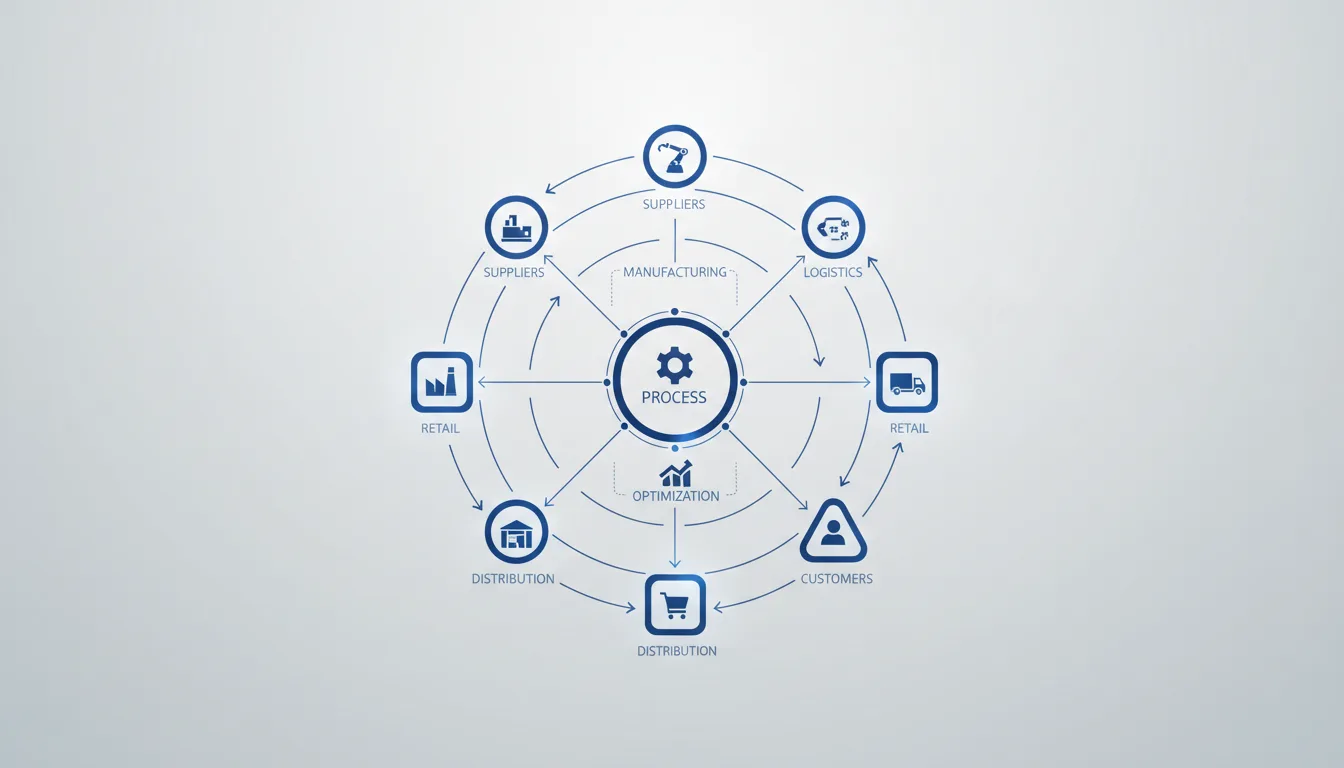
Business Process Management (BPM) is a systematic approach aimed at making an organization's workflows more efficient and effective. BPM focuses on improving processes for better workflow, including the coordination of people and technology. The main goals of BPM are to reduce costs, improve customer satisfaction, and enhance overall productivity. Notably, it plays a critical role in logistics and supply chain management, where streamlined operations can lead to substantial competitive advantage.
Etymology and Origins
The term Business Process Management first gained traction in the 1990s, drawing on concepts from earlier management paradigms such as Total Quality Management (TQM) and Business Process Reengineering (BPR). The etymology of "process" comes from the Latin processus, meaning progression or advancement, which reflects BPM's focus on improving and evolving organizational processes over time. While BPM appeared in literature in the early 1990s, initial documentation as a distinct discipline can be traced back to early software solutions in the 1960s and 1970s, particularly in automated business processes, paving the way for modern BPM tools. Notably, the publication of the influential article "The New Industrial Engineering: Information Technology and Business Process Redesign" by Michael Hammer and James Champy in 1993 marked a pivotal moment in BPM's evolution.
Historical Development
The concept of BPM has evolved significantly since its early days:
- 1980s-1990s: Emergence of process-driven management practices, notably during the rise of Business Process Reengineering (BPR), popularized by figures like Michael Hammer in his seminal book Reengineering the Corporation (1993).
- 1993: Introduction of process modeling tools and techniques, leading to the workflow automation phase, which allowed for better visibility into organizational processes.
- 2001: Adoption of the Business Process Modeling Notation (BPMN), which standardized the way processes are documented and communicated across organizations. The BPMN 2.0 was later released in 2011, further enhancing the specification.
- 2010s: The integration of digital technologies and automation tools, such as workflow systems, transformed BPM into a tech-driven discipline focused on agility and real-time analysis.
- 2020s: The rise of AI-driven BPM solutions that leverage machine learning and data analytics for improved process optimization and predictive capabilities, reflecting an industry shift towards intelligent automation.
Core Concepts
At the heart of BPM are several core concepts:
- Process Mapping: Visualization of processes to identify inefficiencies and redundancies. This often employs tools like workflow designs and BPMN diagrams.
- Continuous Improvement: BPM is iterative; it emphasizes the need for ongoing assessment and refinement of processes.
- Performance Measurement: Key Performance Indicators (KPIs) are established to evaluate the effectiveness of processes. For example, in logistics, this can involve metrics such as order fulfillment time and shipping accuracy. Companies often use mobility solutions to track these KPIs in real-time.
- Automation: Integration of software systems that facilitate automated workflows, significantly impacting efficiency and accuracy in operations.
Industry Applications
BPM finds application across various industries, prominently within logistics. Examples include:
- Supply Chain Management: Facilitating real-time inventory management through mobility solutions that enhance forecasting and order fulfillment.
- Manufacturing: Streamlining production by integrating BPM with lean practices to minimize waste and improve time-to-market. A notable case study includes Toyota, which adopted BPM alongside Just-In-Time (JIT) principles to streamline operations and reduce inventory costs.
- Healthcare: Improving patient care delivery processes and operational efficiencies through better coordination and data management. For instance, healthcare providers leverage BPM to enhance patient flow and minimize wait times.
Benefits and Advantages
Implementing BPM can yield several advantages:
- Increased Efficiency: Organizations can expect reduced process cycle times and improved operational performance.
- Enhanced Adaptability: BPM enables organizations to respond more swiftly to changes in the market or operational conditions.
- Cost Reduction: By eliminating waste and streamlining inefficiencies, businesses can significantly reduce operational costs. According to a study by McKinsey & Company, companies that adopted BPM reported an average cost reduction of 15%.
- Improved Customer Satisfaction: Faster service delivery and quality improvements enhance the overall customer experience.
Challenges and Limitations
While BPM offers numerous benefits, challenges persist:
- Resistance to Change: Employees may resist new processes or systems, hampering implementation. Successful BPM initiatives often involve change management strategies to address these concerns.
- Integration Issues: Aligning BPM systems with existing technology can be complex and resource-intensive. Companies may face hurdles in achieving interoperability, particularly when working with legacy systems.
- Data Management: Ensuring data reliability and integrity is critical yet challenging, particularly in dynamic environments like logistics.
Best Practices
To successfully implement BPM, organizations should consider the following best practices:
- Engage Stakeholders: Involve employees from all levels to gain insights and foster ownership.
- Leverage Technology: Utilize advanced BPM tools that offer automation, analytics, and reporting capabilities. The adoption of tools like order fulfillment software can be instrumental in streamlining processes.
- Regular Training: Continuous training programs should be implemented to ensure employee proficiency with BPM methodologies and tools.
Future Trends
Looking ahead, BPM is expected to evolve through:
- Artificial Intelligence: Leveraging AI and machine learning for predictive analytics and proactive process adjustments. Organizations are increasingly utilizing AI-powered tools to forecast demand and optimize supply chain operations.
- Increased Automation: Greater reliance on robotics and automation tools will drive efficiency further in logistics practices. A recent report from Gartner indicates that organizations adopting Automated Process Management tools witness a 30% increase in efficiency.
- Agile Methodologies: More organizations will adopt agile BPM practices to enhance flexibility and responsiveness in fast-paced environments.
Related Concepts
BPM is closely related to several other concepts in logistics and management:
- Enterprise Resource Planning (ERP): Integrates various functions of an organization into a cohesive system, often utilizing BPM for operational improvement.
- Lean Management: Focused on maximizing customer value while minimizing waste, which aligns well with the principles of BPM.
- Supply Chain Optimization: BPM can enhance processes across the supply chain, improving efficiency from procurement to delivery.