Bullwhip Effect in Supply Chain Management
The bullwhip effect describes how small fluctuations in demand can lead to larger variations in supply chain orders, impacting inventory and efficiency.
Updated
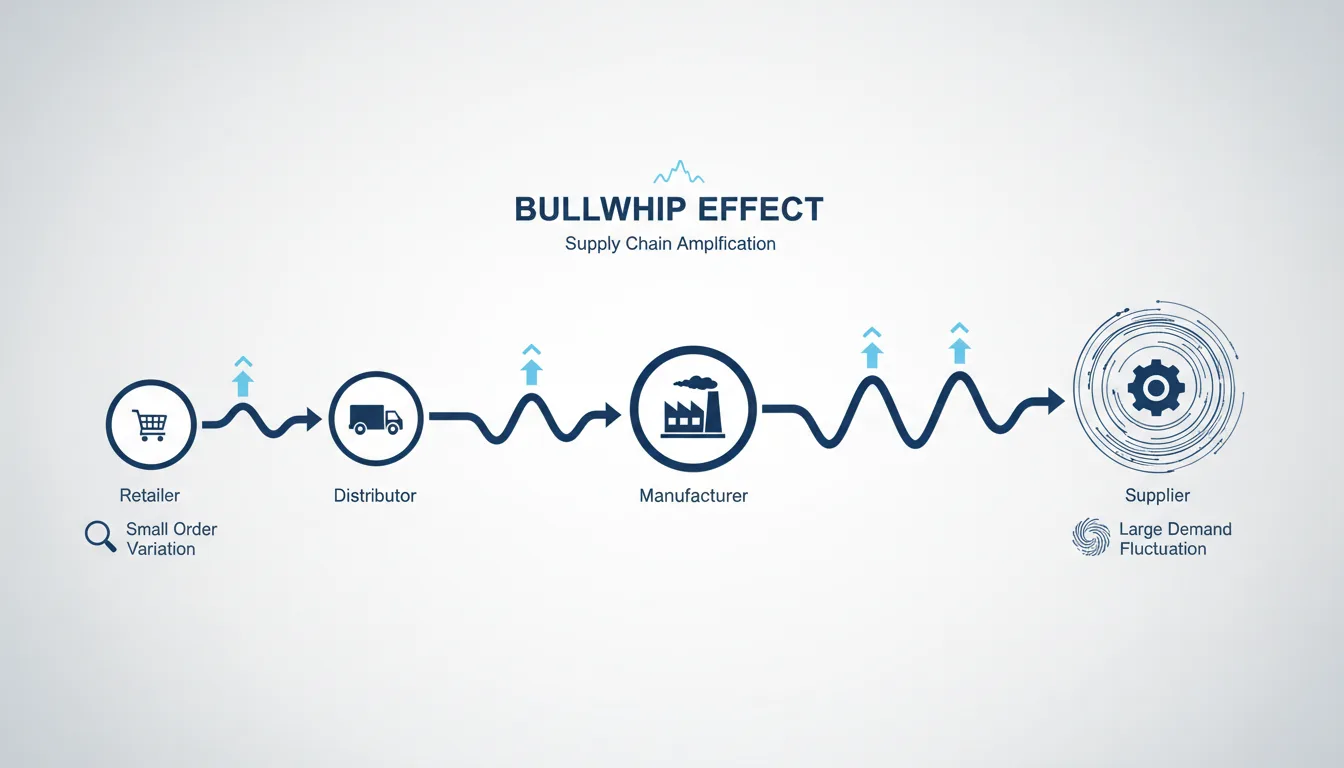
Bullwhip Effect in Supply Chain Management
Overview
The bullwhip effect is a pervasive phenomenon in supply chain management where small changes in consumer demand at the retail level can lead to disproportionately larger and more volatile order fluctuations upstream in the supply chain, affecting distributors, manufacturers, and raw material suppliers. This distortion results in significant inefficiencies, including excessive inventory holding costs, frequent stockouts, lost sales, increased transportation expenses due to expedited shipping, and operational instability. Understanding and mitigating the bullwhip effect is paramount for effective demand forecasting, inventory management, and overall supply chain performance enhancement, ultimately leading to improved profitability and customer satisfaction.
Etymology and Origins
The term 'bullwhip effect' originates from the analogy of a bullwhip, where a minor flick of the wrist at the handle results in a large, amplified motion at the whip's end, culminating in a sharp crack. While the phenomenon was observed earlier in business operations, its formalization and popularization in supply chain management are largely attributed to researchers at Stanford University in the early 1990s. Specifically, the seminal work of Hau L. Lee, V. Padmanabhan, and S. Whang published in Sloan Management Review in 1997, titled "The Bullwhip Effect in Supply Chains," provided a comprehensive analysis and brought the concept to widespread industry and academic attention. Their research elaborated on how minor demand fluctuations could lead to significant inventory and order distortions throughout the supply chain.
However, the intellectual roots of understanding such systemic amplification effects can be traced back further. The concept was vividly demonstrated through the "Beer Distribution Game," an operational game developed in the 1960s at the MIT Sloan School of Management by Jay Forrester and his team. This simulation game allowed participants to experience firsthand how seemingly rational local decisions could lead to severe demand and inventory oscillations across a multi-stage supply chain.
Historical Development
The foundational work for understanding system dynamics and feedback loops, which are critical to the bullwhip effect, was laid by Jay Forrester. His groundbreaking book, Industrial Dynamics (1961), detailed how delays and decision-making structures within industrial systems could cause erratic behavior and amplify small disturbances. This early work highlighted the principles of information feedback and control that underpin the bullwhip effect, long before the term itself was coined.
In the 1980s, real-world observations began to crystallize the practical implications. A famous case study involved Procter & Gamble with their Pampers diapers. P&G noticed significant demand variability at their manufacturing plants, despite relatively stable consumer purchases. This discrepancy prompted further investigation and illustrated the tangible financial impact of the amplification effect. This case, alongside the continuous use of the Beer Game in business education, provided the empirical evidence that propelled researchers like Lee, Padmanabhan, and Whang to formally study and model the phenomenon in the early 1990s.
The advent of computer-based planning tools marked significant milestones in mitigating the bullwhip effect:
- Material Requirements Planning (MRP) systems, introduced in the 1970s, provided structured planning for production and procurement but were often limited to internal operations.
- Enterprise Resource Planning (ERP) systems, which gained prominence in the 1990s, offered more integrated data sharing across various internal departments. While an improvement, ERPs often struggled with seamless data exchange across different companies in a supply chain.
- The late 1990s and early 2000s saw the development of Advanced Planning Systems (APS) and early Warehouse Management Systems (WMS) that aimed to optimize specific supply chain functions and improve visibility. Modern WMS solutions have evolved significantly, offering real-time data, advanced analytics, and automation.
The evolution continued with increased focus on inter-organizational collaboration, aided by technologies like Electronic Data Interchange (EDI) and the internet, paving the way for more integrated supply chain management practices designed to counter the bullwhip effect.
Core Concepts
The bullwhip effect is driven by several interconnected factors, often categorized into five main causes:
- Demand Forecasting: Each stage of the supply chain typically forecasts demand based on orders received from its immediate downstream partner, rather than actual end-customer demand. When a downstream partner places a larger-than-expected order, the upstream partner may interpret this as a real increase in consumer demand and inflate their forecast, leading to over-ordering. This successive re-estimation amplifies variability up the chain. Inaccurate forecasting, especially using simple moving averages or exponential smoothing without considering actual point-of-sale data, is a primary driver.
- Order Batching: Businesses often place orders infrequently and in large quantities to minimize ordering costs, achieve quantity discounts, or optimize transportation efficiency. This practice creates large, irregular demand spikes for upstream suppliers, even if actual consumption is smooth. Optimized purchasing strategies and continuous replenishment can help mitigate this.
- Price Fluctuations (Price Promotions and Discounts): Temporary price reductions, sales, or quantity discounts incentivize customers (retailers or distributors) to buy in larger quantities than they immediately need, leading to 'forward buying.' This creates artificial demand spikes followed by troughs when prices return to normal, distorting demand signals for upstream suppliers. This is sometimes referred to as the 'sales acceleration' effect.
- Supply Lead Time: The time delay between placing an order and receiving it (lead time) significantly exacerbates the bullwhip effect. Longer lead times mean forecasts must stretch further into the future, increasing the likelihood of errors. To compensate for uncertainty during long lead times, companies often build up larger safety stocks, which further inflates inventory levels and can mask true demand patterns.
- Rationing and Gaming: During periods of high demand or perceived scarcity, suppliers may ration available products among their customers. Anticipating this, customers might inflate their orders to receive a larger allocation, creating false demand signals. Once the supply crunch eases, these inflated orders disappear, leading to a sudden drop in demand, further destabilizing the supply chain.
By understanding how these factors interact, supply chain managers can develop targeted strategies to reduce the bullwhip effect and enhance overall efficiency.
Industry Applications
The bullwhip effect has significant implications and manifests uniquely across various industries:
- In the automotive sector, small shifts in car sales at dealerships can cause massive swings in production volumes for component manufacturers (e.g., tire, electronics, or steel suppliers). This necessitates complex inventory management and production scheduling to manage high-value components and long lead times from global suppliers.
- In the retail industry, especially for fashion or seasonal goods, successful promotions can create demand spikes that lead to immediate stockouts, followed by periods of excess inventory when the artificial demand subsides. This is particularly challenging for e-commerce businesses managing rapid fulfillment.
- The pharmaceutical and healthcare sectors face critical challenges, particularly during pandemics or health crises, where small increases in demand for certain medical supplies (e.g., masks, vaccines) can trigger enormous upstream order amplification, leading to widespread shortages or subsequent oversupply as the panic subsides.
- For perishable goods (e.g., fresh produce, dairy), the bullwhip effect can lead to significant waste due to over-ordering and spoilage, or lost sales due to stockouts, impacting both profitability and sustainability.
- In the high-tech and electronics industry, rapid product obsolescence combined with global supply chains means that demand fluctuations can quickly lead to obsolete inventory or missed market opportunities.
The implications of the bullwhip effect are crucial, especially for companies that rely on lean principles and just-in-time (JIT) inventory systems, where even minor disruptions can have cascading, detrimental impacts.
Challenges and Limitations
Mitigating the bullwhip effect presents several complex challenges:
- Lack of Supply Chain Visibility and Information Sharing: The most prominent challenge is the absence of transparent, real-time information flow across the entire supply chain. When upstream suppliers lack direct visibility into true consumer demand (point-of-sale data), they are forced to rely on distorted order data, leading to erroneous forecasting and planning decisions. This information asymmetry perpetuates the effect.
- Data Quality and Consistency: Even with information sharing mechanisms, inconsistencies in data formats, definitions, or accuracy across different partners can hinder effective collaboration and lead to misinterpretations.
- Organizational Silos and Resistance to Change: Within many organizations, departments (e.g., sales, marketing, production, procurement) often operate in silos with conflicting objectives, exacerbating the bullwhip effect. There can also be significant cultural resistance to altering traditional purchasing, forecasting, or operational practices that contribute to the problem.
- Inadequate Technology Infrastructure: Many companies, especially smaller ones, may lack the sophisticated inventory management systems, advanced analytics tools, or integration capabilities required to share data effectively and implement advanced forecasting methods.
- Global Supply Chain Complexity: Modern global supply chains involve numerous tiers of suppliers, complex logistics networks, diverse regulatory environments, and geopolitical risks, making coordinated information flow and decision-making exceptionally challenging.
- Conflicting Incentives: Performance metrics often focus on local optimization (e.g., purchasing manager rewarded for quantity discounts, sales manager for quarterly volume) rather than overall supply chain efficiency, inadvertently encouraging behaviors that fuel the bullwhip effect.
Best Practices
To minimize the bullwhip effect, organizations must adopt a holistic and collaborative approach, implementing several key best practices:
- Improve Demand Forecasting Accuracy: Move beyond simple historical averaging. Utilize advanced statistical models, machine learning algorithms, and external data sources (e.g., economic indicators, weather, social media trends) to create more accurate and dynamic forecasts. Implementing Collaborative Planning, Forecasting, and Replenishment (CPFR) with supply chain partners is crucial for sharing insights and aligning expectations.
- Enhance Supply Chain Visibility and Information Sharing: Establish robust mechanisms for sharing real-time point-of-sale (POS) data, current inventory levels, and promotional plans across all relevant supply chain partners. Technologies like Electronic Data Interchange (EDI), Application Programming Interfaces (APIs), and shared cloud-based platforms are essential. SkuSavvy's Visual Inventory System provides this real-time visibility within a warehouse, and integrations can extend it across partners.
- Reduce Order Batching: Encourage smaller, more frequent orders. This can be achieved through:
- Vendor-Managed Inventory (VMI): The supplier takes responsibility for managing inventory at the customer's location.
- Continuous Replenishment Programs (CRP): Automated orders based on real-time consumption.
- Optimizing transportation logistics to make smaller shipments economically viable. SkuSavvy's Purchase Order Management can facilitate more efficient ordering processes.
- Stabilize Pricing and Eliminate Promotions-Driven Forward Buying: Shift away from erratic pricing strategies that incentivize large, infrequent purchases. Consider everyday low pricing (EDLP) or more predictable promotional schedules to smooth demand patterns.
- Reduce Lead Times: Work with suppliers to shorten order and delivery lead times where possible. This reduces uncertainty and the need for excessive safety stock. Improving internal processes, such as faster purchase order processing and efficient receiving, also contributes.
- Align Incentives Across the Supply Chain: Move away from individual, siloed performance metrics. Implement shared goals and reward systems that encourage overall supply chain efficiency and collaboration, rather than local optimization that might exacerbate the bullwhip effect.
- Foster Strong Supply Chain Partnerships: Build long-term, trusting relationships with key suppliers and customers. This encourages open communication, willingness to share information, and joint problem-solving, which are vital for mitigating the bullwhip effect.
Technology and Tools
Modern technology plays a pivotal role in mitigating the bullwhip effect by providing the data, insights, and automation necessary for better decision-making:
- Enterprise Resource Planning (ERP) Systems: Integrate core business processes and data across finance, HR, manufacturing, and supply chain, providing a more unified view of operations.
- Warehouse Management Systems (WMS): A Mobile Warehouse Management System like SkuSavvy enhances inventory accuracy, optimizes storage, and streamlines order fulfillment, providing real-time data on stock levels and movements, crucial for reducing uncertainty downstream. Features like Visual Inventory System offer unparalleled clarity.
- Demand Planning and Forecasting Software: Specialized solutions that leverage advanced statistical methods, machine learning (ML), and artificial intelligence (AI) to generate more accurate demand forecasts based on a wider array of data inputs.
- Order Management Systems (OMS): Centralize order processing, tracking, and fulfillment, enabling better visibility into customer orders and ensuring efficient routing and automated rate selection for shipping.
- Supply Chain Visibility Platforms: Cloud-based platforms that integrate data from multiple partners, providing real-time tracking of goods in transit, inventory levels at various nodes, and performance metrics across the entire network.
- Internet of Things (IoT): Sensors placed on products, vehicles, and warehouse equipment can provide real-time data on location, condition, and status, enhancing transparency and reducing lead time variability.
- Blockchain: Offers a decentralized, immutable ledger for recording transactions and events, which can significantly improve trust and transparency across complex multi-enterprise supply chains, especially for tracing origin and ensuring data integrity.
- Purchase Order Management Software: Streamlines the purchasing process, allows for better negotiation of terms (e.g., smaller, more frequent deliveries), and integrates with inventory systems for optimized replenishment.
Future Trends
As supply chains become more complex and data-rich, future trends will further enhance the ability to counteract the bullwhip effect:
- Enhanced Data Analytics and Predictive AI: Continued advancements in AI and ML will enable more precise and dynamic demand forecasting, capable of adapting to rapidly changing market conditions and identifying subtle demand signals.
- Digital Twins: Creating virtual models of the physical supply chain allows for simulation and optimization of various scenarios, predicting the impact of decisions before implementation, and proactively identifying potential bullwhip amplifications.
- Hyper-automation and Autonomous Logistics: Increased automation in warehousing, transportation, and order processing will reduce human error, shorten lead times, and facilitate more continuous, less batched operations.
- Blockchain for End-to-End Transparency: The wider adoption of blockchain technology promises unprecedented levels of transparency and traceability across multi-tier supply chains, providing authenticated data for all partners.
- Focus on Supply Chain Resilience and Sustainability: Future supply chains will be designed with inherent resilience (e.g., diversified supplier networks, localized production) and sustainability in mind, which often align with practices that naturally dampen the bullwhip effect by reducing long lead times and encouraging stable relationships.
- Continued focus on collaborative planning and more integrated supply chain systems will be essential moving forward to mitigate risks associated with demand variability and foster a truly connected supply ecosystem.
Related Concepts
The bullwhip effect is closely linked to other fundamental concepts in supply chain management, and a comprehensive understanding of these relationships is essential for developing strategic operational plans that enhance efficiency and stability in supply chains:
- Lead Time variability
- Inventory Turnover and Inventory Optimization
- Demand Forecasting and Forecasting Error
- Safety Stock and Reorder Point management
- Supply Chain Visibility
- Supply Chain Risk Management
- Collaborative Planning, Forecasting, and Replenishment (CPFR)
Sources
- Mobile WMS Overview
- Order Management System
- Visual Inventory System
- Cycle Counting Guide
- Automated Rate Selection
- The Bullwhip Effect in Supply Chains
- Industrial Dynamics
- Purchase Order Management
- Supply Chain Visibility: How to Tackle the Bullwhip Effect
- Collaborative Planning, Forecasting, and Replenishment (CPFR)
- Understanding and Managing Lead Time in Your Supply Chain
- Inventory Turnover
- Stock Replenishment Guide
- Shopify Inventory Management
- Purchase Orders Guide