Bin Location in Warehouse Management
A comprehensive overview of bin location in warehouse management, including its importance, historical development, and best practices.
Updated
Overview
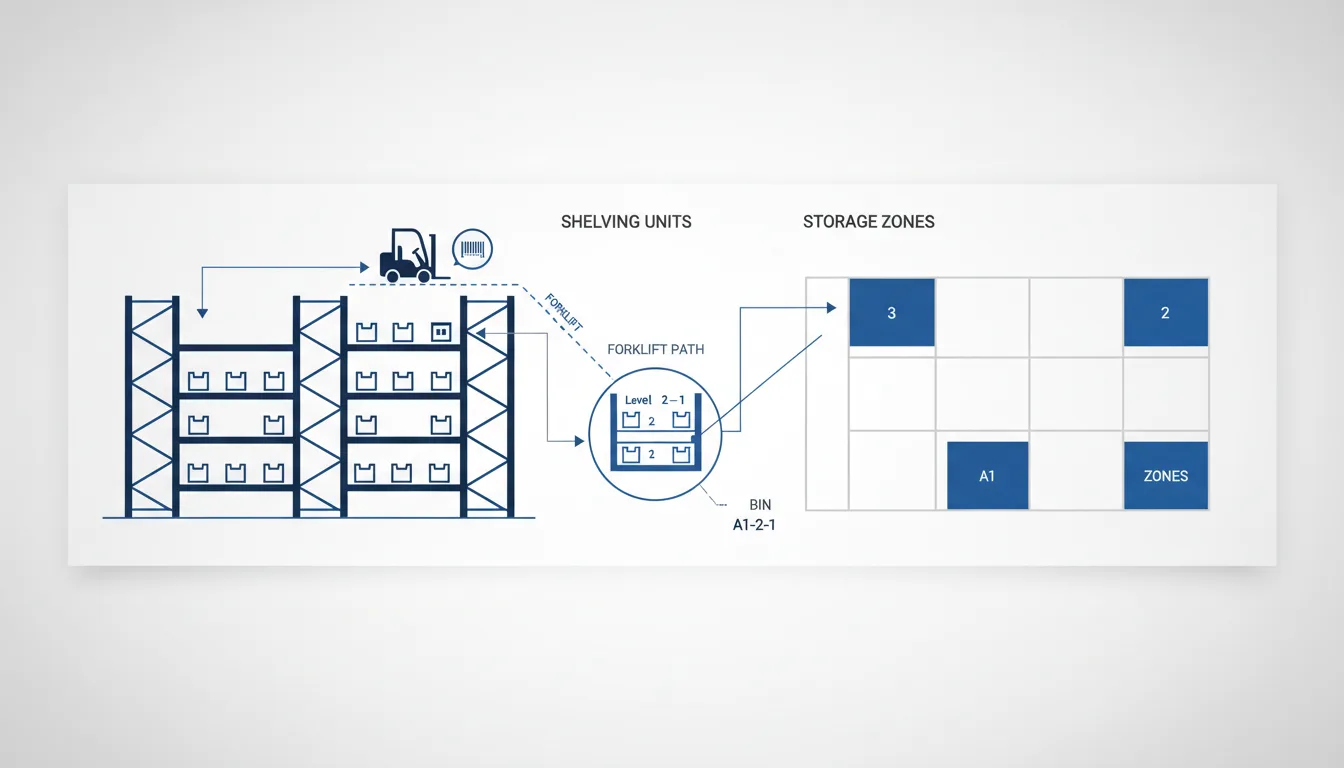
Bin location refers to the designated, organized spaces within a warehouse where specific items are stored. This fundamental concept is crucial for efficient inventory management and streamlined order fulfillment processes. The primary purpose of establishing effective bin locations is to enhance the organization of items, facilitate quick and accurate access, and optimize space utilization within the storage facility. Moreover, well-executed bin location strategies can significantly boost the productivity of warehouse operations, reduce operational costs, and contribute to improved inventory accuracy, directly impacting a company's bottom line.
Etymology and Origins
The term "bin" has deep historical roots. It originates from the Middle English word "binne," meaning a container, box, or receptacle, which itself derived from the Old English word "binn," referring to a manger or crib for animals [6]. Tracing further back, its linguistic origins are found in the Proto-Germanic *binnjō, also signifying a basket or container [6].
Historically, prior to modern warehousing, goods were stored in various forms of physical containers, from simple baskets and chests to large wooden or metal bins for bulk materials. The evolution of the term reflects the transition from literal physical containers to abstract, designated storage slots within a larger organizational system. The concept of a specific "location" within a storage area, rather than just a general pile, began to formalize with the advent of organized commerce and military logistics. The terminology surrounding bin locations has seen significant evolution, particularly with the rise of computerized inventory management systems and sophisticated automated warehousing solutions that manage these locations digitally.
Historical Development
The concept of systematic storage, which underpins bin locations, dates back to ancient civilizations that required organized granaries and supply depots for armies. However, the formalization of bin locations in a modern commercial sense evolved through several distinct phases:
-
Pre-Industrial Era (Prior to 18th Century): Storage was largely informal. Goods were often stored in bulk, stacked, or placed in large, undifferentiated areas within storerooms, cellars, or simple warehouses. Identification relied on visual recognition and tribal knowledge [7].
-
Industrial Revolution (18th - 19th Century): The emergence of factories and mass production led to a greater need for organized storage of raw materials and finished goods. Early systems involved more structured shelving and basic labeling, but without highly formalized bin numbering or mapping. The focus was primarily on volume and accessibility for production lines [7].
-
Early 20th Century - Scientific Management (1900s-1950s): The principles of scientific management, championed by figures like Frederick Winslow Taylor and Frank and Lillian Gilbreth, introduced the concept of efficiency and standardization to industrial processes, including material handling and storage [8]. This era saw the introduction of standardized shelving units, aisle numbering, and a more structured approach to material flow, laying the groundwork for systematic binning. However, management of inventory within these bins was still largely manual, relying on ledger books and physical counts.
-
Post-WWII & Early Computerization (1950s-1960s): The post-war economic boom and growth in manufacturing led to increasing complexity in supply chains. The need for better inventory control spurred the development of early mainframe computer systems. It was in this period that companies began formalizing bin location strategies more rigorously. The 1960s saw the introduction of rudimentary warehouse management systems (WMS) that could track inventory quantities and their general locations, though detailed bin-level tracking was still nascent [9]. Materials Requirements Planning (MRP) systems, pioneered by companies like IBM, also started to influence how raw materials were stored and integrated with production schedules.
-
Barcode Revolution & JIT (1970s-1980s): The commercialization of barcode technology in the mid-1970s marked a significant turning point [10]. By the 1980s, the widespread adoption of barcode scanning and computerized systems dramatically improved item identification, retrieval accuracy, and the speed of inventory operations. Concurrently, the rise of Just-In-Time (JIT) manufacturing, popularized by the Toyota Production System, emphasized minimizing inventory and precise material flow, making accurate and dynamic bin location management critical for operational success.
-
Automation & Real-Time Data (1990s-2000s): The 1990s witnessed the emergence and increasing sophistication of automated storage and retrieval systems (AS/RS), carousels, and conveyor systems. These technologies enabled highly dense storage and rapid movement of goods, often employing dynamic bin location assignments based on real-time inventory needs, product velocity, and warehouse layout. Radio Frequency (RF) handheld terminals allowed for real-time data capture and updates, further enhancing accuracy.
-
E-commerce, Mobility & Advanced Analytics (2000s-Present): The explosive growth of e-commerce in the 2000s demanded unprecedented speed and accuracy in order fulfillment. This led to the proliferation of mobile WMS solutions using Wi-Fi enabled devices and advanced scanning. The 2010s to present have seen the integration of advanced technologies like RFID technology for hands-free, real-time tracking, as well as the adoption of Artificial Intelligence (AI) and Machine Learning (ML) for sophisticated dynamic slotting optimization, predictive analytics, and automated task assignment. Robotics (e.g., AGVs, AMRs) in warehouses further automate put-away and picking, demanding highly precise, often 3D-mapped bin location data, often visualized through tools like SkuSavvy's warehouse layout preview [11].
Core Concepts
Bin location strategies often include systematic approaches like fixed, dynamic, or random storage, each chosen based on specific operational needs and inventory characteristics. Fixed locations assign a specific bin for each unique item (SKU), offering simplicity and ease of tracking for stable, slow-moving inventory. Dynamic storage, conversely, utilizes algorithms to determine optimal bin assignments for stored goods based on real-time factors such as picking frequency, item dimensions, and available space. This approach is highly effective for fast-moving goods and maximizing space utilization. The Bin Put-Away Criteria are crucial guidelines for efficiently allocating space and managing inventory flows based on item characteristics and operational goals [2].
Types and Classifications
Bin locations can be classified into various types, each with distinct advantages and use cases:
- Fixed Bin Locations: Each Stock Keeping Unit (SKU) is permanently assigned a unique, dedicated bin location. This method is straightforward for small inventories or items with predictable demand, as pickers always know exactly where to find an item. It simplifies training and reduces search time but can lead to inefficient space utilization if bin capacities are not perfectly matched to inventory levels.
- Random Bin Locations (or Free Storage): Items are stored in any available bin upon receipt. This method maximizes storage density by ensuring almost every bin is occupied. However, it requires a robust inventory management system to track where each item is placed. Without such a system, retrieval becomes impossible. Advanced algorithms are often used to optimize storage for efficient access (e.g., storing popular items closer to shipping). SkuSavvy's Bin Packing Visualizer can help optimize space within these random allocations [12].
- Zone Storage: The warehouse is divided into specific zones (e.g., fast-moving, slow-moving, heavy items, fragile items). Items are then stored randomly or fixedly within their designated zone. This can improve picking efficiency by reducing travel distances for specific order types.
- Multiple Bin Locations (or Overflow Storage): Variants of the same SKU may be stored in multiple locations to accommodate large quantities, prevent stockouts in primary picking bins, or handle bulk storage away from active picking faces. This is common for high-volume products.
- Dynamic or Chaotic Storage: An advanced form of random storage where an item's location is determined in real-time based on immediate availability, product characteristics (e.g., size, weight, temperature requirements), and expected demand. This often leverages WMS intelligence to continually optimize the entire storage footprint.
Industry Applications
The strategic use of bin locations is critical across virtually all industries involved in goods movement and storage, each with unique requirements:
- Retail & E-commerce: Bin locations are paramount for supporting rapid order fulfillment through effective merchandise organization within distribution centers and retail backrooms. For e-commerce, where high volumes of small, diverse orders are common, precise bin locations are essential for efficient pick-pack-ship operations [13] and ensuring optimal product accessibility to meet tight shipping deadlines. Systems like Shopify Bin Location integrate bin data directly with online sales platforms [14].
- Manufacturing: Bin locations are used to efficiently manage raw materials, work-in-progress (WIP) components, and finished goods. This aids in just-in-time production, precise stock replenishment to assembly lines [3], and ensures that components are readily available, minimizing production delays.
- Third-Party Logistics (3PLs): For 3PL providers managing inventory for multiple clients, robust bin location management is vital. It allows for accurate segregation of client products, optimized storage for diverse SKU portfolios, and efficient handling of varying order profiles and fulfillment requirements.
- Food & Beverage: Critical for managing perishable goods, ensuring FIFO (First-In, First-Out) or FEFO (First-Expired, First-Out) rotation. Bin locations help track expiration dates and specific product batches (e.g., via lots and expiration dates management), reducing waste and ensuring product quality [18].
- Healthcare & Pharmaceuticals: Extreme accuracy is required for tracking sensitive medications, medical devices, and regulated substances. Bin locations ensure precise identification, batch traceability, and adherence to regulatory compliance (e.g., for recalls or expiry management).
Benefits and Advantages
Adopting systematic bin locations offers numerous quantifiable benefits for warehouse and supply chain operations:
- Enhanced Operational Efficiency: Significantly reduces travel times for pickers and put-away staff, leading to faster order processing and higher throughput. Optimized layouts and precise locations allow for more efficient picking paths, such as batch picking [19].
- Improved Inventory Accuracy: By providing a specific address for every item, bin locations drastically minimize misplacements and discrepancies. This real-time visibility is crucial for accurate stock counts and reducing shrinkage.
- Better Space Utilization: Dynamic and randomized binning strategies, coupled with proper slotting, maximize the use of available cubic space, reducing the need for additional warehouse footprint.
- Reduced Labor Costs: Faster picking, reduced errors, and optimized workflows translate directly into lower labor expenditures.
- Faster Training: New employees can quickly learn picking and put-away routes with clear bin locations and a robust WMS, reducing onboarding time and errors.
- Improved Customer Satisfaction: Accurate inventory and faster fulfillment directly contribute to meeting customer expectations, reducing order errors, and improving delivery times.
Challenges and Limitations
Despite the advantages, implementing and maintaining effective bin locations presents several challenges:
- Complexity in Large Warehouses: Managing thousands or millions of unique bin locations across vast facilities can be extremely complex, requiring sophisticated WMS software and precise mapping.
- Misplacement of Items: Human error can still lead to items being placed in the wrong bin, even with scanning technology. This necessitates robust training and verification processes.
- Need for Regular Audits & Maintenance: Bin locations must be regularly audited, often through cycle counting [4], to maintain inventory accuracy and reconcile discrepancies. Neglecting this leads to data decay.
- Initial Setup & Ongoing Optimization: The initial setup of a bin location system can be time-consuming and labor-intensive. Ongoing slotting optimization is required to adapt to changing inventory profiles and demand patterns, which can be computationally intensive.
- Infrastructure Costs: Implementing a WMS, scanning equipment, and potentially automation for dynamic bin management represents a significant capital investment.
Best Practices
Effective bin location management is achieved through a combination of strategy, technology, and process discipline:
- Implement a Robust Inventory and Warehouse Management System: A modern visual inventory management system [5] with strong WMS capabilities is foundational. It should integrate bin location management, tracking, and reporting, providing real-time visibility.
- Develop a Clear Bin Location Strategy: Choose the appropriate binning strategy (fixed, random, dynamic, zone) based on inventory characteristics, warehouse layout, and operational goals. Regularly review and adjust this strategy.
- Optimize Slotting: Continuously analyze product velocity, size, and order profiles to place frequently picked items in easily accessible locations (e.g., golden zone) and group complementary items. Tools like SkuSavvy's Bin Packing Preview can aid in optimizing space within bins [12].
- Standardize Labeling and Barcodes: Ensure all bins are clearly and consistently labeled with unique identifiers. Utilize barcode technology [15] for all items and bins to facilitate fast, accurate scanning during put-away and picking.
- Train Staff Thoroughly: Implement comprehensive training programs for all warehouse personnel on bin location procedures, WMS usage, scanning protocols, and the importance of accuracy. Emphasize the 'every item has a home' philosophy.
- Conduct Regular Cycle Counting and Audits: Implement a continuous cycle counting program to verify inventory accuracy at the bin level and promptly resolve discrepancies [4]. This proactively identifies and corrects misplacements before they impact operations.
- Utilize Visual Warehouse Layouts: Leverage visual warehouse layout tools [11] to gain an intuitive understanding of your storage landscape, identify bottlenecks, and plan optimal bin configurations.
Technology and Tools
Modern technology plays a crucial role in managing bin locations, transforming it from a manual task to an automated, data-driven process. Notable tools and technologies include:
- Warehouse Management Systems (WMS): The backbone of modern bin management. WMS software automates bin assignment, put-away, picking, and inventory tracking. Mobile WMS solutions [1] allow for real-time updates and data capture on the warehouse floor.
- Barcode Scanners and RFID: Barcode scanners are ubiquitous for fast and accurate identification of items and bins [15]. RFID technology [16] offers even greater efficiency by enabling hands-free, high-volume scanning of multiple items simultaneously, ideal for dynamic bin management.
- Automated Storage and Retrieval Systems (AS/RS): These systems automatically store and retrieve items from bins, often utilizing dynamic binning algorithms to maximize space and speed. This includes vertical lift modules (VLMs), carousels, and shuttle systems.
- Robotics (AGVs and AMRs): Autonomous Guided Vehicles (AGVs) and Autonomous Mobile Robots (AMRs) can transport items to and from bins, perform put-away, and even conduct inventory counts, relying on precise bin location data for navigation.
- Slotting Optimization Software: Specialized software, often integrated into WMS, uses algorithms to analyze data and recommend optimal bin locations for new and existing inventory based on demand, size, and other factors.
- 3D Warehouse Visualization and Digital Twins: Advanced systems offer 3D representations of the warehouse layout [11], allowing managers to visually plan, simulate, and optimize bin utilization and material flow.
Conclusion
Effective bin location strategies are not merely an organizational convenience but a critical component of optimizing warehouse management and overall supply chain efficiency. By understanding their rich historical context, embracing core principles like fixed and dynamic storage, and leveraging best practices and cutting-edge technology, logistics professionals can significantly enhance inventory accuracy, reduce operational costs, and improve customer satisfaction. As e-commerce and global supply chains continue to evolve, the strategic management of bin locations will remain a cornerstone of competitive logistics operations, enabling businesses to adapt and thrive in an increasingly demanding market.
Sources
- Mobile WMS Overview
- Bin Put-Away Criteria
- Stock Replenishment Guide
- Cycle Counting Guide
- Visual Inventory System
- Online Etymology Dictionary - Bin
- The History of Warehousing: From Ancient Times to Today
- Scientific Management
- Evolution of Warehouse Management System (WMS) from its Origin to Present
- A Brief History of the Bar Code
- Warehouse Layout Preview
- Bin Packing Visualizer
- Pick, Pack, Ship Software
- Shopify Bin Locations
- Barcodes Guide
- An RFID-based framework for intelligent warehouse management systems
- Mobile Order Fulfillment
- Lots & Expiration Dates
- Batch Picking Guide