ABC Analysis in Inventory Management
ABC Analysis is a vital inventory management technique that categorizes inventory based on value and usage, allowing businesses to optimize their stock management.
Updated
Overview
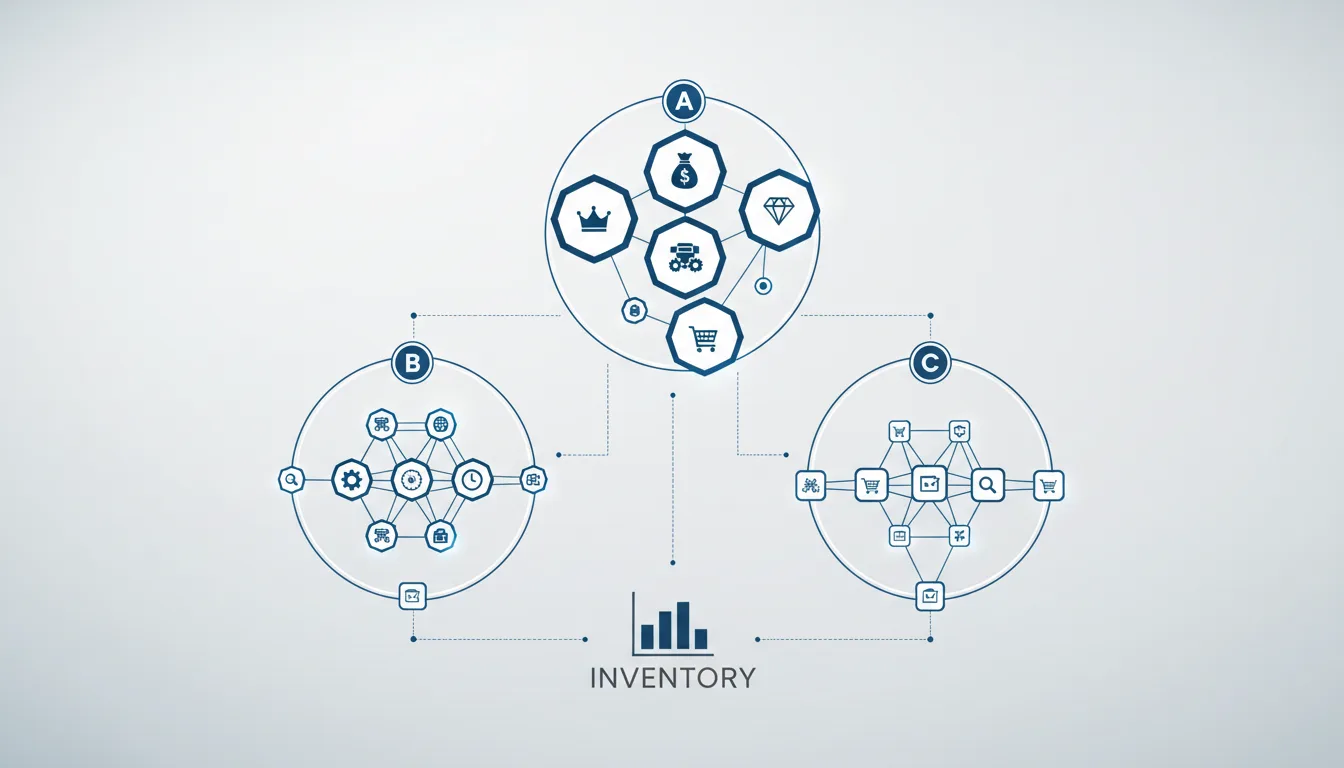
ABC Analysis is a fundamental inventory management technique that segments inventory into three categories: A, B, and C. This classification is primarily based on the Pareto Principle, also known as the 80/20 rule, which suggests that a small percentage of items often account for a large percentage of total value or activity. The primary purpose of ABC Analysis is to prioritize inventory management efforts on items that have the greatest impact on a business's bottom line. By identifying high-value items (A), medium-value items (B), and low-value items (C), companies can allocate resources more effectively, optimize inventory holding costs, and enhance inventory turnover rates.
Etymology and Origins
The term "ABC Analysis" has its roots deeply embedded in the Pareto Principle, which was first observed by Italian economist Vilfredo Pareto in 1896, noting that approximately 80% of the land in Italy was owned by 20% of the population. This observation was later generalized to suggest that roughly 80% of effects come from 20% of causes across various domains.
The application of this principle to business and management, particularly quality control, was championed by management consultant Joseph M. Juran in the mid-20th century. Juran coined the term "the vital few and the trivial many" to describe the phenomenon, advocating for focusing resources on the most impactful issues [5]. This concept was then adopted by the manufacturing sector and formally applied to inventory management. The very first documented use of this classification method in an inventory context is attributed to the early 20th century, particularly within burgeoning industrial and manufacturing operations, laying the groundwork for what would become standard practice in supply chain logistics.
Historical Development
ABC Analysis, while rooted in early 20th-century observations, gained significant momentum and formal application in the post-World War II era.
-
Early 20th Century (Pre-1950s): While the theoretical underpinnings existed with Pareto's work, practical application of differential control in inventory was often informal. Early industrialists like Henry Ford, with his focus on efficient production lines, implicitly practiced a form of prioritization [6]. However, a standardized, formalized "ABC" approach was not yet widespread.
-
1950s - 1960s: Formalization and Operations Research: The 1950s saw the formal adoption of the Pareto Principle in inventory control practices. The rise of Operations Research as a scientific discipline helped formalize these concepts. Pioneers in inventory management, often within larger manufacturing firms and government supply chains, started implementing differentiated control policies. This period saw the integration of ABC Analysis into broader supply chain management frameworks, particularly in the automotive and electronics sectors.
-
1970s - 1980s: The Rise of MRP and Computerization: The advent of Material Requirements Planning (MRP) systems in the 1970s revolutionized inventory data management.
-
1990s - 2000s: WMS and Advanced Software: Technological advancements continued with the proliferation of personal computers and sophisticated software. This period saw a shift from purely value-based classification to incorporating other factors like demand variability and lead time.
-
2010s and beyond: AI, Machine Learning, and Real-time Analytics: Modern software solutions now use ABC Analysis alongside AI and machine learning for predictive inventory management.
Core Concepts
ABC Analysis categorizes inventory based on its relative importance, typically measured by annual usage value (annual demand multiplied by unit cost). The general breakdown is:
- Category A (High Value): Comprising roughly 10-20% of inventory items that account for 70-80% of the total inventory value.
- Category B (Medium Value): Representing about 20-30% of items that account for approximately 15-25% of the value.
- Category C (Low Value): Covering 50-70% of items that contribute to only about 5-10% of the inventory value.
Calculation Methodology: To perform an ABC analysis, one typically follows these steps:
- Determine the annual demand for each inventory item.
- Calculate the unit cost for each item.
- Compute the annual usage value for each item (Annual Demand × Unit Cost).
- Sort all items in descending order based on their annual usage value.
- Calculate the cumulative percentage of total items and total annual usage value for each item.
- Assign items to categories A, B, or C based on predefined cumulative value percentage cut-offs.
This approach helps optimize resources and improve overall inventory turnover rates.
Types and Classifications
- ABC-XYZ Analysis: A combination of ABC with demand variability categorization.
- VED Analysis (Vital, Essential, Desirable): Classified based on criticality to operations.
- FSN Analysis (Fast, Slow, Non-moving): Considers the movement frequency of inventory items.
- SDE Analysis (Scarce, Difficult, Easy): Categorizes items based on procurement difficulty.
- HML Analysis (High, Medium, Low): Based purely on unit price of items.
Benefits and Advantages
Implementing ABC Analysis brings several benefits to inventory management:
- Improved Inventory Turnover
- Reduced Holding Costs
- Enhanced Resource Allocation
- Better Customer Service
- Optimized Purchasing and Supplier Management
Challenges and Limitations
- Data Accuracy: The effectiveness relies on the accuracy of underlying data.
- Dynamic Markets: Changes can render classifications obsolete.
- Simplicity and Over-reliance: It may overlook other relevant factors.
- Implementation Complexity: Maintaining ABC Analysis can be complex.
Best Practices
- Regularly Review and Update Data
- Combine ABC with Other Analytical Tools
- Define Clear Classification Criteria
- Involve Cross-Functional Teams
- Automate Where Possible
- Implement Differentiated Control Policies
Technology and Tools
Modern logistics technologies have integrated ABC Analysis into dynamic processes, offering insights for real-time inventory management. Key technological integrations include:
- Warehouse Management Systems (WMS): Can categorize SKUs.
- Enterprise Resource Planning (ERP) Systems: Essential for accurate data collection.
- Demand Forecasting Software: For accurate predictions.
- Business Intelligence (BI) and Analytics Platforms: To visualize classifications.
- SkuSavvy Solutions: Offer robust features supporting effective ABC Analysis.
Future Trends
Key trends include:
- Dynamic and Real-time Classification
- Multi-criteria Optimization
- Predictive and Prescriptive Analytics
- Integration with Digital Twins and IoT
Sources
- Stock Replenishment Guide
- Shipping & Fulfillment Software
- Visual Inventory Management System
- Pareto Principle
- Joseph M. Juran and the Vital Few
- Henry Ford's Production System
- Inventory Management and Control
- Applying ABC Analysis with Other Inventory Classification Methods
- Bin Put-Away Criteria
- Purchase Order Management
- Automated Purchase Quantity
- Mobile Warehouse Management System
- Cycle Counting Guide
- Visual Warehouse Layout
- Pick-to-Tote Guide
- Shopify Inventory Management
- Shopify Inventory Sync
- Material Requirements Planning (MRP) Systems
- What is ERP?
- Operations Research