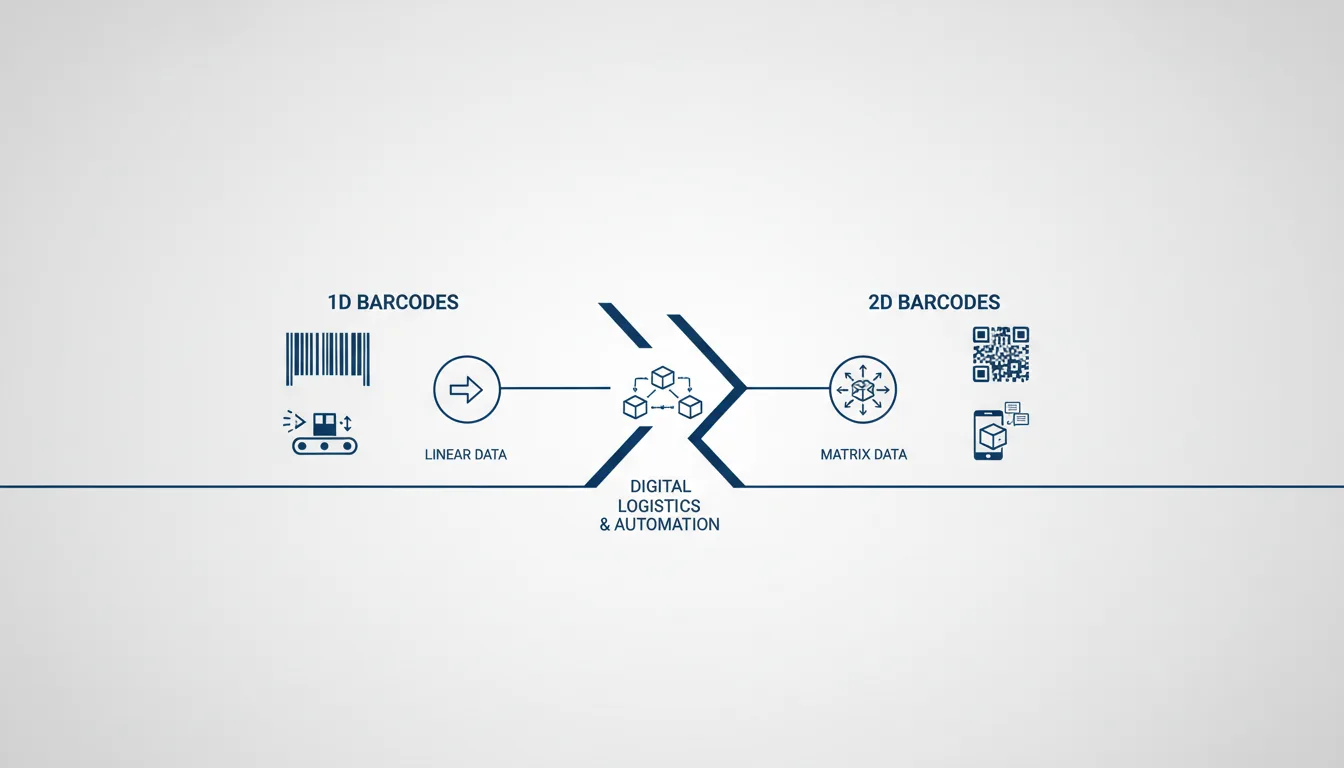
Barcode Standards (1D vs 2D)
Overview
Barcodes are crucial for modern logistics, facilitating automated data capture for inventory management, shipping, and sales. They store data in a visual format readable by scanning technology. Two primary types exist: 1D (one-dimensional) and 2D (two-dimensional). Each type has distinct structural characteristics, implications for data storage, and practical applications in various industries.
Etymology and Origins
The term "barcode" stems from its function to encode information in bar format. The first barcode was developed in the early 1950s by Norman Joseph Woodland and Bernard Silver, who used a series of concentric circles under the name "Bull's Eye Code". In 1974, the Universal Product Code (UPC) gained popularity after being adopted by grocery stores, providing a standardized system for tracking items. The roots of the term can be traced to software automation and data encoding, reflecting how businesses needed increased efficiency in operations as they grew—driving the evolution of barcodes into sophisticated data capture tools.
Historical Development
1950s-1960s: Early Innovations
- In 1949, Woodland and Silver's patent for the barcode was filed, yet practical application took decades. The Bull's Eye Code was the first documented implementation, ultimately leading to the UPC as the barcode format adopted by industries.
1970s: Standardization
- The introduction of the UPC in 1974 marked the standardization of barcodes in retail, as it became the dominant system for product identification in the grocery sector. This era also saw automated scanning equipment developed to read these codes efficiently, transforming checkout processes.
1980s-1990s: 2D Barcodes Emerge
- The late 1980s brought forth 2D barcodes, such as the QR code (Quick Response code), designed to store significantly more information than traditional 1D barcodes. This innovation allowed for the inclusion of URLs and multimedia content, enhancing functionality in supply chains that relied on data-rich applications.
2000s-Present: Technological Advancements
- The advent of smartphones with scanning capabilities revolutionized the use of barcodes, leading to broader adoption across sectors, including retail, healthcare, and logistics. Following the emergence of mobile payment solutions, Mobile barcode solutions diverted the landscape towards interactivity and user engagement.
Core Concepts
1D Barcodes
1D barcodes encode information using lines of varying widths. Common formats include UPC and Code 39. They can hold up to 20 characters of data, typically representing product information like SKU numbers. The scanning process involves a laser that reads the barcode's pattern of lines and converts it into a numeric value for computer systems.
2D Barcodes
In contrast, 2D barcodes, such as QR codes, can store hundreds of characters, incorporating both alphanumeric and binary data. They are read using cameras, allowing for greater flexibility in the types of information they encode, including URLs and multimedia content. This capability is increasingly utilized for marketing and customer engagement in addition to inventory tracking.
Types and Classifications
- 1D Barcodes: Includes UPC, EAN, Code 128, and Code 39.
- 2D Barcodes: Includes QR Codes, Data Matrix codes, and PDF417. Each type has specific advantages based on application. For example, QR codes are popular for mobile applications due to their ability to link directly to digital content.
Industry Applications
Retail
Retail businesses use 1D codes for managing inventory and speeding up checkout processes. 2D codes are increasingly used for customer engagement strategies, offering discounts via smartphone scanning.
Healthcare
In healthcare, 2D barcodes improve medication tracking and patient safety by linking patient information directly to their medications through barcode scanning. This practice is aligned with initiatives for enhancing medication adherence and reducing errors in medication dispensation (American Journal of Health-System Pharmacy).
Logistics
Logistics operations leverage barcodes for inventory management and shipment tracking, ensuring that production movements are accurately recorded. Warehouse Management Systems often use barcode automation to streamline processes, improving accuracy and reducing lead times.
Benefits and Advantages
- Efficiency: Barcodes minimize human error and speed up inventory processes, which is crucial for fast-paced environments.
- Data Capacity: 2D barcodes offer greater data storage options than 1D, allowing for detailed product information and tracking.
- Cost-effective: Integrating barcode technology in systems can lead to long-term savings by enhancing accuracy and reducing labor costs, making it a vital investment.
Challenges and Limitations
While barcodes significantly improve logistics operations, several challenges exist:
- Readability Issues: Poor print quality or damage can hinder the readability of both 1D and 2D codes, causing delays in operations.
- Integration Complexity: Organizations may face difficulties integrating barcode systems with existing inventory management technologies, which can necessitate extensive retraining of staff and operational readjustments.
Best Practices
- Regularly audit barcode quality to ensure easy scanning and minimize disruptions.
- Train employees on proper barcode scanning techniques to enhance operational efficiency and accuracy.
- Use a variety of barcode types strategically according to operational needs—1D for basic product information and 2D for complex data requirements. Case studies such as those from Walmart show that varied usage tailored to customer interaction enhanced their supply chain effectiveness (Walmart Case Study).
Future Trends
Looking ahead, technology advancements, such as augmented reality and AI, may further enhance barcode capabilities. Mobile barcode solutions are expected to dominate customer interactions, shaping how businesses manage and engage with supply chain partners. The rise of automated data collection techniques using AI-driven analytics is also anticipated to redefine the logistics landscape.
In conclusion, understanding barcode standards and their applications plays a vital role in enhancing operational efficiency within logistics and supply chain management.